BESIDES the symbols of governments contained in Dan. viii, there is a definite period of time brought to view, which claims attention. As recorded in verse 13, Daniel heard one saint ask another the question, how long the vision should be concerning the daily [sacrifice] and the transgression of desolation to give both the sanctuary and the host to be trodden under foot. The angel then addressed himself to Daniel and said, Unto two thousand and three hundred days; then shall the sanctuary be cleansed. Waiving for the present the question as to what may constitute the sanctuary, we wish to ascertain if possible the nature, the commencement, and termination, of this period of time. There are two kinds of time to be met with in the Bible: literal and symbolic. In symbolic time a day signifies a year. Num. xiv, 34; Eze. iv, 6. To which class do the 2300 days belong? Being brought in in connection with acknowledged symbols, it would be both easy and natural to infer that they partook of the nature of the rest of the vision and were symbolic, presenting us with a period of 2300 years. And that such is the case is further evident from the fact, as is shown in the investigation of Dan. viii, that the field of the prophet's vision, was the empires of Persia, Greece and Rome. The 2300 days there given cannot therefore be literal days; for literal days (scarcely six years and a half) would by no means cover the duration of any one of these empires singly, much less embrace so nearly the whole of their existence put together, as they evidently do. They must consequently denote 2300 years. Can we now ascertain the commencement of this period? We answer, Yes; the key to the matter being found in the ninth chapter of Daniel, between which and the eighth there is an unmistakable connection, as we shall now endeavor to show.
After their mention in verse 14, the 2300 days are not again spoken of in chap. viii. All the other parts of the vision are there fully explained; it must have been therefore, this point concerning the time, that troubled the mind of the prophet, and in reference to this, solely, that he exclaims at the end of the chapter, "I was astonished at the vision, but none understood it."
It was in the third year of Belshazzar, B. C. 553, that Daniel had this vision of chap. viii. Fifty-three years previous to this time, Jerusalem had been taken by Nebuchadnezzar, and the seventy years' captivity commenced; and thirty-five years before this, the Chaldeans had utterly demolished the city, broken down its walls and burnt the house of God with fire. 2 Chron. xxxvi, 19. Daniel had learned from the prophecy of Jeremiah, [chap. xxv], that the seventy years of captivity were drawing near their close, in the first year of Darius, B. C. 538, as we read in the first verses of Dan. ix; and it is evident that he so far misunderstood the period of the 2300 days as to suppose that they ended with the seventy years of Israel's servitude; therefore turning his face toward the prostrate city and the ruined temple of his fathers, he prays God to cause his face to shine upon his sanctuary which is desolate.
Verse 17.
"And whiles I was speaking and praying," says he, [chap. ix, 20-23], even the man Gabriel whom I had seen in the vision at the beginning, being caused to fly swiftly, touched me about the time of the evening oblation. And he informed me and talked with me, and said, O, Daniel, I am now come forth to give thee skill and understanding. At the beginning of thy supplication, the commandment came forth, and I am come to shew thee; for thou art greatly beloved; therefore understand the matter, and consider the vision. Seventy weeks are determined upon thy people and upon thy holy city," &c.
That this is a continuation of the explanation of the vision of chap. viii, would seem sufficiently evident without the aid of any special argument to prove it so. But as there is a vital point that hinges upon this fact, we will offer a few reasons which place it beyond the limits of contradiction.
1. Gabriel had received a charge [chap. viii, 16], to make Daniel understand the vision; but at the end of that chapter, Daniel says he was astonished at the vision, but none understood it. Gabriel therefore did not complete his mission in chap. viii: the charge still rested upon him, "Make this man to understand the vision."
2. The being who came to Daniel at the time of his supplication, was the very same who had appeared to him in the vision at the beginning; namely, Gabriel. And that he had now come to undeceive him concerning his application of the time, is evident in that he says, I am now come forth to give thee skill and understanding. Why did he not give him a full understanding of the vision at first? Because, we answer, he revealed to him all that he was then able to bear; for he fainted and was sick certain days.
3. Direct reference is made to the vision at the beginning; and if that is not the vision of chap. viii, it is impossible to find it. And again, if Gabriel does not explain in chap. ix, what he omitted in chap. viii, it is impossible for any man to shew wherein Gabriel fulfilled his commission to make this man understand the vision. But a position which will lead to such a result, is utterly unallowable.
4. When Gabriel commenced his further explanation he did not explain the symbol of the ram; for that he had already explained; he did not explain the goat; for he had likewise explained that; neither did he commence about the little horn; for he had made that plain also in chap. viii. What then did he explain? The very point there omitted; namely, time: "Seventy weeks are determined upon thy people," &c. These facts are sufficient to show the connection of Dan. ix, with the vision of chap. viii.
But how do the words of Gabriel, "Seventy weeks are determined upon thy people," &c., explain the period of the 2300 days? The answer is, The word rendered, determined, signifies literally, cut off. Gesenius in his Hebrew Lexicon thus defines it: "Properly, to cut off; tropically, to divide, and so to determine, to decree." The Englishman's Hebrew Concordance says, "Determined, literally, divided."
From what period are the seventy weeks divided, or cut off? From the 2300 days; for there is no other period given from which they can be taken; and this is placed beyond a doubt by the connection of the two chapters, which has already been proved.
Having now ascertained that the 70 weeks of Dan. ix, are the first 490 years of the 2300 days, and that consequently the two periods commence together, we further learn that this period of weeks dates from the going forth of a commandment to restore and build Jerusalem. Dan. ix, 25. If then we can definitely locate this commandment, we have the starting point for the great period of the 2300 years. The Bible furnishes us with four tests by which to determine when the true date is found: 1. From the time of the commandment, 49 years were to witness the completion of the street and wall of Jerusalem, Dan. ix, 25. 2. Three score and two weeks from this time, or, in all, 69 weeks, 483 years, were to extend to Messiah the Prince. Id. 3. Sixty-nine and a half weeks were to extend to the crucifixion—the cessation of sacrifice and oblation in the midst of the week. Verse 27. 4. The full period of 70 weeks was to witness the complete confirmation of the covenant with Daniel's people. Id. In the 7th of Ezra, we find the decree for which we seek. It went forth in B. C. 457. Much concerning this decree and the date of its promulgation, for brevity's sake we are compelled to pass. Concerning it, we can only remark.
1. It contained all the elements necessary to constitute such a decree, and when carried out, resulted in the thorough restoration of the Jewish state. It answered to the prophecy fully in this respect.
2. From the commencement of the work by Ezra, to the last act of reformation by Nehemiah were just forty-nine years, which is the exact period allowed in the prophecy to this work.
3. As this decree went forth B. C. 457, the 69 weeks or 483 years which were to extend to the Messiah the Prince, reckoned from the commencement of the work in the autumn of that year, bring us to the autumn of A. D. 27, when our Lord was baptized by John in Jordan and went forth preaching "the time is fulfilled." Mark i. Luke iii, 22, margin. Three and a half years from this, to the midst of the seventieth week, bring us to the spring of A. D. 31, where, according to Dr. Hales, the Council of Cæsarea A. D. 196, the Alexandrian Chronicle, &c., the crucifixion took place. Three and a half years more, the last half of the week, terminate the 70 weeks or 490 years in the autumn of A. D. 34, where Hales, Usher and Pearson place the martyrdom of Stephen, the first persecution, and the formal rejection of the gospel by the Jewish Sanhedrim.
Here then we stand at the end of this great period which Gabriel in his explanation of the 2300 days, told Daniel was cut off upon Jerusalem and the Jews. There is this one grand fact yet to be noticed: If the first 490 years terminated in the autumn of A. D. 34, the whole period ends in the autumn of A. D. 1844. For 490 taken from 2300, leave 1810; and 1810 added to A. D. 34, where the 490 terminate, make 1844. For the application of this argument, and the event to mark the termination of the days, see article on the sanctuary.
THE SANCTUARY.
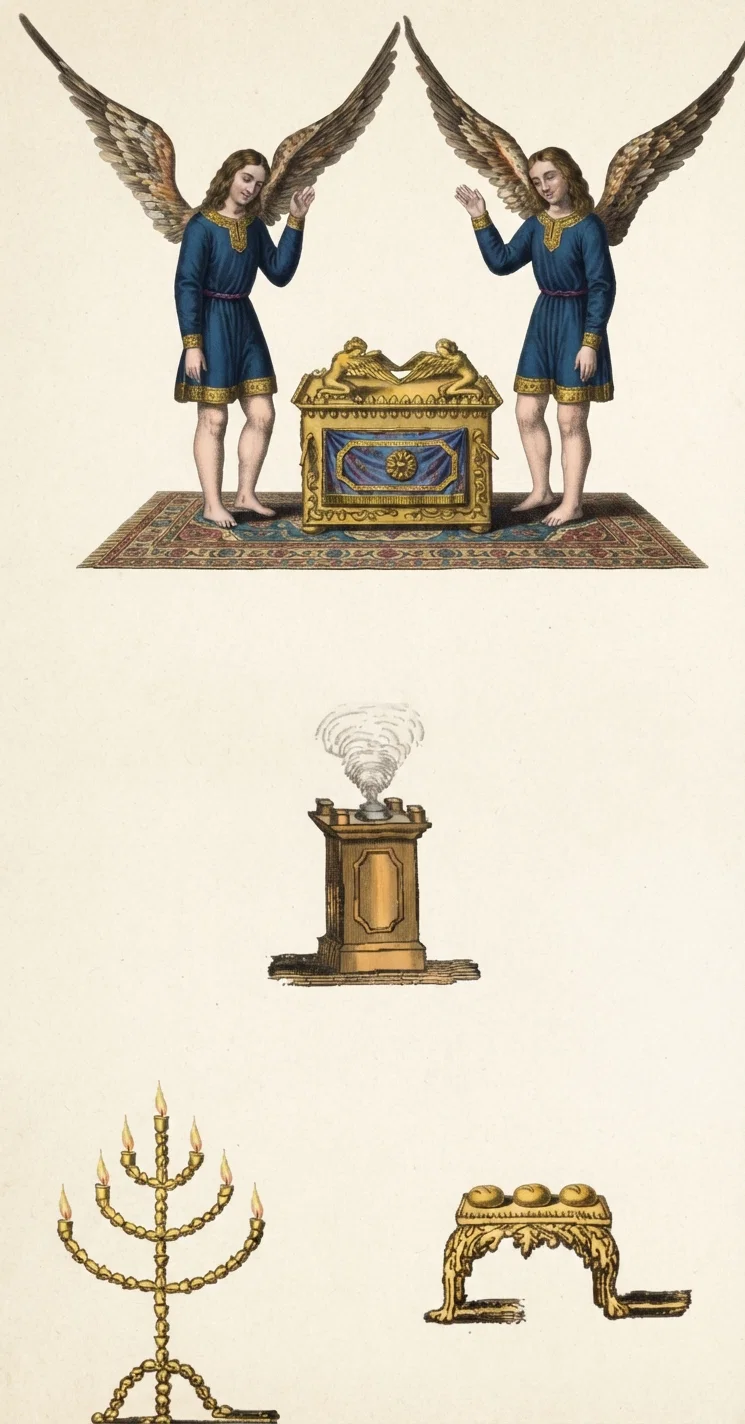
SECOND VAIL. HOLY PLACE.
1. SANCTUARY is defined to be a holy or sacred place. It is a dwelling-place for the Most High. Ex. xxv, 8.
2. It cannot therefore be the earth; for the earth will not bear one of the above definitions; and of the 146 times of the occurrence of the word sanctuary in the Bible, it is not once applied to the earth.
3. It is not the land of Canaan. Substitute "the land of Canaan" for "the earth," and read the above. See also Josh. xxiv, 26. For an explanation of Ex. xv, 17, see Ps. lxxviii, 53, 54, 69.
4. It is not the church; if it is, who are the "host," or worshipers that are invariably connected with it. Dan. viii, 13. Compare Dan. ix, 26, with Matt. xvi, 18.
6. It had two apartments—the holy place and the most holy place. Ex. xxvi, 33, 34; Lev. xvi, 2. In the first apartment were the candlestick, the table of shew-bread, and the altar of incense. In the second, were the ark which contained the tables of the covenant, and the cherubim. Heb. ix, 1-5. That the covenant here referred to is the ten commandments, see Ex. xxxi, 18; xxxii, 15, 16; xxxiv, 28; Deut. iv, 13; ix, 9-11; x, 4.
8. The transgressor confessed his sin over the head of his victim, thus transferring his guilt to it. The victim was slain and the blood bearing that guilt was sprinkled by the priest within the sanctuary. From these sins, thus transferred to it, the sanctuary had to be freed once a year; and this service was called its cleansing. Lev. i, 4, 5; iv, 6; xvi, 16, 33; Heb. ix, 7; Eze. xlv, 18.
10. This sanctuary was not an original building, but was made after the pattern of a greater and more perfect tabernacle, which must therefore be the great antitype of this earthly building, and must take its place when the latter has served its purpose. Ex. xxv, 9, 40; xxvi, 30; Acts vii, 44; Heb. viii, 5. When the tabernacle of Moses gave place to the temple of Solomon, it was still according to the pattern. 1 Chron. xxviii, 10-13, 19.
11. This was the sanctuary of the first covenant [Heb. ix, 1], and was destroyed by Titus in A. D. 70. Dan. ix, 26. For a historical record of this event, see Josephus' Wars, Book vi, chap. iv, sec. 5.
4. Christ bore our sins in his own body on the tree [1 Pet. ii, 24]; and through his ministration our sins when we confess them to him, are transferred to the sanctuary above, rendering it in this sense only impure. Nothing less can be argued from the type.
5. It is therefore to be cleansed. Dan. viii, 14. This text must refer to the heavenly sanctuary; for the earthly was destroyed only 526 years after the 2300 commenced. This cleansing of the heavenly sanctuary is accomplished with blood. Heb. ix, 11, 12, 23, 24.
6. When the glory of the Lord filled the tabernacle, or temple, in the type, there was no ministration. Ex. xl, 34, 35; 1 Kings viii, 10, 11. So it will be in the antitype. Rev. xv, 8.
7. The most holy place in the type was entered only on the day of atonement. Lev. xvi, 2, 12-15, 29, 30; Heb. ix, 7. So it is in the antitype. Rev. xi, 19. Cleansing the sanctuary, and making the atonement, are identical works.
From the foregoing testimony we see that we were only warranted to expect from the declaration, "Then shall the Sanctuary be cleansed," [Dan. viii, 14], that at the end of the days our great High Priest, in the heavenly sanctuary would enter within the vail into the most holy place, to perform before the ark of ten commands, the last act in his ministration. Having since his ascension, ministered in the first apartment of the heavenly sanctuary as foreshadowed by the ministration of the priests in the earthly tabernacle, we believe that at the end of the days in 1844, he entered the most holy place, and commenced, according to the prophecy, that work which is called the cleansing of the sanctuary.
What more befitting than that a work of such momentous importance, the last ministration of mercy by our great High Priest, the closing up of the work of salvation for the world, should be introduced by the termination of a great prophetic period? What point of more thrilling interest and importance could be made known than the commencement of the great though brief period of examination and decision of the characters of men? When this is finished the great decree of Rev. xxii, 11, will go forth: "He which is filthy let him be filthy still, and he that is holy let him be holy still."
REVELATION XII & XIII.
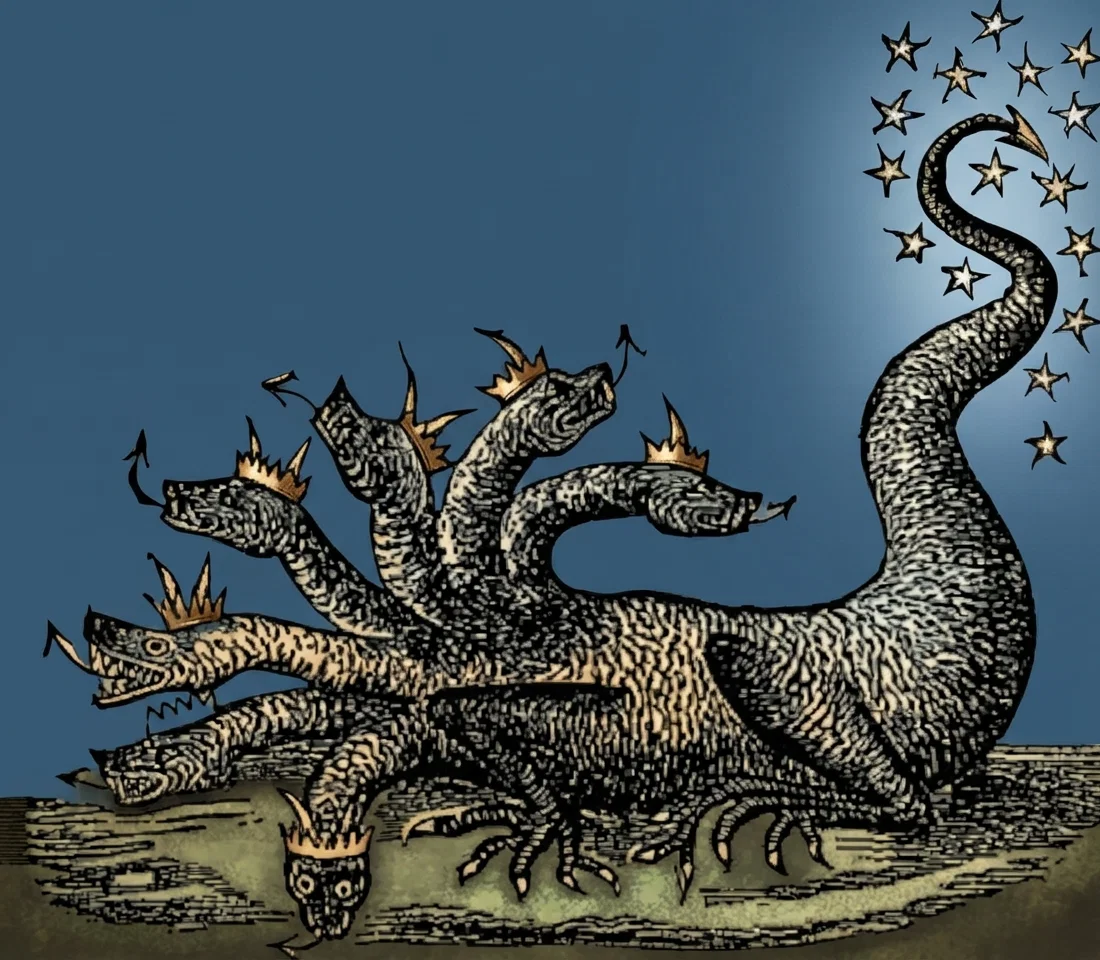
In the book of Revelation we have the fourth kingdom of Daniel's visions brought to view under different symbols. The three preceding kingdoms having passed away when John lived, he commences with ROME IN ITS PAGAN FORM. Chap. xii, 3, 4. "And there appeared another wonder in heaven, and behold a Great Red Dragon, having seven heads and ten horns, and seven crowns upon his heads."
PAGAN ROME,
PAGAN ROME.
The seven heads of the dragon denote the seven forms of government in the Roman empire. These are commonly enumerated as follows:
1. The Kingly. 2. The Consular. 3. The Decemvirate. 4. The Dictatorial. 5. The Triumvirate. 6. The Imperial. 7. The Papal. See Ency. Americana. John lived under the 6th form. Five had fallen, and one was "not yet," in his day. "And the dragon [Rome Pagan] stood before the woman [the church], to devour her child [Christ] as soon as it was born." See Matt. ii.
NOTE.—The Devil is also called a dragon, in verse 9. His has been the master spirit, actuating more or less all the beasts of Daniel's and John's visions. Preeminently was this the case with Pagan Rome; hence the earthly power, as the outward medium, here takes the symbol of the being who inspired its action.
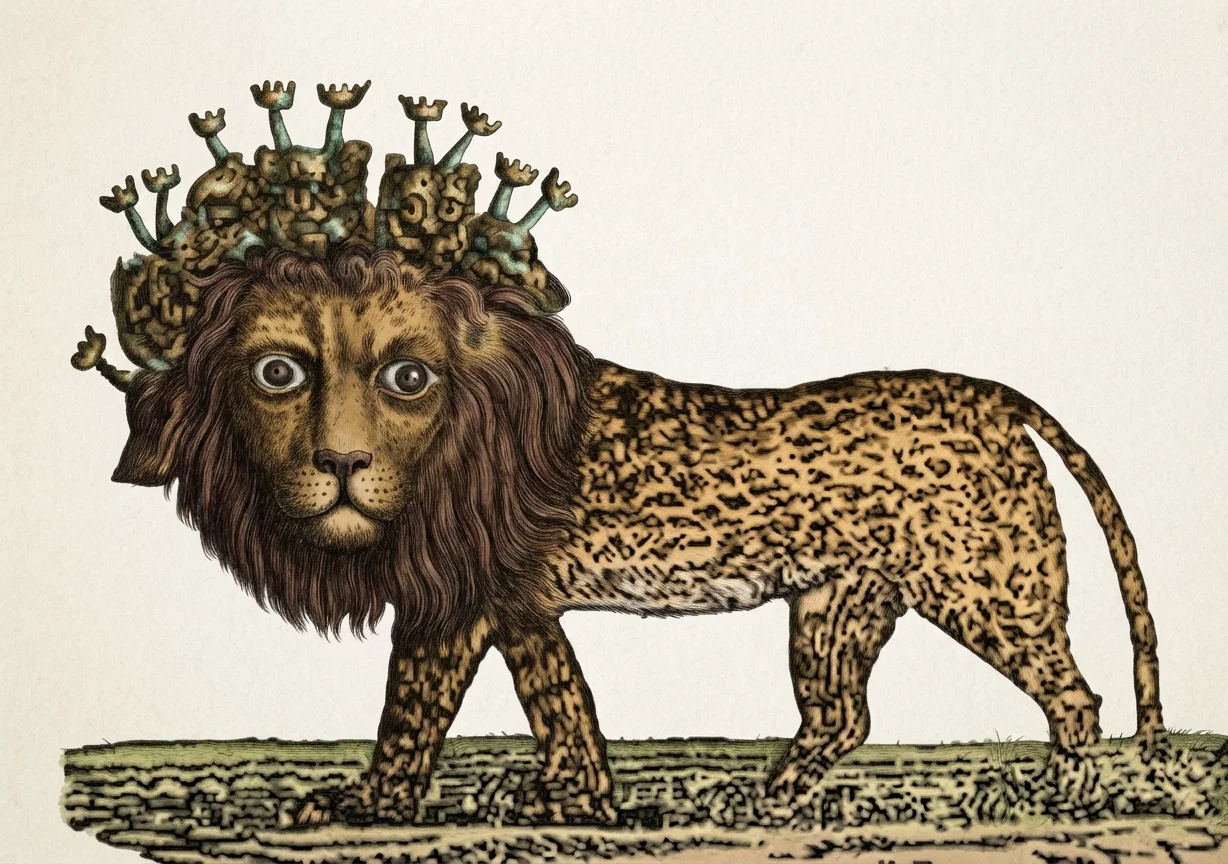
In Rev. xiii, we have another symbol brought to view; namely, a beast with the body of a leopard, feet of a bear, and mouth of a lion, having seven heads and ten horns, and upon his horns ten crowns.
PAPAL ROME.
PAPAL ROME.
Verse 12. To this beast the Dragon gives his seat, his power and great authority. To whom did Pagan Rome give its seat [the city of Rome], and power and great authority? Ans. To the PAPACY. This beast is further shown to represent the Papacy, from its being identical with the little horn of the fourth beast of Dan. vii.
1. The little horn was a blasphemous power. "He shall speak great words against the Most High." Dan. vii, 25. So also does the beast of Rev. xiii, 6, do the same. "He opened his mouth in blasphemy against God."
2. The little horn made war with the saints and prevailed against them. Dan. vii, 21. This beast also [Rev. xiii, 7] makes war with the saints and overcomes them.
4. Power was given to the little horn of Dan. vii, 25, for a time, times, and the dividing of time—1260 years. To the beast also, power was given 42 months—1260 years.
5. At the end of that specified period, the dominion of the little horn was to be taken away. Dan. vii, 26. At the end of the same period, the beast of Rev. xiii was himself "to be led into captivity." Verse 10. Buonaparte fulfilled both in his capture of the Pope. Who can fail to see their identity?
PROTESTANT AMERICA.
At this point of time, John beheld another beast coming up, having two horns like a lamb. This beast is for a while cotemporary with the one above; for he exerciseth all the power of the first beast before him [enopion, in his presence]. We understand this to be a symbol of these United States, from the following specifications:
1. Its location. All Europe is occupied by the first beast and his ten horns. We cannot look there for another beast. Whatever power arises there, must be a part of the first beast, or one of his horns. Consequently we must look for the two-horned beast to another continent.
2. The time of its rise. At the time of the captivity of the Pope (1798), there was no other notable power "coming up," except these United States.
3. The manner of its rise. It comes out of the earth; that is, in a quiet, peaceable manner; unlike the other beast which came up out of the sea—arose through wars and commotions.
4. Its character. It has two horns like a lamb. The lamb feature is a fit emblem of the profession and incipient acts of this government. But it speaks like a dragon—a fit emblem of the practice of this hypocritical nation. Look at the Declaration of Independence and the Constitution; and then look at Slavery, look at the religious intolerance, the corruption and oppression existing throughout the land. A further development may be expected in the future.
5. The form of its government. There are no crowns upon its horns, which shows that the government is not monarchical. Verse 14 [Rev. xiii] shows it to be republican: "Saying to them that dwell on the earth, that they should make an image to the beast," &c. This is not the language of a government, the power of which is vested in a supreme and absolute head. It is the voice of a nation, in the government of which the people participate—fixing it again to these United States.
6. It is a government which tolerates Slavery; for it embraces within its jurisdiction "both free and bond." Verse 16. All the great powers of the earth have now abolished Slavery, except the United States.
7. Its acts. "It doeth great wonders," &c. We need but refer here to the astonishing application of steam power to various purposes, the wonderful discoveries concerning electricity, and its application to the magnetic telegraph, &c.; but more especially the wonders and mysteries of modern Spiritualism, all of which have emanated from this country, and arrested the attention of the nations of the earth.
Its two horns fitly denote the two great branches of power that exist in this Republic, commonly designated, Ecclesiastical and Civil, Religious and Political, Protestantism and Republicanism, or Church and State.
It will be seen by comparing Rev. xiii, 14, with chap. xix, 20 that the two-horned beast is the same as the false prophet. His doom is to be cast alive with the beast into a lake burning with fire and brimstone. Rev. xix, 20.
REVELATION VIII & IX.
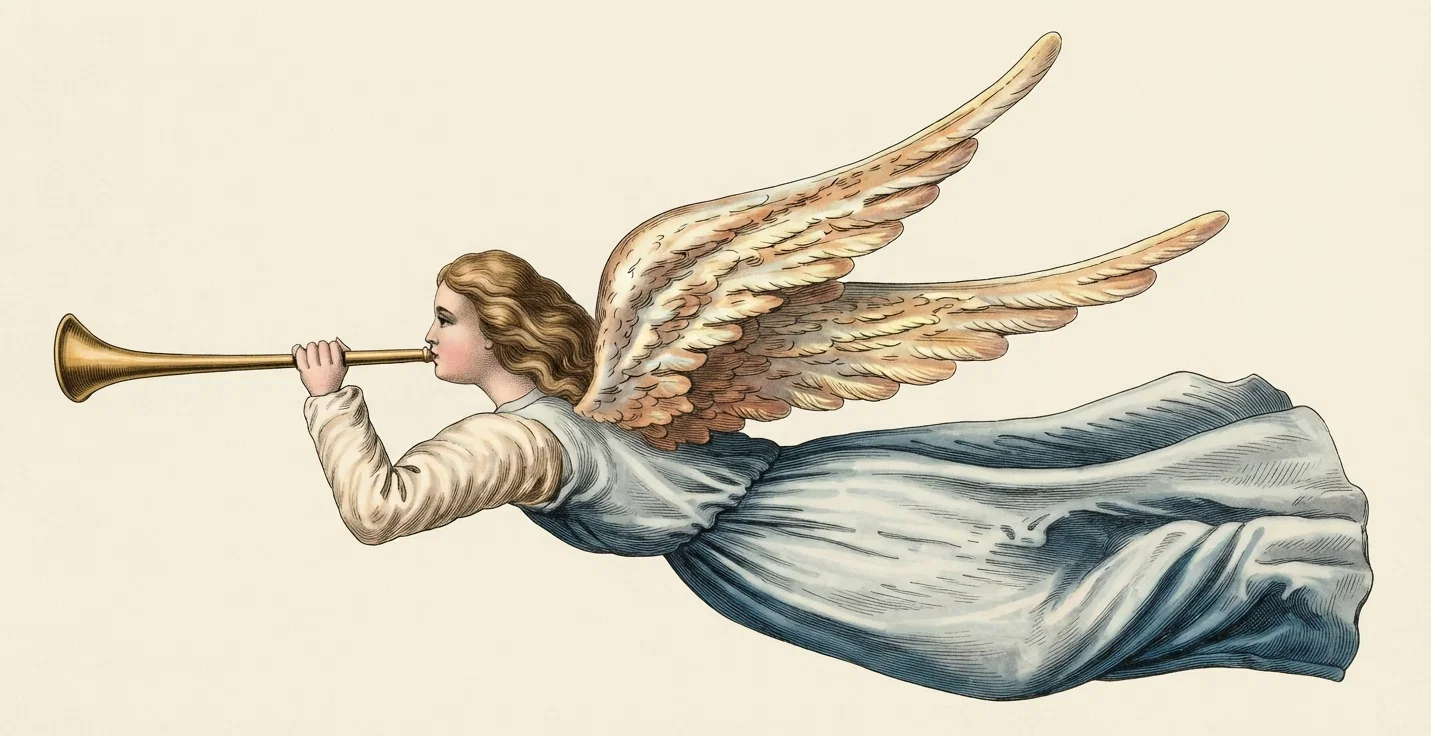
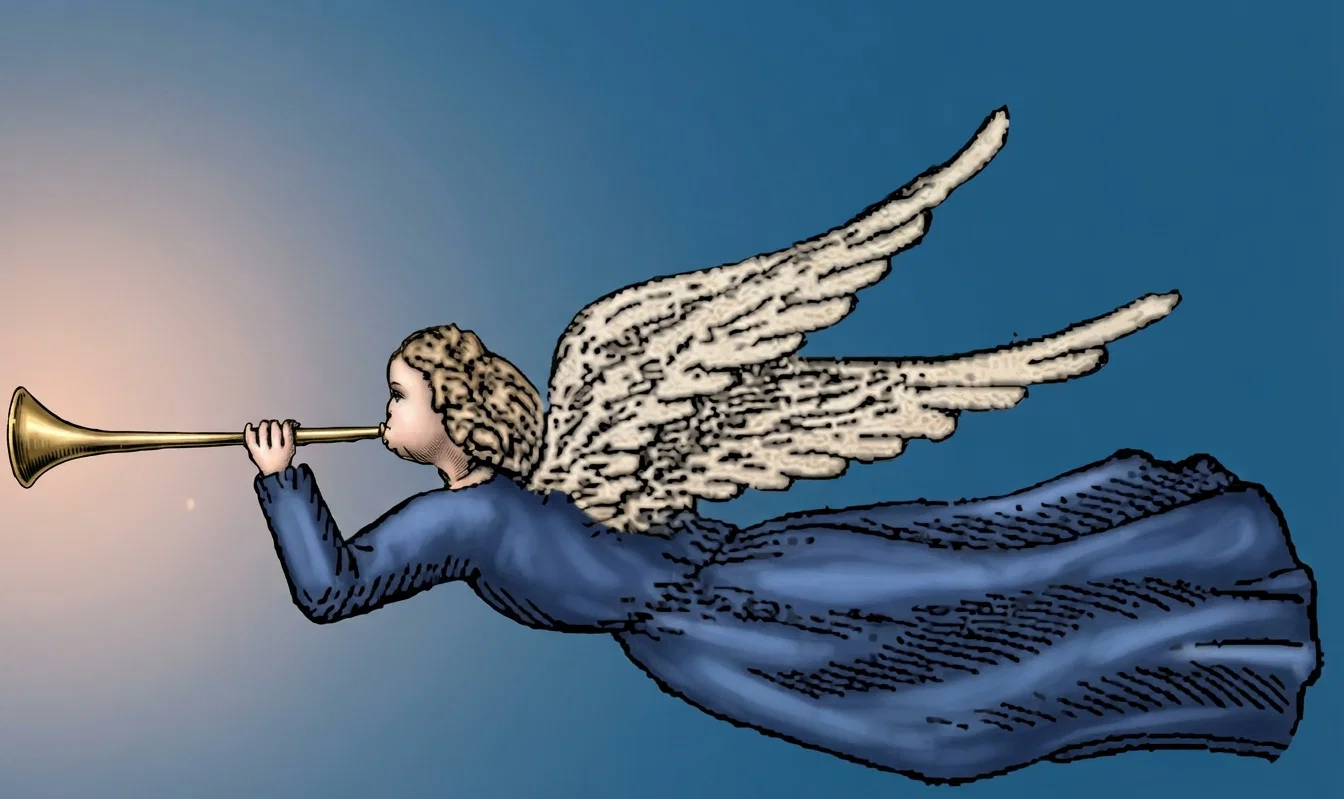
AFTER four trumpets had sounded [Rev. viii, 7-12], an angel was seen and heard flying through the midst of heaven, saying with a loud voice, "WOE! WOE! WOE! to the inhabitants of the earth by reason of the other voices of the trumpet of the three angels which are yet to sound." Verse 13.
"And the fifth angel sounded," &c.
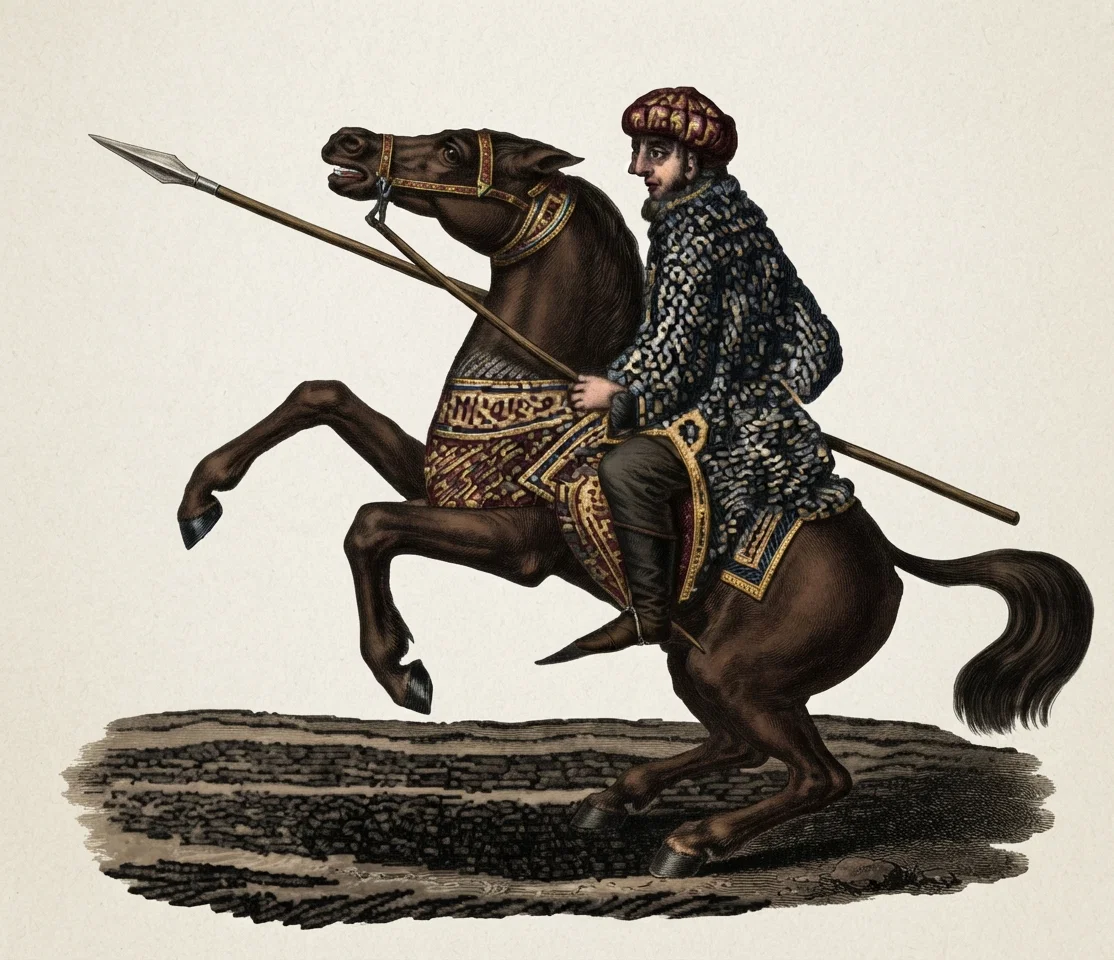
This was fulfilled by the Saracens. The fifth trumpet commenced to sound July 27th, 1299, when Othman, the founder of the Turkish empire, made his first attack on the Greeks. It extended 150 years to 1449. When the fifth angel ceased it was said, "One woe is past, and behold two more woes come hereafter."5
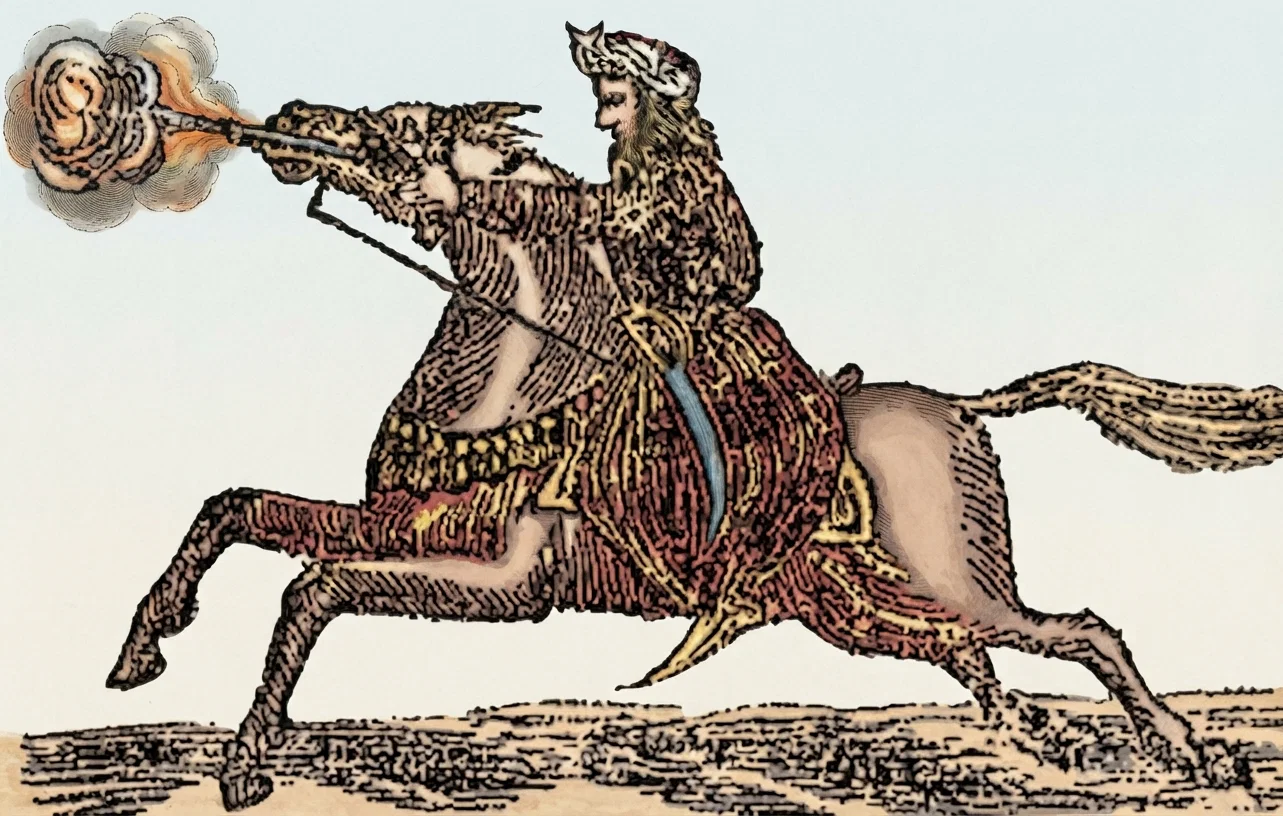
"And the sixth angel sounded," &c. Rev. ix, 13-15. This trumpet commenced July 27th, 1449, when the 150 years of the previous one ended. Its chief characteristic was the use of gunpowder and fire arms, for purposes of war, which were then but recently introduced. "Out of their mouth issued fire and smoke and brimstone." The time designated for its continuance was an hour, a day, a month and a year; amounting to 391 years and 15 days. It ended August 11th, 1840; AND AT THAT TIME THE OTTOMAN SUPREMACY DID CEASE!
"And the seventh angel sounded," &c. Rev. xi, 15. This is not the last trump which wakes the dead [1 Cor. xv, 52], as some have supposed. But it is like the two preceding it, a woe trumpet. Solemn and fearful events are located under its sounding. Read Rev. xi, from verse 15 to 19.