A MAN whom I met on Aitutaki Island was once a heavy drinker of the Maori bush beer, made from bananas, pineapples, etc. It is a custom of the Maoris for one man to make a tub of beer, and then invite his friends to help drink it. This man made frequent visits to these “tubs,” and was often drunk.
His little daughter was grieved at her father’s intemperance, and made it her business to hunt for him, and bring him home from these places of evil. This little girl became very ill; and just before she died, she called for her father to come to her bedside.
“Father,” she said, “I am going to die. You are my father, but you are a wicked man. Who will bring you home from the ‘tubs’ when I go? If you27wish to see me again, you must give up drink, and become a better man, so that we may meet in the kingdom of the Lord Jesus.” After saying these words, she kissed her father and died.
The father told me that these words so touched his heart that he never drank beer again. He had heard a lecture on the evils of tobacco by one of our medical missionaries, Dr. J. E. Caldwell, who formerly was in these islands. A few years later he became ill; and when his wife reminded him of the warnings of the white missionary regarding the evil effects of tobacco, he decided to give that up also. When I found him, he was ready to receive the fulness of saving truth, and it was indeed a pleasure to open before him the way of salvation.
F. E. LYNDON
Rarotonga, South Pacific.
Mixtures of Races and Religions in Sumatra.
By Bernard Judge
In Padang, the capital, we have the Malay proper, some Bataks from north Sumatra, and the Nias, of an adjoining island. Then there are the immigrant Chinese, and the Babas, born of Chinese fathers and Malay mothers, and speaking Malay as their mother tongue. The Chinese proper are Buddhists, Shintoists, or Confucianists in theory, but their real religion is ancestor worship.
Then there are the Tamils, Japanese, and Arabs, the latter being the ones who brought to this country Mohammedanism, which is the religion of the Malays. Mohammedanism is a faith that denies the Trinity, but contains some truth, and in theory teaches many great truths. But the truths it does hold are held in unrighteousness. The result of such a religion is to make the people who accept it more bigoted, more cruel, and more wicked than before its acceptance. Such is the condition of the people among whom we have come to labor in this field.
BERNARD JUDGE.
Padang.
Fiji Becoming Orientalized
By J. E. FULTON
NATIVE TREE-HOUSE IN NEW GUINEA
LAUTOKA, the first port in Fiji, was reached on Tuesday, May 3. Here a large sugar-mill is operated, the second largest of its kind in the world. As we approached the jetty, it seemed good to see again the woolly-headed, good-natured Fijians. As our ship was making fast, they chanted a native song, much to the pleasure and amusement of some of the passengers, especially the newcomers. But this had its charms for me also. How different they are from the stolid, indifferent Indian coolies standing near them! These Indians are now found here in large numbers, being imported by the sugar company to work on the plantations.
That Fiji is destined to be Orientalized is very evident to those who knew these islands a decade or more ago, and compare the numbers of Indians then with the numbers found here to-day. Then there were a few thousand here, but to-day there are about forty thousand. Of native Fijians there are only eighty-seven thousand, showing that there is in Fiji one Indian for about every two Fijians.
Once these islands were peopled with a savage race, but under the faithful labor of the early missionaries, they yielded to the influence of the gospel. They have also to a certain extent been molded by modern civilization. But silently and swiftly these native sons and daughters are passing away.
GROUP OF NEW GUINEA CANNIBALS OF INTERIOR
Now it appears as if, after all these years of missionary toil, an alien race is to step in, and in a few years' time Fiji will be largely heathen again unless the church awakes fully to her duty. To those who have labored for the Fijian race, there is something very sad in the change described. Poor Fiji! May God grant that a remnant may be saved to the message.
Buresala.
J. E. FULTON.
Philippine Islands
By L. V. Finster
SEVERAL months ago I visited the town of Antepolo on business, and took occasion to see the famed “Virgin of Ante-polo,” of whom it is claimed that the carrying of her image insures complete protection in traveling by land or sea. The padre kindly gave us an opportunity to inspect the image. It is a little wooden doll about two feet tall, with long, flowing hair, and dressed in a magnificent robe. Her hands and crown are covered with jewels of all kinds. They say that she is covered with about $50,000 worth of ornamentations. As I stood there viewing her, some devout Filipinos came up, fell on their knees, and kissed her hands. What sadness filled our hearts as we saw people kneeling to an image,—and this in a supposedly Christian land, and by professed Christian people! Before I left Australia, a Catholic asked me why I was going to the Philippine Islands as a missionary. “Why,” he said, “they are all Christians. Why not go to the heathen?” Can you tell me the difference between bowing down to wood and stone images of Buddha in India and bowing before the images of some “saint” or of even the Lord Jesus himself?
L. V. FINSTER.
The World's Need Educationally
By Frederick Griggs
The greatest need of the world to-day is men of honor and worth. In the great battle between right and wrong, lasting over six thousand years, the keenest talents, the brightest intellects, have ever been needed to advance the gospel of truth. The Bible is replete with the biographies of God's missionaries — men who have been sent forth by the power of his love, who were well qualified to carry this gospel to the great as well as to the lowly of earth. Surely the work of a God of perfection requires skilled workmen. The blindness of the heathen is not necessarily an intellectual blindness; and often they are as able to give a reason for their heathen belief as the Christian is for his hope. It needs skilful minds as well as a very pure faith to present the gospel in an attractive and convincing manner. And the greatest work for these men to do is that of advancing the gospel of Jesus Christ, the good news of a wonderful salvation. This gospel is to be carried to the ends of the earth, and in this generation. But the men who carry it must be those who are inured to hardship, who are conquerors of self, rulers of their own spirits. Not only is it necessary to have well-trained minds, filled with useful information, in order to meet the intelligent Orientals, but even the darkest places of earth also need skilled intellectual laborers: missionaries to these lands are often obliged to make the first translation of the Holy Scriptures into the languages of the peoples where they are laboring.
OUR SCHOOL AT GLAND, SWITZERLAND
Not only must the missionary possess a mind capable of close, accurate thinking, and a culture of worth, but he must be skilful in the use of his hands, and resourceful in turning all the elements of his environment to practical account. He must have acquired for himself that perfect poise of the intellectual, the physical, and the spiritual which makes him capable of entering into the world's fiercest strife, and mastering the conditions and odds which may oppose him. These necessary qualifications for the missionary demand schools that give a high grade of intellectual and manual training, and that teach young men and women to be self-reliant, sturdy, and vigorous in their work. Above all else such schools must be permeated with a deep missionary spirit — the spirit of the great Missionary.
Seventh-day Adventists have been seeking for the last thirty-five years to develop just such a system of schools. Hundreds of boys and girls, yea, thousands, from Christian homes, grow into the years of adolescence with but slight purposes concerning their preparation for life's responsibilities, and with absolutely none regarding gospel effort. These schools have a responsibility to receive such young persons, and so to direct the current of their thoughts, so to mold their ambitions and aims in life, that they may qualify as valiant soldiers of the cross of Christ.
Not only is there need for this sort of training in the home lands, but the mission fields themselves offer fertile soil for the development of Christian missionaries. In fact, nearly all our mission schools have constantly in mind the educating of natives to teach their own people and to preach the gospel to them. And we reap large results from this effort.
NYHYTTAN (SWEDEN) MISSION SCHOOL
Seventh-day Adventists have four grades of schools — primary, intermediate, academic, and advanced; and the same general system prevails in all lands, adapted, of course, to the particular needs of the people among whom they exist. They have about 550 primary schools, with an enrolment of upward of 11,000 pupils, employing about 650 teachers. Of the schools above the primary, there are about 85, with an enrolment of nearly 6,000 students, employing nearly 500 teachers. The total property value of these schools is approximately $1,500,000. This is exclusive of the valuation of mission-school property, which, of course, is not so large proportionately as that of the home field.
All true Christian education is identical with the work of the gospel; for it holds in mind the restoration of the image of God in the soul. Our divine Lord was himself a teacher. He came in that capacity, and he was ever known as such. And it is the work of the Christian school to qualify children and youth, no matter what may be their race, color, or degree of understanding, to enjoy the good things which a beneficent Creator has provided.
In the world's evangelization, Christian education should be considered an integral part of the gospel work.
FREDERICK GRIGGS.
College View, Neb.
The School Around a Rice Sieve
By HUNG HEI YING
A Chinese Evangelist's Discovery
Some time ago, while visiting among the country villages back in the interior from my home, I was surprised in one village to find the children intelligent in Bible knowledge. They seemed to know about the Bible characters, and could readily answer a great many questions. This was very strange; for the women, and even many of the men, did not know how to read. Where, then, had these children learned?
I asked if they had a school in their village. No, there was no school there. A chapel then?—No, there was no chapel in that part. Where, then, have you learned these things? One boy answered that a certain man in the village taught the boys a little every evening.
I made it in my way to search this man out, and this is what I saw: He was a farmer, and lived in a little mud-brick house with a straw roof and no floor. He was a poor man, too, for he must pay a high rent to the landlord on the fields he tilled. But every day after the evening meal was finished, he gathered into his little home his own children, and as many others as were willing and free to come. The big rice sieve was turned over on the bottom of a grain basket, and the children clustered around it for their lesson. This was their table, and the plain farmer was their teacher. The school went on happily for an hour or more, the teacher naming the characters, and the children, all together, repeating them after him. Afterward each child took a turn in reading by himself; then the teacher spent a few minutes explaining the meaning of what had been studied.
The table was then inverted, and became a rice sieve again, and the teacher was transformed into the farmer. “Come, children, we must work the harder now, to make up for the time spent in reading. All hands move fast.” The children flew to their work with the same willing spirit they had shown in their study.
OAKWOOD MANUAL TRAINING SCHOOL, HUNTSVILLE, ALA.
These people were too poor to spare the children from work during the day, too poor to help support a school, or even to afford a table upon which to lay their books; but earnestness and zeal made up for the lack of these things, and eternity alone will reveal the influence of that faithful farmer and his school around the rice sieve.
HUNG HEI YING.
A New Cry in the Old East
By J. L. SHAW
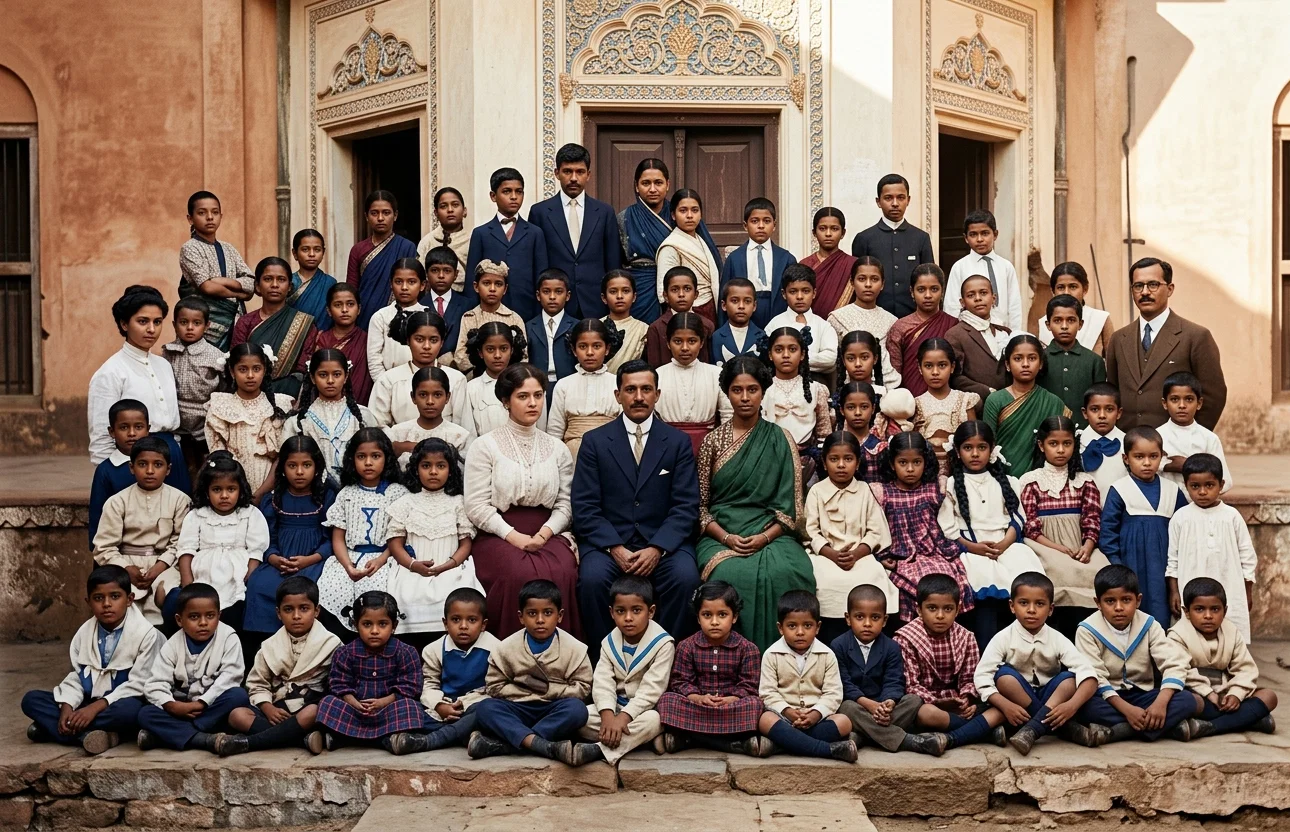
Young India at School
A NEW day has dawned in India, and there is a cry for knowledge abroad in the land. It is estimated that in India and Burma there are one hundred fifty thousand schools, with upward of five million students. There are one hundred sixty colleges granting degrees, with eighteen thousand students. It has been said, and it is probably true, that more degrees are granted in India than in Great Britain. In conversation on a street-car, while in Madras, a graduate of a university, holding a B. A. degree, told me there were so many university graduates seeking clerical employment at so small a salary that he found it advisable to become a cook.
GUATEMALA ENGLISH SCHOOL
This knowledge of Western learning is arousing India. She is waking up, as from centuries of slumber. A leaven is working in her, the result of which only the future can reveal. One thing is sure,—the call of the hour is for Christian schools in India. The time is ripe. Our missions are besieged. Heathen villages call earnestly for teachers. These requests for schools come from those who expect the teaching of the Bible, and allow us to give as much religious instruction as we see fit. We regard these openings for schools and the educational awakening all over the East as a sign of the times, a moment in the history of southern Asia freighted with the glorious privilege of carrying the gospel to its present generation, and declaring unto them the near coming of Christ.
Everything conspires to make the present a time of great moment in India. As missionaries, we have the protection of a stable government; thousands of miles of railway plying to all parts of the empire, opening up the country for mission work; an excellent postal and telegraph system; a rapidly growing reading public; and a vast educational system. This is the time to enter in. Who will volunteer for service?
J. L. SHAW.
Washington, D. C.
The Brighter Side
AN American teacher was employed in Japan on the understanding that during school hours he should not utter a word on the subject of Christianity. The engagement was faithfully kept, and he lived before his students the Christ-life, but never spoke of it to them. Not a word was said to influence the young men committed to his care. But so beautiful was his character, and so blameless his example, that forty of his students, unknown to him, met in a grove, and signed a secret covenant to abandon idolatry. Twenty-five of them entered the Christian training-school at Kyoto, and some of them are now preaching the gospel which their teacher thus unconsciously commended. Christ's gospel received its corroboration in its fruitage.—Missionary Review.
The Magna Charta of Missions
“AND other sheep I have, which are not of this fold: them also I must bring, and they shall hear my voice; and there shall be one fold, and one Shepherd.”
New Era in South America
THERE is a new world of South America growing up to the southward. The River Plate region is the great center, but all the continent has entered the new era. Pastor N. Z. Town, of our Washington headquarters, who formerly lived in Buenos Aires, and who has just revisited that country in the interests of our Spanish publishing work, writes from Argentina of the rapid changes taking place:—
“Can you imagine yourself rolling through Patagonia on a railway train? Yet this is the way now. This country is forging ahead by leaps and bounds. Thousands of immigrants are pouring in. Shiploads of two thousand or twenty-five hundred are not at all uncommon in Buenos Aires.”
OUR FIRST COLPORTEUR IN SYRIA
“La Nacion (Buenos Aires) says of the newly opened Trans-Andine line and other railway projects: ‘With the opening of this line of railway, the republic realizes another step in the program of communication with all the neighboring countries. Paraguay will soon be joined to us, uniting Asuncion to Buenos Aires by a direct route of thirty-nine hours. The railway communications with Bolivia are authorized, and in part realized. With the Brazilian frontier there are several projects of easy realization. A few days ago the government inaugurated the first line in Patagonia. The government has in construction at the present moment eleven new lines, nearly all of which are frontier lines, on which are employed eleven thousand men.’”
“The opening up of these new regions,31and the coming of so many new peoples, make the demand more and more urgent for an increase of gospel laborers. South America needs more colporteurs, more ministers, more evangelistic nurses, and more medical workers.”
NEW CHURCH AT SINGAPORE
British New Guinea
By S. W. Carr
YOUNG SAMOANS
WE have been granted land for a new station established. This is truly a dark island.
While recently about one hundred fifty miles east of Port Moresby, I visited, in a lakatoi, several villages. The Papuan lakatoi consists of two or more canoes lashed together, and boarded over.
We ran up a small river to a native village to purchase food. The houses were all grouped around the dabu, or men's house, which no woman is ever allowed to enter.
In the semidarkness of this building, I soon had a number gathered, and with the aid of an interpreter was able to tell them the old, old story of the cross. With what interest they listened as the story was told in Motuan, and interpreted into their dialect! How strange it all seemed to them—God in heaven, his Son sent to earth as a little child, his life of good words and works, his cruel death, his resurrection and ascension, and the promise of his speedy return to gather his children!
Exclamations of wonder escaped their lips, especially when the resurrection was mentioned. How could such a thing be possible? All knelt in prayer to hear from the lips of the misineri a fervent petition for the Father's blessing upon the words spoken in weakness, and that the darkened minds of the hearers should not long remain in heathen ignorance.
The day following, the same story was told to a gathering on the beach near another village, and was listened to with the same interest.
One's heart goes out to them in their darkness and ignorance. There is no missionary, white or black, along seventy miles of coast, and none inland. Apparently this was the first time that any of those present had heard the gospel of salvation.
S. W. CARR.
Port Moresby.
Language Distribution in Egypt
By George Keough
OUTSIDE of the large towns there is no need of any language but Arabic. English is taught in all the schools. There are foreigners of all nationalities in Cairo and Alexandria, and much French is spoken; but the greatest number of foreigners are Greeks and Italians. The number of Greeks in Egypt is 60,000, and of Italians nearly 40,000. Next in number are the British, with over 20,000; then French, 14,000; Austrian, 7,500; German, 2,500; with many smaller representations of other nations. With the foreigners, the number of Christians in Egypt is nearly 1,000,000.
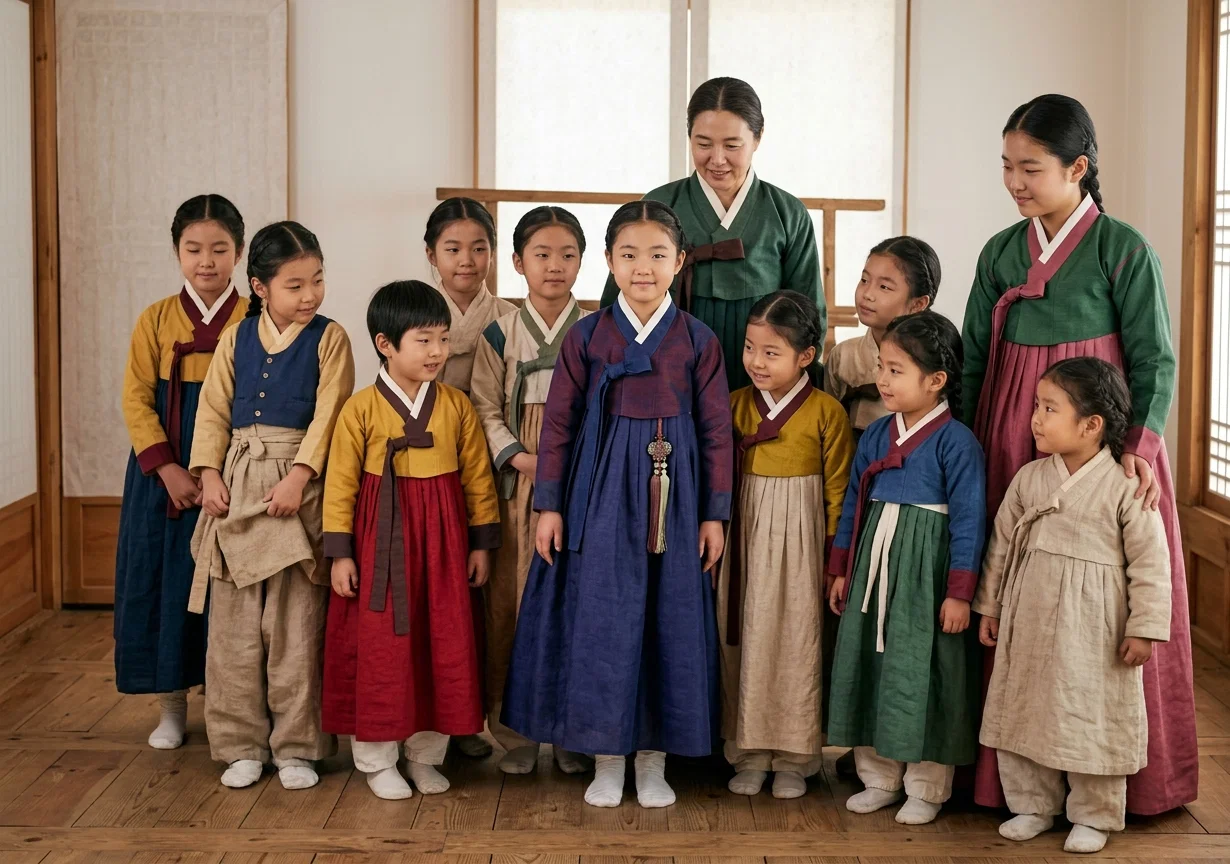
A KOREAN MISSION SCHOOL
There are over 10,000,000 Mohammedans,— an immense number when we think of our small force of workers, and of the fact that it takes a missionary at least two years to learn the language sufficiently well to begin to work for the Arabic people. We need the outpouring of the Spirit to accomplish the work of carrying the message of the Lord's soon coming to all Egypt. But that blessed gift will come, and the work will be accomplished. In this confidence we joyfully labor on, sowing the seed, and leaving the results to the Lord of the harvest.
GEORGE KEOUGH.
Cairo.
A Cry in the City
WISDOM crieth aloud in the street;
She uttereth her voice in the broad places;
She crieth in the chief place of concourse;
At the entrance of the gates,
In the city, she uttereth her words;
How long, ye simple ones, will ye love simplicity?
And scoffers delight them in scoffing,
And fools hate knowledge?
Turn you at my reproof:
Behold, I will pour out my Spirit upon you;
I will make known my words unto you.
— Proverbs 1: 20-23.