WHAT a wonderful chapter! What a sweep of vision it covers! From more than six centuries before Christ, unto the endless cycles of eternity! Down through the kingdoms of Chaldea, Medo-Persia, Grecia, Rome in all her phases, to the present time, aye, even to the everlasting kingdom of God! From Babylon on the Euphrates to Jerusalem on the river of life!
This vision of the kingdom of men came first to one of the greatest of earth’s long list of monarchs. It came through one of the greatest of the prophets of God, a noble prime minister. It was for the instruction and benefit of Nebuchadnezzar, the king of Babylon, to whom it was given, and beyond him to the people of God and all the rulers and the ruled of earth to the end of earth’s history.
Nebuchadnezzar reigned over an empire which has placed its moral and religious stamp upon all the world as has no other nation. Great Babylon has had influence world-wide and ages long. We are still pursuing her methods in education, and her religious principles have affected all Christendom.
Nebuchadnezzar, mighty warrior, noted scholar, famous builder, a discriminating and wise statesman after the manner of men, but haughty and proud, ruled over Babylon from B. C. 605 to 562, a period of forty-three years.
The great monarch was anxious to know the future. His father and himself had builded upon the ruins of other empires. What would follow when he should die? Would any empire succeed Babylon? And to answer these questions in the king’s mind, God gave the king the dream of the great image. For thus the prophet declares: “As for thee, O king, thy thoughts came into thy mind upon thy bed, what should come to pass hereafter: and he that revealeth secrets maketh known to thee what shall come to pass.” Verse 29.
We appeal to the reader to turn to Daniel 2 and read the entire chapter. Read how Nebuchadnezzar was troubled by his God-given dream; how, not to be deceived, he demanded of his wise-men, who claimed to possess supernatural knowledge, that they should make known both dream and interpretation. They could do neither. As impostors, the king decreed their death. Daniel, not consulted because a Hebrew in religion, was, however, numbered among those to be slain. He asks for time to consider the matter. It is granted. He holds a prayer-meeting with his fellows. God reveals dream and interpretation. They praise God for his goodness, and before the king they ascribe all their knowledge to the “God in heaven” who “revealeth secrets,” the One with whom there is “wisdom and might,” who “revealeth the deep and secret things.” This is the dream:—
“Thou, O king, sawest, and, behold, a great image. This image, which was mighty, and whose brightness was excellent, stood before thee; and the aspect thereof was terrible.
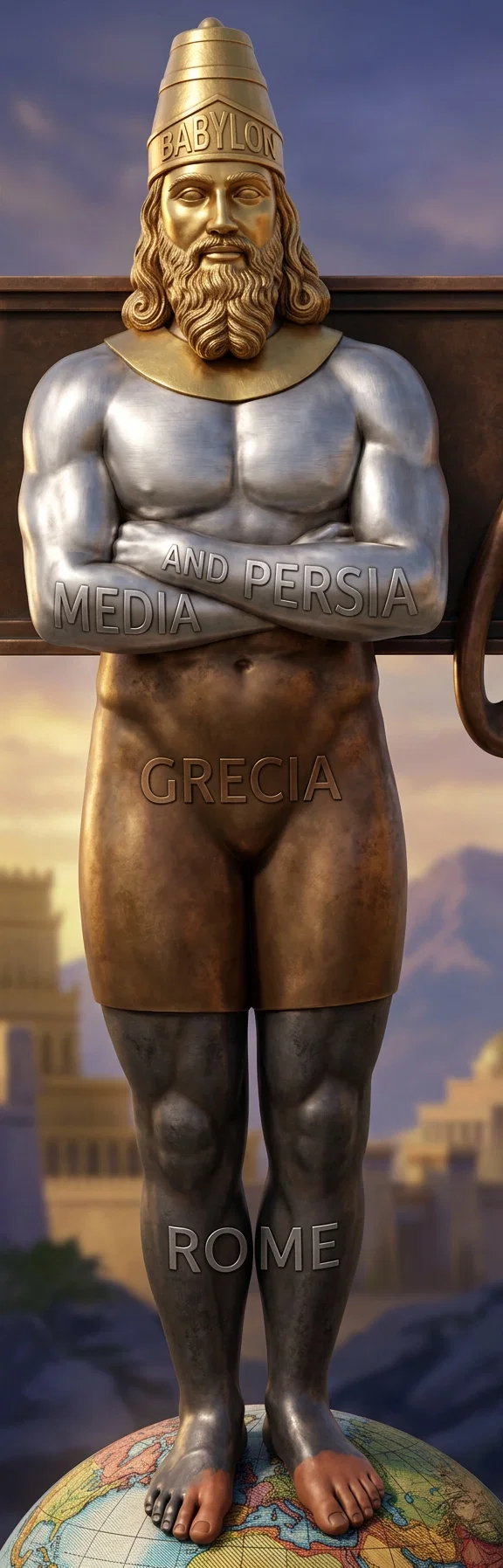
“As for this image, its head was of fine gold, its breast and its arms of silver, its belly and its thighs of brass, its legs of iron, its feet part of iron, and part of clay.
“Thou sawest till that a stone was cut out without hands, which smote the image upon its feet that were of iron and clay, and brake them in pieces. Then was the iron, the clay, the brass, the silver, and the gold, broken in pieces together, and became like the chaff of the summer threshing-floors; and the wind carried them away, so that no place was found for them: and the stone that smote the image became a great mountain, and filled the whole earth.” Verses 31-35.
In these verses is compressed the history of the world. We need not dwell on the details of the interpretation, as there is no room to doubt the application, if we believe the prophecy. In short, the head of gold represents Babylon, of which Nebuchadnezzar was the chief. “Thou art this head of gold.”
The breast and the arms of silver symbolized the successor of Babylon, Medo-Persia. The belly and thighs of brass, from the breast to the knees, represented Grecia. The legs of iron represented Rome in its imperial period; the mingling of iron and clay signified the division of the Roman kingdom, never to be united as one.
It is well to note that it is not particular parts of the image, anatomically, that are symbolical of the successive empires, but the metals. Gold for Babylon. Then silver, a kingdom “inferior.” Then a third kingdom of “brass.” Then a fourth kingdom as strong as iron. No division is indicated by parts of the image. The two arms do not represent two elements in the Medo-Persian empire. Nor do the two legs or ten toes represent aught in Rome. But the mixture of iron and clay does portray Rome in her imperial unity and in her division. Iron and clay will never mix. Men have tried and planned and plotted to unite divided Rome, but God foresaw the future, and correctly delineated it on the prophetic page: “They shall not cleave one to another, even as iron doth not mingle with clay.” Verse 43.
In the days of this divided condition of the fourth kingdom—Rome—the God of heaven shall set up a kingdom which shall utterly obliterate all earthly kingdoms and shall stand forever. This everlasting kingdom is not established by the conversion of worldly kingdoms. It does not enter through the gateway of politics. It is not set up till all earthly rule has been demonstrated failure. It is established only when Jesus Christ shall come the second time, and shall sit upon the throne of his glory. Then, indeed, will the great mountain kingdom fill the world, and her people shall endure forever.
Two Pictures
But we never shall get the emphatic view which God designs we should of this prophecy till we compare it with the third chapter. The image of the second chapter is God’s picture of the kingdom of men. The image of the third chapter is God’s picture of the ambitious minds of men who are patriotic and powerful. God said that Babylon was only the head of gold, and would be succeeded by others. Nebuchadnezzar, in his selfish patriotism, declared, “Babylon shall stand forever;” and so he made his image all of gold,—the apotheosis of patriotism, his prophecy of Babylon,—and commanded all to worship it under pain of death.
Similar has been the dream of all ambitious patriots of power. So Alexander thought of Grecia, Cæsar of Rome, Napoleon of France; many Englishmen so think of Great Britain, many Americans so dream of the United States. Let them all learn from the lesson to Nebuchadnezzar. Babylon has gone and all her glories. Medo-Persia long since passed away. Grecia lives only in her beautiful ruins and works of art. Rome is utterly and forever divided, and her divisions are watching one another with jealous, warlike eyes. Thus has it been for years. They will never know peace or quiet or rest or continuance, for God has spoken. Just on before lies the only kingdom worthy to exist forever, because it is a righteous kingdom. It shall “never be destroyed, nor shall the sovereignty thereof be left to another people; but . . . it shall stand forever.” To that glorious kingdom, dear reader, God invites you. The message of his soon-coming kingdom has belted the earth again and again, and kindled in many lands burning and shining lights. Heralds sent of men are proclaiming its coming; all nature, and conditions in the social and the religious world, proclaim in sure and oftentimes trumpet tones that the sands of human empire are nearly run, and then the everlasting kingdom. Reader, will you continue to be a subject of earth-doomed empire? or will you by faith grasp the eternal in Christ Jesus?
M. C. WILCOX.
The Great Commission Today
To his disciples to-day is the Master saying: “Go ye therefore, and teach all nations, baptizing them in the name of the Father, and of the Son, and of the Holy Ghost: teaching them to observe all things whatsoever I have commanded you: and, lo, I am with you alway, even unto the end of the world.” Matt. 28: 19, 20.
Canvassing Among the Moslems
It is apparently a new thing in Turkey systematically to canvass the Moslems with Christian literature. When our Constantinople publishing depot, the International Tract Society, issued Arabic publications, and set agents to selling them among the Mohammedans, it was a problem to the authorities, even under the new order of constitutionalism and liberty. The following report, from Elder Z. G. Baharian, of Constantinople, tells of first experiences:—
“One of our publications, ‘Who Is Jesus?’ was written in Arabic and dedicated to the Moslems. It was sold with great success from house to house and in the restaurants of Constantinople. This drew the attention of a Moslem newspaper, which raised a warning cry.
“The next day the police began to search for our canvassers. Several times they were arrested, and the tract was carefully read. But as it contained nothing against the Islam religion, they were permitted to go free. One day a canvasser went over to Scutari, across the Bosporus. A Moslem gentleman invited him in, engaged him in conversation, and while politely talking and purchasing a liberal supply, he had a policeman brought, who arrested our canvasser as soon as he stepped into the street. The chief of police set him free, however, and notified the ministerial department of the government concerning our work. The question was finally referred to the superintendent of the punishing department.
“With the superintendent of our book depot, I went to the director, to give him information concerning our work. When we entered his office, he dealt kindly with us. We asked him to examine for himself the booklet ‘Who Is Jesus?’ Just at this point a Moslem teacher, who was standing by, testified that he had read it, and found it wholly in harmony with the Bible. This testimony made a good impression upon the mind of the official, and he assured us that we should not be hindered, if he found that it was in harmony with the Bible.
“Later he gave orders to all the police stations, in substance: Though the nature of the Seventh-day Adventists’ religion has not yet been verified by the government, the tract entitled, ‘Who Is Jesus?’ has been investigated, and found to be in harmony with the four Gospels; therefore, let them be unmolested.”
UNDER RESTRICTIVE LAWS
Where Police Watch Church-Membership
SOME of the regulations in Russia, while perfectly in harmony with the idea that it is the business of the state to foster and enforce religious observances, seem rather strange to us in lands where the Bible principle of religious liberty is recognized. In reply to the question, What about the progress of religious liberty in Russia? Elder J. T. Boettcher, president of our Russian Union Conference, replies:—
“The cause of religious liberty is not progressing as fast as we had hoped. The Duma, the national representative body, is divided on this question. Some are working earnestly for a greater measure of liberty, others as earnestly opposing. It was but recently that the police brought us a written document telling us what steps a person must take in order to be released from the Greek Catholic (or orthodox) Church:—
“1. A petition must be sent to the governor, declaring his intent to leave the church.
“2. The governor informs the priests, whose duty it is to labor for one month to persuade the petitioner from taking the step.
“3. If the person remains firm, he may then unite with another church, and the leader of said church must inform the governor, who, in turn, notifies the orthodox clergy.
“4. Persons under twenty-one years of age can not be released from membership in the orthodox church. If parents having children are converted, the children must remain in the former church until they are of age.
“If these requirements are violated, the minister in charge is held responsible.”
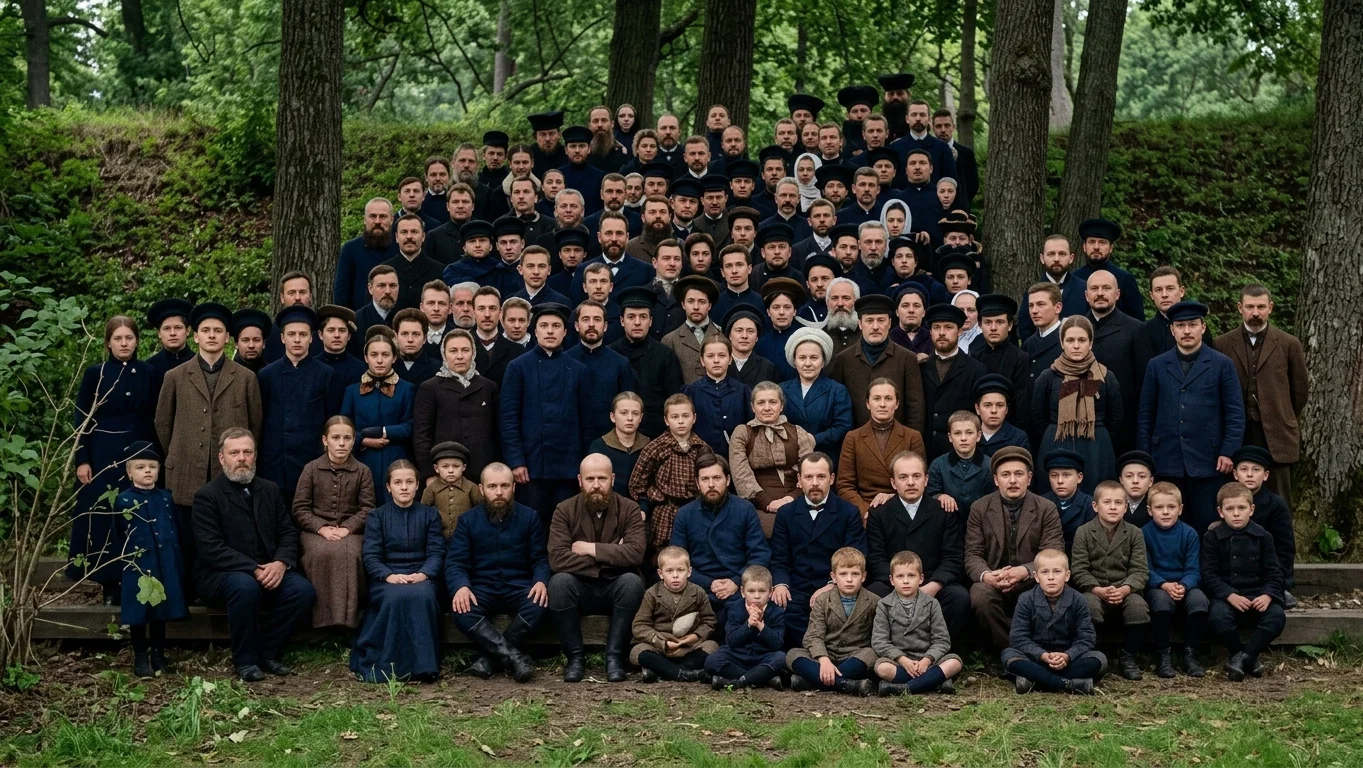
1. SOME OF THE CHURCH-MEMBERS AT RIGA, RUSSIA
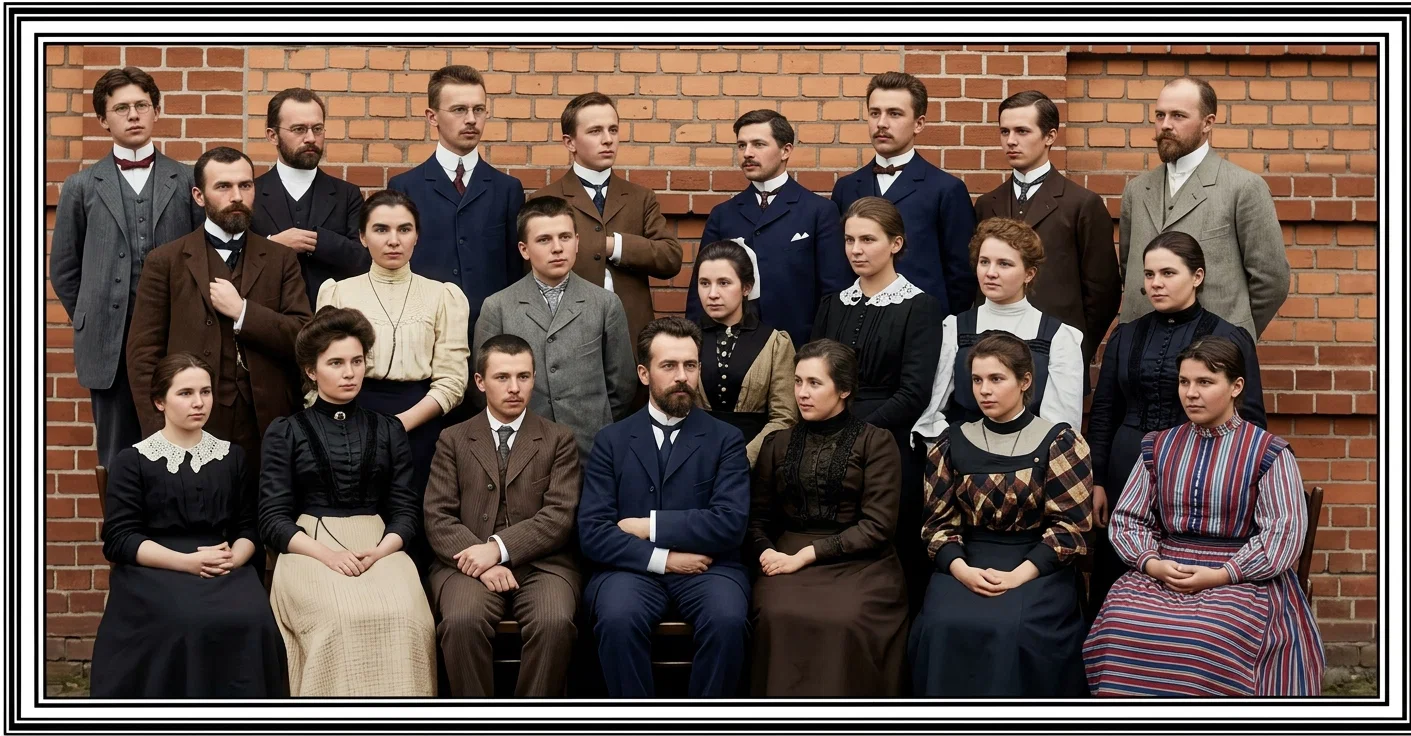
2. RUSSIAN STUDENTS IN ATTENDANCE AT FRIEDENSAU COLLEGE, GERMANY
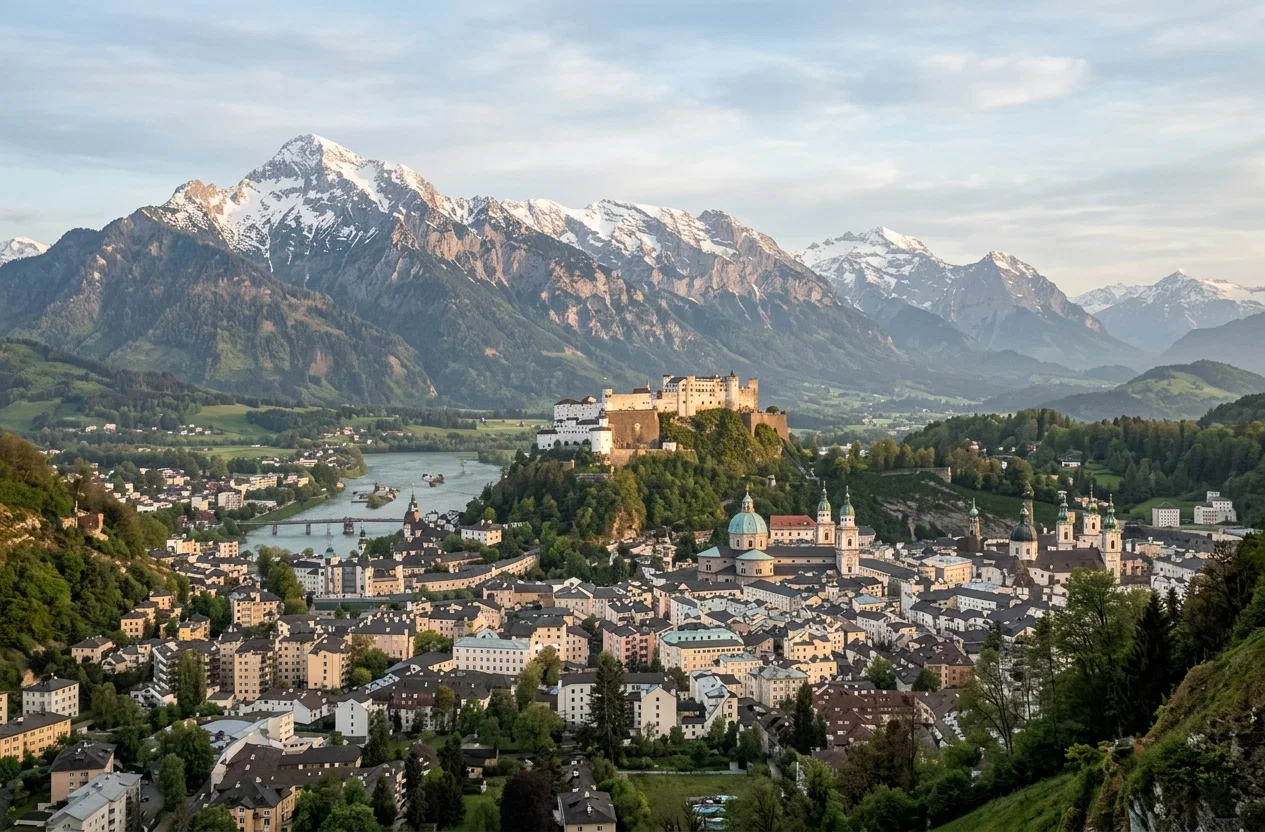
3. SALZBURGER, PRUSSIA, A REFUGE FOR PROTESTANTS ONE HUNDRED FIFTY YEARS AGO
IN THE CITIES
By Ole Andres Olsen
A Plea for the Foreign Population of Our Cities and Country
MUCH is being done to send the gospel to other lands, and to enlighten the heathen nations concerning the plan of salvation through faith in Jesus Christ. This is as it should be; for none too much interest can be shown in bringing the last warning message to all parts of the world in these closing moments of time. But while our minds are directed to the needs of peoples and nations in far-away lands, we must not overlook the great and equally needy and important foreign field here in the United States.
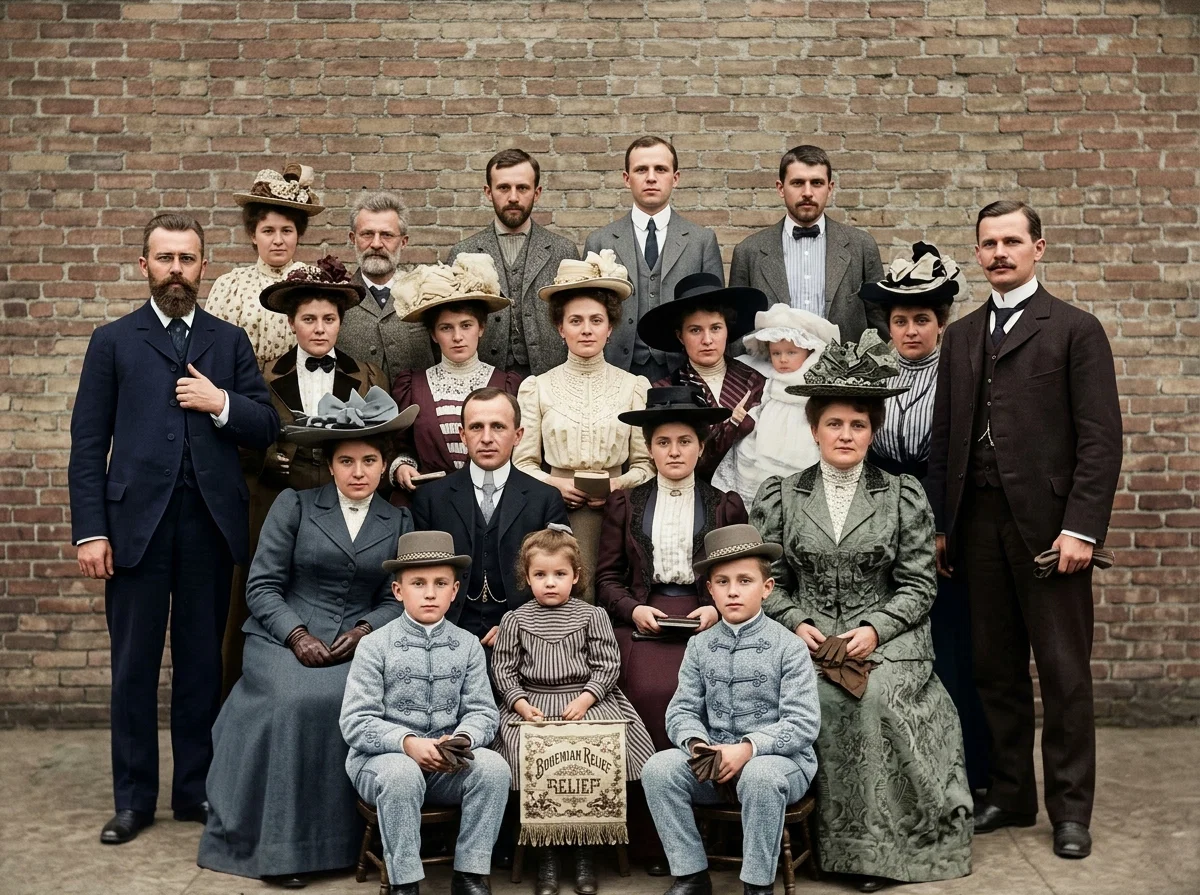
GROUP OF SLAVIC-BOHEMIAN BELIEVERS IN NEW YORK CITY
It is well known that there are a large number of foreigners in this country; but I feel certain that few have any just appreciation of the vastness of the foreign population of our cities and country.
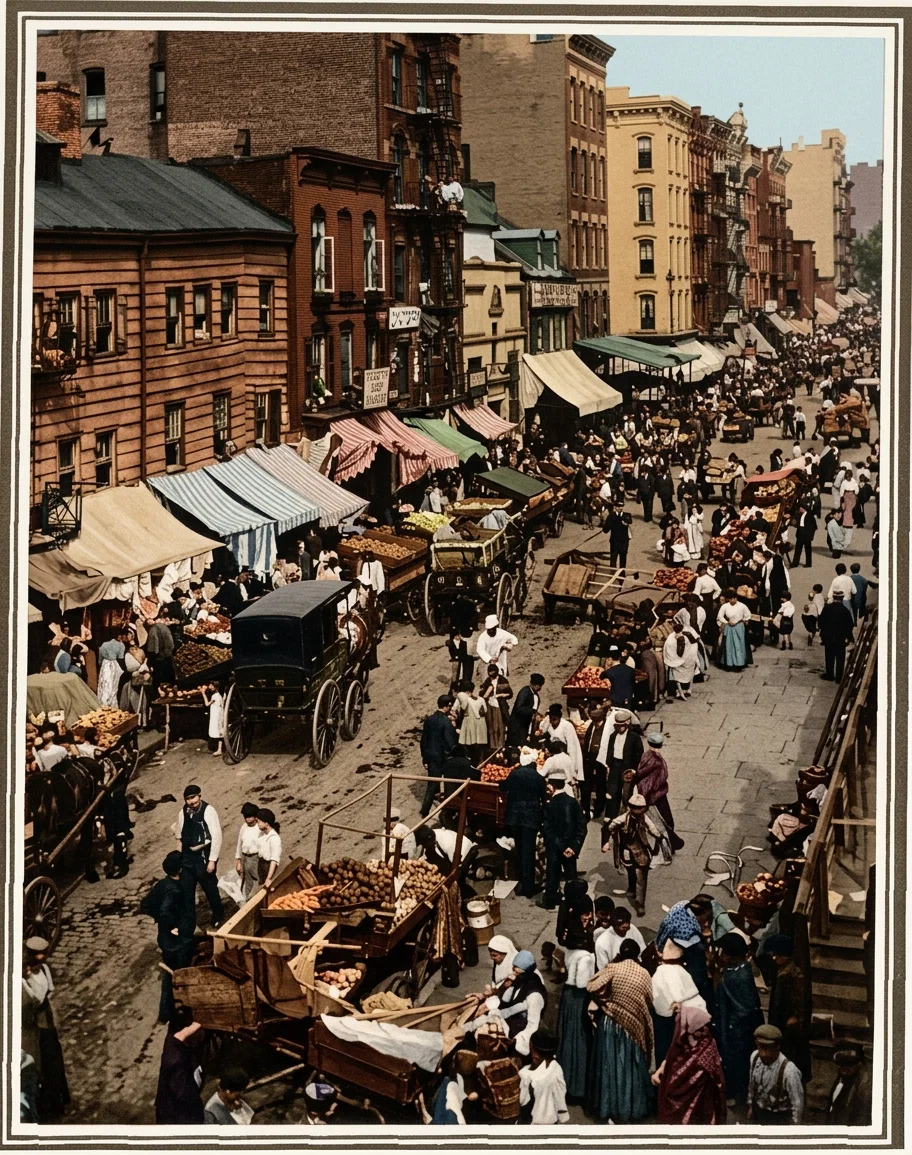
When one stands for a little time at the immigration landing, where he can see the thousands, and hundreds of thousands, of immigrants coming from the European countries and landing on our shores, he appreciates the vast numbers of these people and their need as he can in no other way. Steamer after steamer, vessel after vessel, empties its living freight at the receiving station at Ellis Island in numbers beyond the belief or comprehension of those who do not take the pains to investigate it.
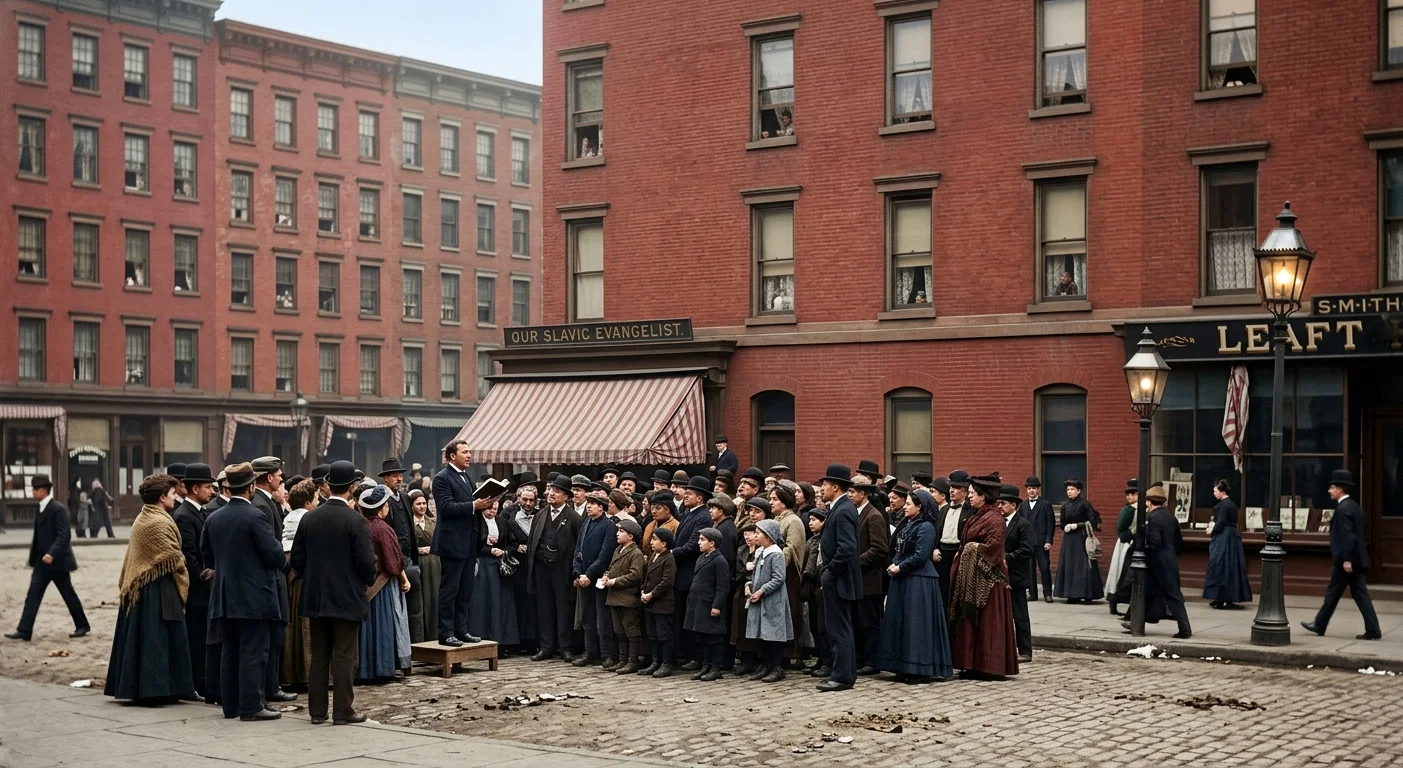
OUR SLAVIC EVANGELIST HOLDING A STREET MEETING AMONG THE SLAVIC-BOHEMIANS IN NEW YORK CITY
To give the reader a better idea of the increasing flood of immigrants, let me refer to the fact that in 1906 the total number was 1,100,735. Where do they all locate? Government statistics for that year tell us that thirty-four per cent settled in New York, over eighteen per cent in Pennsylvania, six and one-half per cent in Massachusetts, a little larger per cent in Illinois, and so on.
The writer has had some opportunity to see the needs of the heathen in Africa and the South Sea islands, but I have not met any conditions that plead more earnestly for the gospel of salvation than what I have seen in New York and other great cities of this country. Truly we have, right here at home, a mission field whose condition is pleading most earnestly for the message of salvation; and as the providence of God has brought these people to our shores, it would certainly be a very wicked thing if we should be indifferent or negligent to our God-given responsibility for this most needy and destitute part of the Master's vineyard. Therefore let us rally to the call of God, and take up this work with an earnestness, a zeal, which we have not as yet manifested.
O. A. OLSEN.
Chicago, Ill.
The Heart-Beat of a City
By Herbert N. Casson
EACH day the living tide throbs in and out —
A rush of human atoms to and fro;
Some carry healing,— health and hope and truth,—
And some a secret poison, as they go.
Some feed the hungry veins through which they pour,
And unto life bring new life — flame to flame;
While others, ruled by wolfish passions, rend
The very heart whence their own being came.
In love and hate these fluent atoms strive,
Flung back and forth by Time’s insistent breath;
For weal or woe the fitful torrent runs,—
The blood that gives the city life — or death!
— Herbert N. Casson.
Giving the Message to People of Other Tongues in the United States
By A. BOETTCHER
WHEN the light of the everlasting gospel for the last generation began to enlighten the world, God drew the races of the earth to one country, in order to reach them with the last glorious message. At about the beginning of the “time of the end,” or the beginning of the last century, people began to flock into the United States. At the time when God gave his special message in 1844, the first wave of immigration really began. It continued till, in 1854, it reached the high mark of four hundred one thousand a year, a number equal to the total of all who had landed on our shores prior to 1830.
When God has a special plan in view, he creates circumstances to bring about the fulfilment of the same. This was seen at the deliverance of Israel from the bondage of Egypt. It was thus at the time of the restoration of the city of Jerusalem, and the rebuilding of the temple after the captivity of Babylon. God not only aroused the minds of his own people to feel the necessity of this work, but moved upon the hearts of the kings of Persia, and especially of Cyrus, to fulfil his will at the right time. The third angel’s message was to go to “every nation, and kindred, and tongue, and people;” and God not only showed his chosen ones the necessity of missionary effort in the regions beyond, but also drew many from those lands to these shores, where they would have an opportunity to learn the message, and take it back to their fellow countrymen.
In the beginning of the last century, in Europe and elsewhere, attention was called to the United States. On account of oppression, and for other causes, numbers were, through unseen forces, driven to immigrate hither. The years 1840 to 1844 mark an especial era in the flow of immigration to the United States. The tide began to rise steadier and higher, and it has continued so to rise until the present day. God had begun to fulfil the great plan of the age—to bring the last message to the nations of the earth. Various conditions and circumstances combined to induce immigration to the New World. In some places religious persecution was the cause of driving many to the land of liberty.
Copyright, Detroit Photographic Co.
Copyright, 1907, Underwood & Underwood, N. Y.
When the host of the enemy surrounded the city of Dothan, and the servant of the prophet could not see the hand of God which was with them, Elisha prayed, “Lord, I pray thee, open his eyes, that he may see. And the Lord opened the eyes of the young man; and he saw.” 2 Kings 6:17. Even so we need a clear vision to understand what this immigration to the United States means to us. Elisha’s prayer is well applicable to our time, because we should realize the divine hand in this marvelous movement,—a movement never seen in the past,—and the great blessings we may bring through the gospel to this vast army coming to our land.
Surely the fields are ripe for harvest, and many are ready to hear the gospel. When the immigrant arrives in our country, the old religious ties have been weakened by the voyage, sometimes broken altogether. The bulk of the new immigration, which began in 1880, is Roman or Greek Catholic. And while, in their respective countries, these are the state religions, yet the ties are not very strong after the individual leaves his home country. “We are tired of our church and our priests,” is an answer we often meet in our labor with this class. The same is experienced by others who have come in contact with them. Mr. Groose says: “Thousands of these nominal church-members drift into open infidelity or schools of atheism, or else into nothingism. Their former church does not keep them, and Protestantism does not get them.”
Perhaps the condition prevailing in many large cities will show this more clearly. In one city in Massachusetts, where there are one thousand seven hundred Italians, it is said that only fifty or sixty attend the Roman Catholic Church; and in another of six thousand, only about three hundred attend the religious services of their church. They are tired of the Roman Catholic Church, and have lost faith in its priests.
The tide of immigration is rising higher and higher. In the past we have not been able to do much for the foreigners already here—and still they continue to come at the rate of a million a year. Shall we be able, in the future, to care for these incoming millions? God has provided us with some means to carry the message to them. There is literature in our publishing houses in nearly thirty different languages. Will you help to distribute this literature among your foreign neighbors?
New York City.
A. BOETTCHER.
In Island Fields
By C. H. PARKER.
Tropical Island Fields Not a Paradise
Not long ago I received a letter, which said: “O, how lovely it must be to live in the islands of the sea, where you can have everything that you want! It must be a paradise.” I trust that no one thinking about making the islands his field of labor will have such thoughts in mind; for if he does, he will be sadly disappointed, and will be anxious to take the first boat back home. Workers for these fields should understand that there is hard work before them. There are sacrifices to make, privations to endure, bitter disappointments to meet, and sin in its vilest forms to face at every step.
But do not look alone at the dark side of the picture. Turn it around, and there is seen the new earth, with many of these poor, ignorant, degraded souls sitting at the feet of Jesus, with you to live eternally where sin can nevermore touch them. This is the hope before us as we labor here in Fiji.
Buresala. C. H. PARKER.
Voodooism in Haiti
By W. J. TANNER
The gospel was given for the express purpose of saving those who are downtrodden and degraded by sin, and it is answering its purpose here in Haiti. Morality here is at a very low ebb. For example, a man's importance in the eyes of his fellow beings may be accurately estimated by the number of concubines he is able to keep. Except in the case of the few Protestants, it is a rare thing to find a man who is living with but one wife. It would appear that this fact would greatly hinder our work. However, although about seventy-five per cent of our members are men, we have had little difficulty with this problem. This I attribute to the fact that reverence for the law of God has such a conspicuous part in all our evangelical work. If the people know nothing else about us, they do know that we honor the ten commandments, and they are not slow to come to the conclusion that if they accept the gospel, they must not only keep the Sabbath, but also change their standard of morality in other respects. Therefore, none come to us but those who are willing to make the sacrifice, and up to the present the sacrifice has always been made; the concubines are put away, and family affairs adjusted without our speaking about it.
Another thing that has a very conspicuous place in the life of these people is voodooism, which was introduced from Africa by the slaves who were brought here in the sixteenth and seventeenth centuries. Roman Catholicism has had little influence over this relic of heathenism, except to modify some of its forms. The altar, for example, is much like those seen in Catholic churches, and the voodoo devotees have also adopted the cross. It was not until after living here two years, that I made this discovery. It was explained to me that the blue cross is the voodoo emblem, and is used to protect the faithful of the cult from evil spirits.
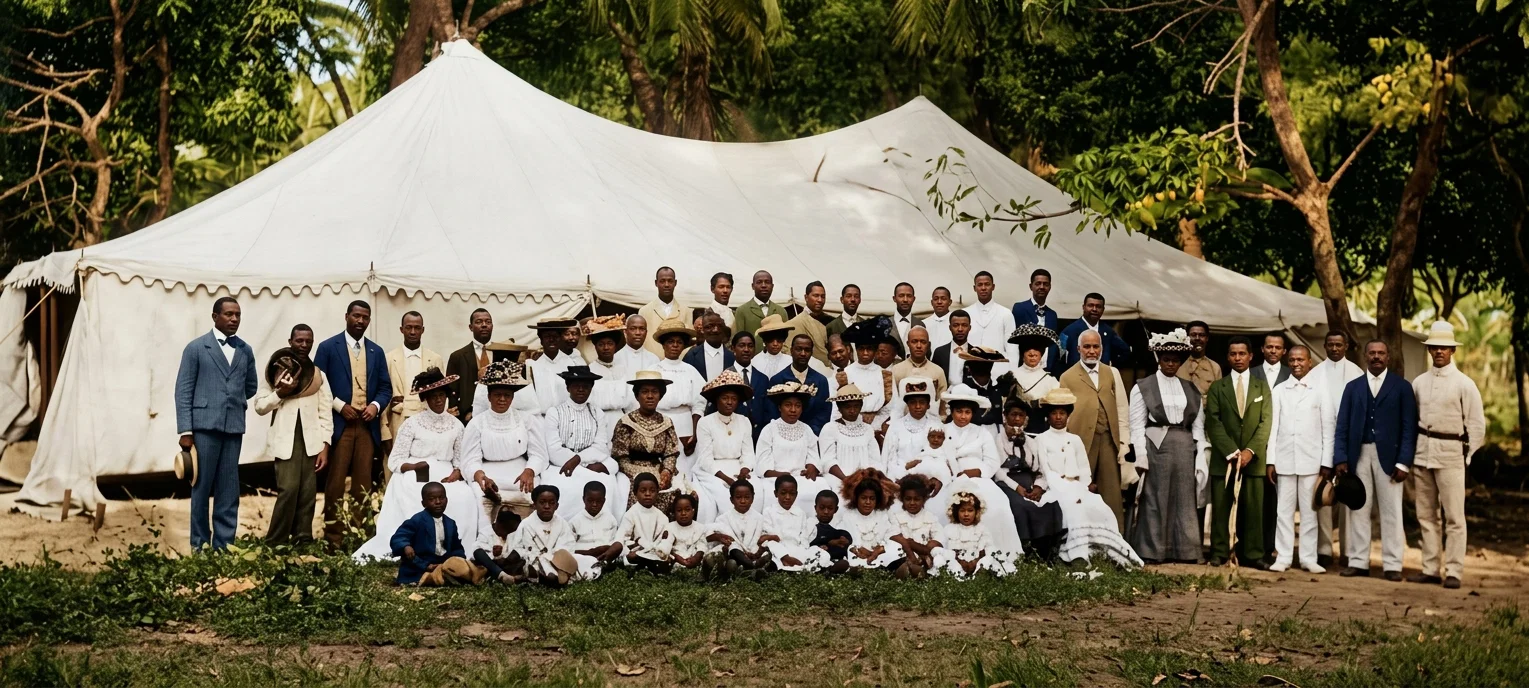
TENT-MEETING IN PROGRESS AT ST. CROIX, DANISH WEST INDIES
Voodooism, in its worship, in its sacrifices, and in its dance, is demoralizing and degrading in the extreme. It is simply a cunningly devised system of vulgar and obscene worship, whereby the enemy of righteousness succeeds, it would seem, in destroying all desire for truth, honesty, and virtue. Those who have never studied the workings of this vile cult can little understand the influence it has over the masses. It apparently blocks the way of the gospel to the hearts of all its votaries. Yet here, too, the third angel's message is admirably fitted to the needs of the missionary. The truths relative to man, his condition in death, the fall of Satan and his angels, and the fact that they can transform themselves into angels of light, all strike a death-blow at voodooism and all kindred beliefs. Without this precious truth I feel that our work for these people would be most discouraging. That we are making headway against such things as I have mentioned, should strengthen and encourage every child of God who reads these lines.
Cape Haytien. W. J. TANNER.