Pacific Press Publishing Company · Oakland, California · Feb 4, 1897
Faith
By Editor
Editorial
Faith.—“The fruit of the Spirit is . . . faith.” The Revised Version and Rotherham has “faithfulness.” Murdock’s Syriac reads “fidelity.” It refers to faith in operation in the Christian life.
Faith is more than Belief. Belief may be no more than mere assent to a truth. “Thou believest that there is one God; thou doest well; the demons also believe, and tremble.” But the demons do not have faith; theirs is nominal, dead belief. Faith is a living principle, which makes real the thing believed. It is “the giving substance to things hoped for, the proving of things not seen.” Heb. 11:1, R. V., margin. To mere belief there is but the empty form; faith sees it filled out, a living reality.
Faith is based on God’s Word. “Faith cometh by hearing, and hearing by the Word of God.” Rom. 10:17. It sees in God’s Word not a dead, dry form, a mere letter; but it accepts that Word for what it is, spirit and life. John 6:63. It takes that Word, not as the word of men, but as the Word of God. It sees God in his Word. It matters not tho to man the things seem to be impossible; faith does not consider the hardness, the difficulty, the impossibilities, to human sight. It merely inquires, Is it God’s Word? and if it is, it sees, it knows, it lays hold, of the power of God.
Faith respects God’s Promises. It finds life by them; it finds life in them. The sinner is delivered from this present evil world and translated into the kingdom of the Son of God’s love through faith in the promises of the Gospel. Col. 1:13, margin. By faith he finds the righteousness of God. Rom. 1:16, 17. By faith in the Son he receives the peace of righteousness. Rom. 5:1. By faith in that same love he drinks of the Fountain of eternal life. Gal. 2:20. In fact, all the way, at all times, faith, living faith, makes its possessor a partaker of the divine nature through the exceeding great and precious promises of God. 2 Peter 1:4.
Faith also respects God’s Precepts. That is not faith which holds to the promise and despises the precept. And yet there are many who hope to be forgiven of transgression, and in the last great day to be made immortal, who are continually despising, or regarding as of no account, the commandments of God. They hope in his promises, and deceive themselves into believing that their hope is sure, but they sit in judgment on the divine precepts, and consider them as not worthy of observance, especially if inconvenient, inexpedient, unpopular, or demanding sacrifice. The obedience rendered is the indicator of faith. The murderer, the thief, the idolater, the profane swearer, the proud, the covetous, the wicked of every class and degree, want prolongation of existence, and peace, and prosperity; and many are led to hope that if they believe God’s promises all these things are theirs. But no man has true faith in God’s promises who does not have true faith in God’s precepts.No man has sure hope in God’s promises who does not have true submission to God’s precepts. God is in the one as truly as the other. Nay, more, the precept is a promise. He who by faith submits with all his heart to a command of God, will find and know the implied promise that what is commanded, with all its beneficent results, is wrought in his character. He who accepts with all his heart the promise of God accepts with it the righteousness of God which makes the promises possible.
Without Questioning.—Faith must accept without questioning. Not that the Lord demands blind unreason. He always gives enough evidence on which to base faith, that is, to the soul which longs to do God’s will. That all men do not believe is no proof of this. The majority of men want God’s blessing, but in their own way; yet this is impossible. God’s blessing must come in God’s way, or it is not his blessing. Received as a matter of course, accepted in unbelief, the blessing is perverted, and works out evil instead of good. So with God’s Word. The man who adds or subtracts from the promises of God, who changes their conditions, does not have the promises of God, but his own. He who seeks to mold, or change, or curtail, or add to one commandment of God, does not possess God’s precept, but one of his own making. He has limited God’s wisdom by his own. He has said that God’s law needed amending, his wisdom supplementing. He who obeys nine precepts out of the ten of the Decalogue does so, not to please God, but to please himself. The test of faith always comes over that which is contrary to carnal desire and wisdom.
Illustrations.—The test of faith to King Saul was the command of God to slay the Amalekites and devote their property to destruction. The wisdom and policy of man said, Spare Agag the king to grace a triumph, and the flocks for sacrifice, lest the people be offended. Saul’s faith was found wanting; it stood in the wisdom of men rather than in the power of God. The result was the loss of a throne and his soul. (See 1 Sam. 15:1–23.) It was simple faith for the ministers of the sanctuary to carry the sacred ark on their shoulders as God commanded; it was the wisdom of men to build a new cart, and let the holy chest be drawn by oxen. The former would have led to glory and blessing; the latter led to dishonor and death. (See Num. 4:15; 7:9; 2 Sam. 6:3–9.) It was simple faith for Naaman to dip seven times in Jordan according to the word of the Lord by the prophet; it was the wisdom of man to prefer the brighter, clearer, colder waters of the rivers of Damascus, to the tortuous and at times roily2Jordan. Yet the former meant leprosy till death; the latter, healing and life. And why seven times? is not one dipping sufficient? Nay, it must be seven. (See 2 Kings 5:1–14.) All through the Book of God are revealed illustrations of faith and its fruits, and unbelief and its consequences.
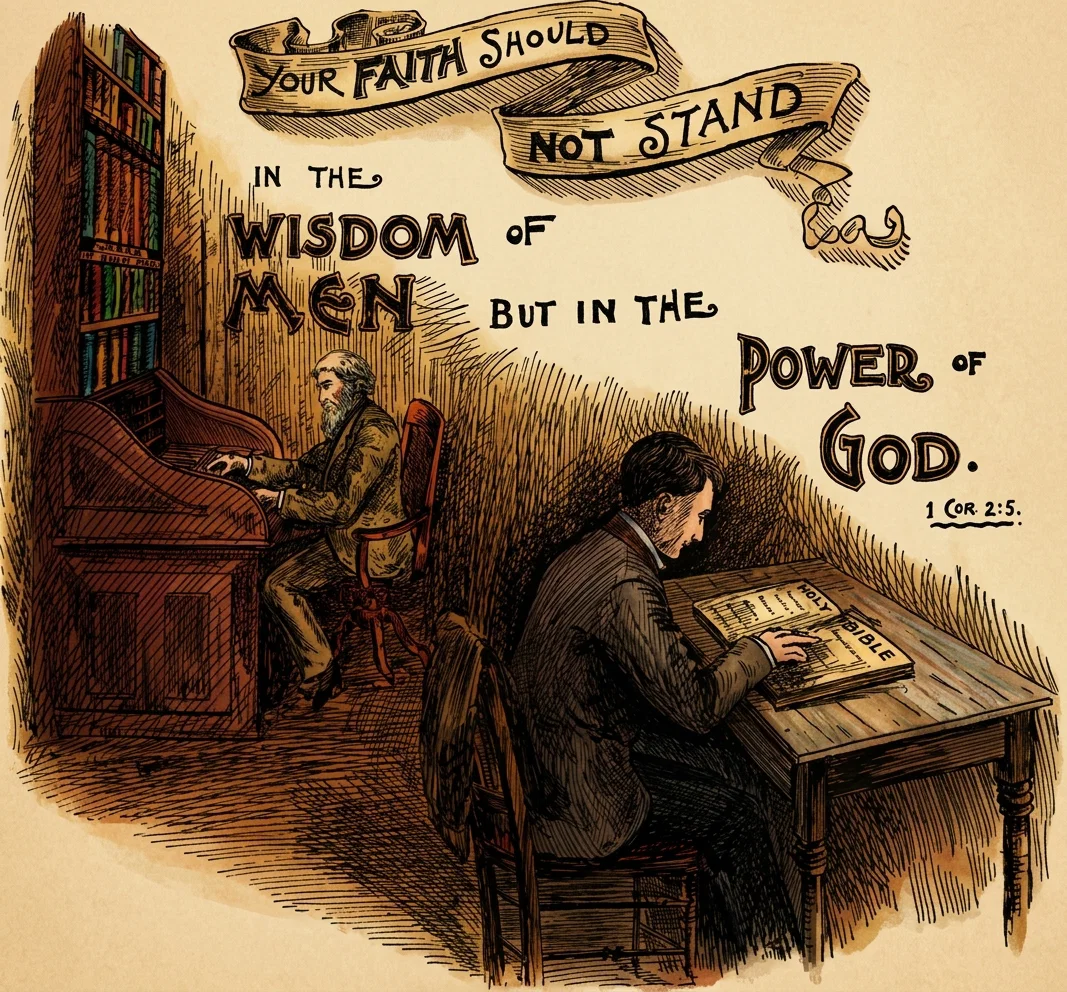
The Power of Faith.—And yet the power is not in the mere accepting of itself or the mere submission of itself. One man may submit to man, and even to the dumb idol. He receives no benefit. It does not remove sins, give peace, or make righteous. His submission is simply to wisdom and power but little if any higher than his own. But he who accepts with all the soul God’s promises, who yields with all his heart to God’s precepts, comes into harmony with the life of God, the will of “him who worketh all things after the counsel of his own will” (Eph. 1:11), who “doeth according to his will in the army of heaven, and among the inhabitants of the earth; and none can stay his hand, or say unto him, What doest thou?” (Dan. 4:35). The power of faith is the power of God, because it is placing him who has the faith in the channel of the working of God’s will; it is bringing him into harmony with God’s “eternal purpose.” But he who allows man to come between his soul and God; who allows tradition however hoary to supersede the Scriptures of truth, who permits commentaries however learned to usurp the place of the Spirit of God in the interpretation of the Word, who chooses the creed instead of Christ, will sadly find at last that the wisdom of men is foolishness with God, and a quicksand foundation instead of the living and eternal Rock. O reader, decide the questions of to-day by simple faith in the Word of God! Open the heart to receive of his fulness. Wholly submit to his every precept. As the electric car reaches up the arm of the trolley and takes from the power overhead, so let your faith connect with Jesus Christ, through the Word, and his life and power are yours. So shall your faith “not stand in the wisdom of men, but in the power of God,” and so shall you prove the faithfulness of him “who shall stablish you, and keep you from evil.”
NOT CHRISTIANITY.
By Editor
OUR esteemed contemporary, the Jewish Ledger, of New Orleans, should not identify the religion that many are seeking to “install” as “the law of the land” with Christianity. That it is called Christianity is true; but it is Christianity only in name. The Founder of Christianity declared, “My kingdom is not of this world,” and, “If any man hear my words, and believe not, I judge [condemn] him not; for I came not to judge the world, but to save the world;” and still again: “Whatsoever ye would that men should do to you, do ye even so to them; for this is the law and the prophets.” These are the teachings of Christianity; Christianity is these teachings in life. It is only the principles of true Christianity in the hearts of men that can prevent religious persecution. Judge Pryor’s decision, to which the Ledger refers, is unamerican, and would be “absurd” if upon such as it were not hinging such dire possibilities. But it is not Christian in any respect; it is antichristian. Even if we were to admit the holiness of Sunday, a day which is neither holy, nor the “Christian Sabbath,” as the Ledger implies, we agree with our contemporary that “before the law” it “should have as little holiness as the Mohammedan sabbath,” and we would add, or the seventh-day Sabbath. The civil law has no right to discriminate between “holy days,” or their respective adherents.
THE NEW CREATION.
By Ellet Joseph Waggoner
“In the beginning God created the heaven and the earth.” “In six days the Lord made heaven and earth, the sea, and all that in them is.” At the close of each day’s work “God saw that it was good;” and at the close of the sixth day, when everything was finished, “God saw everything that he had made, and, behold, it was very good.” Gen. 1:31. Man himself was perfect, and all was as good as God himself could make it.
“Thus the heavens and the earth were finished, and all the host of them. And on the seventh day God ended his work which he had made; and he rested on the seventh day from all his work which he had made. And God blessed the seventh day, and sanctified it; because that in it he had rested from all his work which God created and made.” Gen. 2:1-3.
“In six days the Lord made heaven and earth, the sea, and all that in them is, and rested the seventh day; wherefore the Lord blessed the Sabbath day, and hallowed it.” Ex. 20:11.
The Sabbath was the sign of the power of God’s word. He had spoken all things into existence; and now he rested in perfect confidence that his word would uphold that which he had created. The Sabbath of the Lord—God’s rest—is therefore the mark of a perfect, new creation.
But man, to whom the dominion of the earth had been given, sinned. He sold himself to the enemy of God, and received death as his reward. By his sin the curse came upon the earth, so that God’s perfect, new creation was everywhere marred. But God was not defeated; his purposes can not be thwarted, for he “worketh all things after the counsel of his own will.” Therefore his love devised means to insure the carrying out of his original plan.
“God so loved the world, that he gave his only-begotten Son, that whosoever believeth in him should not perish, but have everlasting life.” John 3:16. Christ was given to death, that man might receive the eternal life which had been lost through sin.
But the cross of Christ is “the power of God.” 1 Cor. 1:18. The Gospel is “the power of God unto salvation to every one that believeth.” Rom. 1:16. But ever since the creation of this world, the eternal power of God has been manifested in the things that he has made. Rom. 1:20. Therefore the cross of Christ—the Gospel—is the same power that is seen in creation. The same power of God by which man was created in the beginning, is now manifested through the Gospel to re-create him—to bring him back to the perfection which he had at first.
This is shown very clearly in the Scriptures. “If any man be in Christ, he is a new creature,” or, as the Revision has it, “there is a new creation.” 2 Cor. 5:17. Of course there can not be a new creature without there having been a new creation. So again, “We are his workmanship, created in Christ Jesus unto good works, which God hath before prepared that we should walk in them.” Eph. 2:10, margin.
This new creation is signalized by rest. Christ says, “Come unto me, all ye that labor and are heavy laden, and I will give you rest.” Matt. 11:28. Whoever comes to him is re-created,—made new,—and then he finds rest—rest in the Word of God.
As this new creation is the same as that wrought in the beginning, and by the same means, the word of God, so it has the same mark, namely, the Sabbath of the Lord, the seventh day. Notice these points:—
1. In Christ there is a new creation. In him all things are created in heaven and in earth. Col. 1:16.
2. With the new creation in Christ, there comes rest. Even so it was in the beginning.
3. Christ is of God made unto us “wisdom, and righteousness, and sanctification, and redemption.” 1 Cor. 1:30. He is the truth, and he sanctifies himself, that we may be sanctified through the truth. John 17:19.
4. The Sabbath of the Lord, the seventh day, on which Christ rested when he had finished the new creation in the beginning, is the sign of sanctification, which comes only through Christ. We read, “I gave them my Sabbaths, to be a sign between me and them, that they might know that I am the Lord that sanctify them.” Eze. 20:12.
So now, as at the first, the Sabbath is the sign of the perfect, new creation. God has not changed, his power has not changed, neither has his sign changed.
But this is not the end. In the beginning God had a perfect earth as the abode of perfect men. So again he will have a perfect abode for the men who are made complete in Christ,—a new earth for his new men. He says, “Behold, I make all things new.” And again, “He that overcometh shall inherit all things.” Rev. 21:5, 7. “We, according to his promise, look for new heavens and a new earth, wherein dwelleth righteousness.” 2 Peter 3:13.
There will be the same new creation that was in the beginning, at the close of the first six days; for it will be “the times of restitution of all things, which God hath spoken by the mouth of all his holy prophets since the world began.” Acts 3:21. And since it is the same new creation, the same thing, namely, the Sabbath, will mark it; for we read God’s sure Word to the new men whom he has created in Christ:—
“As the new heavens and the new earth, which I will make, shall remain before me, saith the Lord, so shall your seed and your name remain. And it shall come to pass, that from one new moon to another, and from one Sabbath to another, shall all flesh come to worship before me, saith the Lord.” Isa. 66:22, 23.
If we would be part of God’s new creation we must have it in God’s own way, and not refuse to allow God to place his own seal of perfection upon it. E. J. W.
Living Nobly in Small Things
“We need no great opportunities to live nobly,” said a German writer. “As the tiniest dewdrop reflects the splendor of the whole heavens, so the most trifling word or action may be filled with the truth and love of God.”
The Side of Right Is Always the Side of Might
The side of right is always the side of might.
MODERN SPIRITUALISM.
There are any number of beliefs among Spiritualists with reference to theological questions; but the essential points may be simmered down to two: (1) A belief that the soul or spirit exists as a conscious entity after death, and (2) that it is possible for it to communicate with persons in the flesh. These beliefs, and these alone, are the essential beliefs of Modern Spiritualism, or, more properly, Spiritism.
But all who hold to these beliefs do not call themselves Spiritualists. On the contrary, they declare that they are not Spiritualists, and avowedly opposed to the ism. And yet, when the matter is sifted, they are simply opposed to Modern Spiritualists as a society, because of other grosser views, but not to the essentials of Spiritualism. But the evil lies not in the organized societies of Spiritualists; it lies in the essential and basic doctrines.
In the remarks we may make on this question here or hereafter, we desire to state at the outset that our contention is not against Spiritualists as persons, but against Spiritualism as a system of errors, a delusion, a counterfeit, and a snare. There are many sincere souls which have been deceived by it. There are those who would break from it did they know the truth. We desire to point them to the truth as it is in God's word.
The origin of the doctrine dates back to Eden. Its author was the father of lies. When the Lord told Adam, “In the day thou eatest thereof thou shalt surely die,” he who was once the angel Lucifer declared, “Ye shall not surely die; . . . ye shall be as God, knowing good and evil.” (See Gen. 2:17; 3:1-5, R. V.) Here Satan laid the foundation of the belief in an immortal, invisible soul or spirit, capable of a separate conscious existence. “Sin, when it is finished, bringeth forth death,” and Satan knew that when death followed sin, as it soon would, man would not be deceived unless he could be made to believe that in some way the real man survived the death of the flesh, and existed like God forever, and generally invisible to mortal eyes.
Man believed, and ate, and died. The man who sinned returned to his dust, to wake no more till the voice of God should call him from his long sleep. Yet the great Deceiver has made the greater part of humanity believe ever since that all those whom the Bible declares have died are still living. Out of this falsehood grew demon worship, the worship of spirits believed by man to have once lived here upon earth; and being great here, they have since death become demons, demi-gods, and gods; and thus the belief in a conscious immortal entity, called “soul,” is responsible for the great systems of polytheistic idolatry.
The teaching of God's word is against it. In that portion of the Scriptures called the Old Testament we have no statement, save that of the serpent in the Garden, predicting immortality of sinful man. In the New Testament immortality is ever referred to as that which men here are to seek for (Rom. 2:7), but which will be given only to the righteous at the coming of Christ, and the resurrection and gathering home of the righteous dead (1 Cor. 15: 51-55). In short, it is plainly declared that only God hath immortality, that is, in himself. 1 Tim. 6:16. On the contrary, we are told again and again in the Bible that the dead have no communication with the living, that they “know not anything,” and that their only hope of life is in the resurrection from the dead. In proof of this note the following passages:—
“But man dieth, and wasteth away; yea, man giveth up the ghost, and where is he?” Job 14: 10.
“If a man die, shall he live again? all the days of my appointed time will I wait, till my change come.” Verse 14.
“If I wait, the grave is mine house.” Chap. 17: 13.
“Thou destroyest the hope of man. Thou prevailest forever against him, and he passeth; thou changest his countenance, and sendest him away. His sons come to honor, and he knoweth it not; and they are brought low, but he perceiveth it not of them.” Chap. 14: 19-21.
“For in death there is no remembrance of Thee; in the grave who shall give Thee thanks?” Ps. 6: 5.
“The dead praise not the Lord, neither any that go down into silence.” Ps. 115: 17.
“For the living know that they shall die; but the dead know not anything, neither have they any more a reward; for the memory of them is forgotten. Also their love, and their hatred, and their envy, is now perished; neither have they any more a portion forever in anything that is done under the sun.” Eccl. 9: 5, 6.
“Whatsoever thy hand findeth to do, do it with thy might; for there is no work, nor device, nor knowledge, nor wisdom, in the grave, whither thou goest.” Verse 10.
“Put not your trust in princes, nor in the son of man, in whom there is no help. His breath goeth forth, he returneth to his earth; in that very day his thoughts perish.” Ps. 136: 3, 4.
“David is both dead and buried.” “For David is not ascended into the heavens.” Acts 2: 29, 34.
“But if there be no resurrection of the dead, then is Christ not risen; and if Christ be not risen, then is our preaching vain, and your faith is also vain. . . . For if the dead rise not, then is not Christ raised; and if Christ be not raised, your faith is vain; ye are yet in your sins. Then they also which are fallen asleep in Christ are perished.” 1 Cor. 15: 13-18.
Certainly these scriptures show that the essentials of Spiritualism are not the teachings of the Bible. Further than this, the Word of God teaches that those who hold communion with the supposed spirits of the dead, and who worship or revere the supposed spirits of great men who have died, do not, in reality, hold communion with the dead or worship the dead, but rather worship demons, angels of Satan, who come, by means of Satan's falsehood, in the guise of the spirits of the dead. So it is that the psalmist, in referring to the idolatry of Israel, declared:—
“They joined themselves also to Baal-peor, and ate the sacrifices of the dead.” “Yea, they sacrificed their sons and their daughters unto devils, and shed innocent blood, even the blood of their sons and their daughters, whom they sacrificed unto the idols of Canaan.” Ps. 106: 28, 37, 38. See also Lev. 17: 7; Deut. 32: 17.
The idolatrous nations believed that the idols they worshiped represented great heroes or rulers who had once lived upon the earth, had died, and afterward became gods, as declared by Satan. The supposed spirits of the dead were, in fact, the demons, devils, or angels of Satan. So also Paul says:—
“What say I then? that the idol is anything, or that which is offered in sacrifice to idols is anything? But I say, that the things which the Gentiles sacrifice, they sacrifice to devils [demons], and not to God; and I would not that ye should have fellowship with devils.” 1 Cor. 10: 19, 20.
Modern Spiritualism, organized or otherwise, with its pretended communication with the dead, is the old necromancy and idolatry modernized. The spirits who appear, the “saints” who are supposed to “bless” or “intercede,” the spirits of good or great men or women who seem to influence and minister to the mourning and bereaved ones, are all lying angels of the devil, coming in the guise of those loved and revered, the better to deceive.
There are none, probably, who are doing more to help forward Spiritualism than many professed Christian ministers, hymn writers, and poets. As an instance of this take the following from a sermon by Dr. Talmage, preached in Washington, Feb. 9, 1896:—
“O, will not some of these glorious souls of the past come down and help us? Come down off your thrones, Nettleton and Finney and Daniel Baker and Edward Payson, and Truman Osborne and Earl and Knapp and Inskip and Archibald Alexander—that Alexander the Great of the Christian churches. Come down! How can you rest up there, when the world is dying for lack of the Gospel? Come down and agonize with us in prayer. Come down and help us preach in our pulpits. Come down and inspire our courage and faith. Heaven can get along without you better than we can.”
Here is another extract from the same preacher, quoted from Fitchburg (Mass.) Present Truths, of January, 1897:—
“When I get to heaven, . . . I will come and see you all, . . . yes, I will come to all to whom I have ministered. . . . To show you that your departed friends are more alive than they ever were, . . . I have preached this sermon.”
But Dr. Talmage will not come. He, like Job and David and Paul and other worthies, will wait in the grave till his Lord shall call him. If any spirit comes purporting to be that of Finney, or Alexander, or Talmage, know that it is a demon, a messenger of Satan in that guise. Concerning these things God has forewarned us, and has given the Gospel armor, that we may be forearmed. See 2 Thess. 2: 9, 10; 1 Tim. 4: 1; Rev. 16: 13, 14; Isa. 8: 19, 20. In these scriptures God has also given us the sure test, and the sure refuge, his law and testimony, and the love of the truth. If we abide by these, we shall not be deceived. If we listen to the message brought by those who claim to be our loved and honored dead, we shall be deceived and led into the delusion of destruction.
The Fourth Commandment.
In the report of the Sacramento Sunday-law Convention, on another page, it will be seen that Mr. Ketchum, in his advocacy of a Sunday law, bases it upon the fourth commandment. He said:—
“The law of God formed one complete and perfect arch of which the fourth [commandment] was the keystone. They must all stand or fall together.”
This is emphatically true. But that fourth commandment declares, “The seventh day is the Sabbath of the Lord thy God.” As that arch came from the hand of the Great Architect and Builder, it is perfect. Every stone will hold. The Sabbath keystone quarried from the eternal rock of God’s truth will endure the thrust of the mighty arch, through all of which runs the life of the Eternal. But our Sunday-law friends propose two evils: They will substitute for the Sabbath keystone of God’s word, a sun-dried brick of traditionary clay; and instead of the arch being bound together by God’s life,—the inherent bond of truth,—they propose to bind it together by the untempered mortar of traditionary religious legislation. Both will fail even when they seem to be the greatest success; the untempered mortar will crumble, the counterfeit keystone will be crushed, and its worshipers will be buried in its ruins.
Question Corner
“Enquire, and make search, and ask diligently.”
No. 469. “Hate.”
Why is the term “hate” used in Luke 14:26, when we are commanded just the opposite in Ex. 20:12 and Eph. 6:1-4? W. F.
The word “hate” is used in the sense of loving less. Compare Matt. 10:37. It does not mean to cherish, or harbor, ill feelings against a person. The text means that we should love God so much that we are willing to forsake all for his sake. Hate here stands for forsaking all, even as love implies following with all the heart. See the conclusion in Luke 14:33.
No. 470. “Thieves and Robbers.”
PLEASE explain John 10:8. Who are the thieves and robbers that came before Him? L.
“All that came before Me are thieves and robbers” (R. V.), that is, claiming to be “the One who should come.” Our Lord evidently refers to the false messiahs who preceded him. This does not include such men as John the Baptist, or the prophets. None of these were self-sent, or came on a mission of their own, or professed to be the Messiah. Jesus seems to have referred to such men as Theudas and Judas, mentioned in Acts 5:36, 37. He only came in “the fulness of the time.”
No. 471. Raising Mules.
PLEASE explain Lev. 19:19. Is it right to raise mules? Earnest Inquirer.
The object of the Lord in such instruction was to impress upon his people that there should be no mingling of the holy with the profane. See Eze. 22:26. A disregard of these common things with reference to natural law, would lead to a disregard of higher and sacred relations in spiritual law. See Deut. 4:2. God desires no mixing of worldly policy and heavenly principle. Mules were in common use among the children of Israel. See 2 Sam. 13:29; 1 Kings 1:33; 10:25; 18:5. And it is probable that they raised them. But if “Earnest Inquirer” has any doubt with reference to the question asked, give God and a good conscience the benefit of the doubt.
Those in Gen. 6:2 doubtless refer to men who were born of God, who professed faith in him, and were called by God’s name. See Gen. 4:26, margin: “Then began men to call themselves by the name of the Lord.” In Job 1:6; 2:1, and 38:7 the term refers to heavenly beings, angels, or messengers of God, among whom Satan once stood.
No. 473. The Bride.
In Rev. 21:2 and in Gal. 4:26 Jerusalem is spoken of as a city, and in Rev. 21:2 it is spoken of as the bride; also in verses 9, 10. In SIGNS of December 10, article 10 of Revelation 17, the church is called the bride of the Lord. Now if the church is the bride, who are the guests at the supper in Rev. 19:9?
The SIGNS has not said that the church is the bride of Rev. 21:2, 9, 10. In the earthly warfare, in the church militant, the believer, the man restored, is represented as being married to Christ (Rom. 7:4), and the church, or congregation of believers, as being espoused to Christ (2 Cor. 11:2). See also Jer. 3:14; 31:32. So also when the earth shall be restored to its rightful King, the land shall be called “Beulah,” or married, and the capital city of that new earth, the New Jerusalem, as the representative of that restored land, will be called the bride. See Isa. 62:2-5; 54:1-5; Rev. 21:2, 9, 10. The guests of the marriage of the Lamb are all the children of Christ, the Everlasting Father, and the New Jerusalem, the mother, and doubtless the angels of God. It will be seen that the figure of marriage, the symbol of the closest union—one flesh—runs through all, the union of Christ with the individual, with the church, and with the eternal kingdom.
No. 474. Who Are the Branches?
In Rom. 11:17 who are the branches broken off? Are we the wild olive tree that is grafted in?
In Rev. 7:5-8 does it literally mean that just an even number of descendants of each tribe of Israel will be saved?
The true Israel of God are not those numbered among the tribes of earth, nor have they ever been, only as those tribes were connected with Christ by faith. There are no known twelve earthly tribes now. But in God’s record above, where the names of true Israel are written, the twelve tribes still exist, not made up necessarily nor largely from the descendants of the Hebrews, but from the believing of all nations. For it is by faith that Israel shall be saved. “And so [by faith, verse 20] all Israel shall be saved.” Rom. 11:26; also 9:6-8; Gal. 3:26-29; Eph. 2:20; 3:6. All who enter the city of God will enter as one of the twelve Heavenly Tribes. Rev. 21:12. The numbers mentioned in Rev. 7:5-8, 12,000 from each tribe, do not refer to the earthly tribes, but to those recorded in heaven; nor does it include all that are saved under each tribe, but those who are saved out of the last generation of men. The sealing work of Rev. 7:1-8 is a work which takes place just before Christ comes, and the 144,000 of that chapter are identical with the company of Rev. 14:1-5. For a fuller explanation see “Thoughts on Daniel and the Revelation,” by U. Smith.
No. 476. Marriage and Divorce.
Do not Matt. 5:32 and 19:9 give a man or woman, as the case may be, the right to marry again if the divorce is obtained on the grounds of adultery, and no other? T.
We read these scriptures in that way. Whoever puts away his wife except for the cause of fornication, and marries another, is guilty of adultery. His first wife having proved true to him, is still his lawful wife.
No. 477. The Worm Dieth Not.
PLEASE explain Mark 9:44, “Where their worm dieth not.”
The place there mentioned by our Lord (verse 43) translated “hell,” comes from Ge-henna, meaning the valley of Hinnom. This was a place outside of Jerusalem, called in the Old Testament “Tophet.” It was once used for idolatrous sacrifices, but afterwards as a place where the offal of Jerusalem was cast and the dead bodies of malefactors were thrown or buried. See 2 Kings 23:10; Jer. 19:4-6. Consuming this filth were numerous worms; and to consume what the worms did not devour, in order to avert pestilence, constant fires were kept burning. The worm was ever present there, the fire did not go out as long as there remained aught to devour or consume. The worm and fire were, therefore, agents of complete destruction. Our Lord uses these facts as symbols of the punishment of the wicked. The Valley of Hinnom is a type of the world, the place of punishment of the wicked. The offal and dead bodies are types of the works of Satan, including evil men. The worm and the fire are types of the agencies which God will use for the utter destruction of sin and those who choose sin. The worm will not die till it has done its work. The fire will not go out till it has consumed the chaff. See Isa. 51:8; Ps. 37:20; Mal. 4:1; Matt. 3:12; 2 Peter 3:7, 10; Rev. 18:8.
No. 478. The Son of David.
How is Christ called the Son of David, and as was supposed the Son of Joseph, and was the Son of neither after the flesh? How then can he be the Son of man? J. M.
He was not the Son of David through Joseph, only in law. He was the Son of David in fact, and the Son of man in fact, by being born of Mary. “When the fulness of the time came, God sent forth his Son, born of a woman.” Gal. 4:4, R. V. The genealogy is reckoned according to Jewish custom through the father. Both Mary and Joseph sprang from David, and when the two branches united in marriage, the son, not the daughter, was counted.
No. 479. Justified without Law.
PLEASE explain Rom. 3:28. Why should we keep the law if we are justified without the deeds of the law? A Seeker after Truth.
Justification, or counting that just which is not just, has reference to the past. Here is a man who has been a criminal—a horse thief—for forty years. He desires to be a good citizen. He can not say, I will keep the law from this time forward, and then I will be accounted a good citizen. This would not do. The judge would say: Your future obedience will satisfy only the future; it will not change the past. It can not undo the crimes you have committed. No deeds of the law you can do will ever restore you to citizenship; but the governor is a merciful man, he will pardon all your crimes. He goes to the governor, and, in his goodness of heart, the governor pardons or justifies the criminal, and he does this without the fulfilling of the deeds of the law on the part of the criminal. Should the pardoned horse thief now say: “Well, the governor has pardoned me for my crimes, which I could not undo; why should I keep the law in the future? I will go back to stealing horses again.” We all know that every one would condemn a course like that. The governor pardons that men may obey the law. Christ forgives what we may not undo, not that we may sin again (Rom. 6:1), but that we may keep the law (Rom. 8:4). He not only forgives sin, but he changes the heart so that it will not hate God’s law (Rom. 8:7), but love it, and love to obey it (1 John 5:3). He who feels that he is justified of Christ in order that he may again go into sin, is not justified at all.
No. 480. What Was Done Away?
Will you please explain 2 Corinthians 3? It says, “For if that which is done away was glorious, much more that which remaineth is glorious.” G. S.
That which is “done away” is what is called the glory of “the ministration of death” (verse 7), and the glory of “the ministration of condemnation” (verse 9). That which remains, which is more glorious, is the glory of “the ministration of the Spirit” (verse 8), and the glory of “the ministration of righteousness” (verse 9). The first glory is represented by the law outside of the man, written only on tables of stone, even as it was to unbelieving Israel of old. It was glorious, but as they did not receive it, it condemned them to death. But Moses received it in his heart, the Corinthian Christians received it in their hearts, through faith by the Spirit, and the Spirit of God wrote it upon the hearts. The law, in such case, does not condemn: it makes righteous; and the greater glory of the righteousness shines away the glory of condemnation. The vail represents sin. When the heart turns to the Lord, he will take away the sin. It is not the law that is done away, it is its condemning power. A fuller answer may be found in a tract soon to be issued, Bible Students’ Library, No. 149.
The Importance of the Sabbath.
The Sabbath is chiefly important for two reasons: (1) It is a memorial of God’s creative power and supreme sovereignty. As long as men observe the Sabbath according to the commandment, remembering it from day to day, they will never forget their Creator. (See Ex. 20:8–11; Eze. 20:20.) (2) Man, being a sinner, needs redemption and sanctification, in order to salvation. It takes the same power to redeem and sanctify as to create. Sanctification is re-creation. The Christian is created in Christ Jesus. (See Eph. 2:10; 2 Cor. 5:17.) The Sabbath, the memorial of the creative power of God in Christ, becomes a sign of God’s redeeming and sanctifying and upholding power in Christ; and therefore as long as the Christian keeps the Sabbath according to the commandment, he can never forget his Saviour, who redeemed him not from a literal Egyptian bondage, but who sanctifies him from sin. (See Deut. 5:12–15; Eze. 20:12.)