Your ShelfYour Projects

Signs of the Times, Vol. 36, No. 15.

Question Corner

Signs of the Times

Apr 14, 1909

Pacific Press Publishing Association · Mountain View, California · Apr 14, 1909

Question Corner

[To Our Inquirers.— (1) The name and address of all who ask questions must accompany questions, not necessarily for publication, in token of good faith, and that we may reply by letter if thought best. All communications will be considered confidential if so desired, and no name will be published unless requested. But we have no time to give to anonymous or unsigned epistles or articles. (2) Let the questions be to the point. Do not say, “Explain Josh. 7:1-8,” but state the thing upon which help is desired. (3) Questions can not be answered immediately in this department. Sometimes it will mean a month or more of waiting. We can not reply to the same question frequently. Read answers to other questions; you may find reply to yours. (4) Members of the Bible Band will kindly enclose stamp if answer is desired by letter. Others will please enclose ten cents. This does not begin to meet expenses oftentimes. (5) “Foolish . . . questions avoid.”]

2806.— Departing and Being with Christ.

Will you please explain what Paul meant by his desire to depart and be with Christ? Does this teach the reward of the righteous at death? C. B. M.
“For the Son of Man shall come in the glory of His Father with His angels; and then shall He render unto every man according to his deeds.” Matt. 16:27. “For the Lord Himself shall descend from heaven, with a shout, with the voice of the Archangel, and with the trump of God: and the dead in Christ shall rise first. Then we that are alive, that are left, shall together with them be caught up in the clouds, to meet the Lord in the air; and so shall we ever be with the Lord.” These and other texts clearly indicate that the children of God will not be with the Lord until He comes the second time. Turning to Phil. 1:21-23, we can, in the light of the foregoing, clearly understand the apostle’s meaning. There were two things between which he could not choose. One was living, and the other dying. In either one God would be glorified; and therefore, the apostle could not choose between the two, but he did have a desire for a third thing, and that thing was to be with Christ. The word rendered there “depart” is the same as is rendered “return” in Luke 20:35. What he was longing for was the second coming of the Lord Jesus Christ when he should receive his reward. See also 2 Tim. 4:8.

2807.— Various Questions.

First, it would seem that inasmuch as the nail prints in the hands of our Lord were visible after His resurrection, they may be visible throughout all the ages to come, as constant evidences of the sacrifice for man. May not this be what is referred to in Hab. 3:4, “And His brightness was as the light; He had rays coming forth from His hand; and there was the hiding of His power”? See also Zech. 13:6.
Regarding the wearing of gold, by reference to 1 Peter 3:3 and 1 Tim. 2:9, it will be seen that the prohibition is against the adorning. Wherever gold is the most useful, and is not used for adorning, we see no objection in wearing it. We do not understand that the Bible prohibits it save for adorning. Sometimes watch chains are used in that way. They are more elaborate and ornamental than is necessary. In the matter of gold bows upon glasses or spectacles, it really is the only material that ought to be used. Everything else corrodes badly, or is altogether too heavy.

2808.— Please Harmonize.

In Jer. 25:1 we read that the first year of the reign of Nebuchadnezzar was the fourth year of the reign of Jehoiakim; and in Dan. 1:1, that Nebuchadnezzar besieged Jerusalem in the third year of the reign of Jehoiakim, which would be the year before he began to reign, according to the former text. D. W. C. M.
Nebuchadnezzar seems to have reigned two years jointly with his father Nabopolassar. He was his father’s representative in Judea. Daniel seemed to have counted from that time rather than from the death of his father.

2809.— Meats.

What is meant by “meats” in Mark 7:19? “This He said, making all meats clean.” (A.R.V.) B. B. 298.
The word “meats” comes from the Greek bromaton, meaning foods of any kind; just as applicable to vegetable as to animal food. The meaning of the expression is that the processes of nature purified the food that one ate notwithstanding the Jewish prejudice against ceremonial uncleanness. The Syriac version renders: “For it doth not enter into his heart, but into his belly, and is thrown into his digestive processes which carries off all that is eaten.” The whole controversy at that time—and the text must be understood with this in mind—was the disciples’ eating with unwashed hands. The Jews felt that their hands not being washed according to their traditions made the food which they ate unclean. Jesus wishes to show them not that it is wrong to wash, but that it was far more important that the heart should be right; that all evil deeds spring from heart uncleanness.

2810.— High Places.

Are the high places in Isa. 58:14 our big cities? Or what are these high places? A. K.
The expression in Isa. 58:14 refers not to the earth in its present condition, but to the new earth when God will finally reward His children, and it evidently refers there to the more prominent parts of the earth which may include the capital city, the New Jerusalem,—places where God’s glory shines greatest.
Isaiah 30:24 evidently refers to blessings not yet realized. Those blessings would have been true in the olden days if Israel had yielded themselves wholly to God. They did not. They will not be filled to the full until the new earth shall be the inheritance of God’s children. See verse 26.
2811.— O. M. Y.— Referring to question 2687 offers another suggestion that did not seem necessary to state in the explanation of that passage, because the inquiry pertained to something else; namely, that Isa. 65:20 clearly indicates that no more children would be born when we came into the new earth state and that those who dwelt there would nevermore grow old; and this is in harmony with the words of our Lord in Luke 20:35: “They that are accounted worthy to attain to that world, and the resurrection from the dead, neither marry, nor are given in marriage; for neither can they die any more.”
2812.— W. S.— Matt. 11:19.— Regarding this text there is nothing whatever in it which would indicate that Jesus drank wine any more than that He was a glutton. He met with publicans and sinners; that is true,—wherever He could do people good,—and that was sufficient for the Jews, His enemies, to say that He was a wine-bibber and a drunkard, just as they say the same things now concerning His people. They said John had a demon. We are not to understand that John had anything to do with the demons in any way. Then too, there are two kinds of Bible wine, fermented and unfermented; and even unfermented wine drunken to the full is likely to take away a man’s senses just the same as eating to excess. Read in the monthly Signs of the Times of January, the article by Mrs. Haskell on Bible wines.

2813.— A Question of Wings.

The Bible does not say that the redeemed will have wings, and as to our having special affection for relatives, we do not know. Evidently those who have been associated in this life, standing together in the warfare against sin and service for God, will be bound together in that life to come; God does not take from us our human affections; He purifies them, elevates them, makes them divine. These are matters that we can leave with Him and know that they will be well. “No good thing will He withhold from them that walk uprightly.”
What are we to understand from Rev. 11:13? J. R.
It is pretty difficult to explain the 13th verse of Revelation 11 without explaining the whole chapter or nearly that. If you have “Daniel and Revelation” or the “Great Controversy,” you will find some remarks upon this chapter that will help you. In brief, the tenth part of the city refers to the tenth part of the Roman kingdom, and that tenth part was France. The great earthquake is the mighty convulsions which swept over Europe, and France at that time lost her power, at least temporarily. The great infidel scheme that was started in France came to an end, and there were killed in the earthquake seven thousand persons or “names of men,” titles it is supposed. The changing of government from a kingdom to a republic was the means of casting down the titles of men. It is impossible in this brief space to give a full explanation of this prophecy. Later on, the book of Revelation itself will be taken up.

2815.— An Actual Vision.

Was it just an immaterial vision the young man saw when he beheld the mountainside covered with chariots and angels, or were they really there? Also the chariot and horses that took Elijah up, were they real? W. M.
The first account is in 2 Kings 6:14-17. The whole account indicates that it was an actual vision. Elisha knew that the angels of God were there. The young man thought that he and the prophet were utterly lost; he saw only Elisha and himself, and against them the host of the king. “And Elisha prayed, and said, Jehovah, I pray Thee, open his eyes, that he may see. And Jehovah opened the eyes of the young man; and he saw: and, behold, the mountain was full of horses and chariots of fire round about Elisha.” And so it is with God’s children everywhere. “The angel of the Lord encampeth round about them that fear Him, and delivereth them.” God in His great mercy holds the eyes of mortals from the glory that surrounds them. In that overwhelming glory they would utterly perish were it not for God’s power in keeping them. Many would depend on sight instead of on God’s word. And so in the record of the ascension of Elijah. They were actual angels that were the servants of God; the forms of horses and chariots were probably not actual horses or actual chariots, but angels of God arranged in the form of horses and chariots, pursuing their upward journey in that form, to make it the more impressive to the human who witnessed. And this answers the next question from the same inquirer. God would not reveal to us in their full glory His mighty angels. Mortal man is not able to bear the sight. Even Moses who had been forty days and forty nights in the presence of God, with God’s glory veiled so that he could not see His face, found it necessary to place a veil over his face when he talked with the children of Israel, because his presence terrified them. No, God’s Spirit does not invariably come to us through guardian angels. His Spirit will come to us through His word and even through human agencies. But we are to test the Spirit by His word, His law.

2816.— Eating Fat.

In Lev. 3:17 and 7:23 the Lord forbade the children of Israel to eat fat. Would it not be wrong for us to eat fat? Does the Lord forbid it? S.
There were certain kinds of fat in connection with the sacrifices which were not to be eaten. It represented the grossness of the animal, and yet there was ordinary fat which it seems was proper for them to eat. See Neh. 8:10: “Go your way, eat the fat, and drink the sweet.”
2817.— Mark 13:14.— Abomination of Desolation.— W. S.— The expression “the abomination of desolation standing where it ought not” refers to the wickedness of that predicted Roman power standing in the holy place of God’s temple. It has no place there, no right to assume authority there. It refers not only to the usurpation of papal Rome, but to pagan Rome.

Christ the Medium of Prayer and Blessing
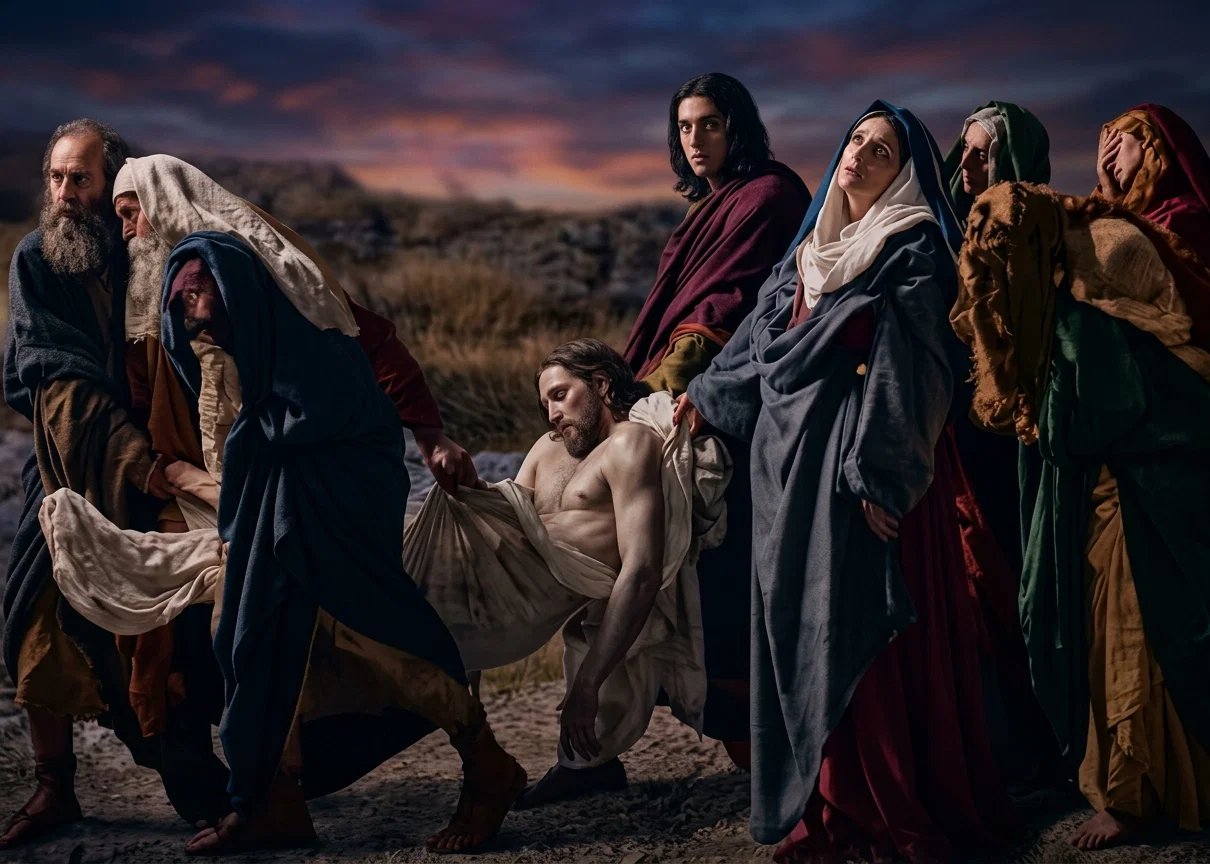
By Mrs. E. G. White
JESUS BORNE TO THE TOMB
His motive in service — He gave Himself for others. Through His sacrifice come all the blessings of Heaven to humanity.
JESUS BORNE TO THE TOMB His motive in service — He gave Himself for others. Through His sacrifice come all the blessings of Heaven to humanity.
God so loved the world, that He gave His only begotten Son, that whosoever believeth in Him should not perish, but have everlasting life." Jehovah did not deem the plan of salvation complete while invested only with His love. He has placed at His altar an Advocate clothed in our nature. As our intercessor, Christ's office work is to introduce us to God as His sons and daughters. He intercedes in behalf of those who receive Him. With His own blood He has paid their ransom. By virtue of His merits, He gives them power to become members of the royal family, children of the heavenly King. And the Father demonstrates His infinite love for Christ by receiving and welcoming Christ's friends as His friends. He is satisfied with the atonement made. He is glorified by the incarnation, death, and mediation of His Son.
In Christ's name our petitions ascend to the Father. He intercedes in our behalf, and the Father lays open all the treasures of His grace for our appropriation, for us to enjoy and to impart to others. "Ask in My name," Christ says; "I do not say that I will pray the Father for you; for the Father Himself loveth you. Make use of My name. This will give your prayers efficiency, and the Father will give you the riches of His grace. Wherefore ask, and ye shall receive, that your joy may be full."
Christ is the connecting link between God and man. He has promised His personal intercession. He places the whole virtue of His righteousness on the side of the suppliant. He pleads for man; and man, in need of divine help, pleads for himself in the presence of God, using the influence of the One who gave His life for the life of the world. As we acknowledge before God our appreciation of Christ's merits, fragrance is given to our intercessions. As we approach God through the virtue of the Redeemer's merits, Christ places us close by His side, encircling us with His human arm, while with His divine arm He grasps the throne of the Infinite. He puts His merits, as sweet incense, in the censer in our hands, in order to encourage our petitions. He promises to hear and answer our supplications.
Yes, Christ has become the medium of prayer between man and God. He has also become the medium of blessing between God and man. He has united divinity with humanity. God's appointments and grants in our behalf are without limit. The throne of grace itself is occupied by One who permits us to call Him Father.
No sooner does the child of God approach the mercy-seat than he becomes the client of the great Advocate. At his first utterance of penitence and appeal for pardon, Christ espouses his case, and makes it His own, presenting the supplication before the Father as His own request.
God desires His obedient children to claim His blessing, and to come to Him with praise and thanksgiving. God is the Fountain of life and power. He can make the wilderness a fruitful field for the people that keep His commandments; for this is the glory of His name. He has done for His people that which should inspire every heart with thanksgiving, and it grieves Him that so little praise is offered.
If we would think of God as often as we have evidence of His care for us, we should keep Him ever in our thoughts, and should delight to talk of Him and to praise Him. We talk of temporal things because we have an interest in them. We talk of our friends because we love them; our joys and our sorrows are bound up with them. Yet we have infinitely greater reason to love God than to love our earthly friends, and it should be the most natural thing in the world to make Him first in all our thoughts, to talk of His goodness and tell of His power. The rich gifts He has bestowed upon us were not intended to absorb our thoughts and love so much that we should have nothing to give to God; they are to remind us constantly of Him, and to bind us in bonds of love and gratitude to our heavenly Benefactor. We dwell too near the lowlands of earth. Let us raise our eyes to the open door of the sanctuary above, where the light of the glory of God shines in the face of Jesus Christ, who "is able also to save them to the uttermost that come unto God by Him."
We must gather about the cross. Christ and Him crucified should be the theme of contemplation, of conversation, and of our most joyful emotion. We should keep in our thoughts every blessing we receive from God; and when we realize His great love, we should be willing to trust everything to the hand that was nailed to the cross for us. "For in Him dwelleth all the fulness of the Godhead bodily, and in Him ye are made full."

Poor, but Rich

A POOR, blind woman in Paris put twenty-seven francs into a plate at a missionary meeting. “You can not afford so much,” said one. “Yes, sir, I can,” she answered. On being pressed to explain, she said: “I am blind, and I said to my fellow-straw-workers, ‘How much money do you spend in a year for oil in your lamps when it is too dark to work nights?’ They replied, ‘Twenty-seven francs.’”
“So,” said the poor woman, “I found that I save so much in the year because I am blind and do not need a lamp, and I give it to shed light to the dark heathen lands.”

The Spirit World and a Future Life

By Prof. Geo. W. Rine

I. Life the Instinctive Hope of Humanity

DEAN SLATTERY, of Fairbault, Minn., recently wrote: “It is a significant fact that the peoples of the world have been born with the instinctive hope of life after death.” The fact is significant, but not in the least strange. Man, being the child of God, is the child of Life, for God is life. With God is the fountain of life (Ps. 36:9). And God in Christ is our life (Col. 3:4). God is Life, and Love, and Light. Hence, He created man, not for death, but that he might ever live and love and shine. “God is love;” hence, He created man not only for His own glory, but also for man’s everlasting happiness and good. Of course neither happiness nor any other blessing is conceivable apart from life. Inevitably, then, man was created unto life.
Deep down in man’s soul, therefore, is divinely implanted the inextinguishable love and hope of life—not temporal life only, but endless life. Hence it is as natural for the normal man to love life and to hope for life beyond this life as it is for grass to grow, for flowers to bloom, and for stars to shine. “All that a man hath will he give for his life,” said even man’s adversary. One who reads the ancient and modern documents of human experience must know that death has always been abhorrent, and a ceaseless life, the desire of desires. Men have lived on this planet for thousands of years. In the earth are found the records of old civilizations and ancient barbarism. These records attest the fact that all peoples ignorant of divine Revelation believed in immortality. Not infrequently such testimony consists in nothing more than the mute eloquence of ancient burying places. With the ashes of the dead are found crude vessels used as receptacles for food to satisfy the needs of the departed. Here we have the pathetic testimony that those remote peoples conceived the theory that their dead were, after all, not dead. Emerging from the shadows of the most distant past, the student finds in the record of historic times the unbroken tradition of a life surviving bodily death. Nothing is more certain than that there is in humanity an ineradicable instinct which reaches out with ardent hope toward life beyond life.

The Meaning of This Universal Hope

True it is that the unsophisticated human heart was never content to face death as an irrevocable ending. The shuddering dread of “going down into the pit” shows infallibly that all wish for endless life. The normal human heart comes back inevitably to the world-old cry, “I do not wish to stop with death. I long for life, life, life.”
This instinctive, irrepressible longing for existence beyond this fleeting life of three score years and ten, possesses a divine significance. It is a primal, God-given instinct. It is the expression of the original “enmity” that the Creator put between the serpent of (Satan) and the woman and between the seed of the former and that of the latter. Gen. 3:15. God’s instilling into the human heart this insistent craving for life was an act of transcendent mercy. Our heavenly Father, who yearns to save all men, knew that an implanted love of life would tend to constrain men to flee from death and its author and to seek life in and through its Author—to shun the devil and flee to Christ.
Tho, in the sovereign goodness of God, man was created for life with all the glory and happiness that life implies, yet death passed upon all men, since all have sinned. Rom. 5:12. But, praise the Lord, man is not irreclaimably lost to life. “God is love,” fathomless love. Hence, naturally, He so loved sinners that He gave His only begotten Son an atoning sacrifice for human sin, in order that whosoever believeth on Him should not perish (die), but have everlasting life. Accordingly, we have the supremely precious assurance, “He that hath the Son hath life.” 1 John 5:12.
Ah, dear reader, do you sometimes find yourself shuddering at the thought of endless death, and, conversely, do you find your heart instinctively reaching out after life—life eternal? Do you find the thought of extinction abhorrent; the thought of endless life irresistibly fascinating? Yes, you answer. Well, it is the Father drawing you to Christ—the only source of life for sinful man. Would you seek life? Then you must seek Jesus; for “he that hath not the Son of God hath not life.” 1 John 5:12. Again, Jesus Himself declared, “He that believeth on the Son hath everlasting life: and he that believeth not the Son shall not see life.” John 3:36. Then, assuredly, if you yearn for the life that knows no end, and if you believe the testimony of God, you will love Jesus; and, loving Him, you will trust Him for the realization of the timeless life you crave.

This Instinctive Hope Perverted

The vast majority of men, either because they knew not God, or because, in their pride and self-worship, they refused to believe God’s testimony, have construed this universal love of life to mean that man possesses an inherent deathless principle—an immortal soul. They reasoned thus: God placed within man an instinctive craving for endless life. God being infinitely good could not fail to provide for the satisfying of this universal craving; therefore, He must have endowed man with a deathless personality called the soul or spirit. Hence, according to this dogma the human consciousness or soul survives the death of the material body.
More and more, however, men are coming to see that this hypothesis has absolutely no warrant in the word of God. In truth, it is in absolute conflict with the plain, positive teaching of Holy Writ. The Holy Spirit expressly characterizes man, in his present state, as mortal. Job 4:17; 1 Cor. 15:53, 54. The same divine Witness testifies in the clearest possible terms that God ONLY has immortality. 1 Tim. 6:15, 16. In words that can not be misunderstood, the Spirit of truth declares that life and immortality have been brought to light through the Gospel. 2 Tim. 1:10. Again, the infallible Witness categorically asserts that believers, by patient continuance in well-doing, seek for immortality. Rom. 2:7. If immortality inheres in man, as is commonly taught, these divine testimonies can not be true. Whom shall we believe, dear reader, pagan philosophers or inspired prophets—man or God?
Many earnest, sincere people do not seem to be aware that the devil, whom Jesus has branded as the father of lies, was the first to enunciate the doctrine that man can not die and is therefore immortal. See Gen. 3:4. Every pagan Religion the world has ever known has held and taught the dogma of human immortality as fundamental. And has not every pagan or false religion been fathered and fostered by Satan, the author of all error? The prince of darkness first erected the abominable mythology of ancient Egypt upon this pet lie of his—human immortality. From the blackness of Egypt this diabolic dogma made its way to Babylon, Assyria, Persia, Greece, and Rome, and became the basic principle of the horridly grotesque systems of mythology peculiar to all those heathen peoples.
Through the agency of the so-called church fathers, who, in the early centuries of the Christian era, were proselytes from the paganism of Greece and Rome, this same dark doctrine wormed its way into the nominal Christian system. Once having infected the Christian church, it contributed no inconsiderable part to the evolution of that great system of apostasy known as the Papacy. The doctrine soon bore its baleful fruit, in the complete outflowering of such gruesome superstitions as belief in purgatory, Mariolatry, the worship of, and prayers for and to, dead saints. The great lay membership of the church being wholly barred from the study of the Scriptures for centuries, soon became completely inoculated with the satanic delusion of human immortality. Coming down to us from the Dark Ages, this world-old falsehood still clings relentlessly to the vast majority of Christian bodies.

Physical Science versus Immortality

As a result of the marvelous discoveries made in the several fields of physical science during the nineteenth century the intellectual fashion became essentially materialistic, and therefore skeptical. Professor Wundt, of Germany, Professor Carpenter, of England, and Professors James and Ladd, of America, succeeded in completely discrediting the old or traditional psychology based upon the assumption that all mental life was simply the expression of the various energies of an indestructible, ethereal principle within man, named the soul. The above-named investigators, by the inductive or experimental method of research, elaborated a “new” psychology, ineradicably rooted in the tissue of the brain and other parts of the nervous organism. They proved incontestably that all mental phenomena are manifestations of nerve or brain energy, and thattherefore, without brain there can be no intellect. Hence, the new psychology is appropriately styled “physiological psychology.” Hence, psychology is no longer studied from the view-point of vapory Neoplatonism, but from that of the immovable rock of demonstrable science. This momentous achievement has naturally dealt an irreparable blow to the immortality hypothesis.
That the immortal-soul dogma is hopelessly incompatible with true psychology has been verified again and again. Note the following argument from the writings of the late eminent thinker, Mr. John Fiske:
“Injuries to the nervous structure entail failure of function, either in the mental operations themselves or in the control which they exercise over the actions of the body; there is either psychical aberration, or loss of consciousness, or muscular paralysis. At the moment of death, as soon as the current of arterial blood ceases to flow through the cerebral vessels, all signs of consciousness cease for the looker-on; and after the nervous system has been resolved into its elements, what reason have we to suppose that consciousness survives, any more than that the wetness of water should survive its separation into oxygen and hydrogen? So far as our terrestrial experience goes there can be but one answer to such a question. We have no more warrant in experience for supposing consciousness to exist without a nervous system than we have for supposing the properties of water to exist in a world destitute of hydrogen and oxygen.”

“Are the Dead Alive?”

This question, of course, is logically absurd, contradictory, stultifying. Yet, preposterous as the question is, it was made to do duty as the caption of a series of articles which recently ran through at least five numbers of the Delineator. The writer of those articles appealed for his answer to the question, to the results of the investigations into the phenomena of modern Spiritism, conducted by the Society for Psychical Research, during the past twenty years. What the above-named society has accomplished in its efforts, through the phenomena of Spiritism, to answer the vexed (?) question of life after death, I shall set forth in a later article of this series.
Are the dead alive? Now, my dear reader, why should you and I not answer this momentous question right here and now, once and forever, by an appeal to the inspired testimony of Holy Writ. Why can we not accept God’s answer to the question? Can He be mistaken? He made man, and hence “knoweth our frame” (how we are constituted). As for me I am going to accept the answer of man’s all-wise Creator. Will you?

God’s Definite, Clear-Cut Answer

Through His servant Solomon, God bears this unmistakable testimony: “For to him that is joined to all the living there is hope: for a living dog is better than a dead lion. For the living know that they shall die: BUT THE DEAD KNOW NOT ANYTHING. . . . Also their LOVE and their HATRED, and their ENVY is now PERISHED.” Does the human consciousness survive the death of the body if, as God declares, “the dead know not anything”? Are not love, hatred, and envy attributes of mind? God tells us that these attributes perish. Most assuredly, then, the mind perishes at death. Eccl. 9:4-6. See also verse 10, where it is explicitly stated that there is no work, nor device, nor wisdom in the place where the dead go.
Note further what God has said through David respecting the condition of the dead: “Put not your trust in princes, nor in the son of man, in whom there is no help.” Why? Answer: “His breath goeth forth, he returneth to his earth; in that very day his THOUGHTS PERISH.” No mist or ambiguity here, is there? God never leaves any doubt as to what He means when He bears testimony. Again, in Ps. 6:5 and Ps. 115:17 and in Isa. 38:18, 19, it is declared that the dead can not render thanks to God, can not praise or celebrate Him. Only “the living, the living, he shall praise Thee, as I do this day,” exclaimed the inspired Hezekiah. (Read chapter 38 of Isaiah.)
[Note.—In the next article I shall set forth the method by which God promises to satisfy the craving of His trusting children for everlasting life.—G. W. R.]

How to Behave

THE apostle Paul was quite anxious that his son in the faith, Timothy, should know how to behave himself, and thus he writes to him: “These things write I unto thee, hoping to come unto thee shortly: but if I tarry long, that thou mayest know how thou oughtest to behave thyself in the house of God, which is the church of the living God, the pillar and ground of the truth.” 1 Tim. 3: 14, 15.
The apostle makes it quite plain that it was not simply the meeting-house that he meant by “the house of God.” Every true follower of Jesus is a member of the church of the living God whose names are written above. As long as a person claims to follow Christ, just so long is he in the house of God, all the time, and everywhere. Hence, the apostle’s instruction is always applicable to every Christian.
Let us now consider some of the rules of behavior that the inspired Word has laid down for us:
1. Jesus kept His Father’s commandments, and thus abode in His Father’s love. Hence we have this rule, if we would abide in the love of God we will do as He did.
2. Jesus taught that if a brother trespass against us, we should go and tell it, not to a single soul, but to the offending brother only. This should always be the first step toward reconciliation, and generally this step, rightly taken, will heal the wound completely. If this is not effectual, the next step is to take two or three with you; and if that fails, as a last resort, tell it to the church. Christian reader, is this the way you behave in the house of God?
3. Hold fast faith and a good conscience; never make shipwreck of either.
4. Pray for “all men,” especially for “all that are in authority, that we may lead a quiet and peaceable life in all godliness and honesty.”
5. “I will therefore that men pray everywhere, lifting up holy hands, without wrath and doubting.”
6. Women should be adorned, not with gold, pearls, or costly array, but with good works, and a meek and quiet spirit.
7. Bishops [overseers, elders] should be blameless, vigilant, sober, hospitable, patient, apt to teach, ruling well their own houses.
8. “Exercise thyself rather unto godliness.” Bodily exercise is good, but godliness is far better, “having promise of the life that now is, and of that which is to come.”
9. Neglect not the gifts or talents that you have, but give yourself wholly to growing up into Christ in all things.
10. Be an example to the church in word, in conversation, in charity, in spirit, in faith, in purity. Then you will save yourself, and gather others to the fold.
H. A. ST. JOHN.

I May Not Know

It may be I shall never know What Jesus has in store for me, What trials are the glassy sea Shall on my ransomed vision glow.
But I will lay in His my hand, And day by day in Him abide, And know that one day by His side Upon that sea of glass I'll stand.
MAX HILL.

How to Obtain the Spirit

IT must be sought by fervent, believing prayer. Christ says, “If ye then, being evil, know how to give good gifts to your children, how much more shall your heavenly Father give the Holy Spirit to them that ask it!” Does any one say, I have prayed for it, and it does not come? It is because you do not pray aright. “Ye ask and receive not, because ye ask amiss, that ye may consume it upon your lusts.” You do not pray from right motives.
A professor of religion, and a principal member in a church, once asked a minister what he thought of his case: he had been praying week after week for the Spirit, and had not found any benefit. The minister asked him what his motive was in praying. He said he wanted to be happy. He knew those who had the Spirit were happy, and he wanted to enjoy his mind as they did. Why, the devil himself might pray so. That is mere selfishness.
The man turned away in anger. He finally saw that he had never known what it was to pray. He was convinced he was a hypocrite, and that his prayers were all selfish, dictated only by a desire for his own happiness. This man saw clearly where he had been in error, and he was converted. Perhaps many here have been just so. You ought to examine and see if all your prayers are not selfish.
David prayed that God would uphold him by His free Spirit, that he might teach transgressors and turn sinners to God. A Christian should pray for the Spirit, that he may be the more useful and glorify God more; not that he himself may be more happy.—Charles G. Finney.

Pride in Learning

To be proud of learning is the greatest ignorance.—Bishop Taylor.
Continue reading: The Great Threefold Message