THE word "gospel" means good tidings; and it is to be regretted that it has not been so translated in all our English versions. But that is what it means to the poor sin-sick souls of earth—good tidings. Said the angel at Christ's first advent: "Behold, I bring you good tidings of great joy, which shall be to all the people; for there is born to you this day in the city of David a Saviour, who is Christ the Lord." Luke 2:10, 11.
By this it is not meant that "the good tidings" here first came to man. Away back in the Garden of Eden, where man fell, the word came that the Seed should come who would bruise the destroyer's head and deliver those whom Satan had bound and shut up in the prison-house of sin. Gen. 3:15. The same precious promises stand out, amplified and enlarged in the history of Abraham. Gen. 12:2, 3; 15:4-6; Gal. 3:7, 8. The promises to Israel embraced the same good tidings. Heb. 4:2. Every lamb and kid and goat and bullock offered thru all the ages prior to the angel's visit, contained in it, to the child of faith, the promise and testimony of the good tidings. Isaiah is luminant with the Gospel. From "tho your sins be as scarlet, they shall be as white as snow," to "look unto Me, and be ye saved, all the ends of the earth," the whole book is vibrant with Gospel life.
The words of the angel quoted from Luke 2:10, 11, simply mark a great advanced step in God's fulfilment of promise and type, and demonstrate that what God has said He will perform. Just before the second advent of our Lord, there still goes forth to the world, backed by His mighty angel, "the everlasting Gospel,"—the age-lasting good tidings,—God's message for all the ages.
What Is The Gospel?
Let the apostle Paul answer: "For I am not ashamed of the Gospel: for it is the power of God unto salvation to every one that believeth; to the Jew first, and also to the Greek. For therein is revealed a righteousness of God from faith unto faith: as it is written, But the righteous shall live by faith." Rom. 1:16, 17.
The blessedness of the good tidings is not that man is not a sinner, is not that there is salvation for him in himself, is not that he is not a fallen creature, but one lacking growth and development. The Gospel tells no such delusive story. Man knows that he is a sinner. God's Spirit has pierced him with the darts of the law. He is "without strength." He has demonstrated that in his own moral failures. He loves sin and is in bondage to the flesh. The history of his own life is the demonstration of its truth. And what is true in him is true in all the race; for "all have sinned, and come short of the glory of God." Rom. 3:23. All are subject to death; for "the wages of sin is death." Rom. 6:23. Aroused by conviction, the sinner longs to do good, and fails. "To will is present with me; but how to perform that which is good I find not. For the good that I would I do not; but the evil which I would not, that I do." Rom. 7:18, 19.
Such is man's condition by nature. Such God's law reveals, pressed home upon the heart by the Spirit. It is no flattering picture which the Spirit draws. The Gospel of God is the message of the true Physician that our case is hopeless; that the disease is fatal; that not only is man unable to save himself; but "none of them can by any means redeem his brother, nor give to God a ransom for him;" that he is "separate from Christ, alienated from the commonwealth of Israel, and strangers from the covenants of the promise, having no hope and without God in the world;" that, not having righteousness, he is "alienated from the life of God." Ps. 49:7; Eph. 2:12; 4:18. And such is all mankind.
Its Power and Purpose.
But not there does the God of love leave the race; "for God so loved the world, that He gave His only-begotten Son, that whosoever believeth in Him should not perish, but have everlasting life." The Father and the Son "gave Himself for us, that He might redeem us from all iniquity, and purify unto Himself a peculiar people, zealous of good works" (Titus 2:14). "Thou shalt call His name JESUS," said the angel; "for He shall save His people from their sins." Matt. 1:21.
That is the purpose of the Gospel—to save men from sin, from sinning, from all the consequences of sin; and that it will do to every one who believes from faith to faith. In that wonderful fact lies the good tidings to lost and sinful men.
If the Gospel saves from sin, it must save to righteousness; and the only righteousness which is acceptable in God's sight is God's righteousness. That righteousness, wrought out by the obedience of Christ, God bestows upon the believer. Rom. 5:19. God counts the believing sinner as tho he had never sinned. "But to him that worketh not, but believeth on Him that justifieth the ungodly, his faith is reckoned for righteousness. . . . . Blessed are they whose iniquities are forgiven, and whose sins are covered. Blessed is the man to whom the Lord will not reckon sin." Rom. 4:5-8.
God's law condemns sin that it may be put away; and when God forgives that sin—the transgression of the law—it is done in harmony with the law. This is evident from the fact that the righteousness which God brings to us thru the Gospel by faith is the same righteousness which the law demands, for to that law the Gospel bears witness. "But now the righteousness of God without the law is manifested, being witnessed by the law and the prophets; even the righteousness of God, which is by faith of Jesus Christ unto all and upon all them that believe; for there is no difference." Rom. 3:21, 22. "The law entered, that the offense might abound. But where sin abounded, grace did much more abound." Rom. 5:20. The abounding grace of God covers every confessed sin, cleanses every acknowledged stain, washes the crimson sin white, bleaches as snow the scarlet heart.
But Christ is not "the minister of sin." God does more than this. He puts His Spirit, His life, His own creative power into the heart of the child of faith, so that in that child may be fulfilled "the righteousness of the law." Rom. 8:4. Thus saith Jehovah: "A new heart also will I give you, and a new Spirit will I put within you; and I will take away the stony heart out of your flesh, and I will give you a heart of flesh. And I will6put My Spirit within you, and cause you to walk in My statutes, and ye shall keep My judgments, and do them."
And to the above the following bear witness: 'If any man be in Christ, he is a new creature; old things are passed away; behold, all things are become new.' 2 Cor. 5:17. The creative power of God in the Gospel has not changed God nor changed His requirements, but has made of man a new creature. The old sin and sinning is gone. The new life of righteousness begins. The Spirit of God gives him new power; for 'the Spirit is life because of righteousness.' Rom. 8:10. And thus is developed by creative power in the Gospel the saints who 'keep the commandments of God, and the faith of Jesus.' Rev. 14:12.
Beyond lies the glorious eternal country of God, where His life shall bloom in eternal characters of immortality, saved by grace, but children of loving obedience forever. This is God's good tidings which saves men from sin and death to righteousness and eternal life. Brother, have you heard the good tidings? Do you know the saving power of the Master? If not, why not? He invites you freely to come.
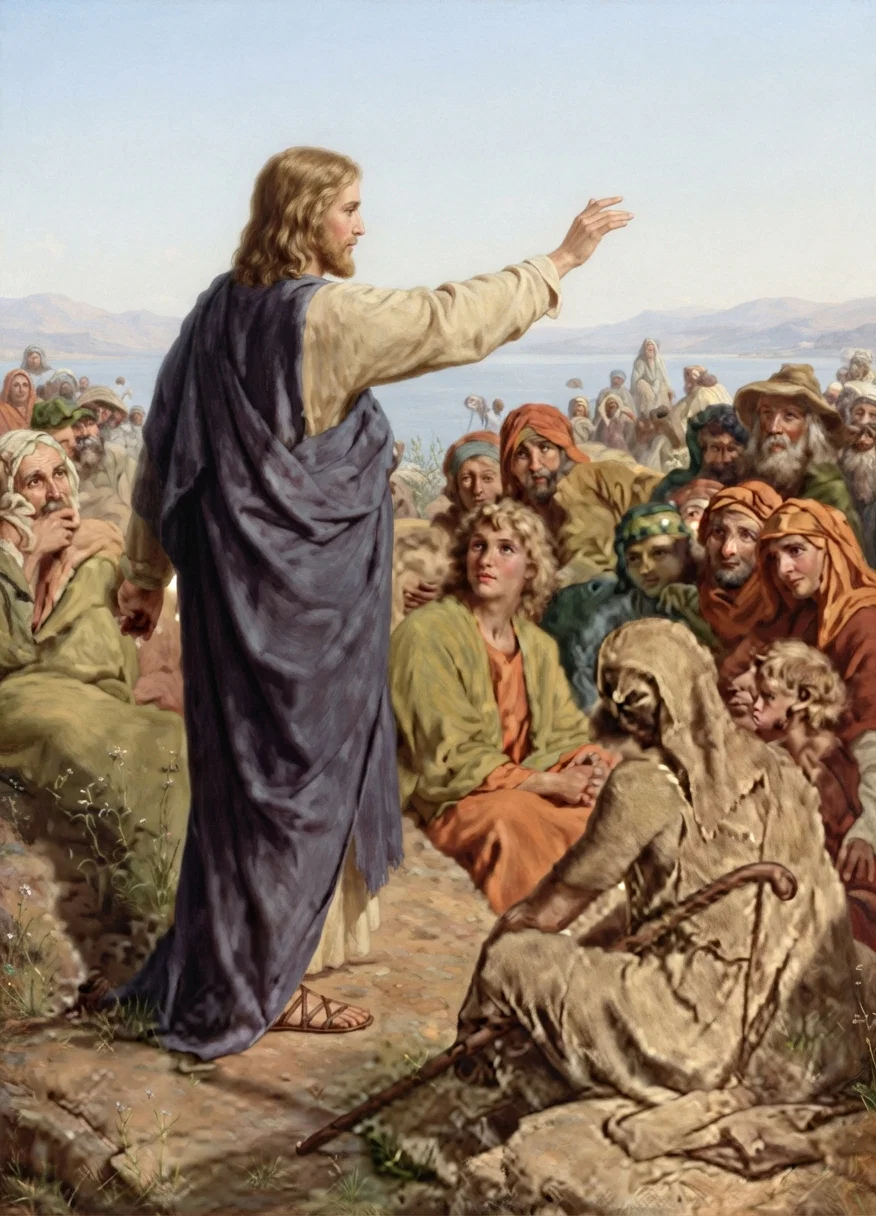
Hofmann The Sermon on the Mount
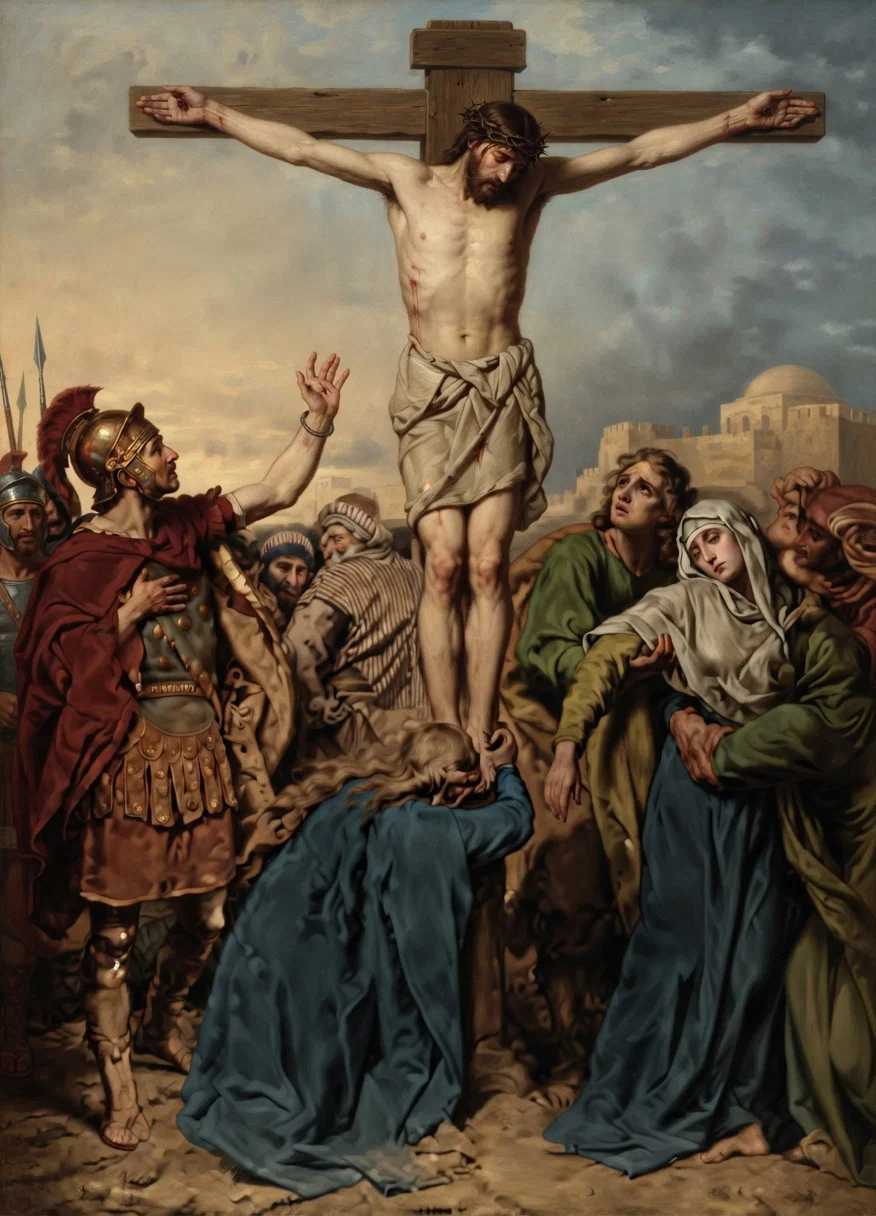
The Crucifixion. Hofmann
The Perfection of the Law
By T. H. Starbuck
By T. H. Starbuck
"The law of the Lord is perfect, converting the soul." Ps. 19: 7.
THE divine perfection of the law of Jehovah is far beyond the power of the finite intellect to comprehend. "God is love," and His great and wonderful love is revealed in His government of all rational beings by moral law. The Creator of worlds would have all His intelligent creatures to be sinless, and to reflect in their lives His divine perfections so far as they are capable. For this purpose He mirrored His perfections and attributes in the form of moral law for the government of His creatures, that obedience to it might insure peace, love, and righteousness thruout His illimitable dominions. The felicities of heaven can be secured only by perfect obedience to a perfect law.
But God's law can not be perfect unless it embodies all the divine perfections of His character. It must reflect every characteristic of the Godhead. It would have to embody every moral principle, and be universal in its adaptations, naturally fitted for the moral government of all morally accountable beings. That it is of this character is proved from the nature of God as revealed in His word. Its Author is the same yesterday, to-day, and forever. He is universally and eternally the same being, which would necessarily make His moral rule the same in all worlds. If the intelligent beings of one world are made subject to one moral code, and those of another world to a different code, the two codes would not agree, and could not manifest in their respective subjects the perfect character of the same God. He could not exercise one kind of moral government in one world, and another kind in another world, for that would make Him inconsistent with Himself, and show Him to be imperfect as a moral governor.
A perfect moral law can not be limited in its adaptations or jurisdiction. Two perfect moral codes are an impossibility. The inhabitants of this world, and the different orders of angels in heaven, are subject to the same moral principles. This becomes apparent when the true nature of sin is fully understood. Sin is the transgression of the law—the same law which Inspiration says is perfect. But sin originated with Satan in heaven long before this world existed.
Then the sin of the fallen angels was the transgression of the moral law, which proves that they were amenable to it before man was created.
This is obvious from another consideration—whatever evil disposition was in Satan after his fall was the same which he instilled into man's nature when he led him to disobey God in Eden, for he could not impart to man a disposition which he did not possess himself. As the trend of character which he imparted to man was a disposition to violate the moral law, it is clear that he had transgressed that law long before in heaven, for the evil nature is obtained only thru disobedience. But it would be impossible for him to transgress a law to which he was not amenable.
From such considerations it necessarily follows that all intelligences in heaven and earth are amenable to the same moral law. It might here be objected that angels are not amenable to the seventh commandment, because the marriage relation does not exist among them; but there is nothing here to militate against the absolute perfection of the law. If there is a moral relation among men that does not exist among angels, they are not subject to that moral principle, while men are. The law is broad enough in its scope to cover the moral relations of all created intelligences. If it were not, it would not be perfect. If, in certain conditions of life, the moral relations of the creatures do not cover all the moral principles embraced in God's perfect law, then such beings are not under the jurisdiction of that part of the law not contained in their relations to each other. God is infinite in His ways, and adapts His moral government to the nature and requirements of His creatures in any state of existence.
Christ's Invitation to the Heavy Laden.
By Ellen G. White
By Mrs. E. G. White.
"COME unto Me, all ye that labor and are heavy laden, and I will give you rest. Take My yoke upon you, and learn of Me; for I am meek and lowly in heart; and ye shall find rest unto your souls. For My yoke is easy, and My burden is light." In these words Christ invites all the weary and heavy laden to come to Him and find rest. It is thru Jesus alone that we can find peace and happiness, and yet men seek to find rest and satisfaction in almost everything except in Christ. All we enjoy in this life is provided for us thru His merit and love, and we only can have hope of heaven thru faith in His name.
Jesus sees the great mass of mankind seeking after happiness in vain, and He would turn men's attention to Himself, away from the false hopes and delusive joys of the world; He would have them place their affections upon Him, their mighty Helper and Deliverer.
Jesus invites all the weary and heavy laden to come to Him. There is no one excluded from the school of Christ, no one debarred from the privilege of learning the precious lessons He would teach His followers. But, notwithstanding the fact that Christ has promised rest to all who are heavy laden, how many of us cling to our griefs, and will not part with our sorrows, and refuse the comfort and hope He assures to those who will come to Him. The condition upon which we shall find rest to our souls is in coming and in taking upon us the yoke of Christ, and in learning of Him who is meek and lowly of heart. He says, "Take My yoke upon you, and learn of Me; . . . and ye shall find rest unto your souls. For My yoke is easy, and My burden is light."
But, instead of taking the yoke of Christ, how many bind upon their souls a galling yoke, a grievous burden. Many wear a load of care; worldly perplexities are accepted, worldly customs are followed, worldly fashions practised, and their character is marred, their life made a weariness. Jesus would have them lay aside this yoke of bondage, and take upon them His yoke of love, that they may learn to be meek and lowly in heart. The weakest soul, wearing Christ's yoke, bearing His burden, may become strong in His grace, and he will find the yoke easy, the burden light.
The greatest Teacher the world has ever known, says, "Learn of Me; for I am meek and lowly in heart; and ye shall find rest unto your souls." The pain, the sorrow, the unrest, the disappointment, that comes into every life, are evidences that there is no rest outside of Christ. Jesus has redeemed us to Himself; we are His property, and He desires us to learn the path of peace and joy by learning to obey the law of God, the rule of His kingdom. All the suffering and distress of this wo-stricken life is the result of disobedience to the law of God, of refusing to come to Christ, that meekness and lowliness of heart may be learned of the great Teacher. If men would come to Christ and learn His meekness and lowliness, they7would not refuse to render obedience to the law of God. But they forsake the Fountain of living water, and hew out for themselves cisterns, broken cisterns, that can hold no water.
But Christ is able to do all that He has promised to do for the sin-sick soul. Those who have an experimental knowledge of Christ can testify to His faithfulness and truth. We may have an appreciation of our sinfulness, and realize that we are full of uncleanness, but as the light of heaven reveals the heart's depravity, we should not become discouraged, for there is help in Jesus for the vilest sinner. The promises of God are for all who will accept them, and Jesus says, Come, and I will give you rest. He does not say, Come, and perhaps I will give you rest, but the promise is positive, "Ye shall find rest." As we take His yoke, and learn of Him, we find sweet solace in His promises, and our hope of eternal life grows stronger and brighter.
I have seen persons in trouble, who, instead of looking to Jesus, kept looking at their trouble, kept talking of their discouragements, and kept dwelling upon their trials. Why did they not comply with the invitation of Jesus? Why did they not come to Him? It was because they had a divided heart; but God wants the whole heart. When we are in trial and sadness, we must look to Jesus. We must take our sorrow to the Lord in prayer; for He has said, "Ask, and it shall be given you; seek, and ye shall find; knock, and it shall be opened unto you." Why is it that we do not comply with the conditions upon which the promises are based? We have a precious Saviour, and He knows our trials before we present them before Him. He loves us with a love that is infinite, and He will do for us all that He has promised to do. We need not walk in darkness. We need not go on in uncertainty. We are willing to believe what our friends tell us, then why not believe the word of our best Friend? Why not take God at His word? Why not "come" and find rest unto our souls, according to the invitation and promise of Jesus?
What the Protestant Episcopal Church Declares.
(From the Thirty-nine Articles.)
"Holy Scripture containeth all things necessary to salvation; so that whatsoever is not read therein, nor may be proved thereby, is not to be required of any man, that it should be believed as an article of the faith, or be thought requisite or necessary to salvation."—Article 6.
"No Christian man whatsoever is free from the obedience of the commandments which are called moral."—Article 7.
The Law Is Written.
By Editor
[From editorial in the Women's National Daily, March 5, 1907]
THERE is no unwritten law. The law of all laws was written on tables of stone and given to man from the Fount of all wisdom. It was the law then, and it is the law now, and it will be the law thru all time. Conditions may change with the on-sweep of the years, and man may evolve new schools of thought. But the supreme law stands because it is founded in eternal truth and born of the Spirit of Love universal. Man may not, dare not, change that law in any one of its ten parts, without bringing disaster upon the world. Wicked men, and weak, have almost from the time the Ten Commandments were made known to man, rebelled against some of their restrictions, and have sought to change them, but always failure has attended such efforts. There have been periods in the world's8
The Written Law.
(Continued from Page 7.)
history when it seemed that some or even all of these commandments had been set at naught by the powers of evil, and that man-made laws, evolved out of evil, had superseded them; but always the pendulum has swung back, even farther toward the side of righteousness, and always after these periods of darkness, these dark ages of the minds and the souls of man, the world has been better than before them.
The Perpetuity of the Law
By J. H. Rogers
By J. H. Rogers
"The works of His hands are verity and judgment; all His commandments are sure. They stand fast forever and ever, and are done in truth and righteousness." Ps. 111: 7, 8.
IT is not simply for the consciousness of being in agreement with all of our Biblical expositors and reformers of evangelical Christianity that I would vindicate the claim for the perpetuity of the Decalogue, or Ten Commandments; but the word of the Lord which liveth and abideth forever is a sure foundation for us if all the world were on the antinomian side of this question. He that said it is "easier for heaven and earth to pass, than one tittle of the law to fail," guards against even thinking that He had "come to destroy the law or the prophets."
Doctor Scott, in his comments on Matthew 5, says, "As long as the world endured, not the least word or letter or point or comma of the whole law should lose its authority or fail. . . . The moral law, till the end of time, would continue to be the standard of sin and holiness to all men, and the believer's rule of duty." Now it is clear this is in harmony with the teaching of Jesus. When asked which was the great commandment in the law, He answered, "Thou shalt love the Lord thy God with all thy heart, and with all thy soul, and with all thy mind," and "thy neighbor as thyself," then concludes by saying, "On these two commandments hang all the law and the prophets."
These two great principles are the standard to determine our love to God and man. If we love God with all our heart and soul, we will not violate one of these precepts that relate to our duty to Him, found in the first table; and so if we love our neighbor as ourself, we will keep inviolate all those commands regulating our duty to Him.
Thus we see the Ten Commandments are immutable in the very nature of things and perpetual in their force of binding obligation; for they came into existence by reason of those relations existing between ourselves and God, and also with one another.
That the principles of the Ten Commandments were in existence and understood in the earlier period of our world's history is manifest, for example, in the case of Cain killing Abel, the licentiousness of the Sodomites, the sin of false gods, that of dishonoring parents, stealing, lying, and even desecrating the Sabbath, all before the giving of the law at Sinai.
So the violation of those principles was understood to be sin, all the way thru the history of the world, for sin is the transgression of the law; and "where there is no law, there is no transgression," or sin. Rom. 4: 15.
It is said of Abraham that he will command his children after him to keep the way of the Lord. Gen. 18: 19.
We find it to be the general consensus and sentiment of all our most learned and Biblical expositors, that the Decalogue, or Ten Commandments, was the eternal, unchangeable and universal law of God, and that all the evangelistic workers and writers till recent years have taken the unvarying course, claiming the perpetuity of the moral law. So that this sentiment is incorporated in, and runs like, a silver thread thru all the catechisms, confessions of faith, disciplines, and church manuals of all denominations in Christendom.
Now permit me, in all kindness, to submit that no other view would have been invented or resorted to but for the fact that one or two Christian bodies in building on the faith of our predecessors, as regards the Decalogue, are urging the obedience of the fourth commandment, which says, "The seventh day is the Sabbath of the Lord thy God," not of the Jews but of the Lord—not has been, but is now, and for all time. It points back to creation for its origin and the reason for its being established—a memorial of God in His creative work and final redemption. For in the new earth state of the redeemed, all shall come from Sabbath to Sabbath to worship the Lord (see Isa. 66: 23), and to eat the fruit of the tree of life, and drink of the river of life. Rev. 22: 1, 2.
So let us come back to the former landmarks established on the "foundation of the apostles and prophets, Jesus Christ the chief Corner-stone." Every evangelical reform has pointed to apostolic faith and practise, exposing the traditions and doctrines of men as innovations leading away from God's word and will. And, last tho not least in importance, a reform is going forward, calling the attention of all to the "commandments of God, and the faith of Jesus." Rev. 14: 9-12. This message is finding its way to every nation, kindred, and people to prepare them for the soon-coming King in glory.
Los Angeles, Calif.
What the Methodist Episcopal Church Teaches.
(From Catechism No. 2. Articles 5 and 6 are substantially the same.)
"86. What is the rule of our obedience?"
"The moral law. 'If thou wilt enter into life, keep the commandments.' Matt. 19: 17."
"It was not the design of Christ to revoke any part of the law. It can not be broken. Every part of it remains in force upon all men in all ages. Neither time, place, nor circumstances make it liable to change."
Christ the Truth.
SUCH Jesus declares Himself to be. "I am the Way, the Truth, and the Life." John 14:6. We will not attempt to define truth; for our readers understand the word as well as they would its definition. Let this be said that truth is harmonious and consistent with itself. Every part of truth is in harmony with every other part. There is no dissonance nor discord.
Truth is from God, the Author or Fountain of all truth. He is called a "God of truth" (Isa. 65:16); His word is declared to be truth (John 17:17); "He keepeth truth forever;" His "law is the truth;" the Gospel is the Gospel of truth. Such terms might be multiplied indefinitely. As God is said to be love and light, so He is truth, and "in Him is no lie." And as Christ came to manifest forth the Father to the world, and as it pleased the Father that in Him should all fulness dwell, therefore truth dwelt in Him, and He could very properly say, "I am the truth." Truth is personified to the world in Him.
The word of God is the truth (John 17:17), because it came thru Him. It was the Spirit of Christ which spake thru the apostles (1 Cor. 2:13; John 16:13, 14; Acts 1:2, 3); the prophets also spake by the same Spirit (1 Peter 1:10, 11). So also Christ is called the Word, because it all came thru Him. John 1:1-3. In fact, all that has been revealed to man of the greatness, majesty, and goodness of the Godhead has been revealed thru Christ. See 1 Cor. 8:6.
When the Bible says God's word is truth, it makes no exception. The Scriptures are "the Scriptures of truth." That truth is to sanctify and keep those who receive it. John 17:17; 2 Thess. 2:10-12; Ps. 91:4. Peter says in one place (1 Peter 1:22) that we are purified by obeying the truth, and in another (Acts 15:9), that we are purified by faith, both of which are the same thing, for the truth is God's word, and faith is based on God's word (Rom. 10:17); and this word is the light of God (Ps. 119:105; Prov. 6:23).
But it is needless to multiply these statements; the word of God abounds in them. The word, the truth, the light of God, are all one and the same, and all find their center in Christ, who of God is made unto us all that we need. That word, therefore, partakes of His power and life (John 6:63), and effectually works in the lives of all those who receive it as the word of God (2 Thess. 2:13).
It is thus with every word or ray of God's truth or light. If received into the heart as the word of God, and followed with honest, earnest desire, it will lead to Christ, even as every solar ray leads back to the sun, even as every nerve-fiber leads back to the brain. The words of Christ being Spirit and life, and the word of God being His words, therefore, every word given of God is truth and Spirit and life. There is therefore salvation in every word of Christ, in the smallest part of His truth if we do not detach it; for if we "follow on," we shall find Him the central Sun, the Author of truth, the Light of the world. Jesus touched sinking Peter with His hand, and he was saved as truly as tho he had been clasped in His arms. The afflicted woman touched only the hem of His garment and was made whole just as much as tho she had grasped her Redeemer with both hands. Such is God's truth.
The way that He saves is therefore the way of truth. Jesus does not save irrespective of truth, but by the truth. His way is "the way of holiness;" it is also the "holiness of truth." He who ignores Christ ignores the way. He who thinks he has the way regardless of what the truth may teach, does not know the way, does not know Christ. Christ is the true and only Way; He is the way of truth and He would have those who worship Him, worship in spirit and truth. Reader, in rejecting God's truth, you are thus rejecting Him who is the Truth.
The Gospel: What It Is; and What It Is For.
By Ellet Joseph Waggoner
THE apostle Paul tells in plain language just what the Gospel is, so that we need not make any mistake concerning it. He says:
"I am not ashamed of the Gospel; for it is the power of God unto salvation to every one that believeth; to the Jew first, and also to the Greek. "For therein is revealed a righteousness of God from faith unto faith; as it is written, But the righteous shall live by faith." Rom. 1: 16, 17.
The Gospel is God's power unto salvation to every one that believeth. Such is the plain statement of the text. No argument or reasoning or anything of the kind is needed. The text itself makes it plain that God's Gospel is power; and, furthermore, it is power that is strong enough to bring salvation from sin. The depth of the sin from which this Gospel is able to deliver is made plain in the verses that immediately follow the foregoing quotation. They read:
"For the wrath of God is revealed from heaven against all ungodliness and unrighteousness of men, who hinder the truth in unrighteousness; because that which is known of God is manifest in them; for God manifested it unto them. For the invisible things of Him since the creation of the world are clearly seen, being perceived thru the things that are made, even His everlasting power and divinity; that they may be without excuse; because that, knowing God, they glorified Him not as God, neither gave thanks; but became vain in their reasonings, and their senseless heart was darkened. Professing themselves to be wise, they became fools, and changed the glory of the incorruptible God for the likeness of an image of corruptible man, and of birds, and four-footed beasts, and creeping things. "Wherefore God gave them up in the lust of their hearts unto uncleanness, that their bodies should be dishonored among themselves; for that they exchanged the truth of God for a lie, and worshiped and served the creature rather than the Creator, who is blessed forever. Amen." "And even as they refused to have God in their knowledge, God gave them up unto a reprobate mind, to do those things which are not fitting; being filled with all unrighteousness, wickedness, covetousness, maliciousness; full of envy, murder, strife, deceit, malignity; whisperers, backbiters, hateful to God, insolent, haughty, boastful, inventors of evil things, disobedient to parents, without understanding, covenant-breakers, without natural affection, unmerciful; who, knowing the ordinance of God, that they that practise such things are worthy of death, not only do the same, but also consent with them that practise them." Rom. 1: 18-25, 28-32.
The foregoing text does not say in so many words that the Gospel can save persons who are sunken so low in vices and heathen superstitions as the ones therein described. But the whole epistle from which the text is taken was addressed to the converts from heathenism, and is very similar in expression to the following that was addressed to a similar class in Corinth:
"Know ye not that the unrighteous shall not inherit the kingdom of God? Be not deceived; neither fornicators, nor idolators, nor adulterers, nor effeminate, nor abusers of themselves with men, nor thieves, nor covetous, nor drunkards, nor revilers, nor extortioners, shall inherit the kingdom of God. And such were some of you; but ye were washed, but ye were sanctified, but ye were justified in the name of the Lord Jesus Christ, and in the Spirit of our God." 1 Cor. 6: 9-11.
This last text names some of the same sins that are enumerated in the text from Romans and says, "Such were some of you: but ye were washed, but ye were sanctified, but ye were justified in the name of the Lord Jesus Christ, and in the Spirit of our God." Then some of the believers in Corinth were saved from the very lowest depths of the vices, superstitions, and iniquities of heathenism; they were lifted out of the same depths of mire that cursed the heathen of Rome in the profligate days of the Cæsars.
And note how complete is this salvation spoken of. Notwithstanding the depth of sin into which these heathen converts had been sunken, it is said of them, they are "washed," "sanctified," and "justified." Their characters are completely made over. They are no longer defiled with sins, but are made just and clean.
Then how literally true it is that the Gospel is "power," yea, it is even "the power of God unto salvation to every one that believeth." We admire the mighty abilities of the great engine, with its multiplied thousands of horse-power, but this is only a mechanical strength to be used in mechanical work. How vastly and indescribably greater should be our admiration of that power that can lay hold on the mind that is degraded by the lowest of vices and sins and lift it up to the high level of justification; so that when the individual is washed by the Gospel's power, he is rendered just. Our highest ideal is the just man. And such is the perfect character that is created by the power of the Gospel.
"Wherefore if any man is in Christ, he is a new creature: the old things are passed away; behold, they are become new." 2 Cor. 5: 17. Then the Gospel's work is to destroy the old creature of sin and make a new man in Christ Jesus. How marvelous the power! And how clear the purpose of the Gospel!