Pacific Press Publishing Association · Mountain View, California · Jun 13, 1911
"IF YE WILL INQUIRE, INQUIRE YE."
By Editor
This Inquirers' Department is conducted for the purpose of helping those who are studying the Bible. The answers are oftentimes only suggestive. They are never to be considered infallible, only as they agree with the infallible Word. The writer who may answer them does not consider that his opinion is infallible. He will simply give the best that he has, and plead with the inquirer to search the Word. Such questions only will be answered as, to the editors, seem to minister to the good of the readers and to the mission of the paper. We can not answer repeatedly in the same volume questions upon the same scripture. The name and address must accompany question, not for publication, but as an evidence of good faith, and that answer may be made by letter if deemed advisable. No letters are answered which do not contain the name of the writer. It is well always to enclose stamp for reply.
There are many passages that are and always will be obscure and difficult to understand, because we do not know the circumstances that demanded the instruction given. It clearly seems that there was danger, in the apostle's day, in the new-found freedom in the Gospel, of women's doing things that were unwomanly, out of place, perhaps after the manner of heathen priestesses. This the apostle rebukes. Altho there may be women capable of leading, and men docile as lambs to be led, reduced to practise, it is inconsistent, incongruous, and to most women abhorrent. Mannish women or womanish men are little help either to church or State or society.
But does this give woman no place, no voice, in the church of the Lord? Let our timid querist read Ex. 15:20; 1 Samuel 1 and 2; 2 Chron. 34:22-28; Prov. 31:10-31, records of God's use of women, and instructions to them. Let her read of the holy women who followed Jesus, ministering to Him; of the labors of Dorcas and Phebe and Priscilla; of the promise that "your sons and your daughters shall prophesy [teach];" of the four daughters of Phillip, all of whom prophesied; of the mothers of good kings, specially mentioned of God. See Luke 8:2, 3; 24:10; John 4:28, 29; Acts 2:17, 18; 9:36-42; 21:9; 18:24-26; Rom. 16:1-3; 2 Tim. 1:5. God wishes to use woman in all her sweet and blessed winning ways, a thousand times more potent in the proper place than in the assumption of undue authority. Will she teach? — Certainly she will; perhaps preach; but she will do it, or should do it, like a woman.
No; God saves character; and He calls to savable character every soul. The first scripture simply teaches that all things are fitting in God's plan. The wicked will belong to the day of wrath, but God compels none to be wicked. See His oath in Eze. 33:11.
God would have glorified His name through Pharaoh's submission if the Egyptian monarch had yielded, even as He did through Nebuchadnezzar and Cyrus. He raised him up, brought him to the Egyptian throne, for that purpose. Pharaoh would not submit, therefore God's Spirit left him to hardness of heart. Yet God got glory to Himself despite the King's stubbornness.
Study one expression in the last scripture passage, Rom. 9:15. On whom is it God's will to have mercy?—"Showing mercy unto thousands of them that love Me, and keep My commandments." Ex. 20:6. We expect that; but upon what other class is it God's will to show compassion and mercy? Listen: "Let the wicked forsake his way, and the unrighteous man his thoughts: and let him return unto the Lord, and He will have mercy upon him; and to our God, for He will abundantly pardon." Isa. 55:7. "Say unto them, As I live, saith the Lord God, I have no pleasure in the death of the wicked; but that the wicked turn from his way and live; turn ye, turn ye from your evil ways; for why will ye die?" Eze. 33:11. God does not tantalize in "whosoever" in John 3:16 and Rev. 22:17.
3461 — The Salvation of Children
By John Norton Loughborough
Will the children of the unrighteous who die in infancy be destroyed? H. N. L.
This question is asked to settle an argument; one holding from Job 14:4 that as unrighteous parents were unclean, their offspring must be; and the other that as Christ saves from Adamic sin, the children, being innocent, having committed no sins of their own, would be saved. We know little of the argument, and care less. Neither is it our desire to settle arguments of any sort. A bad argument with a good arguer sometimes wins, and vice versa.
Now in the first place, the Bible is not given to settle questions of mere curiosity, but to reveal God to responsible souls. He has not spoken explicitly regarding children. They are safe in His hands. We do not see that Job 14:4 has any bearing on the salvation of children. Of course man can not bring a clean thing out of an unclean. He can cleanse neither the scarlet nor the crimson stain of sin. None of them can redeem a brother. Ps. 49:7. But Christ can do all these. Every soul saved is saved out of the unclean.
In a general way Christ saves all from the Adamic sin irrespective of character, because it is not the fault of the human that he was born in sin; and where sin abounds, grace does much more abound to save every soul from his own sins. The children are therefore saved from Adamic sin. They therefore stand innocent before God. No sin is recorded against them. Are they not of that class of which Jesus said, "Suffer the little children to come unto Me, and forbid them not: for of such is the kingdom of God"? Such would receive instruction in that realm of truth without question. Of course, there are monstrosities and perversions of even the normal fallen human, begotten in lust and conceived in iniquity, stamped with perversity. These God in His mercy may let sleep the "perpetual sleep." We do not know. We are willing to leave all with Him. It behooves parents to live for God, that right characters may be formed in their children. Deut. 30:19, 20.
3463 — Money Given by Saloon-Keepers
By C. P. W.
On what principle are Christians justified in accepting and using money for the erection of church buildings, or for any other missionary purpose, that was made from the sale of intoxicating liquors, or what is oftentimes called "blood-money"? C. P. W.
1. We read in the Word given to Israel: "Thou shalt not bring the hire of a harlot, or the wages of a dog, into the house of Jehovah thy God for any vow; for even both these are an abomination unto Jehovah thy God." Deut. 23:18. It would naturally seem that money gotten by corrupting men and women, debauching character, making worse than widows and orphans, would fall under the same category. Read Hab. 2: 9-16. Might we not, expect that stone should cry to beam and agonizing response be given in a house so built? The Word tells us that a "gift blindeth the wise, and perverteth the words of the righteous." Ex. 23:8. Would the church builders feel just as free to save men from the evil of the intoxicants the giver sold, if they received his gift? Remember always that we are not condemning the purveyor of intoxicants. His case rests with God. But we do condemn his business, warn men against the awful evils engendered thereby, and endeavor to save those from practises which make them his best customers. Shall we do aught that will shade down our message, or render us derelict in duty?
2. But we should never refuse such money for the poor, the needy, the heathen. It belongs there. Thank God that some of it is returning to a channel of blessing.
3. If the money comes from one to whom it has come from the saloon-keeper, that is another thing. For instance, the saloon-keeper's wife or son has given it. It presumably belongs to them in a legitimate way, as does the money the milkman receives from the saloon-keeper for furnishing the milk, or the tailor in making his clothes. It is their money they give, not the saloon-keeper's.
4. We do not believe that God asks his servants to seek the source of every coin or note contributed to His cause. Take it as from God, and leave the channel to Him. But when it comes as a bribe, to buy friendship, or to silence testimony, it is quite another matter. Then deal frankly with the giver, and keep heart and conscience and conduct under God's control.
Please explain Matt. 19:8, 9. If Moses permitted a writing of divorcement on account of the hardness of their hearts, would it be right for either one of the parties to marry again? R.
Under that law of Moses the woman might. The law is given in Deut. 24:1-4. In the light of Christ's teaching a man can put away his wife and marry again only in case of fornication. If he does, he commits adultery. If some one marries the guilty woman, he becomes an adulterer.
3465 — The Roman Catholic Church
By Editor
What proof have we that the Roman Catholic Church has not existed since St. Peter's time? — R. T.
The proof is that that body of religionists does not agree with what God has said concerning His church in either character or doctrine. That church, a religio-political organization, may be said to have begun in the time of Constantine. She fits admirably what the Lord predicted of organized apostasy.
3466 — Capital Punishment and Jury Duty
By Editor
Is it right in God's sight to condemn a murderer to death? In this State the jury has to pass sentence. Is it right for a Christian who does not believe in capital punishment to acquiesce in such decision? H.
We believe that invariably a court would excuse a man from jury duty on a murder trial who did not believe in capital punishment; and it is the duty of such a one, if he is chosen, to acquaint the trial judge with his conviction. It is a God-given right that a State should protect its citizens; and he who deliberately kills another, knows the consequence. Normally, it is not the juror nor the judge that condemns a murderer to die; it is the law; and the verdict, if the prisoner be found guilty, is simply saying that under the law he must be executed if there be no extenuating circumstances. If there are, we presume that all States permit modification in sentence.
In Rev. 7:4 does the 144,000 include the righteous that have died before that time?
We do not so understand. They may include some of them. They include (see Rev. 14:1-5) those who have had the special experience described. In Bible numbering, generally the males only are reckoned. If this follows the same custom, there are women and children besides. It is not material. The beauty of the passage is that God will save His elect number, and no one is excluded thereby from salvation.
Will you please give the meaning of "discretion" in Prov. 11:22? H.
The Standard Dictionary tells us that "discretion" means "the ability and tendency to decide with prudence and circumspection; instructive perception of what is wise or proper, united with caution, . . . especially in relation to one's own conduct." The Hebrew word indicates nice perception, good taste. Spurrell (a woman) renders: "As a jewel of gold in a swine's snout, is a lovely woman who hath departed from discretion." That is, unwise, reckless, wanton, silly behavior looks as much out of place in a lovely woman as a gold ring in the snout of a swine.
3469 — L. H. Acts 27:26 — The text is a part of Paul's speech, and predicted that the shipwrecked company should be saved and cast upon a certain island, the name of which, Melita, is told in Acts 28:1.
A whole week in the storehouse of the songs of the Lord, or as Spurgeon calls the Psalms, "the treasury of David." Our comments will be few. Psalm 45 is a prophecy of Christ and His church. Psalm 50 is a prophecy of Christ's coming and conditions preceding it. The next psalm is a good one for the sinner to learn on his knees — to learn its truth by experience. What a note of triumph rings through Psalm 68! The following psalm — 69 — is prophetic of Christ's experience when upon Him for our sakes rested the sins of the world. Psalm 72 is prophetic of the everlasting kingdom of "great David's greater Son" upon this earth renewed.
Read the lesson in the morning. Rise early enough to do it without interfering with absolute time engagements. Many things will press in; shut them all out and retire with God for a few minutes. Read for personal good. Take home the reproofs to your own heart. Humble yourself with the psalmist. Let your faith reach out with his to grasp God's promises. Make the Word yours. Let the Spirit translate it into your life.
— ★ —
— ★ —
— * —
— * —
— ★ —
— ★ —
Text Not Provided
Text Not Provided
— ★ —
— ★ —
— ★ —
— ★ —
--- ★ ---
--- ★ ---
Christ's Use of Parables
By Mrs. E. G. White
By Mrs. E. G. White
THE Lord has momentous truths to reveal to those who would understand the things of the Spirit. His lessons are for all, and adapted to the needs of all. While His lessons are clothed in language so simple that a child might understand them, the truth is so deep that the most learned may well be charmed, and worship the Author of matchless wisdom. Tho the wisest may find abundant food for thought in His simplest utterance, the humblest may comprehend His truth, and appropriate His
promises to the need of the soul. Jesus taught men for the purpose of arousing desire to understand the things of God, that they might behold the excellence of the divine character, and make application for the righteousness of Christ, in which they might stand accepted before the Lord Jehovah. Have you a sense of want in your soul? Do you hunger and thirst after righteousness? Then this is an evidence that Christ has wrought upon your heart, and created this sense of need in your soul, in order that He may be sought unto to do for you, through the endowment of the Holy Spirit, those things which it is impossible for you to do for yourself.
Among the multitudes that listened to the words of Christ, were scribes and Pharisees, Sadducees and elders, rabbis and priests, Herodians and rulers. Most of this class
were proud, world-loving, bigoted, ambitious men, who loved the praise of men more than the approval of God; for they were ignorant both of the Scriptures and of the power of God. In their ignorance they did not scruple to supplant the teaching of the prophets with their own expositions of the Word of God. They wrested the Scripture from its relation to truth, and made it serve the cause of error. But they were exceedingly jealous of their position as teachers of the people, and looked with hatred upon the divine Teacher, who taught as one having authority. Above all things they desired to find something whereby they might bring accusation against Him; and for this purpose they set spies upon His track to see if they could not catch something from His lips that would cause His condemnation, and forever silence Him who seemed to draw the world after Him. But Jesus knew the hearts of all, and understood the character of the men who watched Him with malignant looks from the multitudes that gathered to hear His words, and He presented truth in such a way that they could find nothing whereby they might bring His case before the Sanhedrin. In parables He exposed the hypocrisy and wicked works of those who occupied high positions, and clothed in imagery truth of so cutting a character that had it been spoken in direct denunciation, they would have put an end to His ministry. But while He evaded the treacherous spies, He made truth so clear that error was manifested, and the honest in heart could readily discern what was truth.
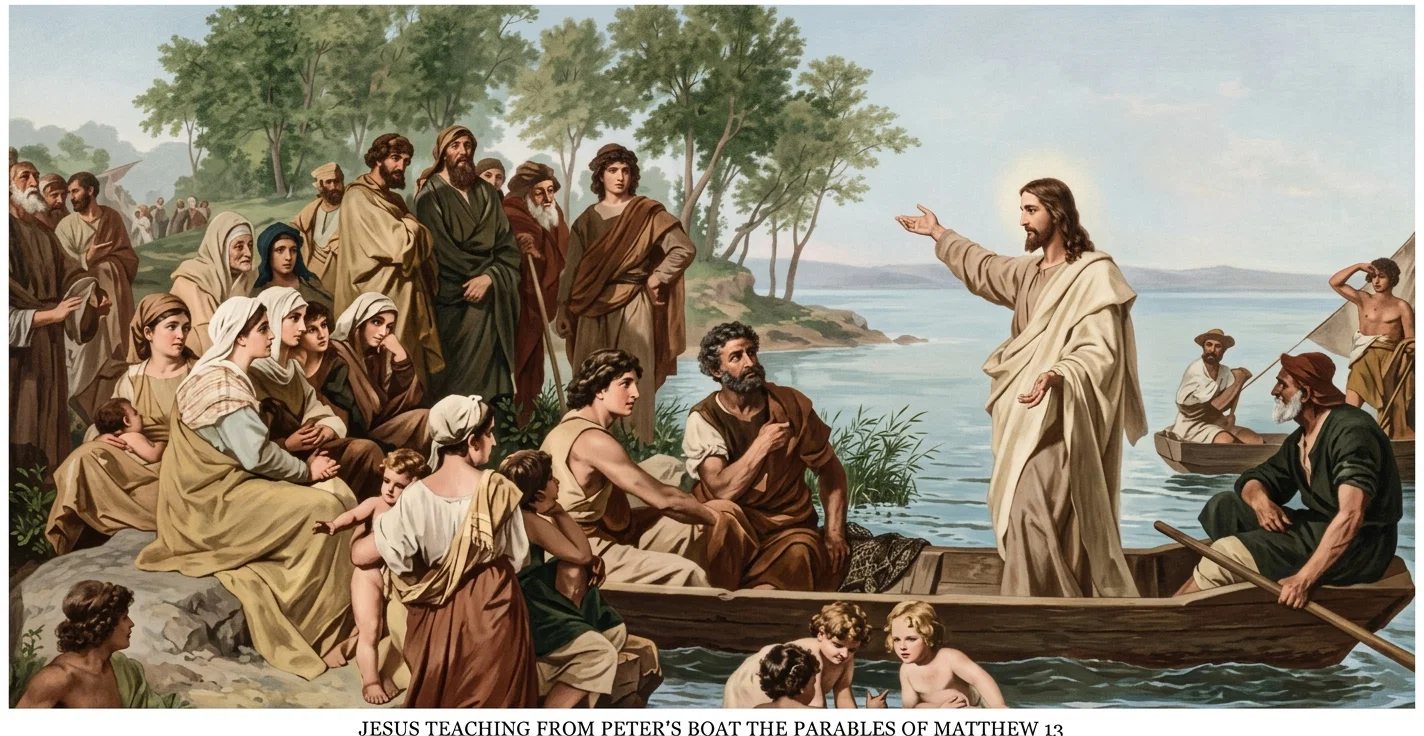
JESUS TEACHING FROM PETER'S BOAT THE PARABLES OF MATTHEW 13
The parables of Christ have been placed on record, and to the honest, diligent searcher after truth, their meaning will be made plain, their mystery unveiled. Those who will not seek for truth as for hidden treasure, make manifest the fact that they do not sincerely desire to know what is truth. Christ still says to His true followers, "It is given unto you to know the mysteries of the kingdom of heaven." "Whosoever hath, to him shall be given, and he shall have more abundance." He who responds to the draw-
ing of Christ, will be found inquiring as to what is truth, that his feet may be directed into the way of righteousness. Christ is drawing all men, but all do not respond to His drawing. Those who yield their will to God's will, who are willing to follow where the Spirit of God may lead, who receive the light and walk therein, will seek for still more of heavenly enlightenment, and "shall have more abundance." But whoever resists the drawing of the Spirit of God, and refuses to walk in the light, choosing to walk in the path of his own selecting, will not be compelled to yield his stubborn will, or be forced to walk in the path of peace and holiness. Those who follow this course are of those who, having eyes, see not, but are blind to the terrible results of their4choice, and walk in sparks of their own kindling, and shall lie down in sorrow.
Isaiah prophesied of the moral darkness that would enshroud those who were lifted up in their own esteem. He said: “Go, and tell this people, Hear ye indeed, but understand not; and see ye indeed, but perceive not. Make the heart of this people fat, and make their ears heavy, and shut their eyes; lest they see with their eyes, and hear with their ears, and understand with their heart, and convert, and be healed.” The Jewish leaders had corrupted their hearts with vain imaginations, with earthly, sensual, and devilish knowledge; and altho they professed to believe in the typical sacrifice that
had prefigured the Lamb of God through all the centuries since the fall of man, they set themselves in opposition to Christ, and rejected the Light of the world. As a pall of death they covered their souls with error; and tho Christ presented to them the inner meaning of the Jewish economy, that they might discern that He was the great antitype, they closed their eyes, that they might not perceive, and hardened their hearts, that they might not understand.
Jesus was the originator of the religion of the Jews; and how clearly could He open to the mind the significance of every shadow and symbol, and reveal the relation of the whole system to Himself? That which had been misinterpreted, He set before them in its clear connection with truth, and made plain the glory of the Levitical service. He sought to open to men the fact that the Jewish system of religion presented in types and shadows the whole mystery of the Gospel. The service of the past was in no way
to be held in contempt; for in Christ, type met antitype, and shadow substance.
The lessons that Christ presented in His words of truth are like precious pearls; for in them He bestowed upon men an inestimable possession. Much that He taught is still but dimly understood, and the rubbish of error covers many a glorious gem of truth. These jewels of truth should be searched for with as great diligence as men search for hidden treasure. Those who know the love of Christ, should regard it as did the man who found the hidden treasure, and for joy thereof went and sold all that he had, that he might buy the field, and dig over every inch of it to discover the rich veins of gold and silver. The teaching of Christ is more precious than any mine of earth can be, and it demands more zeal on our part to seek for the gems of truth than does any possession we can secure in the world. Let him who would comprehend spiritual things, dig deep in the mines of truth.
Hofmann
Hofmann
The Gospel in Type and Antitype
By Loretta V. Robinson
The Fall and the Gospel — Early Types of Sacrifice
In the beginning God created the heaven and the earth. Gen. 1:1.
AFTER the earth, teeming with animal and vegetable life, had been created, man, the crowning work of God, the one for whom all things were made, was brought forth. “And God said, Let Us make man in Our image, after Our likeness; and let them have dominion . . . over all the earth.” Gen. 1:26. The psalmist said, “Thou madest Him to have dominion over the works of Thy hands; Thou hast put all things under His feet.” Ps. 8:6.
The love of God for the beings He had made was not yet satisfied; therefore He planted a garden eastward in Eden, and out of the ground made every tree to grow that was pleasant to the sight and good for food, and there He placed the man and the woman He had created.
In the midst of the garden stood one tree, the Tree of Life, far surpassing in beauty all other trees. In its fruit was the power to perpetuate life.
Power of Choice
But that man might be happy in obedience, and that God might derive pleasure therefrom, he must be more than a mere machine, or an automaton. Power of choice must be given him.
One writer has said: “God is the absolute sovereign. He has made man an absolute sovereign in one realm,—that of his will, his power of choice. There is one place where man reigns alone, an absolute autocrat, where not even God can come save as the autocrat desires it; that is in his will.” And that man might have the opportunity of choice, God placed in the garden the tree of the knowledge of good and evil, with the command that they should not taste it on penalty of death.
Man could never have reached the high ideal for which God had created him, without the power of choice; and only the use of power gives actual possession.
The Climax and the Crisis
The climax is the highest point or the top rung of the ladder. A crisis is the meeting-place of possible victory and possible disaster.
When the temptation came to disobey God, to partake of the forbidden tree, it was climax of opportunity, and a crisis of action. God gave man the opportunity of using his power of choice that he might reach the topmost levels, and with the opportunity came the temptation. And thus God has ever dealt with man.
The suggestion that God was prohibiting something that was needful, was followed by another,—that He was keeping back from them the very thing He was pretending to give them, that was likeness to Himself. “Ye shall be as gods, knowing good and evil,” had the desired effect. And the woman, seeing, as it were, through the eyes of the tempter, “saw that the tree was good for food, and that it was pleasant to the eyes, and a tree to be desired to make one wise, she took of the fruit thereof, and did eat, and gave also unto her husband with her; and he did eat.” Gen. 3:6.
The choice was made. The act was done. The possibility of reaching the precipice height was passed, and man was plunged into the yawning gulf below, without hope and without God in the world, the death sentence hanging over his head. Who can fathom all that lay in that one act of disobedience? All the sin, the misery, the wretchedness, the appalling crime, the sickness and death, with which our earth has since been cursed, lay in embryo in that apparently small act of disobedience. Who can know, in the moment of temptation, the terrible consequences that will result from one wrong step!
The Dwarfing of Sin
Shortly after the transgression, God appeared in the garden, and made known to the guilty pair the results of their disobedience. No longer could they be permitted to remain in their Eden home. God said, “Behold, the man has become as one of Us.” He had exercised his power of choice, he had chosen wrong. “And now, lest he put forth his hand, and take also of the Tree of Life.” “Lest!” Wrong choice always limits our future action. Sin narrows. The sinner must not be permitted to partake of the Tree of Life, and live in sin and rebellion forever. Love drove the man from the Paradise garden until the lesson of obedience should be learned. When he had changed sides in the fight with evil, and got the victory, the gates would again open, and such have a right to the Tree of Life. But altho this tree was shut away from man for a time, yet life itself was offered him in the person of God’s dear Son. He is that tree whose branches bend so low that even the humblest soul may pluck, and eat, and live forever, with no fear that sin will be perpetuated; for only “he that hath the Son hath life.” 1 John 5:12.
The love that drove man from the garden, could not long leave him hopeless and helpless; it must unfold to him God’s wonderful plan of life and salvation, laid deep and sure back in the days of eternity. Christ was “the Lamb slain from the foundation of the world,” “according as He hath chosen us in Him before the foundation of the world, . . . having predestinated us unto the adoption of children by Jesus Christ.” Eph. 1:4, 5.
The plan of salvation was not, therefore, an afterthought. The first intimation of this plan, as recorded, was communicated in the sentence pronounced upon Satan in the garden. The Lord declared, “I will put enmity between thee and the woman, and between thy seed and her seed; it shall bruise thy head, and thou shalt bruise his heel.” Gen. 3:15.
This sentence uttered in the presence of our first parents was to them a promise. While it foretold a great conflict between man and Satan, it declared that Satan should finally be destroyed and man be victorious. But who is this “seed” that should become so one with man as to cause him to triumph?—The same as was promised to Abraham. “And thy seed shall possess the gate of his enemies; and in thy seed shall all the nations of the earth be blessed.” Gen. 22:17, 18.
“Now to Abraham and his seed were the promises made. He saith not, And to seeds, as of many; but as of one, And to thy seed, which is Christ.” Gal. 3:16. “For verily He took not on Him the nature of angels; but He took on Him the seed of Abraham.” Heb. 2:16.5
The Gospel in Type and Antitype
Wonder, O heavens, and be astonished, O earth, that God, the Creator of all things, the Lord of life and glory, should so humble Himself as to become one of sinful humanity, that He might redeem man, and bring him back again in purity and holiness to his Eden home!
To assist in unfolding the Gospel, and that man might have a medium through which to express his penitence for sin and his faith in the promised Redeemer, the sacrificial offerings were instituted. They were also designed to impress upon man the fact that the wages of sin is death, and that “without shedding of blood is no remission.” Heb. 9:22. That is to say, the sinner has forfeited his life, and the broken law can not be satisfied, or vindicated, without the shedding of blood, or taking of life; for life is its due. So when the sin was transferred in figure to the offering, that was accepted for the sinner, and its blood or life taken for his. So the sin was forgiven the sinner, and laid upon another, who suffered its penalty. Thus the offerings were an object-lesson of how “we like sheep have gone astray; we have turned every one to his own way; and the Lord hath laid on Him the iniquity of us all.” Isa. 53:6.
Abel accepted with gratitude God’s plan of salvation, and brought a sacrifice from the flock; and fire flashed from heaven and consumed it as a token of acceptance. But Cain, disregarding the Lord’s express command, presented only fruit. There was no token from heaven to show that it was accepted, hence he was very angry with God and with his brother. Many to-day are making the same mistake, depending upon their own merits instead of the atoning blood of Christ, and see no reason for preaching a crucified and risen Saviour.
During the patriarchal age the father was the ruler and priest of his own family. We find Abraham building an altar and offering sacrifices wherever he pitched his tent. We find that Job “rose up early in the morning, and offered burnt offerings” for all his children; for he said, “It may be that my sons have sinned, and cursed God in their hearts. Thus did Job continually.” Job 1:5.
This form of the priesthood was continued until the time when Israel was led out of Egypt into the wilderness of Sinai, where God gave Moses what is called the Levitical priesthood as connected with the sanctuary, which subject will be considered in a future study.
God’s Love for the World
For God so loved the world, that He gave His only-begotten Son, that whosoever believeth in Him should not perish, but have everlasting life. John 3:16.
The Real Cure
By Flora E. Warren
By Flora E. Warren
Unto you that fear My name shall the Sun of Righteousness arise with healing in His wings. Mal. 4: 2.
Behold the Sun of Righteousness,
With healing in each ray!
Behold His pow'r—
Each day and hour—
To take vile sins away!
He shines o'er every sin-sick heart,
O'er every guilty soul,
That will believe,
And then receive
His pow'r to make them whole.
The germs of error — hidden low
In every heart and mind —
This Sun makes clear,
And brings good cheer
And healing for each kind.
The mind healed by these holy beams
On holy thoughts will dwell;
The tongues made pure
By this blest cure,
Only His praises tell!
Earth's dismal nightshades quickly flee
When bursts the light of morn;
So sin's dark night
Will take its flight
When righteous hearts are born.
My heart believed God's holy Word;
For me His Sun arose;
Each day I lay
Beneath His ray
My sins and all my woes.
O helpless ones — diseased by sin
In body, mind, and soul —
Try day and night
This healing light;
Believe — and be made whole!
Shine, blessed Sun, o'er every soul
Now dying in its sin,
Till some will see
And worship Thee,
E'er death the vict'ry win.
Redeemed by Christ’s Precious Blood
Forasmuch as ye know that ye were not redeemed with corruptible things, as silver and gold, from your vain conversation received by tradition from your fathers; but with the precious blood of Christ, as of a lamb without blemish and without spot: who verily was foreordained before the foundation of the world, but was manifest in these last times for you, who by Him do believe in God. 1 Peter 1:18-21.
Saved by God’s Mercy
But after that the kindness and love of God our Saviour toward man appeared, not by works of righteousness which we have done, but according to His mercy He saved us, by the washing of regeneration, and renewing of the Holy Ghost; which He shed on us abundantly through Jesus Christ our Saviour; that being justified by His grace, we should be made heirs according to the hope of eternal life. Titus 3:4-7.
Christ Jesus Came to Save Sinners
This is a faithful saying, and worthy of all acceptation, that Christ Jesus came into the world to save sinners; of whom I am chief. 1 Tim. 1:15.