A man by the name of J. H. Lindermann, in early life a member of the National Church, as are nearly all those in this country who are not Catholics, was converted in 1842, and became a colporter and preacher in the Reformed Church. From his study of the Scriptures he was led, in the year 1850, to accept the Bible doctrine of baptism. This change of views made quite a separation between himself and his former followers, a portion of whom, however, accepted the doctrine which he preached. Still later his mind was called to the subject of the Sabbath. On searching the word of God, he found to his surprise that there was no authority for the observance of Sunday, and therefore he began to observe the Sabbath of the Lord. This was in the year 1860, and for three years he observed the Sabbath alone. This change of practice was again the cause of division between him and his flock, who through him had received light on the subject of baptism.
As early as 1870 some of this number, however, began to keep the Sabbath with him, and after a time our brethren in Switzerland learned of the existence of such a company of Sabbath-keepers in Prussia. The manner in which they received this information was through a beggar who was permitted to lodge over night at the house of one of our sisters near Basle. As this sister spoke to him concerning the truth, he informed her that there were near Elberfeld people of the same faith, and gave her the address of Eld. Lindermann. Subsequent correspondence led to the visit of Elds. Andrews and Erzenberger, who were cordially received by these friends. It had been but a short time since they learned that there were any Christians in the world, except themselves, observing the seventh day. They had believed there must be others, and now when they came to hear through these brethren of the work of Sabbath reform in America and in other countries, their hearts were made to rejoice, and they shed tears of joy.
During the remainder of this month the brethren labored among these friends, visiting the different localities where they resided, and holding meetings not only with them, but also more publicly in such halls as they could secure. In some localities a remarkable degree of interest was manifested on the part of the public in these meetings, and they were attended by the best class of people. The public meetings held in Gladbach were of special interest; among those who attended were many of the teachers of the city schools, and several clergymen. At the close of one of these meetings a business man, who, though not a Sabbath-keeper himself, was the son of Sabbath-keeping parents, came to Bro. Andrews, and asked the privilege of meeting the entire expense of advertising his work in three of the leading papers in Holland. He had attended the meeting of the previous evening, in which Bro. A. had expressed a desire that these friends, being situated so near the line of Holland, should assist18in this work in that country, as he had already invited the friends in Elberfeld to do for Germany.
In his acquaintance with this people, Bro. Andrews learned that they were believers in the near coming of Christ as well as observers of the rest-day of Jehovah. They held no special errors in doctrine, nor were they fanatical in their worship. They had renounced the use of tobacco, a habit almost universal in this country, and were plain and simple in their dress. Indeed, they seemed to be a sensible, upright, intelligent people, who feared God and who had respect for his word.
They are also a thoroughly industrious and frugal people. As the result of this, though none of them are wealthy, nearly all are in comfortable circumstances, while some have gained what might be considered a competency. Many of these families own the homes which they occupy, and a small piece of land adjoining them. They are mostly employed as weavers of silk, or silk and cotton goods. Thousands of families in this locality are employed in this way, and the younger children as well as the older ones are taught to do this work, which requires much skill and dexterity. Some of the fabrics which they produce are most delicate and exquisite, being woven in a great variety of beautiful patterns. Their looms, which are intricate and complicated, are in their own houses, so that they can control their hours of work.
Having thus employment in their own homes, it is much easier for them to observe the Sabbath than for those who are employed in factories. All through Germany there are manufactories of different kinds. In many localities these furnish almost the only employment by which the mass of the population obtain a livelihood. Men are accustomed to learn but one trade or one branch of business, so that they are wholly dependent upon this particular kind of work for the support of their families. Under these circumstances it is often very difficult for them to obey their convictions concerning the Sabbath, even though they may be thoroughly convinced of their duty to keep it. The circumstances of the people here, as well as the fact that so many were already observing the Sabbath, seemed therefore to recommend this as a promising field of labor. So, after having labored together for five weeks, Bro. Andrews returned to Switzerland, leaving Bro. Erzenberger here to continue the work and to labor in new fields as the way might open before him.
It may be of interest to the reader to mention some facts concerning the legal regulations which must be complied with in order that meetings may be held in this country. Germany may be said to be well governed in the sense that the requirements of the law are strictly and rigidly enforced. These regulations seem very strange to those who have been accustomed to the freedom of American citizenship. In this country, as in all other countries of continental Europe, when a stranger would sojourn for any length of time in any locality, he must on his arrival present his passport to the authorities, and receive permission to remain. In fact, unless this is done within twenty-four hours the person who entertains him is liable to a fine. If any one desires to hold a public meeting, he must give notice of the fact to the authorities, stating the place where the meeting is to be held, and its nature, or the subject which is to be presented. If the permission is granted, the meeting is then under the protection of the law,19and government officers are present to see that order and decorum are maintained. In this respect Germany is one of the most favorable fields in Europe for the public presentation of the truth. It is not difficult to obtain the permission to hold meetings, and the only restriction to freedom of speech is that nothing reactionary or revolutionary is allowed, nor is anything permitted to be said against the government or its regulations.
It is quite difficult, however, to obtain suitable places in which to hold meetings. In fact, there are no places to be secured except halls that are ordinarily used for dancing and drinking. The churches and school-houses are under control of the pastors and officers of the National Church, so that they cannot be obtained without their consent. Of course it is readily to be understood that they do not grant permission for them to be used for the propagation of new doctrines.
It is no uncommon thing to find the halls used for public lectures, fitted up with a regular bar for the sale of beer and cigars, so that those who attend may be supplied with these articles of so common use. It is not considered any breach of good order to drink beer and to smoke while listening to the speaker. A circumstance which occurred during this visit will illustrate to what extent this habit is carried. The brethren had an appointment for a meeting to be held in the village of Hilden. As they entered the hall, they saw four rows of tables extending its entire length, the chairs being placed beside them. On each table was a match case. A large congregation assembled, intelligent in appearance, and well dressed. Before the service commenced, waiters passed about beer, and this they continued to do from time to time during the meeting. And, notwithstanding the fact of its being a religious service, many persons were smoking while the discourse was being delivered. This was not from any intentional disrespect to the speaker, but simply as a matter of custom. The audience paid the strictest attention, and during the time prayer was being offered at the beginning and close of the service, the entire congregation rose to their feet and remained motionless.
A circumstance in the previous history of these German brethren illustrates also a phase of the work of Sabbath-reform in which our brethren in America have had no experience. These brethren are opposed to bearing arms. For refusing to do service in the war with France, which had just closed, one of them was imprisoned for two years at Düsseldorf. While the discipline of the German army is very strict, they inflict no other punishment on those who refuse to do military service than imprisonment or enforced labor on fortifications or in hospitals.
It is not alone during the time of actual war that this question of military service and its relation to the observance of the Sabbath is a practical issue. The German government requires that every able-bodied young man shall perform three years of actual duty in the army, even though it be in time of peace. This service begins at the age of twenty years, and there seems to be no means of avoiding the service without suffering the penalty which follows its refusal. The diplomatic arrangements between the various governments are such that it is impossible to evade this service by removing from one country to another. From the time a young man becomes of age to do military duty his whereabouts are carefully watched. Should he desire20to leave the country, no passport would be granted him, and without this, no European government would give him shelter. If he has already received a passport, it is withdrawn before the time his service is due, and he is left no other alternative than to surrender himself into the hands of the government. Should he by any means evade doing this, he forfeits his rights as a citizen, and whatever property he may have is confiscated. The regulations of Germany are not in this respect more severe than those of most other governments of continental Europe. This relation of Sabbath-keepers to the rigid requirements of military service is one of the practical questions of the work in Europe.
As the result of this visit, there were, when Bro. Andrews left, about fifty persons in cordial sympathy with our work. They had freely returned to the Swiss treasury the amount raised to defray the expenses of this journey, and had assumed the expenses of the further labor which Bro. Erzenberger was to do among them. They had also undertaken the expense of advertising the work in papers in Germany, as had already been done in Switzerland.
As we shall have occasion to speak again of the work in this vicinity, we will simply add that although Eld. Lindermann after a time became estranged not only from our people but also from a large share of those whom he had been instrumental in leading to the observance of the Sabbath, and his subsequent career was unfortunate both for himself and for the truths which he had espoused, yet quite a share of those who became acquainted with our people through the visit of Elds. Andrews and Erzenberger, and were more fully instructed by them in the way of truth, have since that date been united with our work and are still firm friends and supporters of our cause.
On his return to Switzerland, Eld. Andrews again applied himself with renewed zeal to the study of the French, devoting much time to securing a thorough knowledge of the grammar of the language, that he might be able to criticise correctly the paper which he hoped soon to publish. His visit had given him some opportunity to judge from personal observation of the vastness of the field comprised in the Mission. What was to be done to warn the thousands and thousands of people in these various countries? The advertisements in the leading periodicals of Switzerland, Germany, and Holland, brought an interesting correspondence from many persons; and what had he to give them in response to their anxious inquiries concerning the new doctrines which he came to bring them? Having a supply of English publications only, he was obliged to respond to their urgent calls by sending them these with the hope that they might find some one who could read these works for them. With a periodical and publications in French, the case would be much different, as this language is quite generally known in all these countries, especially by the better classes. Toward the accomplishment of this object, as the most direct manner of answering to the immediate demand, he therefore directed his efforts, and began at once the publication of tracts, the means for which work had been donated by the Swiss brethren.
The first French tracts issued in Europe were printed at Neuchâtel; but the work proving unsatisfactory, a Basle printer was next employed, and from this time the work of printing was done at Basle.
In the month of June, a company of twelve persons who had accepted the truth were baptized at La Coudre by Bro. Albert Vuilleumier.
The notices concerning the new mission, which had appeared in the Holland papers, brought in a considerable number of letters of inquiry. To these letters Bro. Andrews replied, although in so doing he worked at great disadvantage. The letters had first to be translated to him from the Holland, and then his replies had to be translated into that language. At first he did not have even so much as a tract in their own language to send them. He afterward, however, received from the Review Office a supply of a tract on the Sabbath, the only work on present truth then published in Holland. These he sent to all those with whom he had been in correspondence.
The second baptism, which took place in the month of August of this year, was an occasion of much interest. The ordinance was administered at a beautiful spot near the north end of Lake Neuchâtel. Eight persons were baptized at this time.
ORGANIZATION OF THE TRACT SOCIETY.
The second annual meeting, a meeting which, in its form and the nature of the business transacted, corresponded to our State Conferences, although as yet no Conference had been organized in Switzerland, was held at Bienne, Dec. 12, 1875. There was a good representation of the brethren of the different churches, and the meeting was interesting and profitable. The committee appointed the year before for the general oversight of the work reported what had been done, and a treasurer’s report was made, showing what use had been made of the funds paid into the treasury. The report of the committee showed that there had been printed during the year three thousand copies of each of the tracts, “The Millennium,” “The Second Advent,” “The Two Thrones,” “The Judgment,” and “The Sanctuary;” and ten thousand copies of “Which Day do you Keep, and Why?”
The subject of systematic benevolence received considerable attention at this meeting, and the pledges of the brethren for the coming year amounted to 2300 francs, or about $460. There were at this time seventy-five Sabbath-keepers, besides a considerable number of Sabbath-keeping children. The executive committee chosen for the ensuing year consisted of Brn. J. N. Andrews, Albert Vuilleumier, and J. E. Dietschy. Brn. Andrews and Erzenberger received credentials, and five persons were granted license.
But the most important work of this meeting was the organization of the Tract and Missionary Society. This was done as nearly after the model of the American societies as the circumstances would allow. Previous to this time there had been apparently but little opportunity for tract and missionary work. As there had been no tracts in the French language, the brethren had been limited to what they could do by personal effort for those with whom they associated. It was true also that they did not realize the importance of this kind of work, and their early zeal had been much abated through the discouraging influence of the unfortunate course of the one from whom they had first received the truth. These brethren had manifested a commendable zeal and willingness to sacrifice of their means for the extension of the work; but it was not surprising that, not having had special instruction on this point, they did not feel that sense of personal responsibility22which was desirable in view of the great work before them. As they now had a limited supply of publications in their own language, it was hoped by means of this organization to bring all into useful activity, and to lead to an individual co-operation for the extension of the important work which had been commenced.
THE WORK IN GERMANY.
During this interval Bro. Erzenberger had vigorously continued the work in Germany. After a course of lectures in the village of Hilden, as the result of which a few embraced the Sabbath, he went to the city of Solingen. There he found an interest on the part of the people to listen to the truth. His first meeting was attended by three hundred persons, and the attendance continued to increase. The most perfect order and quiet was maintained in the meetings. Of course this interest on the part of the people stirred up a spirit of opposition, and after the introduction of the Sabbath question several efforts were made by persons of rank to hinder the lectures and drive Bro. Erzenberger from the place. To accomplish this, an appeal was made to the highest authorities of the city, but it did not avail. The law granted him the right to hold his meetings, and his opponents were not permitted to accomplish their object.
Feeling the urgent need of publications in German, Bro. Erzenberger while here translated and published at his own expense small editions of the English tracts, “Scripture References,” “What is Truth?” “Which Day do you Keep, and Why?” and “Who Changed the Sabbath?”
As the result of the effort in this city, where there was not an observer of the Bible Sabbath when he commenced his course of lectures, sixteen adults embraced the truth. The first baptism by Seventh-day Adventists in Germany was Sabbath, Jan. 8, 1876, the ordinance being administered in a small lake, which at the time was covered with thick ice. Eight persons were baptized, and a very favorable impression was made upon those who witnessed the scene.
While thus laboring in Western Prussia, Bro. Erzenberger learned of a company of Sabbath-keepers residing in the eastern portion of the empire; but for a time he had no direct communication with them.
ELD. BOURDEAU JOINS THE MISSION.
Dec. 25, 1875, Eld. D. T. Bourdeau and family sailed from New York to join Eld. Andrews in the work among the French in Switzerland and France. Eld. Bourdeau, although American by birth, is of French origin, and while a young man pursued his studies in both French and English at Grande Ligne Mission, P. Q., with a view to devoting himself to the work of the ministry as a missionary for the Baptist denomination. Having embraced the third angel’s message, he labored in America for several years, preaching both in English and French; but as the work was now opening among the French in Europe, it was deemed desirable that he should unite in labor with Eld. Andrews, that the mission might have the benefit of his acquaintance with the French language. He was therefore advised to remove with his family to Europe. After a stormy and dangerous passage, during which they faced the reality of a threatened death, they joined Eld. Andrews at La Coudre, Switzerland, Jan. 7, 1876. During this month these brethren23both removed with their families to Locle.
They also visited, in company, all the churches of Sabbath-keepers in Switzerland. While laboring for the spiritual advancement of the brethren, and endeavoring to carry forward the work which had been commenced among them, to encourage Christian temperance, liberality in the support of the cause, and activity in the missionary work, much time and thought were bestowed in considering the best plans and methods by which to bring the great truths of our faith to the attention of the people. Their plans included the publication of a French periodical at the earliest date possible. During this time also they were engaged in the preparation of a special edition of tracts on the three messages, adapted to the work in Europe, and to the translation of the valuable pamphlet, “Exposition of Matthew Twenty-Four.” With these publications, and one or two works on the Sabbath in French, they thought to have a supply sufficient to meet the urgent demands of the work in entering new fields of labor.
After a second tour among the principal churches, Eld. Bourdeau began, in the month of March, a course of lectures in Locle. These lectures were well attended, and among those who embraced the truth as the result of this effort was Bro. Louis Aufranc, the leading teacher in the college of that city. After having become convinced of his duty to observe the Sabbath, Bro. Aufranc addressed the board of education in a firm but courteous manner, informing them that he could not continue to teach on that day. He also addressed a letter to his pastor, in which he stated, in a gentlemanly and Christian spirit, the change in his faith and practice, and tendered his resignation as elder of the church. He received from the president and secretary of the college an honorable discharge, in which they expressed their appreciation of his faithful services and their wishes for his future prosperity. Since that time Bro. Aufranc has rendered valuable assistance in the publishing work as a translator.
While this course of lectures was being given at Locle, Bro. Andrews, at the request of Bro. Erzenberger, again visited Germany. During the interval since his former visit, some of those who had received them so cordially on the first occasion had become imbittered toward them; but the greater portion remained in sympathy and union with our work, and the number of the disaffected ones had been made good by the addition of those who had received the truth under Bro. Erzenberger’s labors. Some of those who had become alienated have since united with us.
The first quarterly tract and missionary meeting of the new society was held in Locle. The report showed the distribution of 26,000 pages of tracts. These had gone to nearly all the countries of Europe. Some of them had been sent into the household of the emperor of Russia, while others had found their way to a missionary in Africa. The interest in Locle which led to the giving of the course of lectures was first started by the distribution of reading matter, and thus the friends were encouraged by seeing what had already been accomplished.
A PAPER ESTABLISHED AT BASLE.
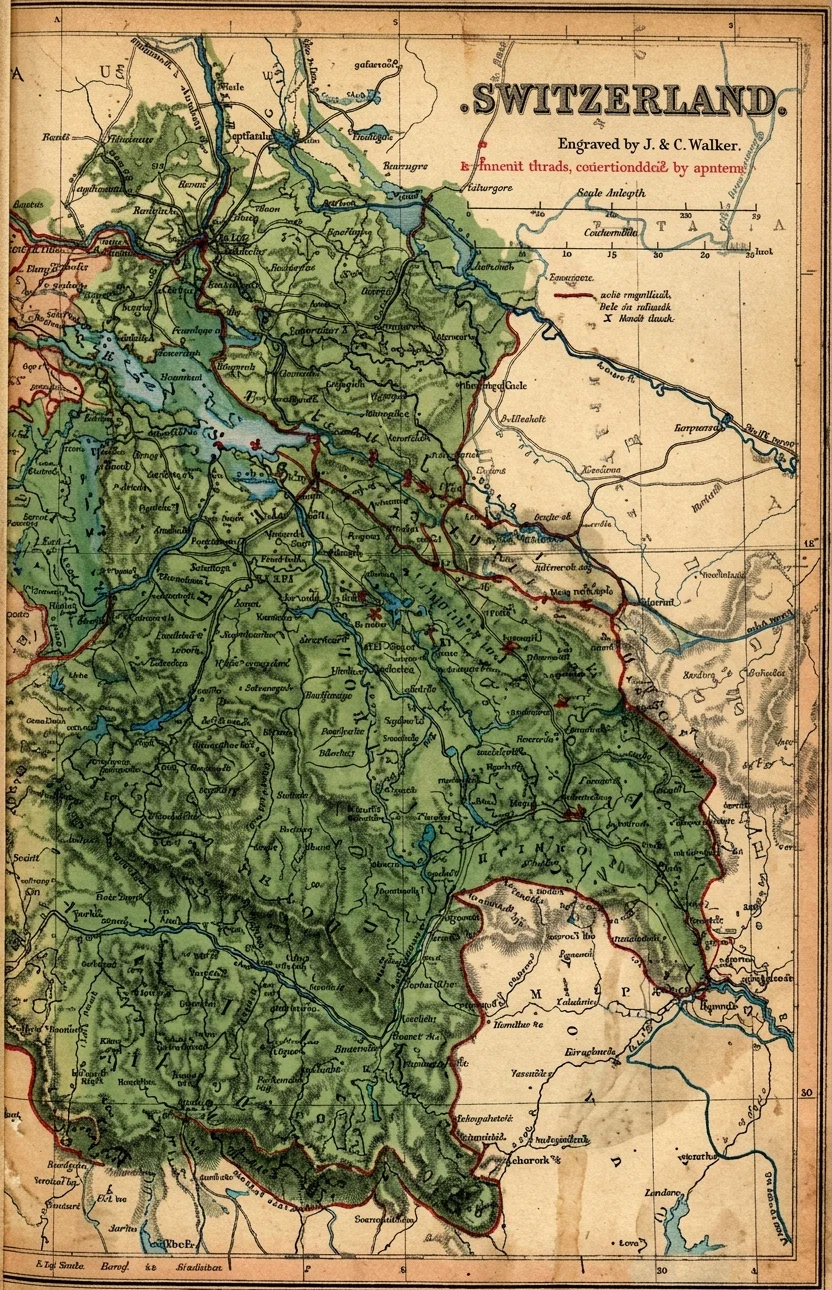
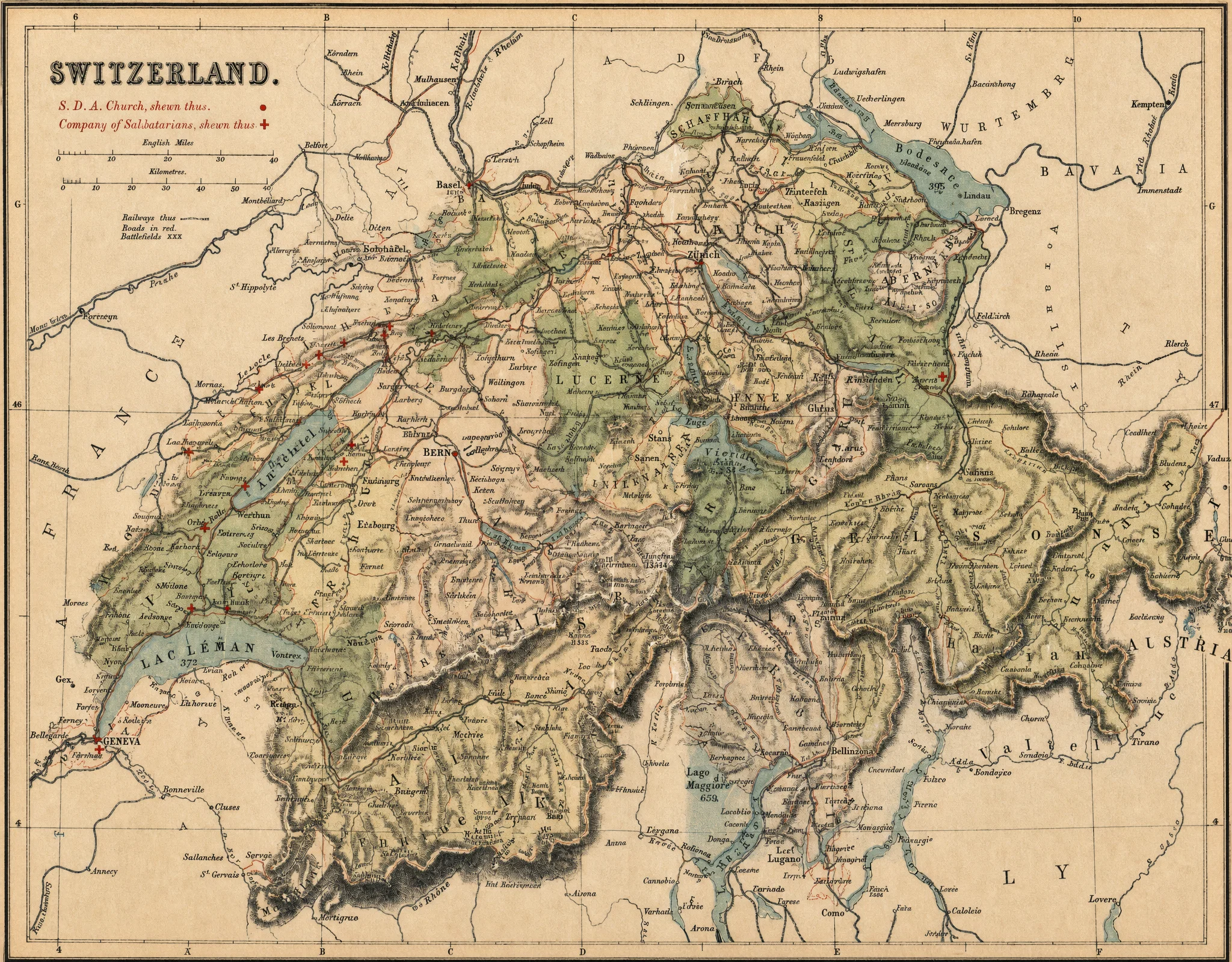
By this time Bro. Andrews had so far progressed in the French as to be able, with the assistance of Eld. Bourdeau, to commence the publication of a French monthly journal, which was appropriately to bear the same title as24that given to the first Adventist paper in America, the Signs of the Times. With this object in view, he removed to Basle in the month of April, considering this city as the most favorable point at which to establish the publishing work. As a reference to the map will show, it is located but a short distance from France, and just on the present boundary line of Germany, so that our publications designed for that country have to be carried but three miles in order to be mailed from a German post-office. Basle has for centuries had a most favorable reputation as a publishing center, especially of religious works; and publications issued from this city are favorably received in any of the countries of Europe. This was a consideration worthy to be regarded.
So, in the old city which fostered the present truth of the sixteenth century, and in which Frobenius turned off from his rude presses words which electrified the thinking minds of that day, the present truth of the nineteenth century was planted, and Les Signes des Temps, the first advocate of the third angel’s message in the Old World, had its birth on a nineteenth-century press, the first number being issued in July, 1876.
Much of the subsequent labor of Eld. Andrews was devoted to this journal, and he spared no pains in his endeavor to adapt it to the wants of the people. Appreciating the situation of the people and the great lack of knowledge of the Bible on the part of the masses, he labored to present the truth in the most clear and simple manner, and in the way best calculated to bring it within the intelligent comprehension of all into whose hands it should come.
His success in these efforts was certainly remarkable, and the present truth, as presented in the early volumes of this journal, furnishes an admirable example, and one rarely attained, of simplicity, clearness, and force. Although advocating truths so unpopular, and notwithstanding the fact that it was devoted almost wholly to religious topics, Les Signes gained a strong hold upon its readers, and attained a standard and reputation worthy of the truth of which it was the exponent. Although it had little but its own merit to recommend it, as, during the early days of its publication, very little was done by way of personal effort for its circulation, it gained a widely scattered list of subscribers, though of course their number was quite limited. Though the matter published was prepared for the masses, testimonials are not wanting to show that many minds among the cultured class were deeply impressed by the great truths taught in Les Signes, and by the spirit of candor, sincerity, fairness, and earnestness with which they were presented.
SOME DIFFICULTIES IN PUBLISHING.
A word here in regard to some of the difficulties which were to be met in this work of translating the truth into foreign tongues. These difficulties are not found to be less as we come to the task of translating our more important doctrinal works into the various languages, and it is proper that our people should know the labor and pains which are required in doing this work, in order that they may not misjudge the slow progress that seems to be made in this direction.
The principal publications in favor of the doctrines of the Seventh-day Adventists have been issued in the English language. These have been prepared with great care, and are the25result of long study and research. It is hardly to be supposed that these important truths would be more faithfully presented by any re-writing, since they are the product of the best thought and most thorough study of men who have been longest connected with this work. Certainly it is not to be supposed that men in each of these foreign countries who receive the truth at a much later date, and who are largely unacquainted with the early history of this movement and the experience which has developed this system of truth during these years since the message originated, would be likely to write out the arguments in its favor with greater clearness and force, or in a more logical manner, than that in which they are presented in our English publications. For this reason it will doubtless be the case that the work of preparing the truth in foreign tongues will ever be quite largely one of translation from the English.
PLATE IV.
SWITZERLAND.
S. D. A. Church, shewn thus •
Company of Sabbatarians, shewn thus ✚
English Miles
Kilometres
Railways thus —
Heights in feet.
Battle fields ✕
CASTLE IS SEEN FROM THE OLD BRIDGE.
At first thought it might seem that this would be a comparatively easy task; but experience has proved it to be quite otherwise. To be a good translator requires not only an aptitude of expression and a use of language which enables one to retain thoroughly the spirit of his own tongue while transferring the thought from another language, but, what is not less essential, a thorough knowledge of the language from which the translation is being made, as well as a thorough acquaintance with the truth and an understanding of its principles. It is rarely that all these requisite elements are to be found. Sometimes the translator, in his study of the foreign language, in a measure forgets the idiom of his own tongue, so that his translation becomes clearly marked with the characteristics of the language from which he is translating. Then, again, if he has not sufficient familiarity with the tongue from which he translates, there is great danger that this lack of knowledge will lead to serious misapprehensions of the idea, so that important thoughts in the original will be overlooked or modified. Especially is this true in translating from the English, a language which has such infinite variety in its shades of meaning, and which, from its richness and abundance in variety and form of expression, is quite likely to be misapprehended by those who have but a partial acquaintance with it.
But supposing the translator has the peculiar qualifications and talent necessary to make him a master in his work, he still finds himself confronted by many serious and perplexing obstacles. Sometimes whole paragraphs of arguments, forcible and convincing in the English, are based upon shades of distinction not found in the foreign tongue. The deviations from the evident meaning of the original, in many of the popular versions of the Scriptures in these foreign languages, are such that frequently those texts which are relied upon as furnishing important and positive proof may not be adduced in evidence—so faulty and erroneous is their rendering. In some instances it is necessary to show the incorrectness of the renderings; but this is a delicate task, so tenacious are the people for the very language of the Bible of their fathers to which they have become accustomed.
For example, the German Bible, as translated by Luther, uniformly reads “Sabbath,” instead of “first day of the week;” and although all scholars understand very well that the staunch old Reformer gave an erroneous rendering of these passages, the common people regard with an almost superstitious veneration27the very language he used. Some of the popular French versions make the Revelator declare that he was in the Spirit on Sunday; and even those who know how utterly unjustifiable is such a rendering according to the original, are not slow to cite this proof of apostolic example in favor of traditional custom, while the unlearned Christian really supposes it to be inspired testimony in favor of first-day sacredness.
The authorities cited in our English publications are either English or English translations of authors who wrote originally in other languages. Many of the English authors, and in particular American writers, are entirely unknown to the common European reader; to quote their language would have no more weight than to cite the opinion of any other unknown person, and would serve only to give the publication a decidedly foreign air. Quotations from the English editions of French and German authors, cannot be translated, but must be found and quoted from the original, or from such other translations as exist in the language in which the work is being prepared. Other foreign writers, as, for example, the Church Fathers, Josephus, and other ancient authors, whose works have been translated into French and German, must be quoted from these translations rather than retranslated from the English. All these things demand such care, precision, and discrimination as makes the work a laborious and perplexing one, requiring much more time and patience than would be at first supposed.
The peculiar organization of Eld. Andrews rendered this kind of work especially perplexing to him. His thorough acquaintance with the truth, and his critical study of its arguments; his conscientious anxiety that entire justice should be rendered to the great doctrines of the message as they were thus reproduced in other tongues, made the work one of great solicitude to him, while at the same time he was most earnestly desirous that it should go forward as fast as possible. It is worthy of remark that even these early publications have stood the test of criticism and have rendered good service in the work, although without doubt they have been improved by later revision.