In the fall of 1884, after the Conference in Sweden, I went to Stockholm, in company with Eld. O. Johnson, and began a series of meetings. Before this time Brn. Rosqvist and Johnson had labored some in this great city, and there were a few keeping the Sabbath.
Stockholm has two hundred and fifty thousand inhabitants, principally Lutherans. Yet there are many other religious elements. The Separatists have several churches in the city, with many thousand members. The Baptists number more than three thousand, and the Salvation Army is also very strong. There has been a great deal of healing by anointing with oil and praying for the sick; those who claim to have been healed in this way number several hundreds. On the whole, there is much more religious stir in Stockholm than in any of the cities of Denmark or Norway. But with few exceptions it is very superficial, and the antinomian element is prominent everywhere, so that great prejudice exists against sound Bible doctrine.
We began to preach in several places, but were driven away from them, until in October we secured a large hall in a very good locality, which would hold eight hundred persons, but was seated for about three hundred. It was poorly heated, and not easy of access, but we were glad to get it. We kept this hall four months, our congregations varying from one to three hundred. During the first two months the congregation changed very much, the most seeming to come from curiosity; but after a time there was a remarkable change in this respect, for the people would stay after the meetings to converse with the preachers, and they manifested a deep interest to learn from the teachings of the Bible. So we gave a second course of lectures, interspersed with many discourses on faith and a Christian life. By the first of March, fifty persons had been added to the church, and the number of members was sixty-six. The last Sunday our meeting was attended by about two hundred persons. The expenses of this series of meetings were paid by donations, which amounted in all to $308. The love and union which prevailed among the friends at that time was truly encouraging, and the blessing of God was evidently with them. Since that time Bro. Norlin has labored in Stockholm, and there are now about ninety Sabbath-keepers there.
After the meetings in Stockholm, I labored two weeks with Eld. Johnson in Örebro. The people showed a great willingness to hear, and as Eld. Johnson remained some time, several embraced the truth, and a small church has been organized.
At this time Sweden had two preachers, seven churches, with 193 members, and three colporters. During the year, $345 was paid in tithes and donations to support the work, and $460 was received for books and papers.
At the same time Norway had two preachers, four colporters, and two churches, with 155 members. The tithes and donations received during the year amounted to $1,316, and the money received by colporters for papers and books to $378.
COPENHAGEN.
Since the spring of 1885 I have labored principally in Copenhagen, Denmark, in connection with Eld. Brorsen. Here the people are so much given to infidelity and pleasure-seeking that it is very difficult to call their attention to religion. Political commotions and financial failures, while thousands are out of work, have brought about a sad condition of society. Our meetings in Copenhagen have not been nearly so well attended as the meetings in Christiania, or even in Stockholm. We have seldom had more than one hundred hearers, while at most of the meetings there have been from thirty to seventy. But the work has been advanced by the help of Bible-readings in families, and by visiting. Quite as much has been accomplished in this way as by the preaching. And the interest, although not a large one, has continued to increase. We have organized a church of twenty members, and some over forty are keeping the Sabbath. Among these are some promising young men.
At the beginning of this year, Denmark had four preachers (colportage is forbidden by law), nine churches, with 160 members, and 258 Sabbath-keepers. During the year, $405 have been received in tithes and donations, and $135 for books and papers.
THE NEW OFFICE AND MEETING-HOUSE AT CHRISTIANIA.
When the Building Association bought the property occupied by our printing work and meeting-hall, it was understood that in June, 1885, a portion of the building would have to be torn down, to make way for a new street. As we neared the time when this must be done, the brethren realized that our old building was not suitable for the growing wants of the cause, and at the same time the payments, which were now about $1100 a year, were a burden that they could not carry without help from abroad. Up to this time the payments on this property had absorbed all the means that could be raised by the Sabbath-keepers in Norway, so that there was nothing to use in supporting laborers in this, one of the best fields in Northern Europe.
After fully considering these things, the trustees of the Building Association requested the General Conference to take the property, as follows:—
Whereas, we learn, that the General Conference in America intends to organize a legal society for the purpose of holding property both in America and in foreign countries, therefore—
Resolved, that it is our wish that said society take the property of the Building Association, and we would hereby request that this be done as soon as circumstances may allow.
This resolution was adopted Jan. 22, 1885.
At the time of Eld. Butler’s visit to Christiania, the matter of a new building was discussed, plans were presented,74and Eld. Butler consented to lay the whole question before the General Conference at its next annual session. At this meeting the matter was considered, and it was decided to go forward with the erection of a new building for a printing office and also for a hall for meetings.
Earnest appeals were made to the brethren in America for means to erect the new building, and to carry forward the work in Scandinavia. These appeals were liberally responded to by donations and pledges, and the work was pushed forward. As Bro. L. Hansen was one of the leading contractors of Christiania, the whole work of building was placed in his hands, under the direction of the Board of Trustees of the Building Association. In May, 1885, the work of building was begun; and March 14, 1886, the meeting-hall was dedicated. At the dedication, the hall was filled, about seven hundred being present.
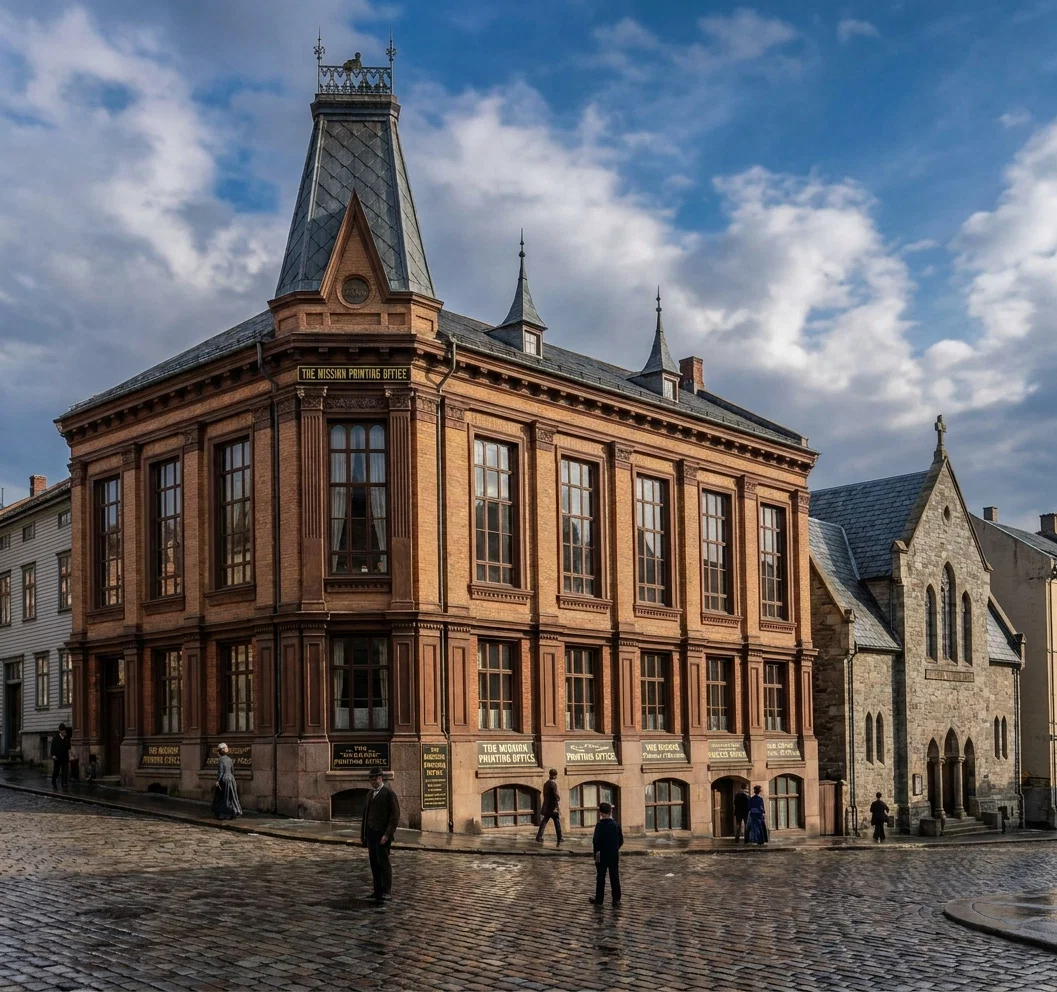
THE MISSION PRINTING OFFICE, CHRISTIANIA.
THE SCANDINAVIAN MISSION HOUSE AT CHRISTIANIA.
This building is situated on the corner of Akersgaden and Thor Olsens Gade. It fronts the north, the main entrance being on Thor Olsens Gade, the new street, the construction of which required the tearing away of a part of the75old building. In front, and nearly opposite, stands the large Catholic church, while immediately adjoining it to the south is the Lutheran mission house, and less than a block away, on the same street, is the large Lutheran church, called “The Trinity.”
Our building is 46x69 feet in size, with two stories and basement. It is built of brick, with a foundation of grey stone, and presents a neat and elegant appearance. The ground on which it stands, slopes rapidly to the south, so that while the entrance to the first story is gained by two steps, the floor of the press room, which is in the south end of the basement, is but two feet below the level of the street. Thus a large part of the basement has abundance of light.
If we enter the building at the main door on the north, and ascend the broad iron stairway to the second story, we find a large, commodious, well-lighted meeting-hall, 55 feet in length, 41 feet in breadth, and 22 feet from floor to ceiling, capable of seating four hundred persons. At the end of this hall is a gallery, 14 feet deep and 41 feet long. That portion of the room under the gallery not occupied by the main stairway, is now used as an editorial room; but it has wide sliding doors, so that in case of need it can be opened into the main auditorium, and thus add 12x19 feet to the meeting-room.
Returning to the first floor we enter the office and sales room, a light, airy room 19x33 feet in size, with windows on two sides. From the office we pass to the composing room, 27x33 feet in size, which, with the office, occupies the west side of the building. Near the center of the east side of the building is another entrance, and near this entrance is the pneumatic elevator for the transportation of type-forms, printed sheets, etc., from the press room in the basement to the composing room and the bindery on the main floor. On the north of this entrance is a room 20 feet square, used for a bindery, and on the south side are a store room and a proof-reader’s room, each about 12x14 feet.
In the south end of the basement is the press room. This room is high and light, and is occupied by a large English stop-cylinder press, a small German cylinder press, a Peerless job press, and a 36-inch-power paper cutter.
The north end of the basement is occupied by the stereotype foundry on the west, and the engine and boiler room on the east. The stereotype room is fully equipped with the best stereotyper’s machinery. Power for running the machinery, and heat for the whole building, are furnished by a ten-horse-power engine, and a fifteen-horse-power boiler. From the north end of the engine and boiler room are partitioned off two small rooms; one is a coal room, and the other is a fire-proof vault for storing stereotype plates and matrices.
The whole building, including the meeting-hall, is heated by steam, both direct and indirect radiation being employed; and ample provision has been made for ventilation. The building proper has cost $10,150. The entire cost of building, fixtures, and machinery, exceeds $18,000.
The lot on which the property stood was quite large, and since the erection of the new building it has been divided, so that the corner lot, on which the new building stands, is called Akersgaden 74, while the remainder is called Thor Olsens Gade No. 1.
That which remained of the old building has been remodeled, repaired, and painted, so that it now furnishes five76suites of rooms, which are rented out to private families for about $350 a year. The income from this house and lot is sufficient to cover taxes, and to pay about five per cent interest on the appraised value of the property. If it should be decided to sell, the improvements made this year make the property in every way more desirable. If, however, the work shall continue to grow, as we trust it will, this house, situated as it is immediately adjoining the printing office, would be very convenient and desirable in case a mission school, office boarding house, or something similar were needed.
At present the office publishes four monthly papers, two in the Danish-Norwegian, and two in the Swedish. One of these in each language is a health journal. The one in Danish, Sandhedsbladet, is the only paper of its kind in that language, and during the first part of 1886 it has been very successful. Considerable effort has been made to call attention to it, by sending out descriptive circulars with testimonials, and subscription blanks, with some of the most influential and widely circulated secular papers. Our office prints the circulars, and the publishers send them out as supplements to their papers, so that each of their subscribers receives a copy. As a result of these and other efforts, subscriptions are coming in every day. About $1200 has been received on this paper since the beginning of the year.
We trust that the time is not far distant when both of our religious papers shall be issued semi-monthly. We see a great work before the office in Christiania. The Scandinavian people will buy good religious books if printed in a style to please, and at prices that they regard as reasonable. There is great necessity for a better assortment of books.
SCANDINAVIAN COLPORTERS.
In Norway and Sweden, canvassing as well as colportage is free, while in Denmark the latter is forbidden, and the former is limited by unreasonable laws. From the first, canvassing and the sale of books and tracts have been made a prominent point in the missionary work in Northern Europe. The colporters have been sustained chiefly by percentage. In many cases they have had no other help; but in some instances where they have had a family to sustain, and their journeys have been long and expensive, they have had some additional assistance. This help has come from fellow-laborers in the mission, from donations sent to the office or to the missionaries, and, in Sweden and Denmark, from the Conference funds. Yet this has been very limited; in Sweden, for instance, three colporters in 1885 received from this last source about $34.
Some of the colporters have very much desired to preach, but having so little judgment in this direction that they would do more harm than good, they have been advised not to do so. Others who are better adapted to this work, have been encouraged to hold meetings now and then in the evening. They have dwelt only on such points of the truth as would be generally well received by the people, and have thus gained friends, obtained free lodging, and increased the sale of their books. The work of the colporter has been considered a good school for those who would become preachers, and it has proved to be so. Since we adopted the plan of holding Bible readings, there is a better chance for all to do something
Assistance being limited, the colporters have had to be very economical. They have traveled at the cheapest rate, and have been very careful of their expenses in every direction. The following facts concerning a trip made by Bro. Norlin through a part of Northern Sweden in the summer of 1884, may give an idea of the work:—
He was away a little less than three months, and during that time obtained subscriptions and sold tracts to the amount of $243. This was in the summer, which is the best time to sell books in that part of the country. In the winter season he sold much less. In most places he was received kindly, and the people often entertained him free of charge. He held meetings where there was an opportunity, and found that the people in this part of Sweden have more interest in religion and less prejudice than in other portions of the country. He went as far as Luleå, which lies six hundred miles north of Stockholm, visiting the cities, and traveling afoot through the country. In Umeå he was allowed to speak in a Lutheran mission house. In Hernösand he obtained fifty subscribers, and in Solefteå forty. Some became interested in the truth, and a few afterward began the observance of the Sabbath, so that a few Sabbath-keepers have sprung up here and there from this effort.
One of our most active colporters in Norway is Bro. H. H. Surthen. About three years ago he came into our office, an entire stranger to us, and said he had come from America to be a colporter in Norway. While on his way to America a few years before, a fellow-passenger had lent him some of our books. By reading these he became interested in the truth, and after reaching America he found Seventh-day Adventists, and began to keep the Sabbath. As time passed, he felt a burden for the people of Scandinavia, and had now come to labor as a colporter among them. This looked to us like a wild undertaking. He was not fluent in speech; in fact, it was almost impossible for him to express his thoughts.
After spending a few days with us, he started out to sell books. These he paid for, and also deposited some money in the office. At first his experience was very discouraging. He went from place to place, meeting with frequent rebuffs but no success, until he became quite disheartened. He finally left the cities and went into the country, and after much prayer and meditation tried again. This time he met with some success, and since gaining a fair start in the work he has labored untiringly.
On one of his late trips to Lofoden, in the far north, he wrote: “At Throndhjem I went on board a small sailing vessel to reach this place in the cheapest possible way. The wind was against us, and it took us three weeks to reach this distant haven. Every time I visit Norland it looks to me like a risky undertaking. The barren, snow-capped mountain peaks towering far up among the clouds, very much resemble icebergs, and bring gloomy feelings. They remind me of the desolate fields of ice with their big white bears; and I begin to think of my ready means, whether it is sufficient to take me back if my undertaking should prove a failure.
“When I reached the rugged mountain peaks of Lofoden (the most celebrated fishing place in Norway), many questions crowded into my mind. Can I find a foothold in this unpleasant place? Will the fish come this year? Have any among these weather-beaten fishermen dressed in oiled clothes a78taste for anything else than fishing and sailing? My courage began to sink, and it was high time to look away from the cold mountains and dreary ocean, to the word of faith which the apostle says is near, ‘in thy mouth, and in thy heart.’ A fearful person may soon lose his faith, and become unfitted for colporter work.
“I have now been here two weeks. My earnings on sales are more than sufficient to cover my daily expenses. My earnings for January were $10.30. Please give the mission one-tenth, $1.03. For February (this was the month in which three weeks were occupied by the voyage) they were $5.02. Give the mission fifty cents.”
So far, the work of our few faithful colporters in Scandinavia, and in Sweden especially, has been rendered difficult by the lack of suitable books. It is of the highest importance for the progress of this branch of the work that the colporters have a good assortment of large and small tracts, pamphlets, and bound books. The publishers are working diligently to prepare books on various points of present truth in such a form as will be most acceptable and useful to the people; and we pray that the Lord may put it into the hearts of many faithful men to engage in the work of circulating these publications.
It is now nine years since this mission was established. For nearly two years I labored alone. Since then, laborers have from time to time been sent from America to engage in the work, and some have been raised up here, until there are now ten ministers, and as many more licensed preachers and colporters, working in these countries.
In Denmark we have nine churches, with 175 members; in Sweden, ten churches with 250 members; and in Norway there are three churches, with over 160 members. Besides this, there are in these countries more than 200 scattered Sabbath-keepers who are not united with any church.
There are many things which help to make the Scandinavian countries good and promising fields of labor. As a class, the people are honest and industrious, kind-hearted and generous. They have great respect for the Bible, and much more faith in it than the people of those countries which were longer under the influence of the papacy. And while we render thanksgiving to the Lord for what has been done in winning souls to obedience to the truth, we must regard what has been accomplished as only a beginning of the work yet before us; and we rejoice that more laborers are being sent to this field.
As this sketch is being closed, we learn of the arrival at Christiania of Eld. O. A. Olsen and his family, Eld. N. Clausen and wife, and Bro. John Lorentz. Eld. Olsen, who for several years has had a general oversight of the Scandinavian work in America, comes at the recommendation of the General Conference to labor for two or more years in Scandinavia, and Bro. Clausen and Lorentz will assist in the management of the publishing work.
At the same time we learn that a linen tent, 40x60 ft., has been purchased in England for use in this mission, and soon after our annual meetings in Sweden and Denmark we hope to see this new tent used for the preaching of the third angel’s message in one of the large cities of Scandinavia.
J. G. MATTESON.
Stockholm, June 6, 1886.