The first two weeks after we landed in Liverpool we spent in visiting among the churches and unorganized companies of Sabbath-keepers in England. At Grimsby we found the mission, or office of the Present Truth, occupying a convenient, well lighted, and pleasantly located building. All the work on the paper, except the press-work, is done in this building, and most of the workers live here. There is also in the house a good-sized room which is used for meetings. We believe that the time will soon come when it will be necessary to secure a larger building, and to purchase a press upon which to print the paper, as well as books and tracts, so that the light may shine forth in more distinct rays to every part of the kingdom.
Friday evening I spoke in Temperance Hall, on the subject of Temperance in the Home. The idea that it is necessary to commence the work of instruction in self-denial and temperance in childhood, seemed new to the people. The most respectful attention was given as I tried to impress upon parents their accountability to God, and the importance of laying the foundation of firm principles in their children, thus building a barrier around them against future temptations.
Sabbath forenoon, when the little company of Sabbath-keepers assembled for worship, the room was full, and some were seated in the hall. I have ever felt great solemnity in addressing large audiences, and have tried to place myself wholly under the guidance of the Saviour. But I felt even more solemn, if possible, in standing before this small company, who, in the face of obstacles, of reproach and losses, had stepped aside from the multitude who were making void the law of God, and had turned their feet into the way of his commandments. In the afternoon a Sabbath-school and social meeting were held. I spoke about thirty minutes in the meeting, and others followed. As I listened to the testimonies borne, I could not but think how similar is the experience of all true followers of Christ. There is but “one Lord, one faith, one baptism.”
Sunday forenoon we had another meeting of the brethren and sisters, and in the evening I spoke in the Town Hall. This, the largest audience room in the place, was crowded, and many were obliged to stand. Those who were best acquainted with the hall estimated that there were twelve hundred present. I have seldom seen a more intelligent, noble-looking company. The “Union Temperance Prize Choir” volunteered to come and sing. This choir, which was composed of about fifty voices, did justice to the English love of music by singing seven pieces, three at the opening, two at the close, and two after the benediction. The subject of the evening was the love of God; and as I reflected that not until the last great day would I again meet all there assembled, I tried to present the precious things of God in such a way as to draw their minds from earth to heaven. But I could only warn and entreat, and hold up Jesus as the center of attraction, and a heaven of163bliss as the eternal reward of the overcomer.
Monday we visited Ulceby, where a little company of Sabbath-keepers had been raised up through the labors of Bro. A. A. John. These manifested the deepest interest as their attention was called to the importance of searching the Scriptures to ascertain what is truth. The acceptance of truth ever involves a cross, but the only safe course is to follow the light God permits to shine, lest by neglect it shall become darkness. One lady who had been convinced of the truth, but who was still in the valley of decision, there determined to obey all the commandments of God.
Wednesday, accompanied by Bro. S. H. Lane, we went to Risely, a small town about forty miles from London. Here Bro. Lane and Durland had been holding a tent-meeting for four weeks. The tent seated about three hundred, and in the evening it was full, and a large number stood outside.
My heart was especially drawn out for this people, and I would gladly have remained longer with them. Of the audience it could be said, There were honorable women not a few. Several of these had commenced to keep the Sabbath. Many of the men were convinced of the truth; but the question with them was not whether they could keep the Sabbath and have the conveniences and luxuries of life, but whether they could obtain bread, simple bread, for their children. Some conscientious souls have begun to keep the Sabbath. The faith of such will be severely tested. But will not He who careth for the ravens care much more for those who love and fear him? God’s eye is upon his conscientious, faithful children in England, and he will make a way for them to keep all his commandments.
Thursday we took the cars for London. Here we had the pleasure of meeting Eld. W. M. Jones, editor and publisher of the Sabbath Memorial, and pastor of an S. D. Baptist church in London, where he has for many years stood in defense of the Bible Sabbath. We appreciated his kindness in accompanying us to the British Museum, and in explaining to us many things of interest. It would have been pleasant and profitable to spend considerable time among these interesting relics; but we were obliged to be content with only a few hours here in order that we might meet appointments at Southampton.
Southampton was one of the earliest Roman settlements. Its history reaches back to the ninth century. At the present time it has, with its suburban villages, a population of over one hundred thousand. Here we saw the old Roman wall and gates with towers above, which were once used as courts of justice. Although built over nine hundred years ago, the wall in many places has not been impaired by age. It was in this place that our mission in England was first established, and here it remained till 1884, when it was removed to Grimsby.
While at Southampton I spoke to the church Friday evening, and twice on the Sabbath. Appointments were out for Sunday evening in a large hall; but Sunday morning found me sick with a severe cold. I could sit up but little. During the day we rode out, and I came near fainting. The brethren saw that it would be impossible for me to speak that night unless the Lord should work in a special manner. I tried to pray over the matter, and decided to do my part. I arose from the bed, rode to the hall, and stood upon my feet, and the Lord gave me strength as he had many times before under similar circumstances.164The pain in my head ceased, the soreness in my throat was removed, and I spoke for more than an hour with perfect freedom. The Lord’s name shall have all the glory. Monday morning I was able to return with our company to London, where we remained two days before going to Switzerland.
Although England covers a small territory, it has a vast population, and is a large missionary field. Hundreds could find room to work here if they had the missionary spirit. The city of London alone has twice as many people as all the Pacific Coast States and Territories. But where, oh where are the men who have love enough for the truth and precious souls to give themselves with unselfish devotion to the work? Men are wanted who are willing to leave their farms, their business, and their families, if need be, to become missionaries. There have been men, who, stirred by the love of Christ and the love of souls, have left the comforts of home and the society of friends, even that of wife and children, to go into foreign lands, among savages and idolaters, in hope of sowing the seeds of truth. Many have lost their lives in the attempt, but others have been raised up to carry forward the work. Thus the work has progressed step by step, and the seeds of truth sown in sorrow have borne a bountiful harvest. The knowledge of the Bible has been extended, and the gospel banner has been established in heathen lands.
Salvation was brought to us at great self-denial and infinite cost by the Son of God. Some have followed his example, and have not let farms, or pleasant homes, or even loved ones, stand in their way. They have left all for Christ. But I am grieved and astonished that there are so few who have the real missionary spirit at this time. The end so near, the warning of a soon-coming Judgment yet to be given to all nations, tongues, and peoples, yet where are the men who are willing to make any and every sacrifice to get the truth before the world? Some who do go forth as missionaries are so grieved to leave the things they love that they keep in a state of sorrow and depression, and one-half of their usefulness is destroyed. They are not called to go among heathen or savages, to suffer for food or clothing, nor are they deprived of even the conveniences of life; and yet they look upon themselves as martyrs. Such are not bold soldiers of the cross of Christ. They do not give him willing service.
True, there are many difficulties to be met in presenting the truth even in Christian England. One of the greatest of these is the difference in the condition of the three principal classes, and the feeling of caste, which is very strong in this country. In the city the capitalists, the shop-keepers, and the day-laborers, and in the country the landlords, the tenant-farmers, and the farm-laborers, form three general classes, between whom there are wide differences in education, in sentiment, and in circumstances. It is very difficult for one person to labor for all classes at the same time. Wealth means greatness and power; poverty, little less than slavery. This is an order of things that God never designed should exist. Nothing of this kind was seen anciently among his people when he was their acknowledged leader. Valuable lessons might be learned by the rulers of to-day, if they would study the plan of government given to the children of Israel.
People were subject to misfortune, sickness, and loss of property the same165then as now; but so long as they followed the instruction given by God there were no beggars among them, neither any who suffered for food. Their wise Governor, foreseeing that misfortune would befall some, made provision for them. When the people entered Canaan, the land was divided among them according to their numbers, and special laws were enacted to prevent any one person from joining field to field, and claiming as his, all the land that he desired, or had money to purchase. No one was allowed to choose the most fertile parts for himself, and leave the poor and less desirable portions for his brother; for this would cultivate selfishness and a spirit of oppression, and give cause for dissatisfaction, complaint, and dissension.
By the special direction of God, the land was divided by lot. After it had been thus divided, no one was to feel at liberty, either from a love of change or a desire to make money, to trade his estate; neither was he to sell his land unless compelled to do so on account of poverty. And then whenever he or any of his kindred might desire to redeem it, the one who had purchased it must not refuse to sell it. And if the poor man had no one to redeem it for him, and was unable to do so himself, in the year of jubilee it should revert to him, and he should have the privilege of returning to his home and again enjoying it. Thus the poor and unfortunate were ever to have an equal chance with their more fortunate neighbors.
More than this, the Israelites were instructed to sow and reap their fields for six successive years; but every seventh year they were commanded to let the land rest. Whatever grew of itself was to be gathered by the poor; and what they left, the beasts of the field were to eat. This was to impress the people with the fact that it was God’s land which they were permitted to possess for a time; that he was the rightful owner, the original proprietor, and that he would have special consideration made for the poor and unfortunate. This provision was made to lessen suffering, to bring some ray of hope, to flash some gleam of sunshine, into the lives of the suffering and distressed. Is any such statute regarded in England? Far from it. The Lord set needy human beings before the beasts; but this order has been reversed there, and, compared with the poor, horses, dogs, and other dumb animals are treated as princes. In some localities the poor are forbidden to step out of the path to pick the wild flowers which grow in abundance in many of the open fields. Anciently a man when hungry was permitted to enter another man’s field or vineyard and eat as much as he chose. Even Christ and his disciples plucked and ate of the corn through which they passed. But how changed the order of things now!
If the laws given by God had continued to be carried out, how different would be the present condition of the world, morally, spiritually, and temporally. Selfishness and self-importance would not be manifested as now; but each would cherish a kind regard for the happiness and welfare of others, and such wide-spread destitution and human wretchedness as is now seen in most parts of England and Ireland would not exist. Instead of the poorer classes being kept under the iron heel of oppression by the wealthy, instead of having other men’s brains to think and plan for them in temporal as well as in spiritual things, they would have some chance for independence of thought and action.
The sense of being owners of their own homes would inspire them with a strong desire for improvement. They would soon acquire skill in planning and devising for themselves, their children would be educated to habits of industry and economy, and the intellect would be greatly strengthened. They would feel that they are men, not slaves; and would be able to regain to a great degree their lost self-respect and moral independence. It is not impossible that deer might often be replaced by equally beautiful herds of cattle; that landscape gardening and ornamental building behind immense stone walls might be carried on with less contempt for expense; that there would be less money to spare for yachting, and for building dog palaces and hiring men to care for them. Indeed, we might then reasonably look for simplicity of manners to be manifested among the higher classes instead of their present exclusiveness and notions of their own dignity, and for high thinking to take the place of high living.
In a country where so large a part of the people are kept in such a state of servitude to the wealthy, and the higher classes are held in bondage by long-established customs, it is only to be expected that the advancement of unpopular truth will at first be slow. But if the brethren will be patient, and the laborers will be fully awake and thoroughly in earnest to improve every opportunity which presents itself for spreading the light, we are sure that an abundant harvest of souls will yet be reaped from English soil. By tact and perseverance, ample means will be found for reaching the people.
There will no doubt always be difficulty in reaching the higher classes. But the truth will often find its way to the noblemen by first reaching the middle and poorer classes. This was the case in Paul’s day. The truth entered Cæsar’s household through one who was held in bonds, and men and women of high rank became disciples of Christ. Some who are now employed in England as servants and ladies’ maids are quietly working to get the truth before those for whom they labor. Thus through servants or relatives the truth will reach the honest-hearted among the highest as well as the lowest.
Energy and a spirit of self-sacrifice and self-denial are needed in entering the missionary field. I know whereof I speak. Resolute and unyielding men will accomplish much. We have had an experience in the work from its commencement. It began in weakness; but we can testify that wonders can be accomplished by resolute perseverance, patient toil, and firm trust in the Lord God of Israel. There is scarcely a limit to what may be achieved, even in England, if the efforts to advance Bible truth are governed by enlightened judgment, and backed up by earnest exertion.
FROM LONDON TO BASLE.
Wednesday morning, September 2, we were to leave London for Basle. Bro. H. W. Kellogg, who had been in London with W. C. White about a week, attending to business connected with the publishing houses at Basle and at Christiania, Norway, was to accompany us. We had determined on an early departure; but this, as those know who are familiar with London habits, was not an easy matter. At eight o’clock in the morning the principal business streets of London are as quiet as are those in most of our American cities at six o’clock; and business men are not to be found in their offices until a still later hour.
At the small hotel at which we were staying, there was little sign of life before seven o’clock. We asked for breakfast at six, but were told that it would be impossible to furnish anything so early. By previous experience we had learned that usually at this hour the fires were not built, nor were the doors unlocked. So, to carry out our plan, we purchased bread, fruit, and milk in the evening, and asked for dishes to be brought to our rooms that we might prepare our own breakfast. The porter was feed to get up early and have the door unlocked at half past six; but this he failed to do until wakened by us in the morning. After this experience, we concluded that in order to enjoy traveling in Europe it is better to conform to the customs of the country than to try to introduce our own. We could have taken a later train, but thought that the early one would be less crowded and more pleasant.
At the station, an effort was made to “check” the trunks to Basle. But on the English roads there are no checks. After we had paid for all that was in excess of fifty-five pounds for each ticket, they pasted onto each piece of baggage two strips of paper, one with the word “Basle” written on it, the other containing the number “103.” To us they gave one of the papers numbered “103,” after they had written on it the number of pieces we had left in their charge. This is the nearest thing to our American checking system that is to be found in Europe. And on many of the local roads in England, even this is not practiced. There each person has to look out for his own “luggage,” as it is called, and see that it is put in and taken out at the right station.
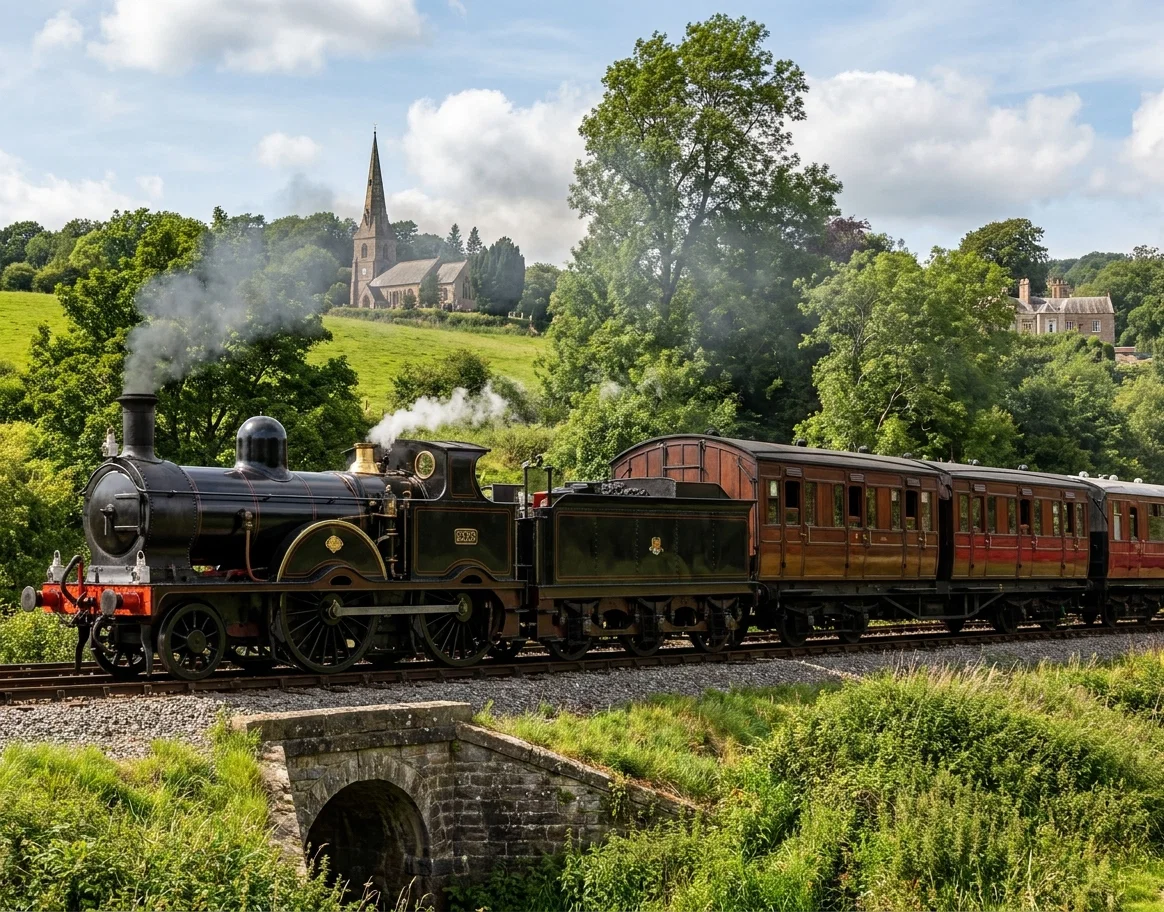
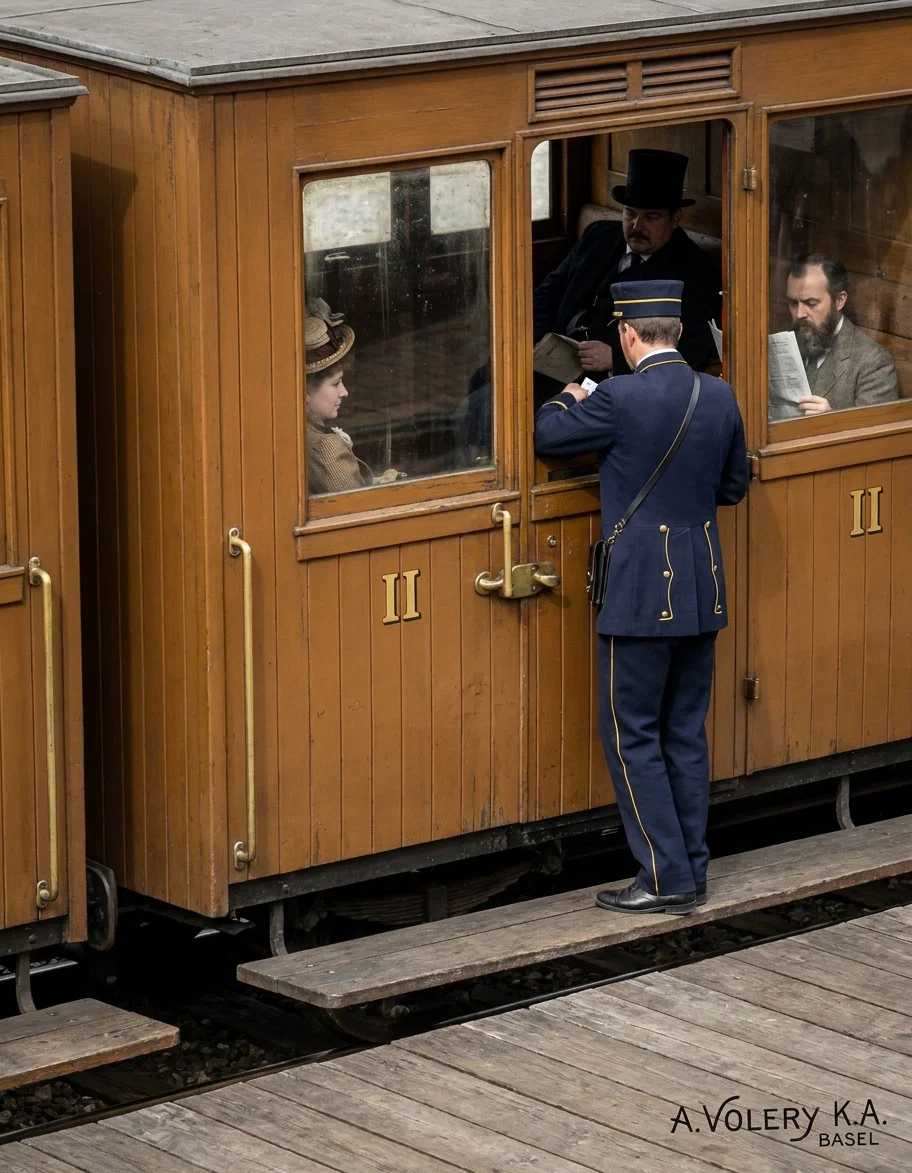
The first sight of an English train gives anything but a favorable impression. The cars are lower, narrower, and shorter than the American cars; and they look even shorter than they really are, because they have no projecting platforms at the ends, and no overhanging roofs. The platform is not needed, because the car is entered from the side. As you approach the train, a gentlemanly official opens the door of a first, second, or third class compartment, according to your ticket, and if you object to one in which smoking is permitted, he finds one in which it is prohibited. Entering through the narrow door, you find yourself in a little room about seven feet by nine, with two seats and two doors, a seat on each side and a door at each end. The end of the compartment is the side of the car. On each side of the doors are stationary windows, and in the upper part of the door is a window which can be lowered or raised according to the amount of ventilation desired. Just before the train leaves the station, the doors are all closed and locked, and are at once unlocked on reaching another station.168The conductor walks along a foot-rail on the outside of the car, clinging to rods placed there for this purpose, and receives the tickets through the window. On fast trains the tickets are usually examined at the stations.
AN ENGLISH TRAIN.
“TICKETS, PLEASE.”
The English engine is a plain, homely-looking affair, without polish or ornament. There is no bell, no immense cow-catcher, no great head-light. These things are not necessary, because the track is thoroughly protected either by high walls or by strong fences or hedges, and all the road-crossings, footpaths, and intersecting lines are generally built above or below the grade. Where they are not thus built, trustworthy persons are employed to guard the crossing, and at a certain signal to close the entrance to the track, either by gates, bars, or chains. Accidents rarely occur; but when one does, the laws are very severe on the railroad company.
The ride from London to Dover occupied several hours, and was very pleasant. Although it was September, the country through which we passed looked as fresh and green as though it had been spring-time. This formed a striking contrast to the dry, brown fields of a rainless California autumn, and is no doubt due in a large degree to the humid climate of England. Were it not for the numerous manufacturing towns and villages thickly dotted here and there, the country would seem like one vast park, as everything is kept in such a high state of cultivation.
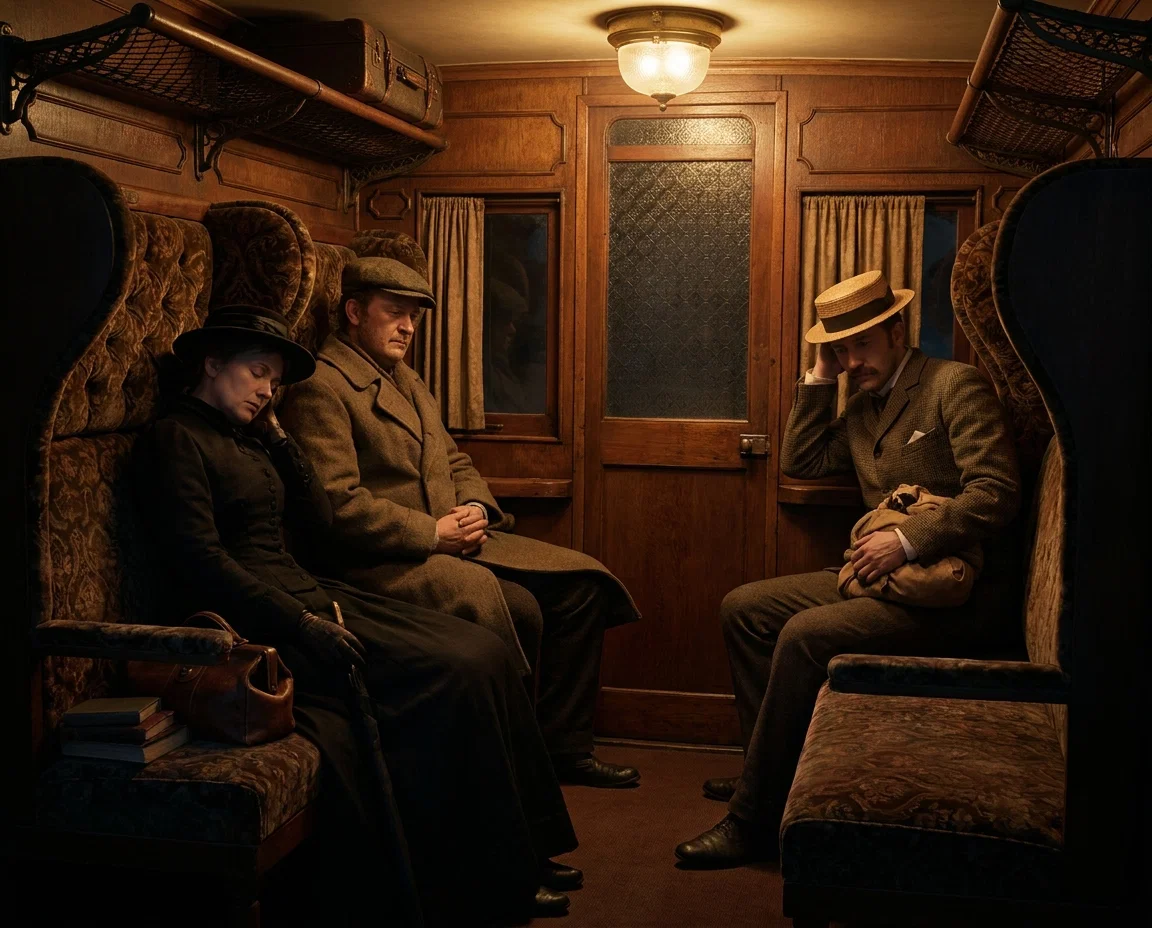
At Dover we went on board a small steamer which took us across the English Channel. The weather was fine, and the channel was unusually smooth; but the waves that would have had no effect on the Cephalonia, tossed this little steamer about, and caused considerable sea-sickness. Our company suffered but little. At Calais we were to take a night train for Basle. Bro. Kellogg and William thought best to secure a berth for me in the sleeping car; but we were traveling with second-class tickets, and the only sleeping car on this train was a first-class coach. To exchange my ticket for first-class, and pay the additional expense for a berth in the sleeper, would cost eleven dollars. This, of course, we could not afford to pay. Fortunately, however, we secured to ourselves a compartment in a car that went through to Basle without change, and by a skillful arrangement of our satchels, bundles, and blankets converted our compartment into a sleeping car, and secured a degree of rest. The railroad builders of Europe have not planned, as have those in169America, to prevent the comfort of travelers; and if you can secure plenty of room, you can make yourself quite comfortable for the night in these couches that at first seem so strange and inconvenient. We could have slept quite well had it not been for the caretaking officials, who would throw open the door at many of the stations, and rattle off some information which we did not understand.
About six o’clock in the morning we reached Basle. Here we were met at the train by friends, and taken at once to the office of Les Signes des Temps, where we met old friends whom we had not seen for years. We are much pleased with the location of the new publishing house. While sufficiently near the center of the town for all business purposes, it is far enough out to avoid the noise and confusion of the city. The building faces the south, and directly opposite is a sixty-acre common of government land, bordered by trees. On the other side of the common are large buildings, behind which rise gently sloping hills covered with green fields and pretty groves. On one of the hills directly opposite us stands a quaint little church, and an old convent long since deserted, and occupied now only by a farmer. Back of all this rise higher mountains, covered with dark firs and forming a fine background to the lovely scene.
A SECOND-CLASS COMPARTMENT AT NIGHT.
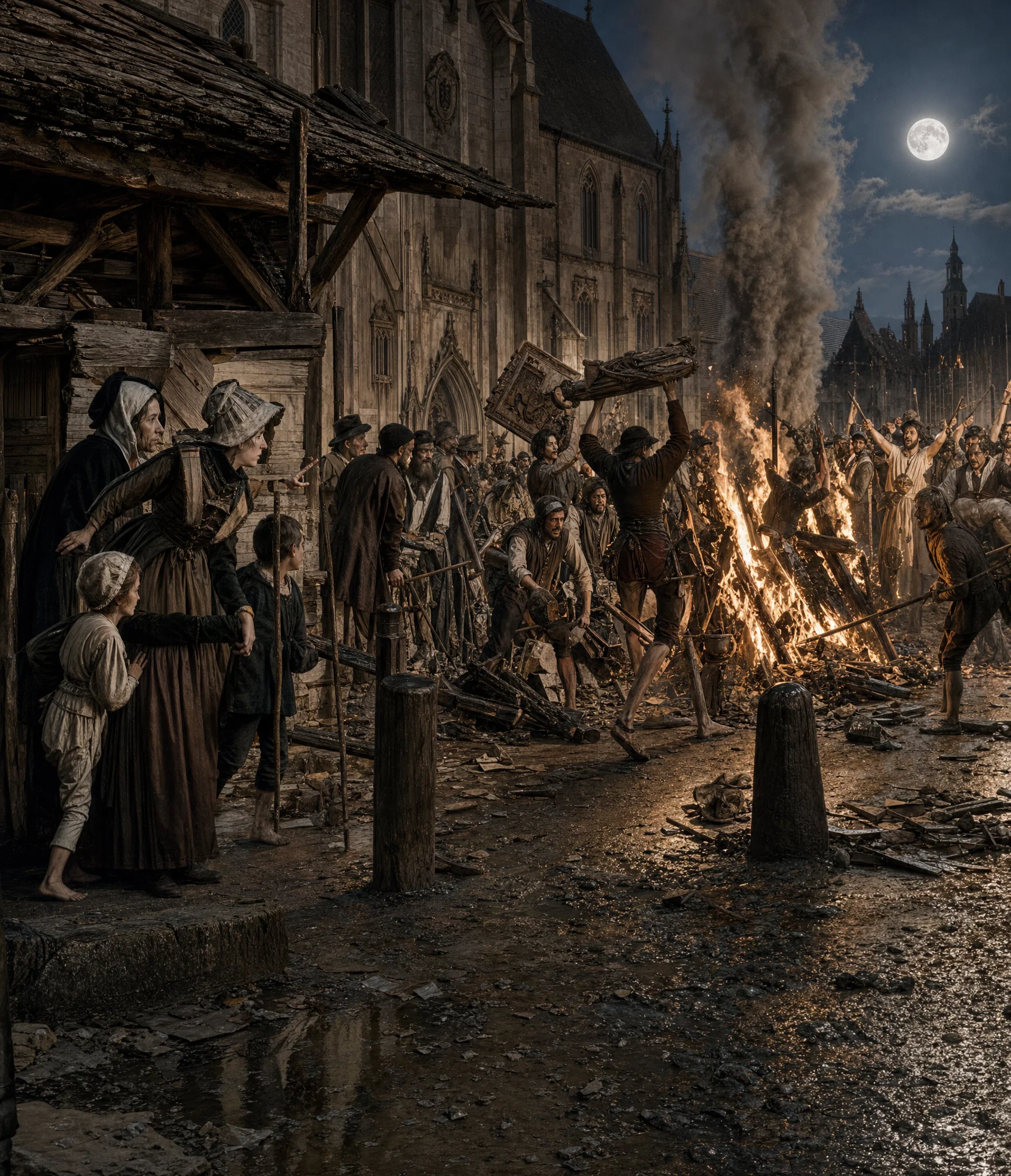
The city of Basle was an important place to the Protestant reformers. Switzerland was one of the first countries of Europe to catch the light of morning, and to announce the rise of reformation. And Basle was one of those points on which the light of day concentrated its rays, and whence they170radiated over the surrounding country. It was not, however, until years of waiting and conflict had passed that the Reformation was fully established here. The reformed then took the matter in their own hands, and, assembling to the number of three hundred, petitioned the municipal council, who affected to occupy a neutral position, to abolish the observance of the mass. In vain did the city magistrates try to reconcile papists and reformers by half measures. The reformers denounced the mass, the papists demanded its continuance. A civil war was feared. The people passed night after night in arms. The numbers on both sides continued to increase. At last twelve hundred persons who sympathized with Lutheranism, insisted that there should be no more delay, and meeting one evening by torch-light, they said to the faltering senate, “What you have not been able to do in three years, we will do in a single hour.” They then began their work of breaking down images, and committing other acts of violence. Continuing their work far into the night, they visited all the churches in Basle, demolishing with pike and ax the altars, tearing down the pictures and idols, and committing the fragments to the flames on the open commons. At this treatment of the images, Erasmus cleverly remarked,171“I am much surprised that they perform no miracle to save themselves; formerly the saints worked frequent prodigies for much smaller offenses.”
Burning of Images in Basle.
Being the seat of a university, Basle was the favorite resort of scholars. It also had many printing-offices. Here Zwingle received his early education; here Erasmus published the New Testament which he had translated from the original Greek into Latin; here Frobenius, the celebrated printer, published the writings of Luther, and in a short time spread them in France, Spain, Italy, and England; and here, too, John Foxe spent a portion of his exile in getting some of his books through the press. Poverty and persecution troubled him, and we fancy we see him walking to and fro upon the surrounding heights, sympathizing with earlier exiles, who said, “We sat down, yea, we wept, when we remembered Zion.” While here he issued the first installment of the “Book of Martyrs.”
As we looked upon our press, working off papers containing the light of truth for the present time, we could but think how much greater difficulties than we have met had been encountered on the same soil in former times by the advocates of Bible truth. Every movement had to be made in secrecy, or their work would be destroyed and their lives imperiled. Now the way seems to be prepared for the truth to go forth as a lamp that burneth. The Bible standard is raised, and the same words that fell from the lips of the early reformers, are being repeated: The Bible, and the Bible only, is the foundation of our faith.
In the providence of God, our publishing house is located on this sacred spot. We could not wish for a more favorable location for the publication of truth in the different languages. Switzerland being a small republic, that which comes from here is not looked upon with the suspicion that it would arouse if passing from one to another of the large rival powers. Three languages are spoken here,—the French, the German, and the Italian; therefore it is a favorable place for issuing publications in these languages.
The grassy common in front of the office, of which we have spoken, is reserved by the Swiss government for military drill. Here, day after day, at certain seasons of the year, we see the soldiers training, so that they may be ready, when needed, to engage in actual service. As we have watched the progress of the drill, and from time to time noted the thoroughness manifest in every department, the query has arisen. Why should there not be in Basle a large army of Christian soldiers drilling for actual service in the battles to be fought in the different countries of Europe against tradition, superstition, and error? Why should those who are preparing to fight the battle for Prince Immanuel be less earnest, less painstaking, less thorough, in their preparation for the spiritual warfare?
Basle has for years been a prominent missionary station among other denominations. Here is located a missionary college in which young men are being educated, and from which some are sent out to foreign lands every year. There are also in the immediate vicinity several other missionary educational institutions. It was in one of these that Bro. Erzenberger was receiving his education when the truth first found him.
We know of no better place in Europe for us to educate workers than right here in Basle. The new office affords an excellent opportunity for persons172to learn various branches of the work, and we would like to see scores of young men and women connected with the office, drilling for the Master’s service. We believe that the time is not far distant when a school will be connected with the work here, so that workers may be more thoroughly prepared to go forth as missionaries, and also that those of our brethren who have children may have a place to send them where they will not be obliged to attend school on the Sabbath. We are grateful that some efforts are now being made to train young people to go forth as soldiers of the cross of Christ to war against the enemies of truth. But we regret that these efforts are so crippled because of our limited means.
The people of God are not half awake. A stupor seems to be paralyzing their sensibilities. Each of us will soon have to stand before the Judge of all the earth, to answer for the deeds done in the body. All will then have to give an account for the good they might have done, but did not do because they were not so closely connected with God that they could know his will and understand his claims upon them. If the money that has been expended annually by our brethren in selfish gratification had been placed in the mission treasury, where there is now one missionary in the field there might be one hundred. Who will have to render an account for this great lack of funds? Many of our American brethren have done nobly and willingly for the advancement of the truth in Europe. But there is a great work yet to be done. Many who have given liberally could do more, and others should now come forward and bear their share of the burden. Now is the time when houses and lands should be converted into mission funds. Men are to be educated and disciplined. We feel alarmed at the little that is being done, when we have a world-wide message, and the end of all things is at hand. Christ is soon to come in the clouds of heaven to reward every man as his works have been. To whom will it then be said, “Ye have done what ye could.”?