It was in this place that Eld. Rosqvist was forbidden to preach, by the church council, and because he continued preaching, was arrested at the instigation of the priest, fined, and finally brought to prison.
On Sunday afternoon I spoke of the time of trial and persecution awaiting God’s people, and their duty to hold fast the truth. God has presented in his word sacred truths, and he expects us to accept them without regard to our own convenience, or good name, or worldly profit. Whenever a doctrine or duty is brought before us, the all-important question to be decided is, Is it enforced by the word of God? Does the Lord require this of us? If so, whatever may be the cross involved, we should unhesitatingly accept it.
If we love God and keep his commandments, we need not expect the world to be in sympathy with us, any more than it was with Christ. Says John, “The world knoweth us not, because it knew him not.” And in all ages the defenders of the faith have realized the truth of the words of Paul, “All that will live godly in Christ Jesus shall suffer persecution.” Because the truth contradicts the doctrines of men, and condemns their unrighteous practices, it excites the most bitter opposition. The majority, even of those who bear Christ’s name, are unwilling to follow his example of self-denial and cross-bearing; and as they become more and more alienated from him, they cannot distinguish between the heavenly196and the earthly; their peace is disturbed by the fact that there is a people that serve God and renounce every sinful practice. Men who are trampling upon God’s requirements feel a constant rebuke from the course of those who render obedience to him; and this is why such enmity is manifested against all who are true to God. For this reason the Pharisees rejected Christ, and the same spirit still exists, and will continue to exist until the close of time.
Said Christ to his apostles: “Behold, I send you forth as sheep in the midst of wolves; be ye therefore wise as serpents, and harmless as doves. But beware of men; for they will deliver you up to the councils, and they will scourge you in their synagogues; and ye shall be brought before governors and kings for my sake.” “Ye shall be hated of all men for my name’s sake; but he that endureth to the end shall be saved. But when they persecute you in this city, flee ye into another.” “The disciple is not above his Master, nor the servant above his Lord.”
Such is the treatment which the servants of Christ receive because they teach truths that are not in harmony with the doctrines of a world-loving church. And have not some of our brethren, even in this place, felt the force of these words of Christ? Have they not met, in the priests of the church, the same spirit that Christ encountered in the Pharisees? They have been forbidden to preach the truth. They have been brought before councils, and scourged in the synagogues, subjected to the stripes of reproach and falsehood, presented to the people as heretics, men not fit to be at large. The church authorities, like the chief priests and scribes of the Jews, have brought them to Pilate, to pronounce sentence against them, and have caused them to be thrust into prison. But all this is only a small matter in comparison with what is to be. The most bitter and cruel persecution always comes from those who have the form of religion without the spirit and power of godliness. There is nothing at which religious prejudice will hesitate.
That which especially excites the enmity of the world in our day is the presentation of the claims of the fourth commandment. And this is the special work for the people of God at this time. The prophet John, looking down to the last days, saw that the temple of God was open in heaven, and the ark of his testament was seen. That ark contains God’s holy law, and John sees a people whose eyes are directed to the temple; their attention is fixed upon the law contained in the ark. “Here are they that keep the commandments of God, and the faith of Jesus.” Heaven is watching this work with the deepest interest. Angels are watching the development of character, and are weighing moral worth. They are bidden to place a mark upon those who are loyal to God’s commandments; such will have special help from God to endure the test and proving of the time of trouble.
If we are seeking earnestly for the truth, we shall find it. The Saviour’s promise is, “If any man will do His will, he shall know of the doctrine.” “The entrance of Thy words giveth light;” and we shall know, “if we follow on to know the Lord, his going forth is prepared as the morning.” As the sun, rising higher and higher in the heavens, sends forth its rays with ever-increasing brightness to the noontide glory, so the Sun of Righteousness sheds its light, shining more and more unto the perfect day.
Those who cling to old customs and hoary errors have lost sight of the fact that light is ever increasing upon the path of all who follow Christ; truth is constantly unfolding to the people of God. We must be continually advancing if we are following our Leader. It is when we walk in the light that shines upon us, obeying the truth that is open to our understanding, that we receive greater light. We cannot be excusable in accepting only the light which our fathers had one hundred years ago. If our God-fearing fathers had seen what we see, and heard what we hear, they would have accepted the light, and walked in it. If we desire to imitate their faithfulness, we must receive the truths open to us, as they received those presented to them; we must do as they would have done, had they lived in our day.
Just before his crucifixion, Jesus prayed for his disciples, “Sanctify them through Thy truth; thy word is truth.” It is the duty of every one to search the Scriptures for himself. We cannot accept the assertions of men as infallible. To those who oppose and denounce our faith we say, Show us from the Bible that we are in error. God’s word is to judge us at the last day, and we want to know what saith the Scripture. We are regarded with jealousy and bitterness because we will not accept as evidence the assertions of men and the testimony of the Fathers; but we cannot purchase peace and unity by sacrificing the truth. The conflict may be long and painful, but at any cost we must hold fast the word of God. “The Bible, and the Bible only,” must be our watchword.
I would say to those who have turned their feet into the way of God’s commandments, It is not enough to profess to keep the law of God; do you carry its precepts into your daily life? To profess the truth and not be sanctified through it, is to dishonor God. We want the truth on every point, and we are to put it in practice daily. Come to Christ in simplicity and faith, and he will enlighten your understanding, and enable you to walk so humbly and circumspectly before your fellow-men that they can speak no evil of you except for the same reason that men spoke evil of Christ. While you follow in the path of humble obedience day by day, you will be gaining a living experience in the things of God,—an experience which you must have in order to stand in the troublous times before you.
I thank God that the light has come to this place. Although it may seem that you are all alone here, yet you are not alone; for Christ is with you; you are in blessed company. You have the words coming down the line from prophets and apostles, to encourage you to steadfastness. Many of these holy men lost their lives for their faithfulness to God. If you suffer for the truth’s sake, remember that this is no more than others have done before you. What trials and afflictions Paul endured, yet he says: “Our light affliction, which is but for a moment, worketh for us a far more exceeding and eternal weight of glory; while we look not at the things which are seen, but at the things which are not seen; for the things which are seen are temporal; but the things which are not seen are eternal.”
As the wickedness of the wicked increases, opposition will be brought to bear upon you closer and closer. Satan has many batteries prepared to open upon the people of God. You will have troubles and difficulties to meet, such as you never experienced before,198and there will seem to be no way of escape. But if you have learned to trust in God, you know that he will not leave you; you have the assurance that he will hear your prayers, for he has been to you all that he has promised. You can hang your helpless soul on Jesus, and in the time of trial he will prove to you a never-failing helper.
Those who here acknowledge God as their ruler, by obeying the laws of his government, will be accounted worthy of a place in his family in heaven; for they have proved that they will reverence him and obey his will in the future life. When the final hour of trial comes, God will send his angels to guard them. When the voice that once shook the earth shall shake not only the earth but also heaven, then the voice of our Lord will be heard saying, “Come, ye blessed of my Father, inherit the kingdom prepared for you from the foundation of the world.” They will see him as he is; they will escape those things that are coming upon the earth, and will stand within the heavenly courts; for Christ has promised, “Blessed are they that do his commandments, that they may have right to the tree of life, and may enter in through the gates into the city.”
A LUTHERAN CHURCH.
We visited a Lutheran church, an old building which has, apparently, stood unchanged for hundreds of years. It is built of logs, the walls as well as the roof covered with clumsy split shingles, and painted a muddy red. The doors are low. On the inside, the building is arched and celled. It seemed like a prison; the air struck us with a peculiar, dungeon-like chill, and the close box pews, with their narrow seats and high, straight backs, suggested torture. In the place where the pulpit stands in our churches, was the altar, but not elevated above the floor. It was surrounded at a little distance by a circular railing, outside of which was a low seat for the communicants to kneel upon while taking the holy wafer. To the right of the altar, attached to a projecting pillar, was a little box-like pulpit approached by a flight of steps. An hour-glass added still further to the antiquated appearance of the place. The priest’s study in the rear was lighted by small grated windows. It contained a table and chair, and two small cases of books, and was in keeping with the rest of the building. A more dismal place I do not wish to see. This old building seemed like a relic of the Dark Ages, as if priest and people had been asleep for hundreds of years. I could not but think that it fitly represented the condition of the church.
The priests enjoy their beer-drinking and smoking, and cling to old forms and customs, as jealous of any reform as were the scribes and Pharisees. They are of the class condemned by Christ, as those who have the key of knowledge, who will not enter in themselves, and those who would, they hinder. They are so fearful lest something shall be introduced that will turn away the people from their creeds and dogmas, and divert the means into other channels, that they spare no effort to excite prejudice, and resort to commands and threats to prevent their members from going to hear Bible preaching. They look with suspicion upon every one who does not fully sustain their church, and denounce as heretics those who instruct the people in Scripture truth. By representing them as working against the interests of the church, they stir up the authorities against them. They claim the name of Lutherans, and point back to Luther,199to his work and his testimony, but they have not cherished his spirit. They do not, like Luther, test their doctrines by the Bible, but by their creed, their church customs, the practices of the Fathers. Their so-called Lutheranism is little better than Catholicism with the name of Luther attached to it.
The moral standing of a community is dependent upon the diffusion of Bible knowledge and the growth of true religion. Where the religious teachers bar the people from obtaining light from the Scriptures, unbelief, skepticism, and infidelity cannot but prevail. And with such examples as are given by these pastors, who are seeking to benefit themselves and not their flock, it is not strange that the people are self-indulgent, pleasure-loving, and sensual. But the Lord will cause the light of truth to shine forth amid the moral darkness; and those who receive the truth should be careful to correctly represent its sanctifying power upon their life and character, to show the contrast between the influence of truth and that of error.
A SWEDISH DINNER.
On Monday we were invited to dine with the family of a merchant whose wife had begun to keep the Sabbath. These friends sent their carriage for us, and did all in their power to render our visit pleasant. Our reception was a silent one, as Eld. Matteson, who acted as interpreter, had not yet arrived; but we were cordially welcomed. After laying aside our wraps, the lady of the house gave me her arm, and conducted me to the dining hall, a large, nicely furnished room, in which were several sofas, and a number of small tables, each covered with a linen cloth. In the center of the room stood a larger table, arranged as usual with a large flower-pot in the center, and spread with bread and butter, cheese, cold meat, and various delicacies. After the arrival of Eld. Matteson, a few moments were spent in conversation; then we gathered about the table, all standing, while Bro. M. asked a blessing in Swedish. We then took what we wished from the table; some stood or walked about, others were seated, as they pleased, about the room. After the “smörgås” was eaten, we seated ourselves at the small tables, and were served with fish, meat, and vegetables very nicely prepared. After this, plates of soup were brought in. It was of two kinds, meat soup, and a dish called plum soup, made from prunes, raisins, apples, etc. Last came the dessert of cooked pears and cream. Then all stood up around the center table and gave thanks in silence. After this, each guest shook hands with the host and hostess, thanking them for the entertainment, and then the ceremony was ended.
We passed into another room, and spent some time in conversation. Eld. Matteson read and explained portions of Scripture, and we had a season of prayer. An hour or two after dinner it is customary to serve cakes and coffee; our friends, knowing that we did not use the latter, substituted hot water and cream. This we drank from tiny china cups, but we had no need to eat again. We bade our friends farewell, and were conveyed in their carriage back to the home of Bro. Hedin. As is the custom in Scandinavia, the leave-taking was more ceremonious than our reception.
ÖREBRO.
On our way to Christiania, we spent two days in Örebro, where there is a small company of Sabbath-keepers.200This place is situated in the central part of Sweden, in the midst of a fruitful valley, beyond which, in the distant west, the blue mountains are visible. It has upwards of twelve thousand inhabitants, and is one of the oldest cities in Sweden, having probably been a city for a thousand years.
We arrived in Örebro in a rainstorm, and as there were no carriages at the station, we were obliged to walk more than half a mile in the rain to the house of Sister Jacobson. I had been ill, unable to take sufficient food to sustain my strength, and this effort affected my heart, causing a sharp pain that alarmed me. But an appointment was out for me to speak that evening, and as the friends obtained a team to take us to the place of meeting, I filled the appointment.
We were much disappointed to see what meager arrangements had been made to bring the truth before the people of this large city. The meeting-hall consisted of a suite of chambers in the second story of a private dwelling. As in many private houses in Sweden, the entrance was at the rear of the building. The principal room would accommodate about fifty persons, and the two smaller ones, opening one into the other from this, would seat twenty each. All were furnished with board benches, without backs. We had two evening meetings. At the first I spoke from the words, “If any man will come after me, let him deny himself, and take up his cross, and follow me;” and at the second, upon the work of preparation to meet our Saviour, my text being, “Watch ye therefore, and pray always, that ye may be accounted worthy to escape all these things that shall come to pass, and to stand before the Son of man.” The rooms were crowded to their utmost capacity. The Lord helped me to speak, and hearts were reached, I know, by the starting tears, and the look of interest on many faces. I will do my part faithfully in bringing the light before the people. If my brethren neglect their duty, the responsibility will be theirs, not mine.
In Örebro, as well as in Copenhagen, I am convinced that we might have had a good hearing if our brethren had secured a suitable hall to accommodate the people. But they did not expect much, and therefore did not receive much. We cannot expect people to come out to hear unpopular truth when the meetings are advertised to be held in a basement, or in a small hall that will seat only a hundred persons. The character and importance of our work are judged by the efforts made to bring it before the public. When these efforts are so limited, the impression is given that the message we present is not worthy of notice. Thus by their lack of faith our laborers sometimes make the work very hard for themselves.
While we were here, this matter was presented to me in a dream. The question was asked one of our laborers, “How far would a light send its rays if it were placed under a bushel?” “No farther than the compass of the bushel,” was the answer. “How far would it shine if put under a bed?” “It would not illuminate the room,” replied the one addressed; “it would be too low and too obscure.” “Then,” said the questioner, “place your light on a candlestick, and it will give light to all that are in the house. Your ideas need to be enlarged and elevated. The people have lost an opportunity to obtain light that God desired them to have.” When the Lord sends his people help, they should show that they value it. Those201who stand at the head of the work in these countries should be careful that they do not give it a narrow mould. As they treat the work, so will be the impression made upon the minds of those who are left to carry it forward in their absence. Brethren, we need less of self, and more of Jesus. We should seize upon every God-given privilege and opportunity, and by example as well as words show the sacredness and importance of the message of warning which God sends to the world.
REFORMERS IN SWEDEN.
Örebro was the home of two of the leaders in the Swedish Reformation, Olaf and Lawrence Patersen. They were the sons of a blacksmith, but received a liberal education, studying for several years at the University of Wittemberg, under Luther and Melancthon, where they received the doctrines of the reformed faith. The elder of the two brothers is said to have been in the crowd before the door of the church at Wittemberg when Luther nailed his theses to it. Both were eminent for their learning and piety, and for the zeal and courage with which they advocated their faith. They are said to have resembled the great reformers of Germany. Like Melancthon, Lawrence, the younger, was learned, thoughtful, and calm, while Olaf by his powerful eloquence aroused the people. For this reason he was often violently assailed by the mob. The Catholic priests stirred up the prejudices of the ignorant and superstitious people, so that upon several occasions the reformer barely escaped with his life.
These reformers were, however, favored and powerfully assisted by the king. Under the rule of the Romish church, the people were steeped in poverty and ground down by oppression. They were destitute of the Holy Scriptures, and having a religion of mere signs and ceremonies, which conveyed no light to the mind, they were returning to the superstitious beliefs and pagan practices of their heathen ancestors. The nation was divided into contending factions whose perpetual strife increased the misery of all. The king determined upon a reformation in the State and the Church, and he welcomed these able and powerful assistants in the battle against Rome. Olaf Patersen he appointed preacher in the great cathedral at Stockholm, while Lawrence was made professor of theology in the university at Upsala. The two brothers translated the Bible into the Swedish language, giving to the people of that country for the first time the word of God in their native tongue.
In the presence of the king and leading men of Sweden, Olaf Patersen ably maintained the doctrines of the reformed faith against the Romish champions. He declared the Fathers to be below and not above Scripture, and that their interpretations were to be received only when in accordance with Holy Writ. He denied that the word of God is obscure when laying down the fundamental doctrines of the faith, and he presented the Bible’s own testimony to its simplicity and clearness. Christ said, “My doctrine is not mine, but his that sent me,” and Paul declared that should he preach any other gospel than that which he had received, he would be anathema. “How, then,” said Dr. Olaf, “shall others presume to enact dogmas at their pleasure, and impose them as things necessary to salvation?” He showed that the decrees of the church are of no authority when in202opposition to the commands of God. And maintaining the great Protestant principle, “The Bible, and the Bible only, as the rule of faith and practice,” he gained a victory which decided the king in favor of the Protestant faith, and virtually established the Reformation in Sweden.
“The stage on which this conference was conducted was an obscure one compared with that of Wittemberg and Augsburg, and the parties engaged in it were but of secondary rank compared with the great chiefs between whom previous contests of a similar kind had been waged; but . . . it shows us the sort of men that formed the rank and file of the army of the reformers. They were not illiterate, sectarian, noisy controversialists; far from it. They were men who had studied the word of God, and knew well how to wield the weapons with which the armory of the Bible supplied them.”
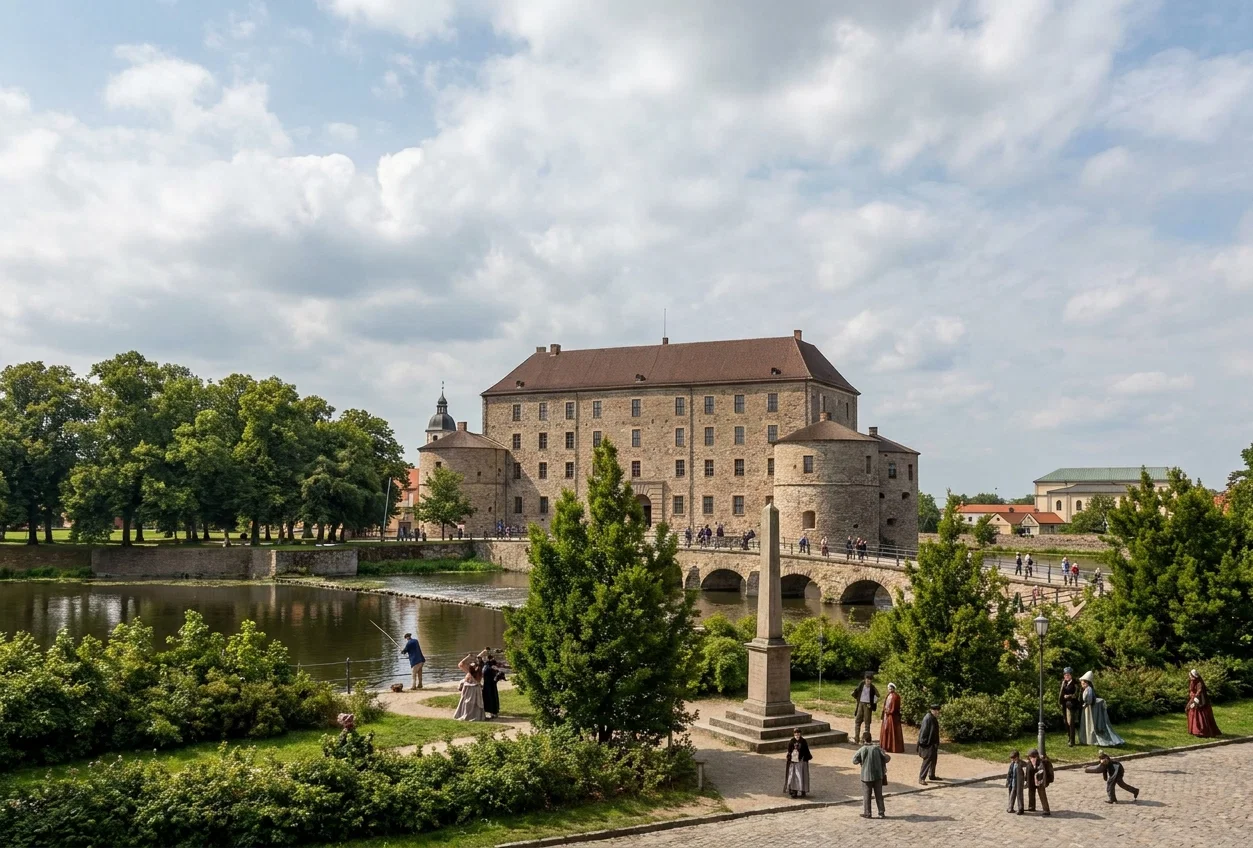
There now stands in Örebro, in a little park in front of the college, a monument erected over fifty years ago to the memory of these remarkable men, and bearing the inscription, “In memory of Olaf and Lawrence Patersen, the first preachers of the Lutheran doctrine in Sweden, born in Örebro. Dan. 12:3.” Just across the river is a beautiful park, and to the right stands “Engelbrekt Slott,” one of the oldest castles in Sweden. For many years this castle was also the prison for the district, and it was here, no doubt, that those arrested for preaching the Lord’s soon coming in 1843 were imprisoned. Some of our friends visited the dark room in the round tower that was used as a prison; they also visited the large prison built since, in which Bro. Rosqvist was confined for preaching the present truth in Grythyttehed.
PERSECUTION FOR PREACHING THE FIRST ANGEL’S MESSAGE.
In Sweden, as in other countries, the most bitter opposition to the reformation was from the clergy. As the reformers gained the ascendency, and Protestantism became the State religion, they grew intolerant and oppressive. The priests of Sweden possess great influence, though their authority is limited. In every town there is a church council, which has power to forbid all preaching that is considered dangerous to the State Church, or that will cause division in it. Of this council the priest is a member; but while he may desire to enforce the law, he can do nothing if the other members of the council are opposed. The law is now very unpopular, and is not often enforced. There is a strong public sentiment in favor of freedom of speech and conscience, but as we have seen, the Lutheran clergy are jealous of any influence which shall weaken their hold upon the people, and the spirit of intolerance and persecution is not extinct.
The preaching of the first message in Sweden excited much opposition, and the experience of those who took part in the movement is full of interest. The message was brought to this country from England. In the province of Örebro it began to be proclaimed in the year 1843, by several laymen, called “ropare.” These preached with great earnestness that the hour of God’s Judgment had come, and a wide-spread interest was aroused among the people. In the fall of the same year, two young men were moved to give the warning. The people assembled in great numbers to listen to their preaching, and the meetings were continued both day and night, sometimes in a private house, and sometimes203in the woods. Many were roused from their careless security, and led to confess their sins and to seek mercy and forgiveness in the name of Jesus. But the greater the interest, the greater the opposition and persecution. There were some who declared the preachers to be insane, or laboring under some strange disease. The priest of the State Church made several attempts to stop the preaching, and to lull the people to sleep again; but without avail. Finally the police were ordered to arrest them, and for six weeks they searched for them in the woods, but in vain.
EVERETT'S SLOTH.
Through the efforts of the priest they were finally arrested and imprisoned. An account of this is given by one of the young men, as follows: “At last the priest summoned us to appear before him. In answer to this summons, about forty of us, mostly young men and women, repaired to his house. After a few questions, he felt our pulse to ascertain if we were affected by disease. We assured him that we were in good health. He then became angry, and demanded a reason for our conduct. This we gave him from the Bible. When we had finished presenting our faith, we noticed that nearly all present had been weeping. All, except my companion and myself, were permitted to return home. The next morning we were arrested by the police, and thrown into the prison at Örebro, where we were assigned a cell among the thieves.
“When we were brought before the governor for examination, he demanded by what authority we were sent to preach. We referred him to Joel 2, and Rev. 14:6-8, and told him further that the Spirit of God came upon us with such power that we could not resist it. After a number of questions he angrily said, ‘I will cure you of your foolishness.’ He then lashed us till his strength failed, when he threw the scourge to his private secretary, and ordered him to continue the lashing. After being severely punished in this way, we were returned to our cell. The same treatment was repeated the next day. The governor ended by saying, ‘If you do not cease your preaching, I will shut you up where neither sun nor moon can ever shine upon you.’”
“The following day we were taken to the hospital to be examined by the doctors. Two physicians, two ministers, and a chamberlain were present. We were requested to testify concerning our faith, and we complied with this request. While we were speaking, the chamberlain left the room, with tears streaming from his eyes. The ministers and one of the doctors soon after withdrew without saying a word. The remaining doctor then called in his servant, and directed him to shave our heads, but to leave some hair in the form of a cross. This was done, and the next day we were taken to the insane asylum.
“Here we were put in a room which had been left by its previous occupant in so filthy a condition as to be not only unhealthful but indecent. In the morning we were conducted to an antechamber, and exposed to a powerful stream of cold water. We tried to protect our heads by covering them with our hands; but as soon as we lifted our hands for this purpose, our attendant gave us a blow on the head. Finally my comrade fell to the floor in a swoon, and as he fell, his crutch [he was lame] struck me in the side with such force that I also fell, completely exhausted. We lay in the water until we regained our strength, when the same treatment was repeated. This done, we were again205taken before the doctor, who noticed that we trembled from cold and exhaustion, and said, ‘I will soon warm you up.’ He produced a large bundle of sticks, and beat us with them until he could do so no longer.
“On the second day after this, we were again brought out for trial, and were told that we would be scourged until we should be compelled to swear. After consultation with each other we repeated the curses mentioned in Deut. 28:15–20, which God uttered against those who would not obey his voice. Through the sympathy of the watchman, it was represented to the governor that we had fulfilled the injunction, and we were then set at liberty.”
They were permitted to return home, but the harsh treatment they had received brought upon both a severe illness, which it was feared, for a time, would prove fatal. Both recovered, however, and afterward preached with greater power than before. Hundreds of people came to their meetings, and the neighborhood for many miles around became stirred. Many hardened and wicked persons were led to seek God, and secret sins and crimes were confessed.
Efforts were again made to have them arrested; but persons who sympathized with them appealed to the king in their behalf, and secured an order that they should not be molested. From that time they continued to labor undisturbed. About the middle of the year 1844, however, the power which they had before possessed left them. The truths they had presented appeared as clear and forcible as ever; but the warning having been given, the special manifestation of God’s Spirit which had been bestowed to aid its proclamation ceased.
CHILD-PREACHERS.
In many places where the power of the clergy was exercised to prevent the preaching of the advent truth, the Lord was pleased to send the message through little children. As they were under age, the law of the State could not restrain them, and they were permitted to speak freely and unmolested. Thus the warning of the soon-coming Judgment was given to the people. This continued about nine months. After that, the influence upon the children was declared by the authorities to be a disease, and some of them were taken to the hospitals; but their mouths were not stopped; for they preached as long as God chose to use them as witnesses.
The movement began in the fall of 1842, and continued through the winter of 1843. An eye witness, speaking of the work accomplished through these children, says: “The weather was providentially very favorable that winter. There was little snow, but the marshes, lakes, and rivers were frozen over so that they could be used as a high-road, and the people went in masses to the places where these child-preachers were, who were mostly poor cottagers. A little girl began preaching but a few miles from the place where I lived, and as the news of the wonderful movement was noised about, I went with my wife to see and hear for myself. When we arrived at the cottage, it was filled with people. The child, who was six or eight years old, moved around among them, and they asked her questions, which she answered as a child usually does. The people flocked together, till the house was surrounded by a great number. When the last had arrived, her manner changed entirely, both in boldness and movements, clearly indicating that she206was moved by an invisible power, and not by her own natural gifts. When she commenced speaking, her voice also changed. She said, ‘Fear God, and give glory to him; for the hour of his Judgment is come.’ She reproved sins, such as drinking, theft, adultery, swearing, and backbiting, and also reproved church-goers for attending church with worldly business in view, instead of listening to God’s word and conforming their lives to it. Her voice and words were impressive. Many were weeping and sighing. They were told that time was given them to repent, but they must do it immediately, and not put it off.
“We went home with stricken and trembling hearts. I felt that I must take my Bible, which I thought I had carefully studied, and search it yet deeper. I could hardly work the following week. My thoughts were constantly running on God’s word, and the sharp reproofs and expositions I had heard from that little child, who probably had not even learned to read.
“A great awakening commenced among the people. Many drunkards became sober men; thieves returned stolen property, and confessed their sins; forgiveness was asked for wrongs done. A work was accomplished such as no preacher with learning and great talent could have effected.”
“A girl who resided in Ljung Parish continued also to preach as long as the first angel’s message was proclaimed. When that ceased, she was imbued with a spirit of prayer, and often went out into the woods and other solitary places, and there earnestly besought the Lord to have mercy on the fallen race of humanity. She was very quiet and reserved, and showed by her Christian walk and conversation that she loved the Saviour, and was trying to live in obedience to God’s holy requirements.”
Years ago, the work of the first message in these countries was presented before me, and I was shown circumstances similar to those related above. It was God’s will that the tidings of the Saviour’s coming should be given in Sweden, and when the voices of his servants were silenced, he put his Spirit upon the children, that the work might be accomplished. When Jesus drew near to Jerusalem attended by the rejoicing multitudes who with shouts of triumph and the waving of palm branches heralded him as the Son of David, the jealous Pharisees called upon him to silence them; but Jesus answered that all this was the fulfillment of prophecy, and if these should hold their peace the very stones would cry out. The people, intimidated by the threats of the priests and rulers, ceased their joyful proclamation as they entered the gates of Jerusalem; but the children in the temple courts afterward took up the refrain, and, waving their branches of palm, they cried, “Hosanna to the Son of David!” When the Pharisees, sorely displeased, said unto him, “Hearest thou what these say?” Jesus answered, “Yea; have ye never read, Out of the mouth of babes and sucklings thou hast perfected praise?” As God wrought through children in Christ’s day, so he wrought through them in giving the first message. God’s word must be fulfilled, that the proclamation of Christ’s advent near should be given to all peoples, tongues, and nations.
God speaks to nations and to cities, sending them messages of mercy, which, if accepted, would save them from great calamities. If they would be guided by his voice, he would be their protector, their front guard and their rear ward. But like the Jews they know not the207time of their visitation. In their pride of heart they refuse his guidance, and are left to walk in their own counsels, and, like God’s ancient people, to reap the harvest which they have sown.
CHRISTIANIA.
FRIDAY morning, Oct. 30, we reached Christiania, Norway, and were soon in the home of Eld. A. B. Oyen, a retired and pleasant location in the suburbs of the city. Here the household language was our own familiar English, and it almost seemed that we were once more in our native America.
At Christiania we have a church of one hundred and twenty members, and here is located our Scandinavian publishing house. The new mission printing-house and meeting-hall were not completed, and part of the old building which Eld. Matteson bought six years ago, and in which were the printing-house and meeting-hall, had been torn down to give place to the new; therefore we had no hall of our own that was suitable for meetings. But the Good Templars very kindly gave us the free use of their hall, which would seat over three hundred.
About two hundred attended the meeting Sabbath forenoon, and in the afternoon one hundred assembled to celebrate the ordinances of the Lord’s house. A large hall belonging to a workingmen’s society had been hired for Sunday forenoon, and I addressed an attentive congregation of about fourteen hundred. The hall was crowded, and many went away, unable to obtain an entrance.
Tuesday we went about thirty miles from Christiania, to Drammen, a city of several thousand inhabitants, where there is a church of twenty members. Here, as in other places, it was difficult to obtain a good hall. But the best in the place was secured, a hall used for balls and concerts, about thirty-six by eighty feet in size, with a narrow gallery on each side, and a huge stove in each end. There was no pulpit nor place for one. Six beer tables, brought in from an adjoining room, served to make a platform. A square carpet was thrown over this platform, and another table set on top for light-stand and pulpit, while steps were made with chairs and stools. We doubt if the hall or beer tables were ever put to so good use before. The people came and filled the seats, the galleries, and all the standing room, and listened with the best of attention while I spoke to them of the love of Christ, and his life of sacrifice.
Wednesday and Friday evenings another hall was secured in Christiania, and I spoke to about five hundred each evening.