After returning from the baptism, we celebrated the ordinance of humility, and were just preparing for the Lord’s supper when I was called to appear before a sheriff who was in the house of a Catholic near by. Bro. Perk went with me to act as interpreter. When we appeared before the sheriff, he at once demanded our passports, and then drew up a statement in which we were both accused of teaching Jewish heresy, and of having baptized two women into this faith. It also accused us of proselyting Russians. The Russian brother was then called in and examined. He testified that he had left the Greek Church eleven years before, and that he had kept the Sabbath for a year, also that I had not taught him at this meeting, for I understood no Russian, and he understood no German, and as there was no interpreter, there was no ground for the charge that I had been teaching Russians. Then the two sisters who had been baptized were called, and asked many questions as to why they were baptized, whether I persuaded them, and why their first baptism, when they were sprinkled, was not sufficient. The officer went so far as to make fun of them, when the husband of one of them reproved him, and told him kindly to mind his own business.
There were several Catholics present, also a Lutheran. These seemed to enjoy the whole proceeding, and at the close of the examination several signed a statement that I had baptized, though they openly confessed that they did not see me do it, and that they testified simply because of what we had said in regard to it. Finally the sheriff asked us to sign the statement which he had drawn up. This we refused to do, for we were not guilty of teaching Jewish heresy. He also asked the brethren to sign a statement that they would not work on Sunday. This, of course, they refused to do.
The people present declared that they had not called the sheriff, and when we asked him who our accusers were he said we would find out in Perekop. Two of our brethren then became responsible for our appearance at that place the next day, and we returned to the place of meeting, and proceeded with the ordinances, the peculiar circumstances of our situation forcibly reminding us of the time when they were instituted. All thought, however, that when we should appear before the judge in Perekop there would be little difficulty in proving our innocence and securing freedom.
On Sunday morning we had a short parting meeting, and then started for Perekop, little dreaming of what there awaited us. The many market wagons which we met, as well as the large market in the town of Arminsky, which was still in progress at 1 P. M., showed how little real regard the people have258for the Sunday Sabbath; yet if a Sabbath-keeper works on that day they are very zealous in their interference. At Arminsky we consulted a lawyer, who told us that the charge of teaching Jewish heresy was a serious one, but that aside from this we had little to fear.
We arrived at Perekop about two o’clock in the afternoon, and presented ourselves without delay before the Isprafnik, the highest officer of the district, and delivered the sealed letter from the sheriff. At first he treated us kindly, but after reading the letter his countenance changed. He eyed us closely from head to foot, and angrily exclaimed, “We want no preachers in Russia.” We had been told that we would be tried at once, and still hoping that this would be the case, we cheerfully followed at his bidding. Leading us across the street to the court house, he remained only long enough to get a key, and then conducted us to a one-story building in the courtyard, directed us to enter one of the small rooms, quickly closed the door and turned the key, and for the first time in our lives we were in prison, and that, too, in Russia. I shall never forget the anxious face of the brother who brought us from Berdebulat, as he stood staring at us through the heavily barred windows. Then he hurried away, hardly daring to wait while we told him to write to Basle.
After our brother had left us, we began to examine our surroundings. A glance was sufficient. Our room was empty, and the floor was nothing but mother earth. After awhile two chairs were brought in, and a speedy trial was promised. We waited expectantly, not knowing as yet how little reliance is to be placed upon the word of a Russian official. Meanwhile we told our sorrow to Him whose ear is always open, and to whom we can have access even when shut away from the world and earthly friends.
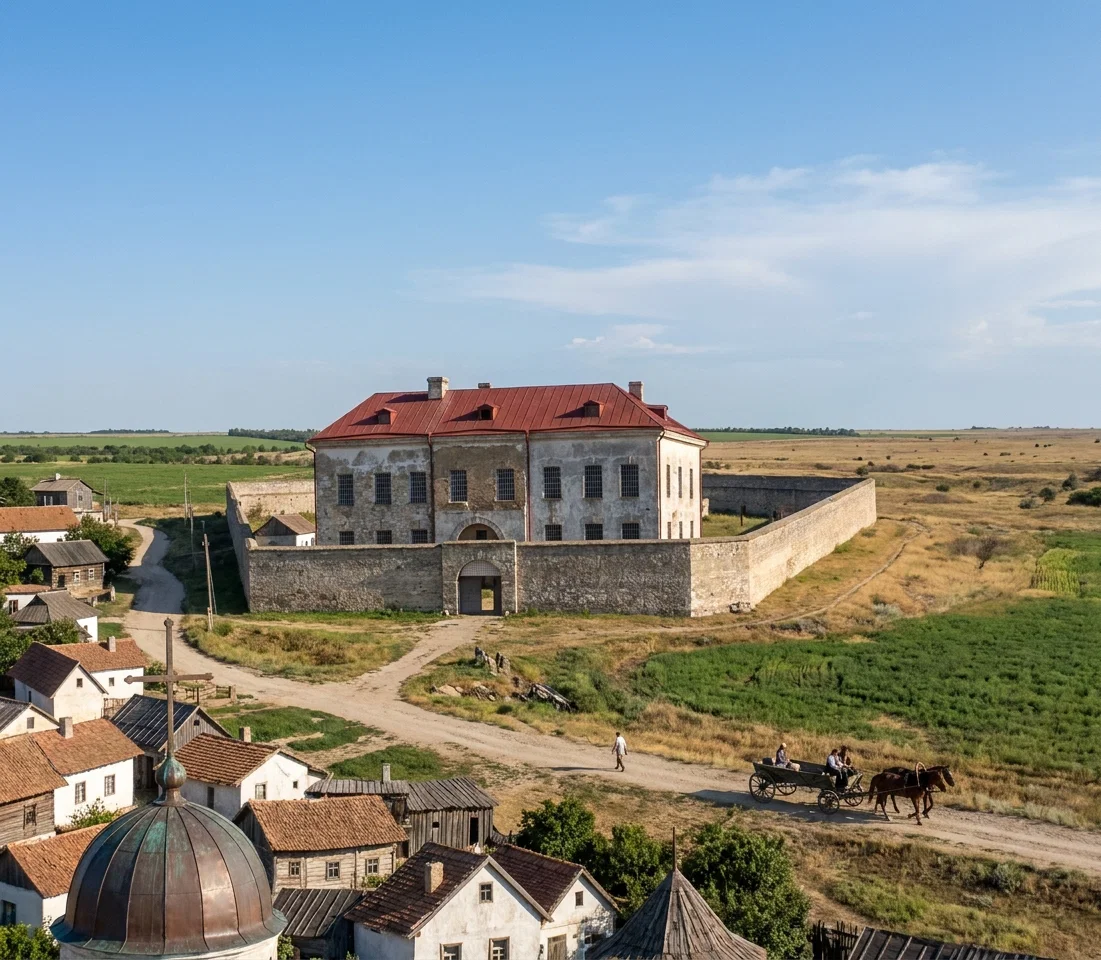
Toward evening our door was opened, and two policemen bade us follow them. They led us through the town, and at the end of a ten minutes’ walk halted before a large white three-story building, surrounded by a high white wall, and situated at a little distance from the town. This was the prison for the district. We afterward learned that some of its inmates were waiting for trial, and some for banishment to Siberia. The policeman knocked at the gate, a bell was rung inside, then the heavy gate was opened, and we passed into the prison inclosure, which we were not to leave for forty days.
They led us in between the guards, and soon we were examined by the jailer and his clerk. First our money was taken and counted. Then watches, knives, pens, and pencils were given up, and the rough prison clothes were brought forward. These consisted of a linen shirt, pants of the same material, a gray mantle, and a pair of slippers. This clothing was not only rough and coarse, but it was thin, and altogether insufficient to keep us warm. We begged to retain our own clothing, and told the jailer that we would not forget any favor shown us. Seeing that we had a good supply of money, he granted this request, and also allowed our German Bibles to be returned to us.
Then we were led by a turnkey to the end of the long corridor on the second floor, and locked into a seven by twelve cell, whose only furniture was a wooden framework apparently intended for a bed, and water and slop buckets. A tallow candle was thrust through the hole in the door, and we were left to259ourselves. Our hearts were full to overflowing, but we told our sorrows to the Lord, and soon found comfort and consolation from Him who was himself taken captive. We were weary and exhausted, and quickly prepared for rest, our boots and coats forming pillow, mattress, and cover. Soon we slept, hardly feeling the tiny wanderers that had discovered their new victims, and under the cover of night enjoyed their bloody meal. In the morning many red spots testified as to what company we had had during the night.
Early the next day we were brought into an empty cell, and as we were permitted to purchase for ourselves different food from the prison fare, Bro. Perk ordered a loaf of white bread and a jar of milk. But the food tasted strange, and I could eat but little. After awhile the Isprafnik was announced, but all the information we could obtain from him was that our cases were referred to the governor at Simferopol. In the afternoon we were permitted to go down to the office to write. On entering, we saw a prisoner standing in the corner. The jailer, who was scolding him, trembled for rage, and growing redder and redder walked up to the prisoner and struck him half a dozen blows in the face. The mouth of the prisoner began to bleed, but not daring to spit on the floor, he took off his slipper and used it for a spittoon. A strange feeling came over me, and with longing eyes I looked through the barred windows to the open fields where one might enjoy freedom, the precious boon for which I had been so little thankful until the present time.
The Prison at Perekop.
After the jailer recovered from his anger, I was permitted to write a dispatch to Eld. Whitney, and letters to the American consuls at Odessa and St. Petersburg. The jailer tried in every way possible to discourage me about sending the dispatch. He said it would be very expensive, and that we should need all our money before we were released. This was quite significant, and not very comforting, for we had over one hundred dollars. He also informed us that everything we wrote would have to go to Simferopol, to be examined by the government officials before it could be sent to its destination. This was not very encouraging, considering the slowness of Russian mails, but I insisted upon sending the telegram and the letters. It was not until the fourth day of our imprisonment, however, that we succeeded in getting them started for Simferopol.
As it was hard to be always locked in our cells, Bro. Perk asked that we might have the same privilege as was granted to the thieves and murderers, that of having a little walk in the prison yard. We were finally granted this privilege for an hour each evening.
On Tuesday our brethren from Japontschi and Berdebulat came to see us. They brought two pillows and a few overcoats for our bed, and with considerable difficulty secured permission to talk with us for a few minutes, in the Russian language, and in the presence of the jailer. As they were not allowed to speak in German, Bro. Perk interpreted for me. They brought us some fruit, and assured us that they would do all in their power for our comfort, and to secure, if possible, our early release. Every Sunday except one during our imprisonment they came the long journey of thirty-five miles, bringing fruit and bread, and endeavoring each time to secure an interview with us. This was permitted but twice more during our imprisonment; but they continued to come, and it was something of an encouragement to see them on the prairie beyond the prison walls, and to know that they saw us peering anxiously out of the prison windows.
On the second day we had been taken to another cell, from the window of which we could see a part of the town, also the prison gate, and not far from the gate a well where the shepherds came to water their flocks, and where the strange-looking teams, consisting of two camels yoked to a huge wagon, sometimes stopped that the camels might drink. This little town, of about a thousand inhabitants, is situated on the neck of the Crimean peninsula, the isthmus at this place being not quite five miles wide. Looking westward, we could see the waters of the Black Sea.
As we became better acquainted, our doors were often left unlocked, so that we could walk in the corridor. We learned that the prison contained about thirty cells, and that there were at this time over eighty prisoners. There were only a few on the same floor with us, and all these were bound for Siberia. As all the prison officers told us that we would be sent to Siberia, we felt that our situation was a grave one.
The days passed slowly. Sabbath came, and I was forcibly reminded that I could not now preach the precious truths of the third angel’s message. Never before had I so fully realized what a blessed privilege it was to preach the gospel, and the thought that I might be forever deprived of this privilege seemed unbearable; but we261sought the Lord in prayer, and the assurance came that he would not permit us to be dragged to a country where I did not know the language, and where we might be committed to a lifetime of slavery in the mines.
Sunday came, and the bells of the Greek church rang loudly to invite the people to worship; but the long train of market wagons showed what god was served by the majority. Our brethren came, and we were allowed to talk with them, the last time for many weeks. They had done all in their power for our relief, but had been harshly repulsed at every step.
As early as Sabbath we had begun to rejoice at the thought that by this time our dispatch must have reached Basle, and that our letters would soon be in the hands of the consuls at Odessa and St. Petersburg; but lo, on Tuesday morning we were called down to the office, and there were our letters and the dispatch. They had been examined at Simferopol, and returned to us, and we were now permitted to send them. This was the tenth day of our prison life, and as yet no news as to our arrest and imprisonment had reached our friends. Again we counted the hours till the message should arrive at Basle.
The next morning we saw the telegraph operator enter the prison. Probably he brought a dispatch for us, but no news came till evening, when we were called down to the office, and the following telegram was handed us: “Whitney in jail. Told police. Could not be found.” We saw that some miserable blunder had been made, and we learned afterward that my telegram, which read, “Whitney, Basle. In jail for Jewish heresy. Write to American Consul,” had been changed by the operator here so as to read, “Whitney in jail, Basle.” The police at Basle had made a faithful search, but they could not find Whitney in jail. Oh, how painful were all these delays and disappointments! The next day, however, we learned that my dispatch had at last been delivered to Eld. Whitney, who, thank the Lord, was not in jail, and who promptly did what he could for our relief, by laying the case before the American Minister at St. Petersburg.
During the following week we were told that we should be taken to Simferopol, and later that our case had been referred back to the authorities at Perekop.
On the second Sabbath the judge came and called me down to the office, where he began to question me through an interpreter about my history, my plans, and my reasons for coming to Russia. He wrote down my statements until noon, when he left, promising to return the next day. Sunday afternoon the judge came again, and questioned me closely about the baptism, why we “baptized again” those who had been sprinkled, how baptism was administered, and on what conditions a person was allowed to be baptized. Considerable time was spent in trying to make the judge, and the interpreter, who was a Catholic, understand what I meant by conversion or regeneration. Then they questioned me about the Sabbath, and finally about the organization of our denomination. Page after page was covered, for they questioned and wrote industriously for four hours.
At the close of the examination, the judge asked me if I would be satisfied to be released on bail for one thousand rubles. If so, he wished me to sign the statement he had drawn up. I did so, and gave him the names of seven witnesses who could testify as to the correctness262of the statements I had made. He then called out Bro. Perk, and questioned him for half an hour, and then left, promising to see the witnesses soon, and then to admit the bail. For a time we had high hopes of a speedy release, but soon we learned that in some unaccountable way the judge’s statements regarding the bail were construed so as to apply only to the case of Bro. Perk, and that no security would be admitted in my case.
When the brethren heard that we might be released for a thousand rubles, they made a great effort to sell their crops and to raise the money. But on presenting it to the authorities, they were told that this bail would be accepted for Bro. Perk, but that I could not be released on bail. As they knew that I could not understand the Russian, they thought it best for Bro. Perk to remain with me. Thus they as well as we were learning more thoroughly the fact that there is no reliance to be placed upon the word of a Russian official. The very uncertainty of our situation increased their anxiety and added to our misery.
Sunday morning we had been moved to a room below, where we could walk in the yard every alternate two hours, but there were so many in this part of the prison, and the stench at times was so terrible, that we longed for our old room. We also found that our food, which we had tried to cover, was quickly overrun by large black beetles that were devouring it rapidly. So at our request we were moved upstairs again, and two days later we were put in another room with better accommodations. We had agreed to pay liberally for these favors, and for a long time they had been promised. The improvement consisted of two iron bedsteads with three narrow boards in the place of a mattress, and a little wooden stand. Simple as these accommodations were, they made our cell look more homelike, and we could keep down the insects better than while sleeping on the large wooden frames.
We now concluded to try prison fare, so as to save our money. This consisted of two and a half pounds a day of heavy black rye bread, and a dish of soup at noon. On Wednesdays and Fridays, which are the fast days of the Russian Church, it was noodle soup without meat, and on other days it was usually “borscht,” the national dish of the Russians. This is a sour vegetable soup with some meat in it. When well made it may be quite palatable, but our prison cooks put in half-peeled potatoes, and used meat which was far from being the nicest. As to quantity, we were not stinted; the soup was brought in a wooden tub of three or four gallons’ capacity, and there was usually twice as much as we wanted. In the morning and evening, by paying extra for it, we could get a little hot water to drink with our black bread.
Twice during our stay we were allowed to take a Russian bath in a bath-room adjoining the prison. The steam was produced by a large kettle kept constantly boiling. The last time I fainted after the bath, and was quite weak for several hours following.
On the 19th of August I received the following letter from the American Consul at Odessa: “Your letter, dated August 4, 1886, was received at this consulate to-day. I will do all that is within my power to secure an early trial. I regret very much that you should have brought yourself in conflict with the Russian authorities on a question of religion. It is a subject on which they are very sensitive, and had I seen263you, and known that the object of your journey was of a semi-religious character, I would have warned you that the Russian authorities deal very severely with any effort of this nature. I have written to the governor of Simferopol, and also to the American Minister at St. Petersburg, asking that immediate attention be given to your case. “T. F. HEENAN.”
On the following day I received a number of letters which our brethren had brought for me. These had been taken by the jailer and forwarded to Simferopol, to be examined at the office of the Procuror. Strangely enough, they were returned to us without having been opened, and I was now allowed to receive them. The next Sunday our brethren failed to come as usual, and for many days we knew nothing as to what was going on in the outside world. At first I had been allowed to go from time to time to the office, and write in my day-book, but this was now forbidden.
After some days I received the following letter from the American Minister at St. Petersburg: “Sir: The Consul General of the United States at this place has handed me your letter to him, and also a letter from Mr. B. L. Whitney. I have written to the Minister of Foreign Affairs, asking him to investigate your case, and to grant you quick relief. I fear that it will be found that the laws of Russia forbid any minister of a foreign denomination of Christians, from coming into Russia, and from teaching their distinctive views without special leave having been first granted therefor. I shall do all I can for your relief, but must say to you that the action of the foreign office is very slow.
“G. V. N. LATHROP.”
We afterward learned that Mr. Lathrop not only wrote to the Minister of Foreign Affairs, but, in order to hasten the matter, went personally to the Russian authorities, and told them that I was a Christian, and not a Jew. Had it not been for such kindness on his part, we might have remained a much longer time in prison.
Sabbath, the 28th of August, we spent in specially seeking the Lord by fasting and prayer. That evening we received cheering letters from home, and from Brn. White and Whitney. These letters the jailer was so kind as to hand direct to me without sending them to Simferopol.
On Monday the Isprafnik came as usual to visit the prison, and chanced to notice on the wall in our room a little writing. When we entered the prison, it happened that we each had a long pencil and a short one. The long pencils were taken from us, but as we were not obliged to change our clothing, the short pencils had remained in our vest pockets. As Bro. Perk had noticed many characters scratched upon the wall, most of them not very handsome, he thought it would be well to put on something of a different character, and with his pencil had written in Russian the first part of each of the ten commandments. When the Isprafnik noticed this, he said that it was forbidden to write anything upon the walls, and the jailer at once ordered the turnkey to take Bro. Perk to the “carcer,” or dark hole. The turnkey hastened to carry out the order, but while Bro. Perk was putting on his boots, the Isprafnik interfered, and a terrible Russian scolding was substituted.
OUR RELEASE.
On the 5th of September the Isprafnik gave us the first encouragement264that I also might be released under bail, and again our brethren were permitted to talk with us a few moments. On the 8th it was announced that the Procuror, who is the highest law officer of the government, would visit the prison. Consequently everything that had the appearance of comfort had to be taken from our cell. Nothing but the bare bedsteads were left, and we had to exchange our coats for the prisoner’s mantle. Soon this dreaded dignitary came, and to our great joy announced that the judge would set us free the next day, and tell us the conditions of our freedom. Shortly the jailer came and told us that, if liberated, we would not be allowed to receive our passports. The next morning we peered anxiously out of the corridor window to see the judge approach. He came in the afternoon, and several prisoners were set at liberty, but our door was locked, a thing which was now quite unusual.
When we were released for the usual evening walk, we again paced back and forth over the rough pavement, wondering what new surprise they had in store for us. In no other country have we seen drunkenness so common as in Russia. It is no strange sight to see men lie on the street so drunk that they cannot move. It seemed strange that the great number of men in this condition were regarded with such indifference. But then, whisky is regarded as a holy water, and men cross themselves before putting the bottle to their lips. As we passed the jailer’s house, we could see and hear several men drinking and carousing. The jailer came out, so drunk he could hardly walk, and told us it would be several days before we could be set at liberty, but that if I would give him something, he would secure me my passport. Another man came out, more intoxicated than the jailer, and poured upon us a shower of curses.
The judge, who was a little more sober than the others, then came and for the first time gave us the assurance that we should not only be freed the next morning, but that we should have our passports. Our friends in America seem to have known for two weeks that our release had been secured through the intervention of the American Minister, but we were left in the greatest uncertainty as long as it was possible for them to keep the truth from us. How slowly this last night passed away.
Early in the morning we were called to the office, and a whole package of letters was handed to me,—letters that I had written, and that I supposed had been forwarded to my friends. Among them was a postal card to my wife, which the jailer had especially promised to forward without delay. Oh, what cruelty! Thirty days had passed, and not one line had been allowed to go to my wife or friends.
About seven o’clock we again passed through the main doorway, and were outside the prison walls. Oh, how sweet and precious the liberty seemed! But lo, the turnkey was with us yet, and no passports were in our hands. We were marched over to the office of the judge, where I had to designate some place in Russia as my residence, with the understanding that I would notify them when I was to leave.
The judge said that the trial might be in three, six, or twelve months, or not at all, but he granted me liberty to leave Russia whenever I chose. They demanded a Russian copy of my passport. So I translated it into German, and Bro. Perk translated it from German into Russian, while he wrote out an exact copy.
The judge then returned our passports, and told us to hurry to Aibar, as our brethren from Japontschi had been called to appear there that day. He also instructed us to notify the brethren in Berdebulat that they need not appear the next day as had been appointed. From this we concluded that our release had been ordered by the higher authorities; for no one but the two sisters who were baptized had had a hearing, and the investigation of our case seemed to have but just begun. The whole management of our case was characteristic of the Russian manner of treating persons accused of any misdemeanor.
From the judge’s office we returned to the prison, got our money and clothing, paid what we had promised for the scanty favors we had received, telegraphed the news of our release to the friends in Basle, and hiring the best rig we could find, an old one-horse lumber wagon, we went on our way rejoicing, twenty-five miles to Berdebulat, where our brethren were.
AMONG THE BRETHREN.
Toward evening we reached our friends, and what a joyful meeting! They had been kept as much in uncertainty as to our future prospects as we had been, and our coming was entirely unexpected. It was Friday, and providentially the brethren, who were much scattered, and held their meetings sometimes in one village, and sometimes in another, had appointed the Sabbath meeting for this place. Soon our brethren who lived in Japontschi, came in from Aibar, where they had been waiting in vain all day to meet the official who was to examine them.
A little later, Bro. Oscar Roth came in from the post-office. He had come all the way from Switzerland to see what could be done for our relief. As my letters written from the prison had not been forwarded, our friends were left in entire ignorance as to our condition and prospects, and they had felt so anxious over the matter that Bro. Roth was sent to ascertain if possible what our prospects were, and to see if anything could be done for our release. He had learned at Odessa that we were soon to be released, but would have hastened on to Perekop on Friday, if our brethren had not urged him to stay with them so as to attend their meeting on the Sabbath, and go with them to Perekop on Sunday. He brought cheering news from my family and the brethren at Basle, besides many letters and a whole package of Reviews and Signs, the first I had seen for over ten weeks.
What a blessed privilege it was to be among brethren and friends again, and to have an opportunity to talk with them about the present truth. We held a long meeting that evening, and another on the Sabbath, perfecting the organization of the church and of the tract society. Several promised to be baptized and to unite with the church.
Evening after the Sabbath we went to Japonschi, where we met some brethren who had come thirty miles from the south, and had brought with them several persons who had embraced the truth since our imprisonment. This meeting we also regarded as providential, for no appointment had been made for it by the brethren. Our meeting, which began at nine o’clock, continued till near morning, and after a few hours of rest we again assembled. Several persons joined the church and the tract society, and others promised to be baptized at the first opportunity. All seemed anxious to dedicate themselves266to the Lord, and they freely gave a tithe of their income for the advancement of his work. The brethren had worked day and night to get through with their harvesting early, that they might sell their grain to raise money for our bail; but while they lost some time in visiting us, and were obliged to sell their grain at the earliest opportunity, the Lord blessed them, and they found afterward that they had received more for their grain than those had who sold later.
Sunday afternoon I was invited to lead the Mennonite Baptist meeting, a thing which they had never asked me to do before. During my absence from the place, many inquiries had been made as to whether I could not come and preach again, and now all seemed sorry that I could not remain longer. Several of those who had accused us expressed their regret for having done so. My imprisonment had only increased the interest, and the fact that I had been forbidden to preach created a great demand for our reading matter.
We held meetings in several other places, and everywhere found new ones accepting the truth. We also spent a day at Biten, the old home of our Milltown brethren. Here many are in good circumstances; but while they are piling up earthly riches, some are losing sight of the eternal riches which the true followers of Christ will soon possess.
September 15 we again reached Eupatoria. Though our campaign in the Crimea had in some respects been a hard one, yet we all felt to thank God for what had been accomplished. There are now about fifty keeping the Sabbath, peace and unity reign among the brethren, and new ones are accepting the truth. The prospects are favorable for the growth of the work if our brethren remain humble.
IN EASTERN RUSSIA.
From Eupatoria we returned to Odessa, and during our stay made the acquaintance of the American Consul, who had shown much interest in our welfare. Notwithstanding the dangers we had already encountered, we decided that before returning to Switzerland Bro. Roth and I would visit some of the German colonies in Eastern Russia. Accompanied by Bro. Perk, we again embarked on the Black Sea, sailing eastward as far as the mouth of the Dnieper River. Going up the Dnieper, we spent the Sabbath at Cherson, an old fortified city, and after a pleasant trip of three days arrived in Alexandrov, from which place we continued our journey on the cars. Near Alexandrov was a Mennonite settlement, and all along the road we noticed their neat little villages.
At Wiesenfeld, the home of Bro. Perk, we spent two days. Though our stay was short, we found some interested ones, and regretted that we could not visit all the Sabbath-keepers in this section. As we proceeded on our journey, we found the country changing for the better. We noticed more timber, and there was more wood used in the construction of the buildings.
A journey of about fifteen hundred miles from Odessa brought us to Saratov, on the Volga. This city has upwards of a hundred thousand inhabitants, among them many Germans, who have two fine churches here. As Bro. Perk had friends in the city, we made our home with them during our stay.
No sooner had we arrived than we were informed that the Lutheran ministers, having learned from our papers267of my intention to visit Saratov, were ready at the first opportunity to secure our arrest. But being thus forewarned, we were on our guard to give them no occasion against us.
We arrived in the city early Sunday morning, and in the forenoon I spoke by request to a select company of friends. In the afternoon we visited a family of Sabbath-keepers who live on the outskirts of the city. We were glad to find here a good earnest couple who were not only trying to keep all God’s commandments, but were doing all they could to spread the truth.
With these friends we ascended one of the hills which form a semicircular wall around the city, while the river Volga forms the front. We had a good view of the city and its many churches, of the great river, alive with steamers, and of the great plain across the river, stretching away toward the east. A few days’ drive across this plain would bring us to Asia, the home of more than half the world’s population. Already the truth has taken root in Saratov, this great outpost; who will carry it to the millions beyond? Oh, as in imagination we looked beyond the barriers, to this great dark continent with its eight hundred million souls, we could but say, “Truly, the world lies in darkness, and Satan is the prime ruler.” But soon a better day will come, when righteousness shall prevail. May God help us to prize the light and to let it shine, that some may yet be brought from darkness.
The next day we left Saratov, to visit Bro. Conrad Laubhan, from Kansas, with whom I had become acquainted in that State, and who with his family came here in May to labor among his friends. We went by steamer down the Volga, and had a pleasant trip, not only enjoying a view of some fine scenery, but finding much that was of interest on the steamer itself. Most of the steamers on the Volga are built in England, some being fitted up after the American style, and they are fast sailors. The Volga is navigable for over fifteen hundred miles, while there is a thousand miles of navigation on the Caspian Sea. There being no railroad that follows the river, it is the channel for all the commerce of the vast region drained by its tributaries, and of the countries bordering on the Caspian. The Volga is, in fact, the great eastern highway for all the travel from the interior of Asia to the principal centers of commerce in Russia, especially to Nijni-Novgorod, where, during the famous markets, from two to three hundred thousand persons gather.
Our steamer was well filled, not only with Russians, Tartars, Cossacks, and German colonists, but with Persians who were on their way home from Novgorod. These people occupied the whole of the lower deck. They had their carpets spread on the floor, and sat with crossed legs, some chatting in their peculiar tongue, others sipping tea from tiny china cups, while others were smoking tobacco. Their pipes were quite a peculiar and elaborate affair. On the floor stood an air-tight vessel containing water, and on this rested a large bowl with the tobacco, while a little tube passed from the pipe into the water. The smoking tube, which is very long and flexible, was inserted in the side of this vessel, and as the smoker drew out the air, the smoke was forced through the water, and thus, before it reached the smoker, was freed from some of its poisonous qualities.
On the boat we had an opportunity to see the Mohammedan worship. Toward evening, while we were sitting on the268deck, a man approached the paddle-box, spread a handsomely ornamented shirt upon it, and taking off his shoes set them on two of the corners to hold them down, while he laid his comb on the opposite end. He then engaged in prayer, closing his eyes, and seeming to be lost to all around him. He stood while praying, but from time to time would kneel, and touch his forehead to the comb. When we afterward went below we found all the Persians chanting their prayers, some standing and some kneeling, some touching their heads to brazen rings instead of their combs.
Late in the evening we arrived at the Russian village of Tscherbakovka. From this place a road leads along a little creek, through a narrow valley, to a German village by the same name. There are about forty mills on the creek, and at one of these Bro. Laubhan resided with his brother. The night was very dark, the road muddy, and the neighborhood infested by robbers, but we fortunately met two German mill-boys, who conducted us safely to our destination.
We were glad to meet our brother in this far eastern land, and we spent several days in counseling together, and visiting a few interested ones. When he came here, Bro. L. held a number of meetings, but was finally stopped by the elders of the Lutheran Church at the request of their pastor. He then extended his work to other places, but continued to visit the interested ones here. Many were convinced of the truth, several had begun to obey, and a number were investigating.
From this place we returned to Saratov, where we had a good meeting on the Sabbath. Had not these friends been so scattered, and our time so limited, we would have organized a church, but we hope that an organization will soon be effected. Toward evening we parted from the friends here, and Brn. Perk and Laubhan, with another brother who had that day kept his first Sabbath, accompanied us to the station. Bro. Perk had been three months with me. We had started out with high hopes, but how suddenly had they been overthrown. We had spent many a day together in painful uncertainty, only relieved as we sought consolation from above; but the Lord had been better to us than our fears. Now, after sharing joy and sorrow, we separated, he to continue to labor amidst perils and difficulties for the advancement of God’s cause in Russia, I to return to preach the word to the millions in Germany and Switzerland.