At the invitation of a friend who had read our papers, we soon went to Alstrup, a small country place in the northern part of Jylland. Here we remained during most of the fall and winter. We made our home with the people, staying awhile with one family, and then with another. After a time we made arrangements with a gentleman to build a house which we could rent of him for a meeting-hall, with a small room in the second story for us to live in. Although perfect strangers when we came to the place, we had by this time gained a number of friends; and though they were not Sabbath-keepers, they hired this house, when finished, to hold meetings in for five years.
A remarkable interest was manifested by the people in this vicinity. In the busiest summer season they left their work and came to meeting at five o’clock in the afternoon, three or four times a week; and sometimes we had two meetings a day. For awhile we met in private houses. The largest ones in town were open to us, and the people would fill all the rooms, and gather about the doors. When these places became too small, we occupied the barns. On Sunday from a hundred and fifty to two hundred people would congregate, while the attendance at the church was sometimes only from six to twelve persons.
We held meetings also in many of the neighboring towns and villages, and the people would crowd together to hear the preaching. In some places I would stand on a box walled in by the crowd, leaning with one hand on the shoulder of the man who stood nearest, while I held the Bible in the other. Often my head reached nearly to the ceiling. The62windows could seldom be opened, and the crowd would extend through the entrance hall and outside door, allowing but little circulation of air.
Only a few in the vicinity of Alstrup embraced the truth, though the people are still anxious to hear when I come into the place.
TYLSTRUP
In the latter part of the winter I began a series of meetings in the country, six miles from Alstrup, on the opposite side of a large marsh. As the distance was much greater by the road around it, I often walked across the marsh. At first it was frozen over, but afterward the ice broke in many places, so that I had to wade through the water, often becoming very wet and much exhausted before reaching the shore. I labored earnestly in this place. The people were degraded, and many of them given to drunkenness, yet there were some who accepted the truth. In the spring, several were baptized. This caused much opposition. My life was threatened, and in various ways we were hindered in our work. I had to apply to the police for protection, which was promptly given
In this place, as well as in the vicinity of Alstrup, the priests sometimes came to our meetings in the barns, to oppose our work. At these times the attendance was much larger, and the discussions with the priests always helped the truth. On one occasion a priest came with three school-teachers. We agreed that he should question me about our faith as much as he wished, and that I should answer. Then I was to have the same privilege of questioning him. After awhile he had nothing more to ask, and my turn came. He soon acknowledged that some of the points on which I questioned him were too deep for him, that he had never thought over them, and could not fathom them. At the close of the meeting I spoke of Christ and his tender mercies, and he listened with interest, while tears came into his eyes.
FANŌ.
During the fall of 1877 I went to Fanō, a small island off the west coast of Denmark, and afterward visited the cities on the west coast. At Norby, the only village on the island, I hired a hall, and a goodly number attended the meetings. The authorities tried in every way to hinder my labors, but without success. When forbidden to take up collections, I requested one of the citizens to do so in my place, and all my expenses were met, except my time. When ordered not to sell tracts, I gave them away, and told the people they were at liberty to contribute in return as they thought best. No church was raised up here, yet some are rejoicing in the truth to-day who then first heard it.
RINGSTED.
In the summer of 1878 we visited Själland, where a few in the vicinity of Ringsted had become interested through reading. Our meetings here were not largely attended, yet some took their stand on the truth, and a small church of Sabbath-keepers was organized. This church now numbers over thirty members, but they are quite scattered.
NORWAY.
In September I went to Norway, having been urged to come to Christiania by a man of some influence who had become interested by reading our books. Here I rented rooms for a year for meeting and housekeeping, intending63to make this place our home for that time. Then I visited Trondhjem, Bergen, Stavanger, and some other places, holding a few meetings in each place. I found the people in Norway far more religiously inclined than those in Denmark; they are much less tainted by German and French infidelity, and are not so much given to pleasure-seeking. I found also that in this country no restrictions are placed upon preaching, printing, or the sale of books and tracts. What I learned on this trip convinced me that Norway was the best field of labor, and I was satisfied that Christiania should be made the center of our future work.
About this time the two Bru. Brorsen arrived in Denmark to assist in the work. Through their labors the mission in northern Jylland was extended farther east, and here we have ever since found the best field for our work in Denmark.
OUR WORK IN CHRISTIANIA.
I now felt free to locate in Norway; and in October, 1878, we moved to Christiania. We had a suite of four rooms which we could use for meetings. The largest room and one adjoining it were seated, and when the large folding doors between the rooms were opened, and I stood in the middle one, the preaching could be distinctly heard in all. On the second Sunday the meetings began. I had advertised in three papers, and put up handbills announcing the subject to be presented,—the second coming of Christ. The people began to come an hour before the time, and continued to come until they filled all the rooms and the stairs, while many who could not find entrance had to go away. They64crowded together, leaving barely room for me to stand, and listened with marked attention, without seeming to become weary from standing. Thus they continued to fill the rooms, evening after evening.
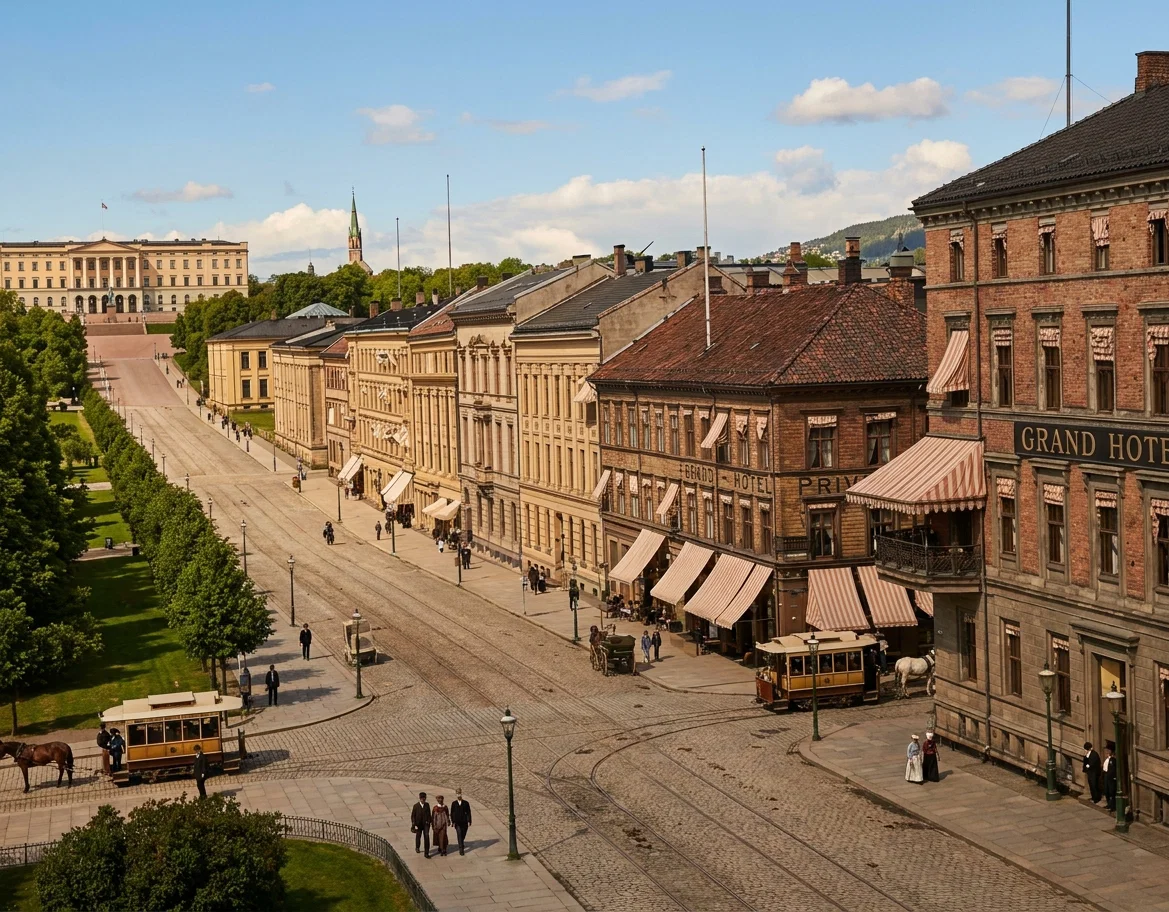
View of Christiania, looking toward the King's Palace.
The interest being so great and steady, I anticipated a long battle, and went slowly, explaining the prophecies and mingling in practical discourses; taking care to have a new and distinct subject every time, yet to connect one subject with another, also to point out the next, and thus keep up the interest. We continued to occupy our rented rooms during the week, but found it necessary to hire halls for our meetings on Sunday.
January 1, 1879, I hired a gymnasium to use every Sunday evening for three months. Here was room for six hundred people, but they crowded in and filled up every available space, so that there were often more than one thousand present.
Our expenses for halls and house rent, advertisements, seats, etc., were all met by donations. Now and then I spoke to the people in regard to the matter, encouraging them to help us. Two contribution boxes were placed at the entrance, and at the larger meetings we had two, and sometimes five men with plates stationed in different parts of the room, where all could see them, ready to gather up the donations at the close of the service; and I called attention to them before dismissing the congregation. Before each meeting, our tracts and papers were offered for sale, one brother being stationed at the door for this purpose, while others went around with them among the people; and again after meeting, we all sold what we could.
On the holidays, such as first and second day of Christmas, Holy Thursday, Good Friday, and first and second day of Easter, I gave the people an opportunity to donate especially for the preacher, this being an ancient custom here; and on such occasions they would give silver and bills. These donations have sometimes amounted to from $25 to $35 at one meeting. I still follow this plan, and do the same also at the close of a series of meetings, whenever I have preached in a place a week or more, taking care to state, a day or two beforehand, that there will be an opportunity, at our last meeting, to help defray the expenses of the minister. In order to get any help in the old countries in sustaining our work, it is necessary to gather up all the little rivulets.
OPPOSITION.
For several months I said nothing directly about the immortality question, because the people were greatly prejudiced against this doctrine, while they did not object so much to the Sabbath, at least not in theory. Several persons had begun to keep the Sabbath, but no one had as yet opposed us. Then a small leaflet was scattered all over the city, containing an appeal to the shepherds of Christiania, inquiring if they were blind watchmen or dumb dogs that could not bark, since they said nothing against this new doctrine. Two opposition sermons were now preached by a venerable old priest. He told the people that they need not be alarmed; for that kind of doctrine would never be believed by the multitude, as it involved too great a cross. He also stated that the Sunday-Sabbath was introduced by the church, and was a matter of expediency, and that no stress should be laid on Sunday-keeping.
Other persons now began to make a great ado to arouse the prejudice of the people. They said that our views in65regard to the prophecies and the Sabbath were not so dangerous, but that we denied the doctrine of eternal torment, teaching the final destruction of the wicked, and this was an awful heresy. Thus it became necessary to introduce the immortality question and discuss it thoroughly.
At this time Mr. Isaacsen, a Methodist minister, gave a series of lectures against our views. He had a large hall, and drew crowds of people; but I did not go to hear him, fearing that a debating spirit would be aroused in me, which would hurt the work. He also wrote a series of articles against us in a daily paper, to which I afterward replied in the same paper. Mr. Isaacsen became very personal and abusive in his attacks, and he was therefore invited, in the presence of witnesses, to enter into a public discussion. For some time he would give no answer, but at last a decided refusal came in one of the daily papers.
Our work in Christiania was spoken of in all the public papers, and rumored all over the country. The general impression was that we taught some truth and much error, but were so skillful in the use of the Bible that it was useless to try to oppose us. Consequently no one in Norway has ever offered to discuss with me.
OTHER LABORERS.
During the winter, Bro. Andrew Brorsen assisted in the work at Christiania, but in the spring he returned to America, while his brother Knud continued to labor in Denmark. The brethren and sisters in Christiania took a lively interest in distributing tracts and papers. Sometimes they sold them on the streets and in public places, and sometimes they went from house to house with them. Thus our publications and our work became quite well known. Some young men gave themselves especially to this work, among whom was Bro. Rosqvist, who afterward preached the message.
In the spring of 1879, Bro. J. P. Jasperson and his wife came from America to help in the work, and they brought our children with them. During the summer, Bro. Jasperson labored some in Christiania, and during the fall and winter in Skien, where he was assisted by Bro. Rosqvist. The following summer he went to Denmark, and labored principally in Själland, encouraging the brethren, and bringing a few new ones to accept the truth. In 1881 he returned to America.
A CHURCH ORGANIZED.
Some fifty persons in Christiania had begun the observance of the Sabbath, and the Sabbath meetings were often attended by more than a hundred persons. June 7, 1879, a Seventh-day Adventist church was organized, with thirty-eight members. I was elected elder, but before acting in this capacity I had to appear before the authorities, and under oath present a declaration of our faith. The church was then acknowledged as a Christian church, and I was permitted to officiate as elder, that is, to baptize, and administer the Lord’s supper. Those who administer these ordinances without such acknowledgment from the authorities are liable to be fined.
These were very stirring times. We were attacked by the priests, and this caused us to rejoice; for the truth always shines more clearly when it meets with opposition. About eighteen hundred persons attended our meeting in a large hall in Klingenberg.
A PERMANENT PLACE FOR MEETINGS.
All other methods of opposition having failed to stop our work, a general effort was now made to crowd us out of every hall large enough to hold our congregations. The power of the influence of the clergy, in a matter of this kind, can hardly be appreciated by our brethren in the New World. But so difficult did it become to obtain a suitable place for our meetings, that we at last thought of buying some property that we might control a meeting-hall.
We found in a favorable location, an old building of considerable size, which was offered on very easy terms. Part of this could be fitted up for a meeting-hall, part for the printing work, and there would then be much room that could be rented for workshops and for family living-rooms. A large lot accompanied the building, which it was thought could be sold for building purposes.
In February, 1879, a Building Association was formed, and this property was purchased for $14,580. The payments were to be made in semi-annual installments, extending, if we desired, over a period of thirty years. This looked like a great undertaking; but we had confidence in the cause, and faith that the Lord would help.
Up to the time when the new buildings were erected, the rent obtained for the lot and for rooms in the house more than paid the interest and running expenses. To meet the payments on the principal, each member contributed fourteen cents a week; afterward shares were issued by the Building Association, at $5.40 each. The prospect of meeting the yearly payments sometimes looked dark until a few days before the time when they must be made, yet means have always been provided in season. Some one brought $15 or $30, or a friend lent us $50 or $100; and thus the interest and payment have always been met in time. Of late, when the payments have become larger, our brethren in America have helped us to meet them.
By the first of June, a part of this house was arranged for a meeting-hall, and dedicated. This hall, with adjoining rooms, could seat some over four hundred persons. There were now eighty members in the church, and from four to five hundred hearers would congregate on Sunday.
PUBLISHING AND PRINTING
Seventh-day Adventists have always felt the importance of using the press. They have but few ministers, and therefore try in every possible way to use the silent preachers,—papers and books. In Christiania we felt the need of a paper, and in January, 1879, we had begun to publish Tidernes Tegn. Fifteen hundred copies were printed every week, and sold for one and a half cents per copy. Those remaining unsold were distributed next week in the city. From the first of April, Tidernes Tegn became a regular subscription paper, an 8-page semi-monthly, at fifty-four cents a year.
In June I bought a hand-press, and in July we began to print our own paper, as well as many tracts and pamphlets. My own children did most of the work, so the expense was small. None of us had received any practical instruction in printing, and we had many obstacles to meet. We could not at first do very good work; yet the papers could be read.
Our first effort to print the paper on the hand-press was almost a failure. I had obtained some printers’ ink in a67little box; but it did not prove to be of the right kind, being intended for a cylinder press instead of a hand-press. We did not dampen the paper, as we should have done; and as it had quite a smooth surface, the print was very black, and would not dry; every touch smeared the paper. Our last resort was to do as we had heard that printers did in Norway,—hang up the papers on a line to dry. Thus in the course of a week we succeeded in drying a sufficient number to supply our subscribers.
As we gained more experience, we did better work. Diligence and patience enabled us to overcome difficulties, and the Lord blessed our efforts. At this stage of our work, the help obtained from America was limited, and we saw close times. We lived very economically, and the printing work paid its own way, by the help of a few donations from friends.
About this time a Tract Society was organized, which was quite active. During the first six weeks of its existence, the members sold 67,000 pages of tracts, and 600 papers. A report made in February, 1880, shows that during the past year $1,208 had been received from the sale of tracts and books, and from subscriptions and donations. Besides this we had books and papers in the office worth $335, and we had printed in all 576,000 pages of tracts. All the gain was invested in type, paper, etc., and used to extend the work.
A VISIT TO AMERICA.
In the summer of 1880 I visited Denmark, and a small Conference was organized. Under the faithful labors of Eld. Brorsen, a number of believers had been gained in several places in the country. In September I went to America to obtain help to enlarge the work. Bro. Rosqvist came to Christiania to preach and do missionary work in my absence, and the printing office was left in the care of my daughter Tina.
It was a great privilege, after an absence of more than three years, to meet old friends again, and to attend the General Conference. I felt deeply the necessity of enlarging the publishing work in Norway, and hoped to receive aid in this direction; but the brethren did not feel disposed to invest much in the work while it was a private enterprise, nor did they think the time had come when the General Conference could assume the responsibility of the publishing work in Norway, and sustain it with mission funds. As I felt that the work must go forward, I proposed to purchase a cylinder press with my own means, and upon my own responsibility to begin issuing a Danish-Norwegian health paper. The Conference Committee consented to this plan, and loaned me some means for the purchase of type and other materials for the printing office. Dr. J. H. Kellogg was much interested in the proposed health paper, and helped me with a liberal donation.
The following winter I spent among our Scandinavian brethren in America, from whom I obtained some subscriptions for the new health paper, and some donations to the publishing work. On the prairies of Iowa I was exposed to the piercing winds without being sufficiently protected with clothing. This exposure brought on a severe attack of bronchitis, and I sought help at the Battle Creek Sanitarium, where I was cured and very kindly entertained free of charge. Greatly encouraged, I returned to Europe in April, 1881.
THE PUBLISHING WORK EXTENDED.
After my return to Norway, I bought a small cylinder press for $600. This68enabled us to do a great deal more and better work. From the first of July a quarterly called Biblical Sermons was published, containing sermons preached in our hall and taken down in short-hand. At the same time the health journal, Sundhedsbladet, was started, and soon obtained several thousand subscribers. In 1883 the Swedish health journal was started, and in 1884 a Swedish religious journal, Sanningsens Härold. The latter is now united with the American paper of the same name in such a way that the subscribers receive a paper from Norway at the beginning of the month, and a paper from America in the middle of the month. Besides these papers, many tracts and pamphlets and some books were published.
July 23, 1882, a Publishing Association was organized, and shares were issued at $2.70 each. I afterward sold the press and the health journal to the Association, so that they own everything belonging to the publishing and printing work. For a few years the printing work was self-sustaining, the facilities not being much enlarged. The books show that in January, 1883, the receipts for the previous year amounted to $1,435, and the property of the Association, after all debts were paid, was $1,281. In the year 1883 the receipts were $2,970, and the property owned by the Association was $1,620. In 1884 the receipts were $3,105, and the property $2,563. In the last-named year, 115,000 papers were printed in all, besides many thousand signatures of tracts and books.
THE WORK IN SWEDEN.
As in many other places, the truth was first introduced to the people of Sweden by papers and tracts. Many of these had been sent to Sweden by our people in America, and also by the brethren in Norway, and a few in several places were anxious to hear the Scriptures explained more fully by a preacher. In accordance with this desire, Bro. Rosqvist, who had gained a good experience as a laborer in Norway, began in April, 1880, to preach the present truth in Sweden. After laboring about a month in Amot, he went to Grythyttehed, where some were convinced of the truth. Here he labored about four months. Forty-seven commenced to keep the Sabbath, and in August a church was organized. During the entire time he spent in this place, a lively interest was manifested in the meetings. He held, on an average, ten meetings a week, although the evening meetings on the working days had to be held between the hours of nine and eleven.
While laboring here, the priest of the State (Lutheran) Church requested Bro. R. to call on him. This he did, and found the priest in good humor, complacently smoking his pipe. The priest then explained that he desired information about some strange doctrines which it was reported that Bro. R. was preaching in that place. He proceeded to question him as to his teachings on the subject of the Trinity, man’s condition in death, the Sabbath, baptism, and other doctrines, and then requested Bro. R. not to labor against him. To this Bro. R. replied that if he was laboring for the salvation of souls, there would certainly be no conflict between them.
About this time Bro. Rosqvist was called to Christiania, to labor for that church while I went to the General Conference. The following April he returned to Sweden, and resumed his labors in Grythyttehed. And now the priest seemed fully aroused, and did all he69could to oppose the work. He called a church council, and ordered Bro. R. to come before them and answer for the doctrines he was teaching. The examination was brief, and was upon the same points as the priest had questioned in the previous interview. They asked Bro. R. if he still held to these views, and when assured that he did, they formally forbade his preaching any more in Grythyttehed.
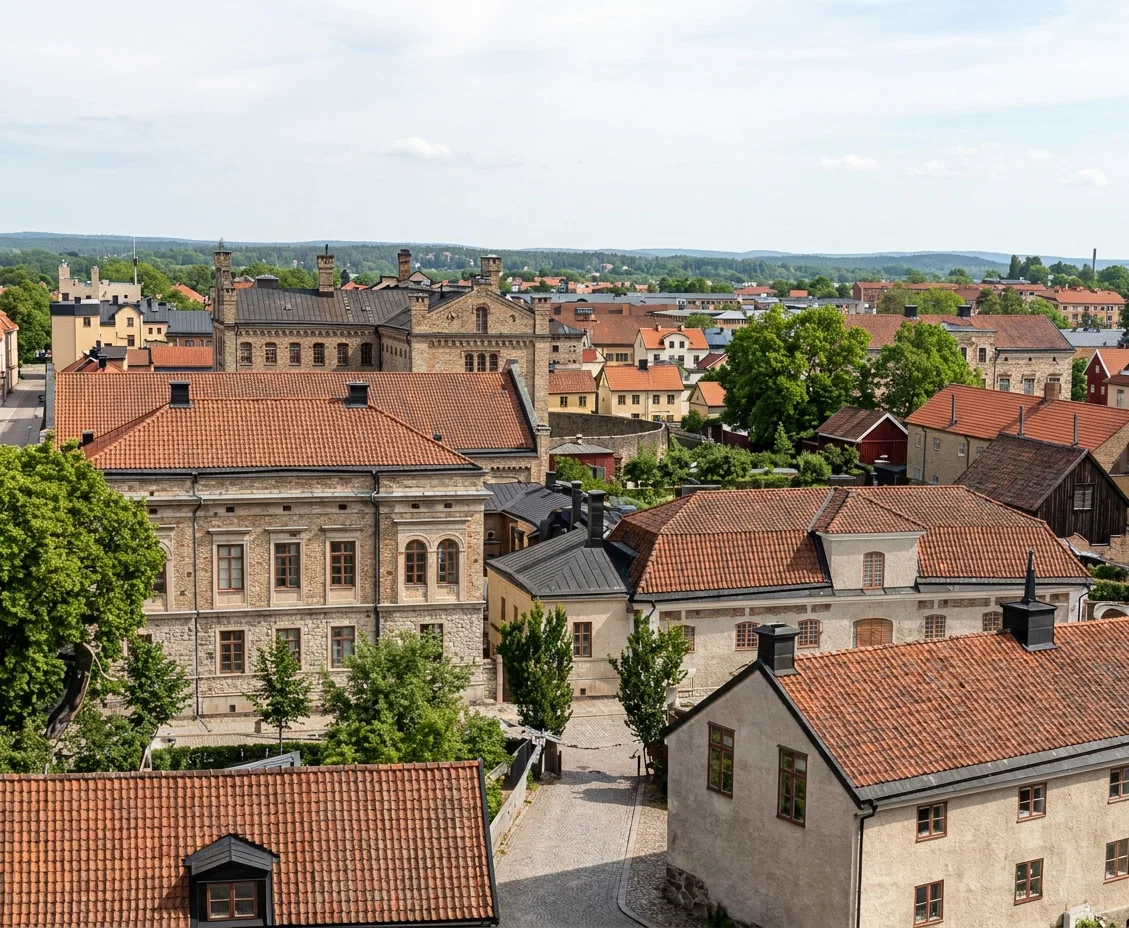
PARTIAL VIEW OF ÖREBRO, SHOWING THE PRISON IN BACKGROUND.
But as the interest to hear was good, and many came to the meetings, he continued to labor as before. On the 22nd of May he was summoned to appear before the court, to answer for this offense. The warrant read as follows:
WARRANT FOR CRIMINALITY.—The Adventist minister, J. P. Rosqvist, from Christiana, is hereby summoned to appear before the fall session of court for Grythyttehed and Hellefors mining districts, to be held the ensuing October, to answer for the accusation of liability to law for having, contrary to the decree of the church council in Grythyttehed Parish, continued to preach such views as are not in conformity with the belief and creed of our evangelical Lutheran church.”
Paying no regard to this summons, he continued to labor in Grythyttehed, Lund, and other places. In October he was fined fifty kronor ($13.50), and was summoned to appear at the spring session. He refused to pay the fine, saying that if he had sinned against God, it could not be atoned for with money, and if he had not sinned against God, he had not sinned against man by preaching the word of God. In January he was arrested, and sent to prison at Örebro.
The old statute which still stands among the laws of Sweden, providing for the punishment of any who shall70preach doctrines which will lead to division in the State Church, is very unpopular, and is seldom enforced. Dissenters, or Separatists, as they are called, are not few in Sweden; but it is seldom, in these days, that a priest is willing to bring contempt upon himself by an effort to enforce the old law. Some have thought that it was best to resist this law, and suffer the full penalties, that its injustice might be made the more prominent, and public opinion be aroused to secure its repeal.
Of his experience in the prison, Bro. Rosqvist has written: “I was sentenced for eight days, but was kept twenty-two hours longer. I requested the warden to let me keep my Bible, some writing paper, and a lead pencil, but this was denied me. But I was allowed to have a New Testament to read, a privilege which many before me had not had.
“I was not permitted to keep my own clothes, but had to exchange them for a regular prison suit, consisting of a coarse shirt made from hurds, coarse pants, vest, and jacket, some ragged, patched-up stockings, and a pair of very large shoes. It was very cold in the cell at times, and the bed was shut up in the daytime, so there was no opportunity to rest. In the morning they gave me bread and water for breakfast, and in the evening only water. Prisoners were forbidden to sing, or read aloud. I was much encouraged during my confinement, by letters from the dear brethren at Grythyttehed, who met every evening for prayer during the time I was in prison. . . . When I stepped out of prison, I was met by a merchant who had inquired for me, and who invited me to his house. Here I took breakfast, and spent a few hours pleasantly with his family. I left Örebro rejoicing in my heart, and praising God for his goodness to me, and returning to Grythyttehed, at once resumed my labors.”
A lively interest was manifested to hear the man who had been imprisoned for preaching Bible truth; and in the places where he had labored, some began to keep the Sabbath. In March he was again called to Grythyttehed to answer the charge of preaching views that would lead to division in the State Church. But the warrant was incorrect, and the case was deferred till the fall session of the court. When the fall session convened, Bro. Rosqvist was not able to be present, and although it could not be proved that he had done the acts specified in the warrant, he was fined for disobeying the order of the priest, that he should not preach any more in Grythyttehed. After this Bro. Rosqvist was constantly liable to arrest; for the fact that he had been condemned and forbidden to preach by the church council of Grythyttehed, subjected him to liability to arrest for preaching in any other place in Sweden. In one place where he was laboring shortly after this, a warrant was sent for his arrest, but the sheriff sent back word that if the priest wanted him arrested, he must come and do it himself.
During the year 1882, Bro. Rosqvist labored in the northern part of Sweden, where several small companies began to keep the Sabbath. In this year I visited Sweden, and a Conference was organized. Considerable has been done to extend the knowledge of the present truth to the people of Sweden, by the labors of faithful colporters. Their lot is not an easy one, and their earnings are very meager; but they have not engaged in the work because it is the easiest or most pleasant, but because they love their fellow-men, and desire to warn them of the evils to come.
Very few of the people of Scandinavia are rich, and the majority have a hard struggle to obtain a comfortable living; but they are kind-hearted, and many who cannot afford to purchase a book of any considerable cost, will buy one or two small tracts. At first our colporters had very few tracts to work with, and these must be sold at very low prices if sold at all. The colporters receive one-third of the selling price as their compensation, and this, with a few donations, is all their living. Now they have more books and papers; but the greatest economy must be practiced in order to live.
In the summer of 1883, Bro. Rosqvist went to America, at the request of the General Conference, to labor among the Swedes of the United States; and since that time, Bro. O. Johnson, who received the truth in Christiania, has labored in Sweden. Bro. C. Norlin, who has labored several years very faithfully as a colporter, and during the past winter as a preacher also, has brought quite a number of souls into the truth.
PROGRESS OF THE WORK.
VISITS OF AMERICAN BRETHREN.
In the summer of 1882 we were encouraged by the visit of Eld. S. N. Haskell. In Christiania he attended our quarterly meeting, on which occasion eleven persons were baptized, and seventy-eight brethren and sisters took part in the ordinances. On the Sabbath he spoke of the importance of leaving all and following Jesus; on Sunday, of the proper use of the talents committed to our trust, and of the last message of mercy. He labored to arouse a greater interest in the tract and missionary work, and encouraged the brethren much.
In company with him I made a short visit to Sweden, visiting the brethren in Amot and Grythyttehed. At the latter place, Eld. Haskell spoke seven times. These meetings were well attended; the brethren were much encouraged, and promised to pay one-tenth of their earnings to sustain the mission. A Tract Society was also organized, which has been active ever since.
In the summer of 1884, Elds. Butler and Whitney made us a short visit. They came to Denmark, and found us holding a general meeting in Valsömagle, Själland. They had been delayed on their journey, and therefore attended but one day of the meeting. Each spoke once to the brethren, who were much encouraged by their presence and testimony, and although it is a slow and difficult process to speak by an interpreter, yet the truth went from heart to heart. The blessing of God was felt, and a greater interest was awakened in the work which God has committed to his people in the last days.
The next day they went on their way to Christiania. Here they held six meetings, which were well attended. The word preached was thankfully received, and seemed to make a deep impression. Many of the brethren and sisters testified to the goodness of God, and expressed their thankfulness to their brethren in America for all the help and light received from them. At this time plans were laid for the erection of a new building which should give ample room for the growth of the publishing work, and provide a large and commodious hall for meetings.
Since Eld. Butler’s return from his visit to Europe, a much deeper interest in foreign missions has been manifested by the American brethren, and the Scandinavian mission has been liberally72sustained with means for the support of the laborers, and for the erection of the mission building.
While Brn. Butler and Whitney were with us, Elds. A. B. Oyen and E. G. Olsen arrived from America. The General Conference had sent them to assist in the work of this mission, and we were much encouraged by their coming. We were thankful for the protecting care of God in their behalf. The steamer on which they had first arranged for passage was wrecked, and about one hundred and thirty-five persons were lost; but our brethren had been unavoidably delayed, and thus escaped this danger.
Eld. Oyen has taken the management of the printing work, and thus I have been enabled to labor more extensively in the mission. His experience as a printer and editor has been very valuable in connection with our publishing work, and his labors as preacher and elder in the Christiania church have been a great benefit to this church.
Eld. E. G. Olsen has labored principally in Christiania, Drammen, and Laurvig. In each of these places some have embraced the present truth, and in the latter place about twenty have begun to keep the Sabbath.