One week after we reached Basle the Swiss Conference began. This continued from Sept. 10-14, and was followed by the European Council, which lasted until the 28th. The Conference was quite generally attended by our Swiss brethren, and by representatives from Germany, France, Italy, and Roumania. There were nearly two hundred brethren and sisters assembled; and a more intelligent, noble-looking company is seldom seen.
As I looked over this congregation of dear friends, so ardent and cheerful in the truth, and so anxious to catch every ray of additional light, my reflections were indeed solemn. I thought, These have been highly favored in receiving a knowledge of the present truth. They have accepted it in the face of opposition and ridicule, and often at the expense of worldly prosperity. How earnest should they be to help and encourage one another! They are the members of Christ’s body, and we are members one of another. The Day-star has risen in their hearts; the rays of the Sun of Righteousness have shone upon their minds. Happy people indeed who are thus highly favored! Truly, “it doth not yet appear what we shall be; but we know that, when He shall appear, we shall be like him; for we shall see him as he is.”
The meetings increased in interest from the first. The congregation was divided into three parts, those speaking German, French, and English, each company occupying a different part of the hall. Two interpreters followed the speaker. If the sermon or testimony was given in English, it was translated into French and German. If given in French, it was translated into German and English, and into French and English if given in German. This way of speaking was rather embarrassing at first; but this soon wore away, and to me it has proved far less taxing than I anticipated.
Sabbath and Sunday were precious seasons. The Lord especially blessed in speaking Sunday afternoon. At the close of the discourse an invitation was given for all who desired to be Christians, and all who felt that they had not a living connection with God, to come forward, that we might unite our prayers with theirs for the pardon of sin, and for grace to resist temptation. This was a new experience for many, but they did not hesitate. It seemed that the entire congregation were on their feet, and the best they could do was to be seated, and all seek the Lord together. Here was an entire congregation manifesting their determination to put away sin, and to engage most earnestly in the work of seeking God. After prayer, one hundred and fifteen testimonies were borne. Many of these showed a genuine experience in the things of God.
At the close of the Conference, many of our Swiss brethren were obliged to return to their homes; but some remained to the close of the Council, although it continued one week longer than was expected. The Council was attended by laborers from England, Ireland, Wales, Norway, Sweden, Denmark, Germany, France, Italy, and Roumania. Besides the regular business meetings each day, there were held two Bible readings, a class for the benefit of canvassers and colporters, and one for those who wished to learn English. There were also several ministers’ meetings, besides the sermons and regular morning meetings for social worship. I felt urged by the Spirit of God throughout the meetings to impress upon all the importance of cultivating love and unity. I tried to present the danger of building up separate interests between different nationalities.
If we have the truth, the work in these countries must enlarge. New fields will be continually opening, and the church must extend her efforts by entering these fields. The message must go, notwithstanding the hard times. We must make special efforts in this direction now, while the angels are holding the four winds. Soon the time to labor will be past. Who does not want to have a part in this closing work? All can do something. Those who cannot give themselves can give of their means, and all can pray not only that the Lord will raise up laborers, but that the treasury may be supplied with the necessary funds to extend the work. Pray, brethren, pray earnestly, that the hearts of some who are doing very little, and of others who have as yet done nothing, may be opened, and that the means that God has intrusted to them may be used to his glory. The work begun in weakness will be carried on to a glorious termination. The truth must go to all nations, tongues, and peoples, and that speedily.
VISIT TO SCANDINAVIA.
At the close of the meetings at Basle the question was raised as to when we should visit the Scandinavian missions. I was weary with labor, and needed rest, having spoken twenty-two times through an interpreter, besides writing many pages. We knew that it was late in the season for a visit to these northern countries; June was said to be the best time to travel in the North, and it was planned to hold the Conferences for the next year in that month. But we were not sure that we should remain in Europe till that time, and we felt that the safest course was to visit the leading churches in Scandinavia at the earliest opportunity. The condition of some of these churches had been presented to me in years past, with many things showing that Denmark, Norway, and Sweden were promising fields for labor. We knew that a great work lay before the missionaries in this field. They desired our counsel about the different branches of the work, and we felt that we could advise with them to much better advantage after making them a visit. It seemed unwise to postpone till another summer this part of the work which we had made the long journey from America to accomplish.
We left Basle Tuesday evening, October 6. There were four in our party, — my son William and myself, Sister (174) McEnterfer my attendant and stenographer, and Sister Cecilie Dahl of Christiania, who had remained after the Conference to be our guide and interpreter. We could not afford to patronize the sleeping car, which is more expensive here than in the United States, but we were very fortunate in securing a compartment to ourselves, and by the use of our blankets, were enabled to rest quite comfortably. The plan of the European car is quite favorable to a comfortable night’s travel, when it is not crowded.
There is a great diversity in the railway carriages on the roads in Switzerland, Germany, and Scandinavia. On some roads they are divided, like those in England, into small compartments between which there is no communication; on other roads, especially in Switzerland, they are more like our American coaches, where they are entered at the end. The first-class compartments are elegantly furnished. The second-class compartments, which often occupy part of the same car with the first-class, are usually clean and comfortably furnished, and when not overcrowded are more comfortable than our American day-coaches. Many of the second-class cars are divided into two compartments, two-thirds of the room being devoted to the smokers, and one-third to those175who do not smoke. The third-class cars are often closely seated with narrow, hard seats. On some roads, fourth-class cars without seats are run for the accommodation of the very poorest classes. Most of the express trains run first, second, and third class coaches, and so different are the patterns that it is not uncommon to see a long train with no two cars alike.
In the car which we chanced to take for Frankfort, the seats could be drawn together, and the high, upholstered back fell forward from one side, making quite a comfortable couch.
We reached Frankfort Wednesday morning about daylight, where we waited two hours. As it was raining, we saw but little of the city. We found the waiting room very pleasant, being large, and furnished with tables, chairs, and comfortable sofas, and well supplied with maps and guide books. We spread our lunch upon one of the tables, and with the addition of hot milk from the restaurant, enjoyed our simple breakfast.
Frankfort is an ancient city, mentioned in history as having been the seat of a religious council more than a thousand years ago. It is a place of great wealth, and is said to possess more beautiful promenades than perhaps any other city in the world. Within a short distance of the town are delightful villages, and several famous watering-places.
In this city Charles V., Luther’s great enemy, was elected to the throne of Germany, and here his coronation took place. Hither came the reformer on his way to the Diet at Worms. Having been taken suddenly ill on the journey, he rested for a short time at Frankfort. Suffering as he was, and with the prospect of a martyr’s death before him, but still undaunted, he wrote to Spalatin at Worms, announcing his approach. “I am arrived here,” he said, “though Satan sought to stop me in my way by sickness. From Eisenach to this place I have been suffering, and I am at this moment in a worse condition than ever. I find that Charles has issued an edict to terrify me; but Christ lives, and we shall enter Worms in spite of all the counsels of hell, and all the powers of the air.” The dwelling occupied by the reformer is still known as “Luther’s house.”
From Frankfort we pursued our journey toward Hamburg, passing through a country diversified with hamlets and cities, mountains, rivers, forests, and cultivated lands. Many features of the landscape are quite unlike America. The farming lands are not divided by fences, and instead of our wide-spreading fields much of the land is cultivated in narrow strips, each appropriated to a different crop. In summer the plains appear as if covered with ribbon work of almost every shade of green and brown, giving a very pleasing effect. There are few scattered farm-houses. From the open country we pass suddenly into the midst of high, square blocks, in which the people are crowded together almost as closely as in the most populous cities. The houses are usually large, each containing many families. They are expected to last for hundreds of years, and are built in the most substantial manner, of brick or stone plastered over on the outside. The partition walls and the floors are often of stone or brick, and tile or slate is used instead of shingles for covering the roof. There is little danger of fire passing from one story to another.
Many of the houses present a very ancient appearance, with their steep roofs and small-paned windows. Often a considerable part of the house appears to be above the eaves. There may be only three or four stories below the176eaves, while there are sometimes four or five above, with as many rows of odd little dormer-windows on the roof. Many of the houses in the small villages and in the outskirts of the towns serve the purpose both of barns and dwellings, the people living in one end of the building and the cattle in the other. Sometimes each end is occupied by a family, while the beasts have the center; these are usually kept in the stable by day as well as by night, for most of the land is too valuable to be used for pasturage.
In this densely populated country, every foot of available land has been cultivated for centuries. Wherever the country is too barren and mountainous for other uses, and there are rivers to furnish means of transportation, it is devoted to the raising of forests. In many places where in former times the forests had been destroyed, they have been replanted at the public expense. In many States they are the property of the government, and are as carefully kept as gardens. There are laws prohibiting even private owners from wasting their forests without regard to the public good.
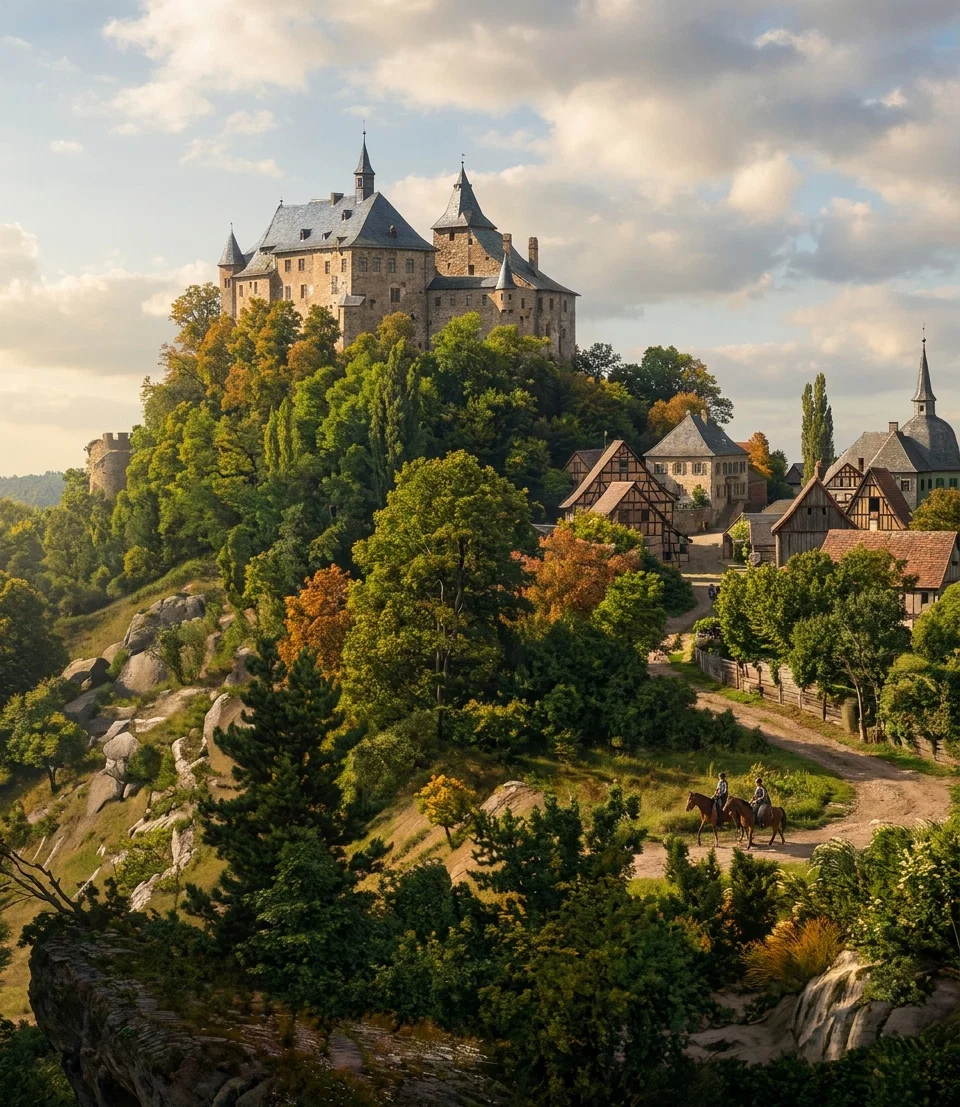
Here and there, crowning the loftiest and most inaccessible heights, we see an ancient castle, often in ruins, but sometimes kept in repair and still inhabited. These old battlements must have an eventful history. Some of them, like the Wartburg, were the refuge of the Protestants in the time of the Reformation. Could those moss-grown walls but tell what has transpired within their strongholds, or in the mountain fastnesses around them, we would hear stories of thrilling interest connected with the lives of the defenders of the faith. Those witnesses for the truth were hunted down by the fury of their persecutors, driven into dens and mountains and caves of the earth, because they honored the law of God above the precepts of the church of Rome.
Only by terrible struggles has the right of religious liberty been maintained. When the stake and the scaffold proved ineffectual to destroy the Reformation in Germany, popery summoned her armies, the Catholic States banded together to crush out Protestantism, and for thirty years the tempests of war swept over these now fertile plains and populous cities. At the opening of the thirty years’ war, in 1618, the country had reached a high state of prosperity. It is said that at that time the methods of cultivation were fully equal to those of 1818. “Germany was accounted a rich country. Under the influence of a long peace its towns had enlarged in size, its villages had increased in number, and its smiling fields testified to the excellence of its husbandry. The early dew of the Reformation was not yet exhaled. The sweet breath of that morning gave it a healthy moral vigor, quickened its art and industry, and filled the land with all good things. Wealth abounded in the cities, and even the country people lived in circumstances of comfort and ease.” Since the Reformation, a school had existed in every town and village in which there was a church, and a knowledge of reading and writing was generally diffused among the people. The Bible had found its way into their houses. The hymns of Luther were sung in their churches and their homes.
But during the terrible years that followed, all this was changed. Foreign soldiery, savage and blood-besmeared, traversed the country, marking their course by pillage, fire, and murder. The greatest imaginable horrors were so common that it was a matter of surprise when they failed to be perpetrated. At the approach of the troops, the terror-stricken people sought safety in177flight. “They dived into the darkest parts of the forests; they burrowed in the bleakest moors; they lurked in old clay pits and in masses of fallen masonry; and to this day the people of those parts show the retreats where their wretched forefathers sought refuge from the fury of the soldiery.” The war ended in victory to the Protestants; and the religious toleration which was then won, they have ever since enjoyed. But the long, awful strife had covered the period of a generation. When peace was at last declared, the whole land had become a tomb. Cities, towns, and villages were in flames. The country was empty of men; the high-roads were without travelers, and briars and thorns covered the once richly cultivated fields. In some parts no more than one-fiftieth of the population remained, and178there were regions left without inhabitant.
AN OLD CASTLE.
Such was the spirit of popery in the seventeenth century, and such is her spirit to-day. Let Rome but gain the power, and our own favored land would witness scenes like those that covered Germany with heaps of slain, and made her harvest fields a lair for the wild beasts.
At Hamburg, about 7 P. M., we again changed cars, and had to wait two hours. After walking from one station to the other, we were shown into a waiting-room where men and women were eating and drinking, and the air was full of tobacco smoke. We chose to remain on the platform outside.
Hamburg, situated on the river Elbe, contains upwards of two hundred and seventy thousand inhabitants. The trade of all Northern Europe centers here; it is the great port of entry for the German empire, and is the most important commercial town on the Continent. Though very ancient, it is a beautiful city. It was here that Tyndale, when forced to flee from England, began the publication of the English New Testament. In wretched lodgings he endured hunger and cold while toiling day and night to give the gospel to England. The Gospels of Matthew and Mark, translated and printed here, were secretly sent to London as the first-fruits of his great work.
A three-hours’ ride from Hamburg brings us at midnight to Kiel, on an arm of the Baltic Sea. Here we are transferred to a little steamer, and are soon at rest in our state-rooms, glad of an opportunity for a few hours’ repose. In the early morning, we land at Corsor, Denmark, and resume our journey by rail.
Denmark is a small country, consisting of a peninsula and larger and smaller islands. Its area is about the same as that of Maryland, but it contains more than double the number of inhabitants, its population being upwards of two millions. This country lies as far north as Labrador and Hudson’s Bay in America; yet the climate is not severe; the winter is milder than in most of our Northern States. No doubt this is largely due to the influence of the gulf-stream, which brings a current of warm water from the Gulf of Mexico across the Atlantic Ocean to the shores of Europe. This is a priceless blessing to its far northern countries, which would otherwise be deprived of many of the blessings of life.
The scenery of Denmark is unlike that of Germany. The surface is an almost unbroken plain, in most places but a few feet above the level of the sea. Some parts, indeed, are hilly, but it is said that if the sea level were one hundred feet higher, more than half the country would be covered with water. The fine forests with which Denmark was once adorned have decayed or been cut down. The land is mostly divided into small farms, the possession of a few acres being the summit of a Danish farmer’s ambition. Formerly the greater part of the country was owned by the nobility, but during the present century the peasants or farmers have had an opportunity to buy the land, and thus have become an independent class of society. To us this country wears a more familiar aspect than Germany. The fences separating the fields, the farm-houses dotted over the landscape, and the pretty beech groves, remind us of some parts of the United States.
Denmark has considerable moorland, from which a great quantity of peat is obtained. When burned, this produces much heat, and it is largely used by the179country people for fuel. The black turf is cut in square blocks like brick, and laid in long rows to dry in the sun; when dry, it is stacked, ready for market. About the homes of the people it was piled in neat stacks, rounded on the top, like beehives. This is one of God’s merciful provisions for the poor. The laboring class are so poorly paid that without this it would be extremely difficult for them to obtain fuel.
COPENHAGEN.
THURSDAY forenoon we reached Copenhagen, and were met by Eld. Matteson, who for some months had resided in the city, and who took us to his home. Here we wound our way up long flights of stairs that seemed almost interminable. We do not find elevators in the cities of Europe as in America, though there is quite as much need of them. In the sixth story we found our friends. They were comfortably and pleasantly situated, though very high up in the world.
The view from our windows was very fine. Just across the street were beautiful grounds which had the appearance of an extensive park or garden. We were somewhat surprised to learn that it was a cemetery. The tombstones were mostly concealed from view by trees and shrubbery. Evergreen hedges separated the inclosures, and choice flowers and shrubs were scattered everywhere. Close by was the large botanical garden and floral nursery, containing rare trees and shrubs, and the most beautiful flowers in almost endless variety.
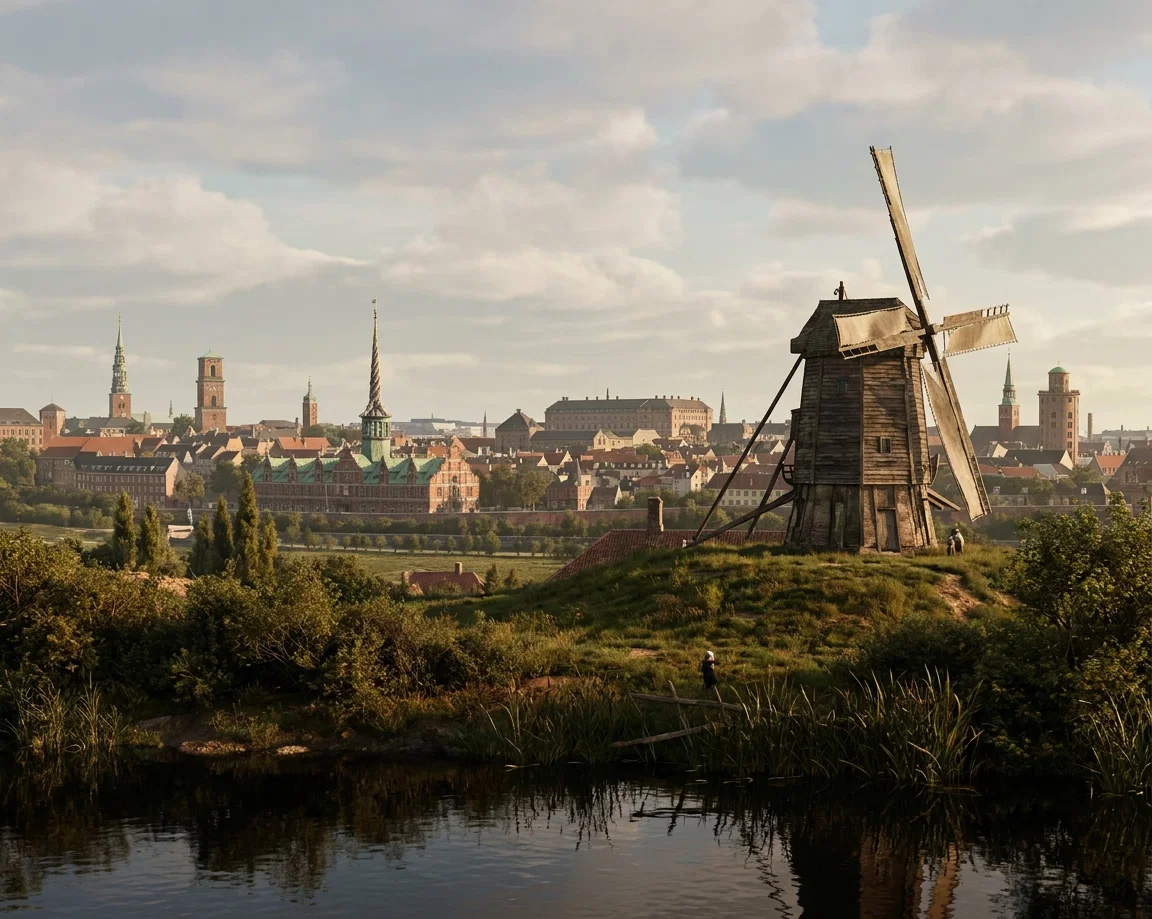
VIEW OF COPENHAGEN.
Toward the sea we saw the huge windmills used for grinding grain. A little to the right is the glistening dome180of the Greek church. This dome, we are told, is overlaid with gold, and it is customary to adorn these houses of worship in this manner.
Our first meeting was held on Friday evening, in a little fourth-story hall close at hand, used for Sabbath meetings by our people. About thirty-five were present, most of whom had received the truth through the labors of Brn. Matteson and Brorsen. There were about a dozen in Copenhagen who had begun to keep the Sabbath, and the remainder had come in from the adjacent churches.
SERMON.—PARABLE OF THE FIG-TREE.
“A certain man had a fig-tree planted in his vineyard; and he came and sought fruit thereon, and found none. Then said he unto the dresser of his vineyard, Behold, these three years I come seeking fruit on this fig-tree, and find none: cut it down; why cumbereth it the ground? And he answering said unto him, Lord, let it alone this year also, till I shall dig about it, and dung it; and if it bear fruit, well; and if not, then after that thou shalt cut it down.” Luke 13:6–9.
The Jewish nation was represented as the fig-tree which God had planted in his vineyard. This people he had taken unto himself as his own. They had been greatly favored with temporal and spiritual blessings, and he looked to them to bring forth the fruits of righteousness. Year after year he had come to them hoping to find fruit, but had found none. He had been long forbearing. Justice had urged, “Cut it down; why cumbereth it the ground?” But mercy pleaded for still another trial. The Dresser of the vineyard will put forth yet one more effort to save the fruitless tree. The Son of God will come in person to plead with the chosen people. He will take upon himself humanity, and set before them the example of his own life. If this fails to bring them to repentance, it is their last trial. “After that thou shalt cut it down.” In the terrible destruction which came upon the Jewish nation we read the fate of the unfruitful tree.
Under the symbol of the fig-tree, Christ represents, not the Jews only, but all who have neglected to improve the gifts of Heaven. He has bestowed upon us greater blessings than were granted to his ancient people, and he claims of us fruit corresponding to the gifts bestowed. What is this fruit? It is a pure and holy character; godliness, self-denial for others’ good, meekness and loveliness of heart. Jesus claims penitence, faith, and obedience. He came to leave for men a perfect model of character. He was obedient to all the requirements of his Father. If we follow him, we shall in our life carry out the precepts of God’s holy law.
Dear brethren, He who has given you talents, has by these sacred trusts made you capable of bearing precious fruit to his glory. Through Christ, God has opened heaven before you, and all needful grace is brought within your reach. The Saviour died that by his grace you might become partakers of the divine nature. He expects you to bear fruit. With what interest has he watched and waited for some returns for his great sacrifice.
Consider, I pray you, the solemn lesson of this parable. The dresser of the vineyard pleads for a respite for the doomed fig-tree; but if it still bear no fruit, he himself declares, “After that thou shalt cut it down.” May not this be the position of some now before me? May they not be even now receiving the last trial? The divine illumination, the example of perfect goodness, are granted us. From time to time, now181opportunities, new lessons, are given. And what will be the result? If we are careless and neglectful, we know not how soon the word may be spoken of us, “Cut it down; why cumbereth it the ground?”
How many years have we been in the Lord’s garden? and what profit have we brought to the Master? How are we meeting the inspecting eye of God? Are we increasing in reverence, love, humility, confidence in God? Do we cherish gratitude for all his mercies? Are we seeking to bless those around us? Do we manifest the spirit of Jesus in our families? Are we teaching his word to our children, and making known to them the wonderful works of God? The Christian must represent Jesus by both being good and doing good. Then there will be a fragrance about the life, a loveliness of character, which will reveal the fact that he is a child of God, an heir of heaven.
Brethren, be no longer slothful servants. Every soul must battle against inclination. Christ came not to save men in their sins, but from their sins. He has made it possible for us to possess a holy character; do not, then, be content with defects and deformities. But while we are to seek earnestly for perfection of character, we must remember that sanctification is not the work of a moment, but of a lifetime. Said Paul, “I die daily.” Day by day the work of overcoming must go forward. Every day we are to resist temptation, and gain the victory over selfishness in all its forms. Day by day we should cherish love and humility, and cultivate in ourselves all those excellencies of character which will please God and fit us for the blessed society of heaven. To all who are seeking to accomplish this work, the promise is very precious, “He that overcometh, the same shall be clothed in white raiment; and I will not blot out his name out of the book of life, but I will confess his name before my Father, and before his angels.”
Every Christian will have a missionary spirit. To bear fruit is to work as Christ worked, to love souls as he has loved us. The very first impulse of the renewed heart is to bring others also to the Saviour; and just as soon as a person is converted to the truth, he feels an earnest desire that those in darkness should see the precious light shining from God’s word.
We are grateful that a few in Copenhagen have accepted the truth of God. Missionaries are needed to spread the light of truth in these great cities, and the children of God—those whom he calls the light of the world—ought to be doing all they can in this direction. You will meet with discouragements, you will have opposition. The enemy will whisper, What can these few poor people do in this great city? But if you walk in the light, you can every one be light-bearers to the world. Do not seek to accomplish some great work, and neglect the little opportunities close at hand. We can do very much by exemplifying the truth in our daily life. The influence which we may thus exert cannot be easily withstood. Men may combat and defy our logic; they may resist our appeals; but a life of holy purpose, of disinterested love in their behalf, is an argument in favor of the truth that they cannot gainsay. Far more can be accomplished by humble, devoted, virtuous lives than can be effected by preaching when a godly example is lacking. You can labor to build up the church, to encourage your brethren, and to make the social meet182ings interesting; and you can let your prayers go out, like sharp sickles, with the laborers into the harvest field. Each should have a personal interest, a burden of soul, to watch and pray for the success of the work.
You can also in meekness call the attention of others to the precious truths of God’s word. Young men should be instructed that they may labor in these cities. They may never be able to present the truth from the desk, but they could go from house to house, and point the people to the Lamb of God that taketh away the sin of the world. The dust and rubbish of error have buried the precious jewels of truth; but the Lord’s workers can uncover these treasures, so that many will look upon them with delight and awe.
There is a great variety of work, adapted to different minds and varied capabilities. In the day of God not one will be excused for being shut up to his own selfish interests. And it is by working for others that you will keep your own souls alive. Do you shrink from this work because there is a cross connected with it? Remember that self must be denied if you would win Christ. Earnest, unselfish effort will garner sheaves for Jesus. The humble worker who obediently responds to the call of God, may be sure of receiving divine assistance. The Lord is a mighty helper. If the workers will rely wholly upon him, he will accomplish a great work through them.
THE SABBATH MEETINGS.
It was with difficulty that I could speak at the meeting of Friday evening, for the hall was cold and very damp. In this building the plaster had been put directly onto the brick walls, leaving no air chamber, and thus permitted the dampness of the wall to be communicated to the room. There had been no fire in the hall during the season, until a few hours before we assembled, and then it only served to draw out the dampness, and render the atmosphere humid. There was a penetrating chill in the air, that made one shiver in the warmest wrappings. I suffered much from pain in my lungs while I was speaking, and for hours afterward.
Sabbath morning I still felt the effects of the evening’s chill. For two weeks I had been suffering much from some teeth that had been improperly treated by the dentist, and the cold that I had taken not only affected my lungs and throat, but rendered the pain in my teeth almost unendurable. I felt unable to speak to the people; but my earnest prayer went up to heaven for needed strength. Again I ventured to the hall, and found it well filled with interested hearers. I spoke from John 15:1–8, on the subject of the True Vine. I was strengthened and blessed; my infirmities were forgotten in the interest I felt for precious souls. The dear Saviour seemed very near, and the Holy Spirit rested upon the assembly.
The discourse was followed by a social meeting, Bro. Matteson acting as interpreter. Many good testimonies were borne. Some expressed their thankfulness to God that he had sent Sister White such a great distance to visit them. They had read her books and her articles in their paper, and had thus received most precious light and a great blessing. The Testimonies which had been translated into their language had opened to them the Scriptures, and had made the truth so plain that they could not resist it. A high standard had been presented for them to reach, and this had led them to read the Bible, to search183their hearts, to pray more, to have greater love for Jesus, and to seek more earnestly to save souls.
One brother said that when he listened to the sermon impressing upon them the necessity of purity and perfection of character, he felt that he could not be saved; that his case was hopeless. But when it was stated that sanctification was not the work of a moment, but of a lifetime, he was encouraged, and determined that day by day he would pray and watch, and search the Scriptures; he would be an overcomer, gaining an experience daily, until he should become strong, and be able to be a blessing to others. With many tears, some expressed their gratitude for the interest the American brethren had taken in them in this far-off country.
EVENING MEETINGS.
As the meeting-room occupied by our people was small, and at a distance from the central part of the city, it was thought best to secure for our Sunday and evening services a hall in a more favorable location, and one capable of accommodating a larger audience. It is difficult in Copenhagen, as in all the cities of Scandinavia, to obtain a suitable place for meetings. The halls are mostly used for dancing, concerts, and theatrical entertainments, and they are rented at a high price. After some effort, however, the brethren secured a hall which they assured us would meet the requirements. What was our surprise, upon going to the place for service, to find it in the basement of a building, in the upper stories of which were halls for dancing, and places for drinking. The room was large enough to accommodate two hundred persons, but contained seats for only half as many. It was quite damp, the moisture at times being plainly seen on the walls. One evening, while I was speaking, some young men from the drinking halls above, half intoxicated, gathered about the windows of our hall, and by loud talking and laughing endeavored to interrupt the meeting. They even thrust their heads through an open window, shouting into the room. If it is necessary to speak in such places, we will do so cheerfully. If in this rich and beautiful city there is no suitable room where the truth can be presented to the people, we remember that there was no room in the inn at Bethlehem for the mother of Jesus, and that the Saviour of the world was born in a stable.
There were some in the audience who seemed deeply interested, persons of talent whose countenances I remembered, for they had been presented before me. These persons had been pleasure-lovers, enshrouded in darkness and error, but God was permitting beams of light to shine upon them from his word. The arrows of the Lord were wounding the heart, that the sin-sick soul might turn to the great Physician. I felt such an intense interest while speaking to these souls that I lost sight of my surroundings; I felt that some were in the valley of decision, and I longed to see them take their stand fully and decidedly upon the side of Christ. The Saviour had purchased them by his blood, and he had given them precious talents of influence which they had wasted and abused, and given to the service of the Lord’s bitterest enemy. Now there was an opportunity for them to change leaders, and to unite their interests with those of Christ’s true workers.
As I spoke, I felt the peril of souls;184that some would decide from that time to obey the truth, or would refuse the cross, and reject the offers of mercy. We are to do our work in sowing the gospel seed as though each opportunity were our last to present Christ and him crucified before those assembled; and we should speak to them in such tenderness and love, yet with plainness and fidelity, that though we never meet them again, we shall have done our whole duty.
I spoke five times in Copenhagen. While I was glad to present the truth to the few who could be accommodated in our small meeting-rooms, I would have been pleased to honor my Master by bearing his message to a larger number. I am far from being convinced that these small and obscure halls were the best places that could be secured, or that in this great city of three hundred and twenty thousand inhabitants, the message should be given in a basement room that will accommodate but two hundred, and this but half seated, so that a large part of the congregation have to stand. When God sends our brethren help, they should make earnest effort, even at some expense, to bring the light before the people. This message is to be given to the world; but unless our brethren have broad ideas and plans, they will not see much accomplished. While we should labor earnestly for the poorer classes, we are not to confine our efforts to them, nor should our plans be so laid that we shall have only this class of hearers. Men of ability are needed. The more intellectual ability is brought into the work, so long as the talent is consecrated to God and sanctified by his Spirit, the more perfect the work will be, and the higher it will stand before the world. The people generally will refuse the message of warning; yet efforts must be made to bring the truth before those of position and education as well as the poor and illiterate.