An interesting experience related to us by one of our Danish brethren, shows how the truth is sometimes advanced by the very efforts made to hinder its progress. Bro. C. C. Hansen had been convinced by reading the Bible, that the seventh day is the Sabbath. And as the Baptist minister had been presenting to him the Bible argument for immersion, his mind was exercised on the subject of baptism also. About this time Bro. Brorsen visited the place, and gave to the Methodist minister the tract, “New Testament Sabbath.” When he had read it, he gave it to Bro. Hansen, in the hope that by showing that the Bible presents as forcibly the duty of keeping the seventh day, which is universally disregarded, as it does the duty of baptism, he could lead him to renounce the idea of being immersed. He argued that the Sabbath is disregarded by Baptists as well as others, and it could be no worse to set aside immersion than to reject the Sabbath. But the result of this effort was the reverse of what the minister wished. Bro. Hansen read the tract again and again, wept and prayed over it, and instead of renouncing baptism, he decided to keep the Sabbath. At first he thought it his duty to keep Sunday also, and in the attempt to keep two days became discouraged, and gave up the Sabbath. But just at this time Bro. Brorsen came to his help, and explained from the Bible the true relation of the Sabbath and Sunday. Some time later, he was much impressed by reading in the Advent Tidende an account of what I had seen in regard to185some in foreign countries receiving the papers and tracts, reading them, praying over them, and finally taking their stand on the Sabbath, for this exactly described his experience.
A MISSIONARY FIELD.
Copenhagen seems like Athens in Paul’s day. The pursuit of wealth and pleasure engrosses the attention of the people. Atheism is popular. Eating and drinking, dancing and merry-making, are the subjects of thought and conversation. There are many large and beautiful churches; but the people, like some of the Athenians, are worshiping an unknown God. There is no lack of doctors of divinity, of learned preachers, but they are ignorant of Bible religion.
The teachers in the State Church are looked up to by the people as unquestionable authority in matters of religion. They appear upon the street in a long clerical robe reaching to their feet, with a stiff, quilled ruffle of white linen, nearly a quarter of a yard in width, about the neck. As they pass, men take off their hats and make a low obeisance, and women courtesy, with an air of the greatest reverence. As I saw them, I could not but think of the words of Christ,—and the words apply to these priests as truly as to the ancient rabbis,—“All their works they do for to be seen of men; they make broad their phylacteries, and enlarge the borders of their garments, and love the uppermost rooms at feasts, and the chief seats in the synagogues, and greetings in the markets, and to be called of men, Rabbi, Rabbi.”
It seems a difficult matter to awaken an interest in religious things in these large cities; and yet there are many honest souls in them who will yet accept the light and reflect its rays to others. Copenhagen is sending missionaries to convert the heathen in far-off lands, when there are multitudes of her people who are as truly ignorant of God and his word. Men with the spirit of Paul are needed to preach Christ and him crucified.
A BEAUTIFUL CITY.
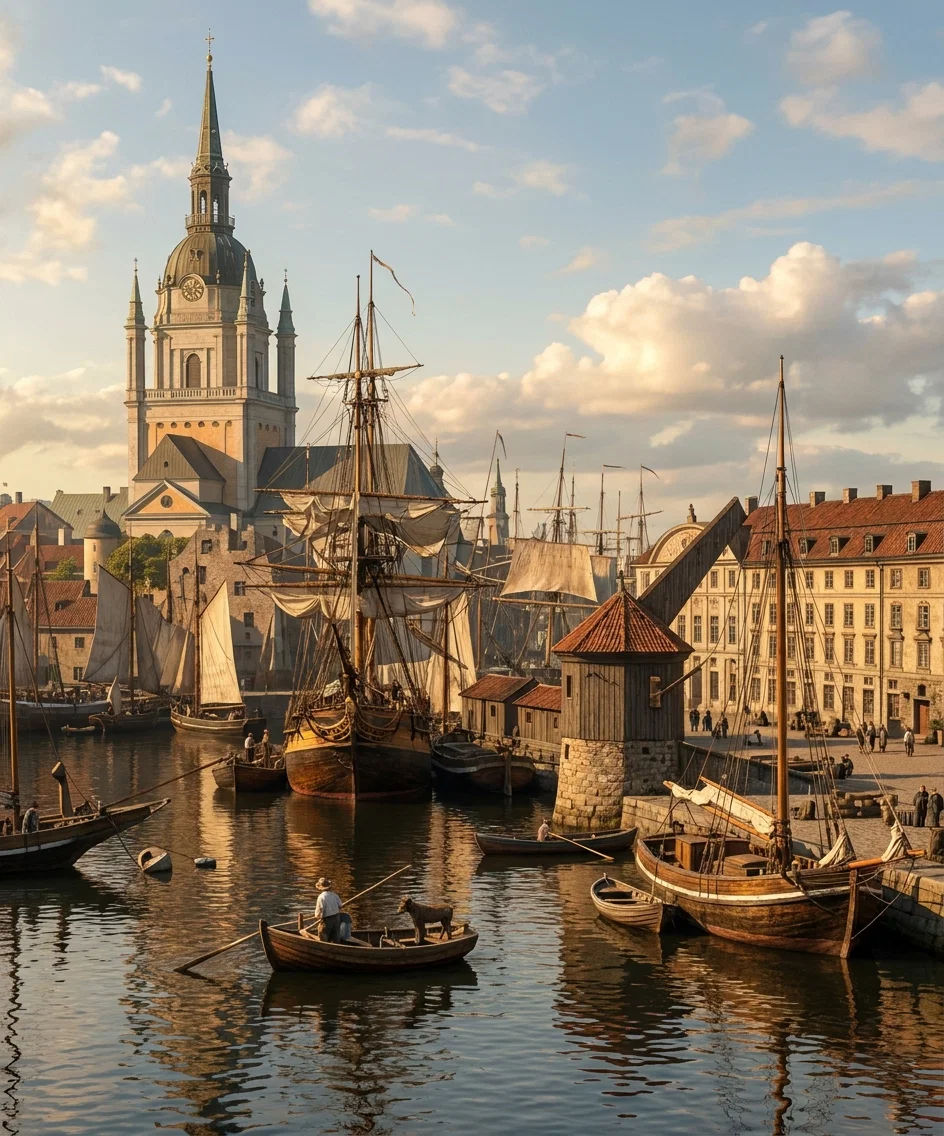
Copenhagen is a large city for the little kingdom of Denmark. It possesses an excellent harbor, and being situated on the narrow straits connecting the Baltic with an arm of the North Sea, it is on the highway through which passes much of the commerce of Sweden, Germany, and Russia. It is the residence of the king, and the head-quarters of the Danish army. In the midst of the city, and surrounded on all sides by massive stone blocks, are wide, open spaces containing many acres, which are reserved as training-grounds for soldiers. In the early morning we hear the measured tread of large companies of soldiers marching along the streets, and wherever we go on the streets we see companies of tall, athletic young men dressed in the light, jaunty uniform of the king’s guards. The king of Denmark is allied with some of the most powerful nations of Europe. While we were in Copenhagen, he was receiving a visit from his son-in-law, the czar of Russia. One of his daughters is wife of the prince of Wales; another is married to the duke of Cumberland. The crown prince is married to a Swedish princess; another son has married a French princess; while one of his sons is the king of Greece.
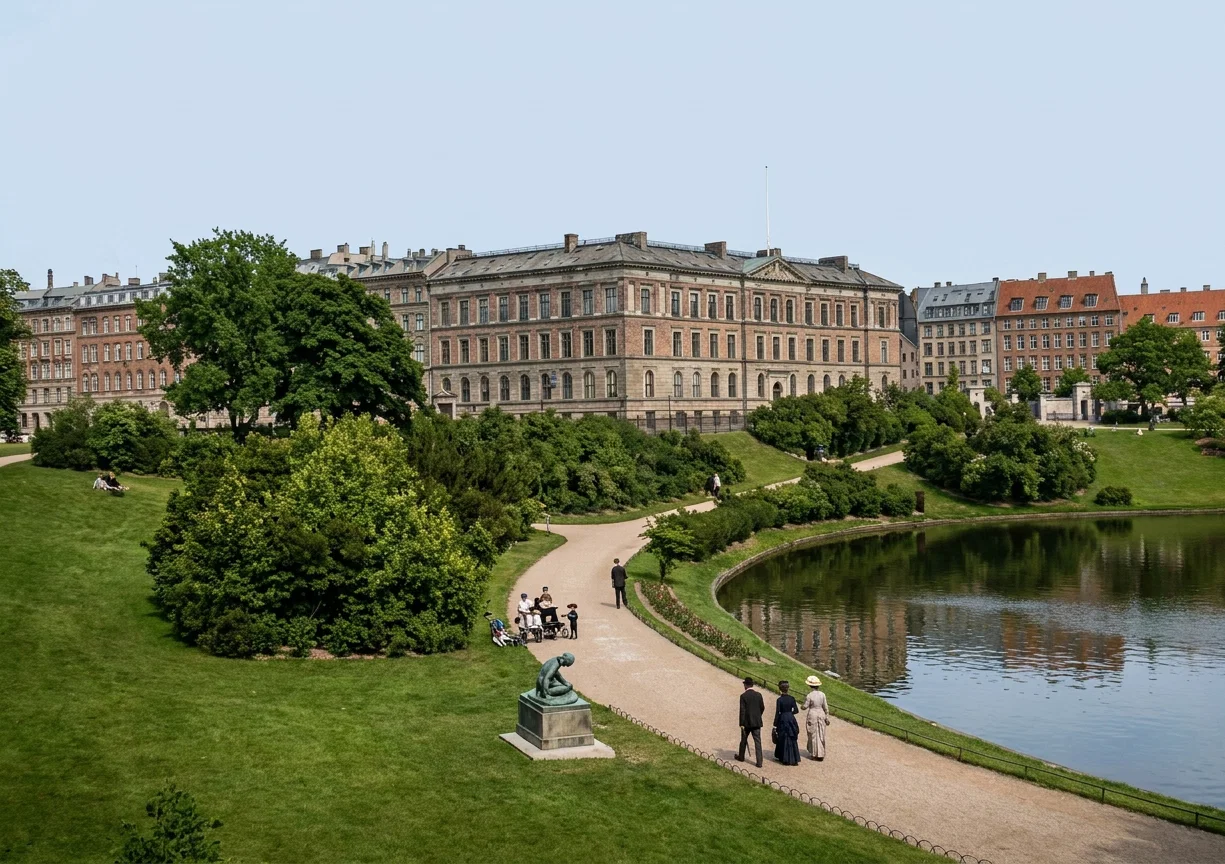
There is probably no city of its size which has so many beautiful parks, artificial lakes, and pleasant avenues. At a little distance from our stopping-place186is an artificial lake which is two miles in length. The water is clear as crystal, and upon its glassy surface many beautiful white swans were floating gracefully. It is crossed by pretty foot bridges, while a broad street runs all around it, and rows of chestnut-trees beautify its borders. In Copenhagen the children have not been forgotten. In different parts of the city there are small inclosures of three or four acres with groves of shade-trees, which are kept solely for play-grounds. No vehicles are allowed to pass through them, and the children can here enjoy their sports in safety.
A PARK IN COPENHAGEN.
One day we rode out to a place of resort at the sea-shore, about ten miles from the city. As we look across the strait, here about sixteen miles wide, the hills of Sweden are visible in the distance. The water is very clear, so that the white, sandy bottom can be distinctly seen for a considerable distance. It is strewn with rocks, and with mounds of sea moss of lighter and darker shades of green, forming a lovely picture. At a little distance from the beach is an extensive park four miles in length, a dense forest of beech-trees interspersed with evergreens. This forest is kept like a garden, and there are walks and drives extending through it in all directions.
The dark blot on this beautiful scenery is the beer gardens. At the entrance to the grounds are buildings fitted up in the most attractive manner for the sale of wine and beer, and these places are liberally patronized. It is not enough that temptation lurks at every street corner in the great city, but it lies in wait for all who go out for recreation amid the scenes of nature. God designed that we should be refreshed and invigorated by the blessings he has bestowed upon us in his created works. It is his purpose that the beauties of187nature should have a refining, elevating influence upon us. He has endowed men with mental powers capable of reasoning from cause to effect; by studying the great book of nature, they may comprehend the majesty, the goodness, and the power of the Creator. Were the senses kept clear, and the intellect unclouded, they would thus find manifold sources of elevated, satisfying enjoyment, and their hearts would go out in praise and gratitude to God.
But this Satan is determined to prevent. Therefore he tempts men to the use of wine and strong drink, by which the understanding is darkened, the senses confused, and the image of God defaced. By the indulgence of appetite the perceptions become so blunted that men cannot discern God in his works; they may range through the most beautiful scenes in nature, but they have not a thought of the Creator. How many, endowed with good natural abilities, thus degrade the intellect and dishonor God. Their nature becomes brutish; it is impossible for them to be heavenly-minded. They have rendered themselves incapable of governing or guiding the springs of mental or moral activity. Thus Satan prevents man from fulfilling the destiny which Heaven has marked out for him,—to reach the highest attainments, physical, mental, and moral, that he himself may be happy, that his fellow-men may be blessed by his example, and that God may be glorified.
The things of this world would be enjoyable, were it not for the curse of sin; but crime, sorrow, suffering, and death meet us everywhere. Property, and even life itself, is not safe. Upon the most beautiful portions of the earth, in the valleys, on the mountains, in the crowded cities, in the wilderness, or upon the waters of the great deep, there is danger and death. The restless, surging masses of humanity have forgotten their Creator; transgression of God’s law has brought discord, misery, and desolation upon our world; and yet, in their blindness and madness, men continue to transgress. They refuse to listen to the voice of God, inviting them to find peace in him. Kings, statesmen, the mighty ones of the earth, are powerless to give peace and rest to the soul. It is only in obedience to God’s law that true happiness can be found. We must submit our will to God if we would have his divine and eternal harmony in our souls.
The richest treasures, the highest blessings of this life, are meager and unsatisfying when compared with those of the future, immortal life. There will open to the senses scenes of beauty that no language can portray. “Eye hath not seen, nor ear heard, neither have entered into the heart of man, the things which God hath prepared for them that love him.” And these precious treasures are freely offered to all who will accept them. “Blessed are they that do his commandments, that they may have right to the tree of life, and may enter in through the gates into the city.”
STOCKHOLM.
From Copenhagen a small steamer takes us across the strait to Malmö, Sweden. This has for centuries been a thriving sea port, and is now the third city of Sweden in population and importance.
The channel which separates the coast of Denmark from that of Sweden, is in some places but a few miles wide. On both sides of this channel there are fortifications, and for hundreds of years all the commerce of the world going through this strait was required to pay188tribute to Denmark for the privilege of passing. About thirty years ago, however, our government strongly protested against this demand, and other governments uniting with it, Denmark was forced to give up this source of revenue, to which, indeed, she had no just claim.
Hardly a town or hamlet that we have passed on our journey since leaving Basle but has an interesting history connected with the Reformation. Malmö was one of the first cities of Denmark—to which it then belonged—to fully receive the gospel. In 1527 the first Protestant sermon was preached in a meadow outside the walls. Those who had listened to the gospel of God’s glorious grace desired to express their feelings in songs of praise, but there existed nothing in the Danish language suitable to be used on such occasions. In the Romish church the people were silent worshipers; the only songs were the chants and canticles of the priests in an unknown tongue. But such worship could not satisfy an intelligent faith. A translation of the songs of David into the Danish language, soon after published, was everywhere received with great joy. They soon displaced the ballads which had been sung till then. They were heard in the castles of the nobles, and were used in the assemblies of the Protestants, and they may be said to have opened the gates of Malmö to the gospel.
“Louder songs re-echoed day by day round the walls of Malmö, as the number of worshipers increased. Soon the gates were opened, and the congregation marched in, to the dismay of the Romanists, not in serge and sackcloth, not with gloomy looks and downcast heads, as if they had been leading in a religion of penance and gloom, but with beaming faces, and voices thrilling with joy. The churches were opened to the preachers; the praises uttered outside the walls were now heard within the city. It seemed as if Malmö rejoiced because salvation was come to it. Mass was abolished, and in 1529 the Protestant religion was almost universally professed by the inhabitants.” A theological college was established here, from which many able teachers went out to spread the doctrines of the Reformation.
A night’s journey by rail from Malmö brings us to Stockholm. Here we have a church of ninety members, the result of Eld. Matteson’s labors and some colporter work. This church seemed to prize very highly the privileges afforded by the meetings. Their hall, which had seats for some over two hundred, was crowded every evening. Every foot of standing room was occupied. I spoke to them on the Sabbath and at three evening meetings. Our brethren and sisters gave earnest attention, and all were prompt to respond.
There is in Stockholm much more interest in religion than in Copenhagen. The churches are better attended, and there is a more general interest to investigate the prophecies, and the doctrines of Scripture. The Scandinavians, and in fact nearly all European worshipers, manifest much more reverence than is seen among Americans. As soon as they enter the place of worship, they bow their heads and offer silent prayer.
AN EASY RELIGION POPULAR.
We are told that the people of these countries will be pleased with our discourses if we dwell on the love of Jesus. Of this they never tire, but we are in danger of losing our congregations if we dwell on the sterner questions of duty and the law of God. There is a spurious experience prevailing everywhere.189Many are continually saying, “All that we have to do is to believe in Christ.” They claim that faith is all we need. In its fullest sense, this is true; but they do not take it in the fullest sense. To believe in Jesus is to take him as our redeemer and our pattern. If we abide in him and he abides in us, we are partakers of his divine nature, and are doers of his word. The love of Jesus in the heart will lead to obedience to all his commandments. But the love that goes no farther than the lips, is a delusion; it will not save any soul. Many reject the truths of the Bible, while they profess great love for Jesus; but the apostle John declares, “He that saith, I know him, and keepeth not his commandments, is a liar, and the truth is not in him.” While Jesus has done all in the way of merit, we ourselves have something to do in the way of complying with the conditions. “If ye love me,” said our Saviour, “keep my commandments.”
HUMBLE LABORERS.
There are some in Stockholm who in humble circumstances are seeking earnestly to spread the knowledge of the truth. One of these is Bro. Norlin, who labors as a colporter. Shouldering his pack, stocked with our books and papers, he goes on foot from place to place, often traveling many miles a day. His profits have been very small, especially on those of our Swedish books that are published in America, where the cost of production is greater than in Europe, and the expense of transportation to Norway and then to Sweden must be added to the first cost. When the whole expense is taken from the low prices at which books are sold in these countries, very little margin is left for the colporter. On one of the large bound books he received but five cents a copy, on some other books only three cents. On those works published at our office in Christiania he received one-third discount; but these are mostly small pamphlets or tracts which sell for a few cents each. Of course it is difficult to support himself and his wife on such profits; but Bro. Norlin’s wife is an industrious worker, doing house-cleaning, washing, or any other kind of hard work by which she can help in gaining a livelihood. They live in a very economical manner, occupying one good-sized room on a fourth floor, with the use of a small kitchen with another family. This is a sample of how the work has had to be done in Denmark, Sweden, and Norway. Those who are thus traveling on foot and carrying the books and papers in their feathern sacks are apparently engaged in a humble work; but they should not feel that it is in any sense degrading. It was in a humble manner that Christ labored when he was on the earth; he went on foot from place to place, teaching as he walked. Those who are spreading a knowledge of the truth are scattering precious light that some souls will accept. In the kingdom of God the fruit of their labors will be seen.
A SWEDISH HOME.
When we came to Stockholm we were taken to the home of Bro. Norlin, who, living near the meeting-hall, had secured extra rooms in order to entertain us. Neither he nor his wife could speak English; Bro. Matteson, who came with us from Copenhagen, acted as interpreter. But our good friends had just moved into a new brick house,190which was not thoroughly dry; in some parts of the building the masons were still at work, and the chill and dampness rendered it unsafe for me to remain there. I thought of taking a room at a hotel for myself and Sister McEnterfer; but neither of us could speak the Swedish, and how were we to make our wants known? While we were thus in perplexity considering the situation, Sister Johannesson, who had lived in America and could speak English quite well, came in to invite us to her home. This invitation we gladly accepted. Her house was pleasantly situated on a hill in the suburbs of the city. A cosy little parlor on the third floor was appropriated to our use. I had become much reduced in strength by the pain I had endured and still continued to suffer from my teeth, and the rest and quiet of this home was very grateful.
We were pleasantly surprised to find the table very much the same as at our Sanitarium at Battle Creek. The dishes were simple and healthful, and prepared with a skill and nicety that made them inviting and palatable. There is great need of a more general knowledge of the science of healthful cookery. There is a wide field of usefulness open to intelligent, experienced cooks in teaching young ladies how to prepare plain, simple food in a palatable and healthful manner.
The rooms were warmed by tall, earthenware stoves, reaching nearly to the ceiling. These stoves are made square or round to suit the taste, of various colors, and many are more ornamental than our black iron stoves. The one in the family sitting-room was nearly square, and set in one side was a large gilt-framed mirror, not less than six feet long and half as wide. In the morning a wood fire is made, and when the fire is well under way, the doors may be opened, and we have a bright, cheerful blaze throwing out its heat into the room as from a fire-place. When the wood has burned down to a coal, the doors are shut, and the drafts closed. Thus the whole structure becomes heated, and retains its warmth all day. In most Swedish houses, one of these stoves is to be found in nearly every room except the kitchen.
This sister’s husband had not taken his stand on the truth, but his interest was with our people. He was a salesman in a large cloak and fur store, and, to all appearance, it would be impossible for him to keep the fourth commandment and retain his position.
The Scandinavian children seem remarkably quiet and well trained. Wherever we went, they came forward, one by one, and shook hands with us, the girls making a courtesy, and the boys a low bow. Sister Johannesson’s four children, from the girl of eight down to the three-year-old boy, welcomed us in this manner when we came; and whenever they met us, morning, noon, or evening, the greeting was repeated. At another place where we visited, even the little girl of two and a half years went through the ceremony with credit.
Mr. Johannesson was training his children in singing, and we enjoyed the music of their little voices blending together in sacred songs. If parents generally would give more time to the education and training of their children, having really a home school for them, their families would be far happier. Children who are gifted with the talent or love of music may receive impressions that will be lifelong by a judicious use of these susceptibilities as the medium for religious instruction. Less time should be spent in the ornamentation of191clothing, and far more attention should be given to making the character lovely. It is the inward adorning that will endure; the influences which give direction to these young lives will be far-reaching as eternity.
A SAD CALAMITY.
A short time before we came to Stockholm, a sad calamity occurred, which cast a gloom over the entire city. Christine Neilson, the famous Swedish singer, visited Stockholm, and thousands crowded to the theater to hear her sing. But there were great numbers who could not secure admittance, and for the benefit of these she promised to sing in the open air before her hotel, at the close of her last evening’s engagement. An immense crowd collected, from twenty-five to thirty thousand people. There was a bridge opposite the hotel, and as the people crowded upon this at the close of the entertainment, the cry was raised that the railing was giving way, and the people were being crowded into the water. A panic followed. In the rush to get off the bridge, men, women, and children were trampled down, eighteen persons were killed, and not less than seventy wounded.
We often hear of disasters in theaters and pleasure resorts, where lives are lost, and many are wounded, and perhaps made life-long sufferers. But these things do not arrest the pleasure-seekers. They rush on, thirsting for excitement, and often in the very act they too are hurled into eternity; without a moment’s warning, their probation is ended; and what has been their life record? Can Christ say of these, “Well done, good and faithful servants”? Multitudes are vainly seeking happiness in worldly amusements. They crave something which they have not. They are spending their money for that which is not bread, and their labor for that which satisfieth not. The hungry, thirsting soul will continue to hunger and thirst so long as it partakes of these unsatisfying pleasures. Oh that they would listen to the voice of Jesus, “If any man thirst, let him come unto me and drink.” Those who drink of the living water will thirst no more for frivolous, exciting amusements. Christ, the well-spring of life, is the fountain of peace and happiness.
SITUATION OF STOCKHOLM.
Stockholm has been called the Venice of the North. Its situation, upon islands, on a plain, and on rocky hills surrounded by water and islands in every direction, is exceedingly picturesque. In one respect it is strikingly unlike most other cities; living, as it does, in immediate proximity to primeval forests and rocky islands where there is hardly a trace of cultivation. There are few cities in Europe whose general aspect is more attractive than that of this northern capital.
The islands on which the city is built are connected by massive stone bridges; the houses are generally of brick stuccoed, and colored buff or yellow. The streets in the ancient city are crooked, narrow, and dark; but in other portions they are wider and straighter than in many other European cities. Modern Stockholm reminds us of San Francisco.
SWEDEN AND THE THIRTY YEARS’ WAR.
Sweden is a weak and apparently unimportant country, in comparison with some of its powerful neighbors; but its history is not without events of thrilling interest. It was from Sweden that deliverance came to Germany in192her terrible struggle against the papal armies during the thirty years’ war. The imperial forces had swept over the Protestant States of Germany, to the shores of the Baltic Sea, and were looking across its waters to a conquest which should extend the papal dominion over the countries of the North. The religion and the liberty of Christendom were on the point of being trodden out. For years the work of ruin had been going forward. Other nations looked on, but lifted no hand to interpose. Even England stood apart. And in Germany itself, some of the Protestant princes had so far lost the spirit of the Reformation that they contented themselves with appeals and protests, and lent no aid to their brethren struggling against such fearful odds.
STOCKHOLM.
For years the work of ruin had been going forward. Other nations looked on, but lifted no hand to interpose. Even England stood apart. And in Germany itself, some of the Protestant princes had so far lost the spirit of the Reformation that they contented themselves with appeals and protests, and lent no aid to their brethren struggling
Then it was that Gustavus II., the king of little Sweden, came to the deliverance of the oppressed nations. It was a herculean task which he had undertaken. With slender means and a small army he must encounter an enemy that possessed exhaustless resources and unnumbered forces. But faith that God, whose cause he was undertaking,193would sustain him, urged him forward to become the defender of Protestantism.
“Like a dying man he set his house in order,” and bade a solemn farewell to the States, which he was never to see again. With his little force he landed on the shores of Germany on the 24th of June, 1630, exactly a hundred years from the day when the Augsburg Confession had been presented to Charles V. The emperor Ferdinand heard with contemptuous indifference of the coming of Gustavus. The proud courtiers of Vienna “looked in the State Almanac to see where the country of the little Gothic king was situated.” Even the Protestant princes failed to discern their deliverer in a guise so humble. They had hoped for assistance from some powerful nation, but what help could a petty kingdom like Sweden bring them? But the Lord delivereth neither by few nor by many. The armies of Ferdinand could not stand against the attacks of Gustavus. Victory after victory attended the Protestant arms. In the full tide of success, Gustavus fell; but his people, true to the purpose for which his blood was shed, continued the struggle, until a peace was won which delivered all Northern Europe from the papal yoke.
In the old Riddarholms church at Stockholm the body of Gustavus is entombed. The following inscription is placed near his resting-place: “He undertook difficult things; he loved piety; he conquered his enemies, extended his kingdom, exalted the Swedes, and delivered the oppressed; and he triumphed in death.”
APPEARANCE OF THE COUNTRY.
A large part of Sweden is lowland, yet it has mountains so high as to be covered with eternal snows. There are extensive forests of spruce and hemlock, and a great number of beautiful lakes. It is said that one-tenth of the entire area is covered with lakes. The larger of these have been connected by canals, so that small ships can cross the country, from Stockholm on the east coast to Gottenberg on the west. These numerous bodies of water serve to moderate the climate, which, from the position of the country, would naturally be very severe.
This country, though old, is sparsely settled. With an area more than fifteen times larger than that of Denmark, it has only two and a half times as many inhabitants. Outside the great cities the people are primitive in their habits. While they are characterized by general intelligence, they are slow to accept changes or to make improvements. The styles of living, the means of transportation and locomotion, the marriage and funeral customs, and the religious ceremonies, all show how old usages retain their power. Yet the inhabitants of Sweden are generally more willing to listen to new doctrines than are those of Norway or Denmark.
In the country and small towns the houses are nearly all built of logs, or of timbers about six inches square. They are ceiled on the inside, covered with cloth, and papered. After the logs have had a year or two to settle, the houses are boarded on the outside, and painted red. Nearly all the houses in Sweden are red. Many are thatched, and some are roofed with turf; a layer of birch bark is first used, and this is covered with sods; the grass grows on the turf, keeping it fresh and green, and flowers are sometimes planted in it. These houses are said to be warm and dry; they present a quaint and picturesque appearance.
We saw in Stockholm many countrywomen in their provincial costumes. Those from one locality wore a cone-shaped cap fully a foot high, a red tunic, and a large checked or striped apron woven of coarse yarn as we weave striped carpets in America.
At Copperberg, where we spent the night after leaving Stockholm, we first had an opportunity to observe the Swedish table customs. In the dining-room of the hotel was a table having a large flower-pot in the center, and spread with bread, butter, cheese, cold salt meat, and various relishes and liquors. All are expected to patronize this table as an introduction to their regular meal,—a novel method of stimulating the appetite, which those unaccustomed to it are not likely to find successful. Men and women help themselves to what they wish, and walk about the room, talking and eating. After this they order whatever dishes they desire, seat themselves at one of the small tables, and eat at their leisure. But this first course, called “smörgås,” is always eaten first, and usually in the manner I have described.
GRYTHYTTEHED.
SABBATH and Sunday, October 24 and 25, we spent at Grythyttehed, a village surrounded by forests, nearly a hundred and fifty miles north-west from Stockholm. Here we were kindly cared for at the hospitable home of Bro. and Sister Hedin. This brother had in former years been a man of dissipated habits; and as the result, he was poor in every sense. When the truth was preached here, he received it, and it began its work in his life and character. He became temperate and industrious, and began to prosper in his business, so that he now keeps several men in his employ. He desired to entertain the ministers that visited them; but his house was small, and his family large, and it was often necessary for the ministering brethren to find a place among strangers. Such was Bro. Hedin’s love for the truth, that he hired money to build a good-sized two-story house where he could have room to receive the Lord’s servants. Two large chambers, comfortably furnished, and provided with stoves and writing-tables, are kept for their use. This brother’s history shows what Bible truth can do for a man. It elevates, ennobles, and refines him; it will fit him for the society of holy angels in the kingdom of God.
But worldly prosperity is not often the lot of those who receive the truth. Our brethren in America have but little idea of the difficulties to be met by those who keep the Sabbath in these countries. The laboring class is poorly paid, especially in the country. Many a man works for thirty-five cents a day in the summer, and fifteen in the winter. Most of our people are poor, and it is very difficult for them to obtain work, even at low prices. The elder of this church is employed in a store as general manager, and when he began to keep the Sabbath, his salary was cut down from 700 to 600 kroner, about $162, a year; on this small sum he supports a family of five. There are many who have to lift a heavy cross, and walk by faith, not by sight. Many suffer poverty and reproach; but this should not prevent them from obeying God’s commandments. Their reward will be in accordance with their self-denial and sacrifice for the truth’s sake.
At this place is one of the oldest companies of Sabbath-keepers in Sweden. They number about fifty. Here there195was the greatest interest in the meetings. Our people hold their meetings in a union house built by dissenters, and open to all denominations. Here a plan quite common in Sweden, but new to us, was adopted to supply the lack of an organ. A lady who occupied a room adjoining the meeting-hall, and who had charge of the building, was a skillful player on the guitar, and possessed a sweet, musical voice; at public worship she was accustomed to supply the place of both choir and instrument. At our request she played and sung at the opening of our meetings.
Our people here are considerably scattered, but on the Sabbath they came in from all the surrounding country. The ground was covered with snow, and one brother came thirty miles in a sleigh, while others, both men and women, walked from six to twenty miles. Eld. Matteson preached in the morning, and when all had had time to come in from a distance, I followed, speaking from Phil. 4:4–7: “Rejoice in the Lord always.” I dwelt upon the importance of exercising faith in God, so that we can rejoice in him even in the midst of trials and persecutions, and of laboring in the spirit of Christ to win others to the truth.
We saw in this company several brethren, who, we believe, could do good work as canvassers and colporters. The importance of this work was set before them, and the brethren agreed to meet together and study the Bible, preparatory to engaging in missionary labor. As we passed out of the house at the close of the meeting, many crowded around to shake hands with me. They could not express their feelings in words, but they pressed my hand, and with the tears coursing down their cheeks silently pointed upward. We hope to meet these dear friends among the saved, when we shall all have one language, and there will be no barriers to our communion with one another.