While some have been urging their man-made tests upon the people, the claims of the fourth commandment have been held very lightly. We knew that the blessing of God could not rest upon this church until there was a reformation upon this important point. Those who stand in responsible positions should be careful that their words and example are such as will lead the people to correct views and practices. They should be sure that in no way they belittle the requirements of God. Because the fourth commandment is so widely disregarded, we should be the more earnest and decided in seeking to honor this precept of God’s holy law. The third angel’s message is that which we are to present to the world. Here God has a test for us, and if we come up to the standard, we shall be a peculiar people. Whoever obeys the fourth commandment will find that a separating line is drawn between him and the world. The Sabbath is a test, not a human requirement, but God’s test. It is that which will distinguish between those who serve God and those who serve him not; and upon this point will come the last great conflict of the controversy between truth and error.
Among our people generally in these kingdoms, the Sabbath has not stood in the exalted position where God has placed it. The world is the instrument that sifts the church, and tests the genuineness of its members. The world holds out inducements, that, when accepted, place the believer where his life is not in harmony with his profession. Some of our brethren engaged in business have not kept the Sabbath according to the commandment. Some have been in partnership with unbelievers, and the influence of these Sabbath-breaking associates has had its effect upon them. Some have been so blinded that they could not discern the danger in such connections, but it is only the greater because unperceived. While one partner is professedly observing the Sabbath, the other, with the laborers employed, is carrying on the business of the firm. The Sabbath-keeper, though not outwardly engaged in labor, cannot keep his thoughts from business matters. While he may endeavor to keep the Sabbath, he does not keep it. The Lord looks upon him as a transgressor.
Even in business relations we cannot, without involving principle, connect ourselves with those who are not loyal to God. What the one party feels that conscience forbids, the other allows.216And this not merely in regard to religious matters, but in business transactions. The one acts from selfish motives, regardless of God’s law or the salvation of the soul; and if the other sincerely loves God and the truth, there must be either a sacrifice of principle or frequent and painful differences. It will require a continual struggle to resist the worldly influence and example of his ungodly associate. He has great difficulties to meet; for he has placed himself on the enemy’s ground. The only safe course is to give heed to the inspired injunction: “Be ye not unequally yoked together with unbelievers; for what fellowship hath righteousness with unrighteousness? and what communion hath light with darkness?” “Come out from among them, and be ye separate, saith the Lord, and touch not the unclean; and I will receive you.”
Some of our people have sent their children to school on the Sabbath. They were not compelled to do this, but the school authorities objected to receiving the children unless they should attend six days. In some of these schools, pupils are not only instructed in the usual branches of study, but are taught to do various kinds of work; and here the children of professed commandment-keepers have been sent upon the Sabbath. Some parents have tried to justify their course by quoting the words of Christ, that it is lawful to do good on the Sabbath day. But the same reasoning would prove that men may labor on the Sabbath because they must earn bread for their children; and there is no limit, no boundary line, to show what should and what should not be done.
Had these dear brethren possessed greater spirituality, had they realized the binding claim of God’s law as every one of us should, they would have known their duty, and would not have been walking in darkness. It was very hard for them to see how they could take any other course. But God does not consult our convenience in regard to his commandments. He expects us to obey them, and to teach them to our children. We have before us the example of Abraham, the father of the faithful. The God of heaven says, “I know him, that he will command his children and his household after him, and they shall keep the way of the Lord.” And this was why such great blessings were pronounced upon him and his posterity.
Our brethren cannot expect the approval of God while they place their children where it is impossible for them to obey the fourth commandment. They should endeavor to make some arrangement with the authorities whereby the children shall be excused from attendance at school upon the seventh day. If this fails, then their duty is plain, to obey God’s requirements at whatever cost. In some places in Central Europe, persons have been fined and imprisoned for not sending their children to school on the Sabbath. In one place, after a brother had plainly stated his faith, an officer of justice came to his door, and compelled the children to go to school. The parents gave them a Bible instead of their usual text-books, and their time was spent in studying it. But wherever it can be done, our people should establish schools of their own. Where they cannot do this, they should as soon as possible remove to some place where they can be free to keep the commandments of God.
Some will urge that the Lord is not so particular in his requirements; that it is not their duty to keep the Sabbath217strictly at so great loss, or to place themselves where they will be brought in conflict with the laws of the land. But here is just where the test is coming, whether we will honor the law of God above the requirements of men. This is what will distinguish between those who honor God and those who dishonor him. Here is where we are to prove our loyalty. The history of God’s dealings with his people in all ages shows that he demands exact obedience.
When the destroying angel was about to pass through the land of Egypt, and smite the first-born of both man and beast, the Israelites were directed to bring their children into the house with them, and to strike the door-post with blood, and none were to go out of the house; for all that were found among the Egyptians would be destroyed with them. Suppose an Israelite had neglected to place the sign of blood upon his door, saying that the angel of God would be able to distinguish between the Hebrews and the Egyptians; would the heavenly sentinels have stood to guard that dwelling? We should take this lesson to ourselves. Again the destroying angel is to pass through the land. There is to be a mark placed upon God’s people, and that mark is the keeping of his holy Sabbath. We are not to follow our own will and judgment, and flatter ourselves that God will come to our terms. God tests our faith by giving us some part to act in connection with his interposition in our behalf. To those who comply with the conditions, his promises will be fulfilled; but all that venture to depart from his instructions, to follow a way of their own choosing, will perish with the wicked when his judgments are visited upon the earth.
If parents allow their children to receive an education with the world, and make the Sabbath a common day, then the seal of God cannot be placed upon them. They will be destroyed with the world; and will not their blood rest upon the parents? But if we faithfully teach our children God’s commandments, bring them into subjection to parental authority, and then by faith and prayer commit them to God, he will work with our efforts; for he has promised it. And when the overflowing scourge shall pass through the land, they with us may be hidden in the secret of the Lord’s pavilion.
God brought his people Israel from Egypt that they might keep his Sabbath, and he gave them special directions how to keep it. The ten precepts spoken by his own voice from Sinai, and the instructions given to Moses, were recorded for the benefit of all who should live upon the earth, to the close of time. God has given man six days for labor, but he has reserved the seventh to himself, and he has pronounced a blessing upon those who keep it holy. The day before the Sabbath is to be made a day of preparation, that everything may be in readiness for its sacred hours. “Bake that which ye will bake to-day, and seethe that ye will seethe.” “To-morrow is the rest of the holy Sabbath unto the Lord.” Divine mercy has directed that the sick and suffering should be cared for; the labor required to make them comfortable is a work of necessity, and no violation of the Sabbath. But all unnecessary work should be avoided. Many carelessly put off till the beginning of the Sabbath little things that should have been done on the day of preparation. This should not be. Any work that is neglected until the commencement218of holy time should remain undone until the Sabbath is past.
The words and thoughts should be guarded. Those who discuss business matters and lay plans on the Sabbath, are regarded of God as though they engaged in the actual transaction of business. To keep the Sabbath holy, we should not even allow our minds to dwell upon things of a worldly character.
Sunday is generally made a day of feasting and pleasure-seeking; but the Lord would have his people give the world a higher, holier example. Upon the Sabbath there should be a solemn dedication of the family to God. The commandment includes all within our gates; all the inmates of the house are to lay aside their worldly business, and employ the sacred hours in devotion. Let all unite to honor God by cheerful service upon his holy day.
In our labor for the Christiania church we faithfully presented before them the far-reaching requirements of God’s law, and their great need of thorough repentance and returning unto the Lord. During our meetings, the dear Saviour came very near to us again and again. A good work was begun. We called them forward for prayers several times, and though this was a new experience to them, there was a quick and hearty response. Earnest, heartfelt confessions were made. Several had become discouraged and backslidden because of the accusing spirit manifested, and the lack of love for God and for one another. These humbly confessed their own wrong in allowing their faith in God and the truth to become weakened. Some had yielded the Sabbath through fear that they could not support their families. Others acknowledged that they had indulged a critical, fault-finding spirit. Many said that they had never realized as now the importance of the truth and the influence that it must have upon their life and character. Not a few testified with gratitude that they had received God’s blessing as never before.
We were thankful for every token that this dear people were obtaining a sense of their true condition. But some who should have been personally interested, were looking on as though they had no interest at stake. The testimonies which the Lord gave them did not seem to be received. They did not break the bands which held them under condemnation of the Spirit of God. The Saviour was knocking at the door of their hearts, but they were unwilling then and there to remove the rubbish which barred his entrance. The Lord’s time was not their time. Had they cleared the way, the Lord would have given them an experience of the highest value. But we know that souls have accepted the truth who have never felt the transforming power of the grace of Christ. We hope that this will not be the last invitation of the Spirit of God to them. We did all that we could for these dear souls. We did not cease to warn and entreat them, and we spent many hours in prayer for them while others were sleeping. If those who let that golden opportunity pass, had taken their position decidedly for the truth, determined to share with the church the warfare, the self-denial, and the reproach, and to share the final victory, there would have been a revival whose influence would have been far-reaching outside the church.
God calls upon the workers in this mission to reach a higher, holier standard. Christiania is an important point in our mission fields; it is the great center of the work for the Scandinavian219people. From this place the publications are sent out, and the laborers go forth to proclaim the commandments of God, and it is of the greatest importance that a right influence be exerted by this church, both by precept and example. The standard must not be placed so low that those who accept the truth shall transgress God’s commandments while professing to obey them. Better, far better, would it be to leave them in darkness until they could receive the truth in its purity.
There are those who are watching this people to see what is the influence of the truth upon them. The children of this world are wiser in their generation than the children of light; when the claims of the fourth commandment are set before them, they look to see how it is regarded by those who profess to obey it. They study the life and character of its advocates, to learn whether these are in harmony with their profession of faith; and by the opinions thus formed, many are influenced very largely in the acceptance or rejection of the truth. If this people will conform their lives to the Bible standard, they will be indeed a light in the world, a city set upon a hill.
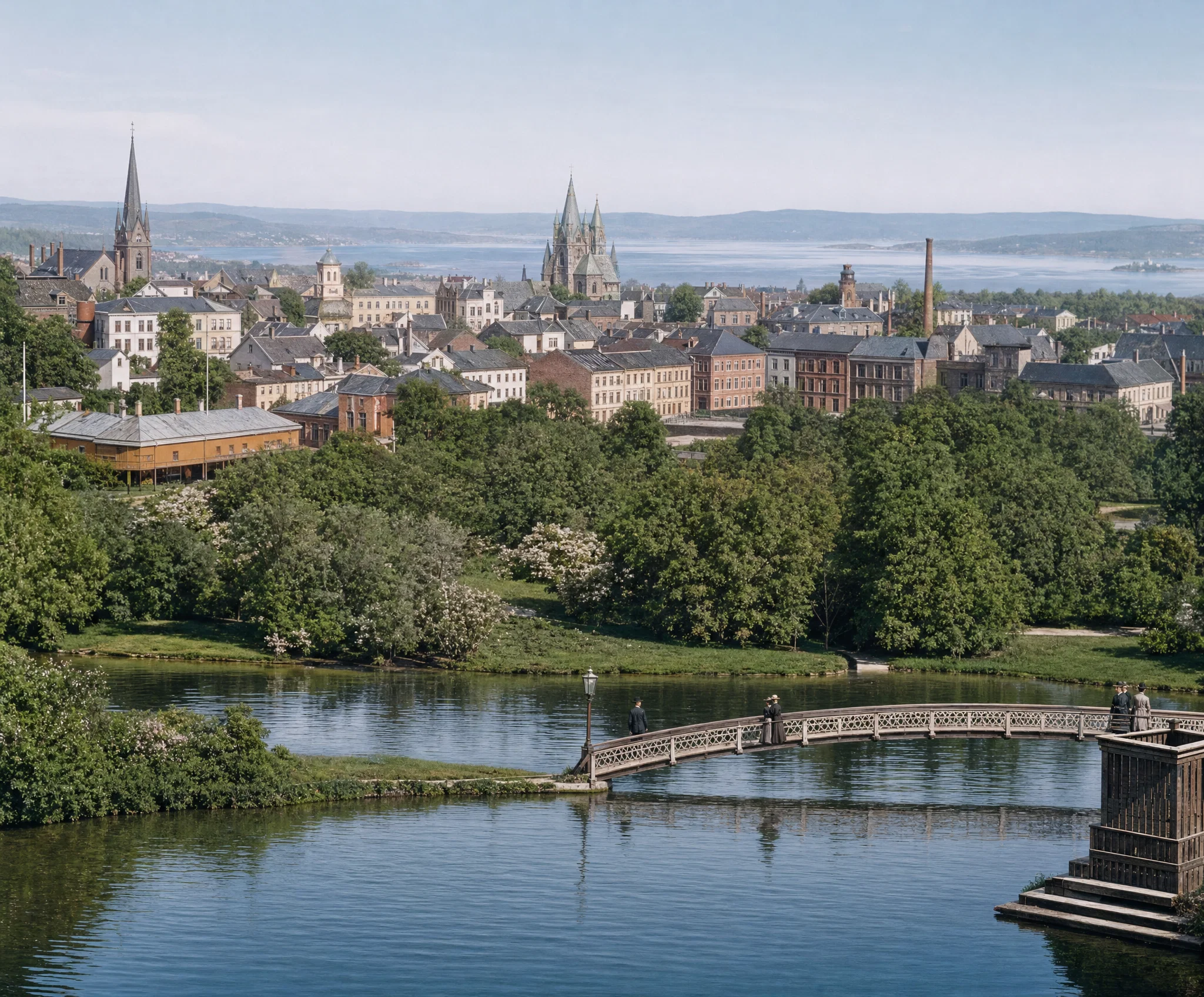
Christiania.
THE COUNTRY AND THE PEOPLE.
Christiania presents but little of special interest to the traveler. It is pleasantly situated at the foot of gently sloping, grassy and pine-clad hills, the picturesque fjord stretching away in the distance, enlivened with occasional steamboats and sailing vessels. For the most part, the dwellings, as well as the customs of the people, are very plain and simple.
It is hard to realize that in Christiania we are as far north as the southern point of Greenland and Alaska. The winters here are not severe. But the days at this season are very short. The sun rises as late as half past nine, and sets about three. In summer, of course, the days are correspondingly long. At mid-summer it is so light all night that one can see to read print. Children are often playing in the streets till midnight. At the North Cape the sun does not set from May 15 to July 29.
Norway has about two million inhabitants; the people are remarkable for their independent, liberty-loving spirit. For many centuries this country belonged to Denmark; but about seventy year ago the Norwegians cast off the Danish rule, and united themselves with Sweden. They have their own legislative body, which is called the Storthing. The king is required to be of the Lutheran religion, and he must live four months of every year in Norway.
The Norwegians are generally a well-educated, intelligent, law-abiding people. Honesty and cleanliness are cardinal virtues among them. They are simple and kind-hearted, and hospitable to strangers.
RETURN TO SWITZERLAND.
On the 16th of November we left Christiania, on our return to Switzerland. William had parted from us a few days before, going by the way of the North Sea to England, and thence to America, to attend the General Conference. We had seen the necessities of the cause in the different European fields, and were impressed with the great need of means and laborers; and as we neared the time for General Conference, he felt that it was his duty to attend; that he could best serve the cause by presenting in person the wants of these mission fields, and assisting to arrange some business matters for the mission publishing-houses. When the matter of his going was first mentioned, I could not consent; but prayerful consideration convinced me that God had put this into his mind, and I would not bid him stay. Accordingly he left us at Christiania, and Bro. H. W. Kellogg accompanied our party on the return to Basle.
On our ride from Christiania to Gottenburg, Sweden, the wild mountain scenery in some places reminded us of Colorado. But neither the height of the mountains nor the grandeur of the landscape equals that of Colorado. We passed through extensive pine forests; but the trees do not grow to a large size; they are small, and set close together. The soil is rocky and sterile. We occasionally saw evidences of wealth and prosperity, but most of the dwellings are small and poor. It is only by constant industry and frugality that the people here obtain a livelihood.
This day we were favored with a sight of the most glorious sunset it was ever my privilege to behold. Language is inadequate to picture its beauty. The last beams of the setting sun, silver and gold, purple, amber, and crimson, shed their glories athwart the sky, growing brighter and brighter, rising higher and higher in the heavens, until it seemed that the gates of the city of God had been left ajar, and gleams of the inner glory were flashing through. For two hours the wondrous splendor continued to light up the cold northern sky,—a picture painted by the great Master-Artist upon the shifting canvas of the heavens. Like the smile of God it seemed, above all earthly homes, above221the rock-bound plains, the rugged mountains, the lonely forests, through which our journey lay.
Angels of mercy seemed whispering, “Look up. This glory is but a gleam of the light which flows from the throne of God. Live not for earth alone. Look up, and behold by faith the mansions of the heavenly home.” This scene was to me as the bow of promise to Noah, enabling me to grasp the assurance of God’s unfailing care, and to look forward to the haven of rest awaiting the faithful worker. Ever since that time I have felt that God granted us this token of his love for our encouragement. Never while memory lingers can I forget that vision of beauty, and the comfort and peace it brought.
At Gottenburg we embarked in a small boat which was to convey us across the channel to the coast of Denmark. Here I was provided with a state-room containing two sofas, and shut in by heavy curtains,—accommodations which we then thought hardly necessary for a day journey of only six hours. We had occasion, however, to change this opinion before reaching land. The first hour we spent on deck, in the cheerful and well-furnished ladies’ cabin. The weather was pleasant, the sea smooth, and we anticipated an enjoyable trip. But soon the captain, passing through the cabin, advised us to go below and lie down at once, for we were coming into rough water. We complied, though rather unwillingly. In a short time the boat began to rock violently; we could hardly keep our position upon the sofas. I became very ill, now in a profuse perspiration, as if every organ was struggling against the terrible malady, and then overcome by deathly seasickness. This was what I had dreaded in crossing the Atlantic, fearing the effect of violent wrenching upon my heart. At that time I happily escaped, but I now suffered all that I then anticipated.
The waters seemed lashed into fury by the merciless winds. The boat was wrenching and creaking as if going to pieces. Whenever we attempted to rise, we were thrown back with great force. Even our faithful stewardess, unable to keep her footing, was thrown across the room from side to side as the vessel rolled and pitched. As I lay helpless and exhausted, with closed eyes and ashen face, Sister McEnterfer feared that I was dead. She was herself unable to leave her sofa, but from time to time she called my name to assure herself that I was still living. Death seemed very near; but I felt that I could cling, with the firm grasp of faith, to the hand of Jesus. He who holds the waters in the hollow of his hand could keep us in the tempest. The waves of the great deep obey his voice, “Hitherto shalt thou come, but no further; and here shall thy proud waves be stayed.” I thought how Jesus calmed the fears of his disciples as he stilled the stormy Galilee; and should I be afraid to trust to His protection who had given me my work? My heart was kept in perfect peace because it was stayed on him. The lesson of trust I learned during these few hours was very precious. I have found that every trial of life is given to teach me a new lesson of my own dependence, and of trust in my heavenly Father. We may believe that God is with us in every place, and in every trying hour we may hold fast that hand which has all power.
At 3 P. M. we arrived in Frederickshaven, and were glad to step off the boat, and to feel solid ground again beneath our feet. It was a welcome222change to our compartment in the car, and the gentle, gliding motion of the train. We lay down upon the seats, and cared only to enjoy the luxury of rest. We were sleeping soundly when at three in the morning the cars stopped, and the guard informed us that we had reached the borders of Germany, and must all pass through the custom-house. It was bitterly cold, and Bro. Kellogg went to the officers and asked permission for the ladies to remain in the car, stating that one of them was ill, and must not be disturbed. But no, nothing would avail; sick or well, we must all appear for inspection. Two officials came to the car door, and the other ladies of the party at once started to leave the car, but they had only stepped on the platform when the officers said, “That is enough; you can go back.” But they were not fully satisfied about the reputed sick woman. As I lay covered with shawls and blankets, they evidently suspected that I might be a bundle of dry goods which our party were trying to smuggle into Germany. As the officers again came to the door, flashing the bright light of their lanterns into the compartment, I quickly sat up and said, “Here I am, gentlemen, please look, and see that I am a living woman.” I do not know whether they understood my words, but they burst into a hearty laugh, said in German, “All right,” and left us to compose ourselves to sleep again if we could after this untimely interruption.
COLOGNE.
When we left Basle, we went to Hamburg by the way of Frankfort, down the right bank of the Rhine. In returning, we came up the left bank of the river, passing through Cologne, Bingen, and Mayence.
About 8 P. M. we reached Cologne, or “Köln,” as the Germans spell it and pronounce it. Here we spent the night. Our hotel was but a short distance from the celebrated cathedral, and we had a good view of it by moonlight. This is said to be the most magnificent Gothic edifice in the world. It is built, as cathedrals usually are, in the form of a cross, is 444 feet long, and has two towers each 512 feet high, the loftiest in Europe. The building is covered with turrets and statuary, and presents a most imposing appearance. It was more than six hundred years in building, and the names of the first architects have long since been forgotten. In 1848 was celebrated the six-hundredth anniversary of the laying of the corner-stone. The cathedral was completed in 1880, at an estimated cost of $10,000,000.
Cologne is one of the oldest cities of Northern Europe. It is said that a colony was planted here by the mother of Nero in 51 A. D., and even this occupied the site of a still more ancient city. Many ruins of this early period are still in existence. The old streets are exceedingly narrow, and there are no sidewalks, or scarcely any. A few years ago there was one street in which a man standing in the center and extending both arms at the same time could touch the buildings on each side. But most of the narrowest streets have now been swept away.
This city possesses an interest for us far greater than that excited by its grand cathedral. Hither came Tyndale from Hamburg, to complete the printing of the New Testament, hoping to find here better opportunities for sending the work, when finished, to England. He had not, however, proceeded far in his labors, when his secret was betrayed, and he escaped from the223city only in time to save his printed sheets from falling into the hands of the papists. A little boat conveyed him and his precious wares up the Rhine—along the very route which we are to take—to Worms. There he completed his great work, and England for the first time received the Bible printed in the language of the people.
ALONG THE RHINE.
We leave Cologne in the early morning. The weather during the entire homeward journey is bright and sunny, and we have a good opportunity to see the country. From this place to Bingen our route lies through the far-famed highlands of the Rhine. The scenery is grand and picturesque, and in summer it must be beautiful beyond description. The railroad lies close to the river bank, the track winding around the mountains, and affording a fine view of the river all the way. On each side there are mountains, here sloping gradually to the shore, there rising abruptly from the water’s edge. Palaces and towers are scattered everywhere on the river bank, adorning every commanding position along the shores. From almost every rocky crag or mountain summit an ancient castle or ruined arch looks down upon the smiling valley. The mountains are terraced and covered with vineyards, and steep, zigzag paths lead up their sides, to the watchtowers and pavilions on the pinnacles of the rocks, or far up to the towers and castles that crown the summit. On the hills and in the valleys are groves, orchards, and gardens; and nestled at the foot of the mountains, or clinging to the steep hillsides, may be seen the villages of the peasants, a grey old church lifting its spire from some elevated site above the little hamlet. On each side of the river are the road and the railroad track, the train on the opposite bank dashing along as if in strife with ours, and often disappearing from view as it darts through some mountain tunnel. Close beside us flows the beautiful Rhine, as still and smooth as glass, and upon its quiet bosom little steamers are gliding up and down.
This country being the resort of tourists and pleasure-seekers, great attention is given to everything connected with their comfort and entertainment. Large and elegant hotels, surrounded by beautiful terraced grounds, groves, shrubbery, and flowers, are built all along the river banks. And even in the smallest and most secluded villages the hotels and inns are like palaces in comparison with the dwellings of the people.
The roads along the Rhine are as near perfect as it is possible to make them. And well they may be; for workmen have been constantly employed in building and improving them for nearly two thousand years. In many places they have been walled up on the side toward the river, the rock cut away on the land side, valleys filled up, hillsides terraced, and chasms bridged over, so that though passing through a very mountainous region, they are almost as level as a railroad.
Great labor has been bestowed also on the paths up the mountain sides. There is nothing like them to be seen in America. They are made just wide enough for two mules to pass each other; not a foot of ground is wasted. On the upper side is a wall supporting the vineyard terrace, on the other, one that incloses the vine plantings. The paths are graveled hard, so that the rain may not wash them out, and they mount by regular zigzags to lessen the steepness of the ascent. Except the streams and mountains themselves, these224roads and mountain paths are, no doubt, more ancient than anything else which we look upon.
The mountains are terraced for vineyards, to the very summit. It must have cost an immense amount of labor to build these terraces, and the cultivation of the vineyards thus formed is no easy task. Earth as well as dressing has to be carried from the valley below; and as in many places even donkeys cannot be used, the work is done by men and women. Large baskets three or four feet long, flat on one side and rounded on the other, are lashed to the back, and they carry these, filled with earth or dressing, up the steep mountain paths.
Castle on the Rhine.
At Bingen the aspect of the country changes. Instead of the romantic scenery of the mountains, we see level and highly cultivated plains. In summer225they must be very beautiful, with their groves and orchards and crops of every kind, separated by green hedges, and dotted with villages and towns.
About noon we passed through Worms, the quaint old town which Luther has inseparably linked with the history of the Reformation, and from which went forth Tyndale’s Bible, the most powerful agent in the Reformation of England.
At Mayence the train waited two hours, and we improved the opportunity for a walk about the city. On our return to the station, our baggage, which we had left in the waiting room, was nowhere to be seen. After considerable search we succeeded in finding it in charge of a railway porter, who informed us that it needed guarding. We were required to pay a mark (25 cents) to one man for removing it from the waiting room, a franc (20 cents) to another for standing guard over it, and a franc to another for putting it in the car. This is an illustration of what is to be constantly met in traveling in Europe.
We reached Basle, November 19, our homeward journey having occupied four days. We were absent six weeks on this Scandinavian tour, and traveled more than twenty-five hundred miles.
In all the meetings in Scandinavia as in Switzerland, my sermons were spoken in English, and translated sentence by sentence into the language of the people. Although this was hard work for the speaker, yet the interest of the hearers was sufficient encouragement, it being equal to that of any congregations we have seen in America. On some occasions some who could not find seats would stand for one hour without any sign of weariness.
Wherever we went, our people warmly expressed their gratitude for the help which had been sent them and the interest manifested in their behalf by the brethren in America. In the social meetings nearly all spoke with deep feeling of their sorrow that we could not understand each other’s speech. They knew that this barrier was the result of sin, and they looked forward with earnest expectation to the time when there would be nothing to prevent our communion with one another.
VISIT TO NORTHERN ITALY.
WEARY and worn from the arduous labors of our northern trip, I would gladly have rested a few weeks in our home at Basle. But the next morning after our arrival, the brethren presented the necessity of a speedy visit to Italy, as some there were becoming discouraged, and were in great need of help. Arrangements were therefore made to start the next Thursday morning, less than a week from the time we reached home.
The intervening time was spent in writing letters to some of the workers in Europe, and in earnest labor, both public and private, for the young people connected with the office at Basle. Various influences had been at work to draw their minds away from true devotion to God; and they had allowed their interest and affection to be divided, giving to others that place in their hearts which the Lord alone should occupy. Sunday morning I met with them in their season of prayer, and spoke about thirty minutes upon the necessity of faithfulness in their labors. At the close of my remarks, a request was made for all to rise who would from that time make most earnest efforts to reach a higher standard. All arose. My heart was greatly drawn out for these young people, that they might improve all the powers that God had given them, and become faithful, devoted soldiers of the cross of Christ.
In the Sabbath congregation we saw a number of new ones who had become interested in the truth through reading. Among these were several young men, students from a theological school in the city. One of them, although every inducement was held out by his relatives and by the college professors, has since taken his stand decidedly for the truth. He understands the French, the German, and the English, has served a two-years’ apprenticeship in a printing office, and is now doing good work in our office as German translator. As we near the end, and the work increases, we look for such conversions to be more and more frequent. All through these countries there is talent that God will yet use to advance his cause.
On the morning of November 26, I left Basle for Torre Pellice, Italy, accompanied by my daughter, Mary K. White, and Eld. B. L. Whitney. It was my fifty-eighth birthday, and surely it was to be celebrated in a way and place that I had little dreamed of. It seemed hard for me to realize that I was in Europe; that I had borne my testimony in England, Switzerland, Denmark, Norway, and Sweden, and was on my way to labor in Italy. In my youth I felt a strong desire to be a child of God, and227as his Spirit began to impress my heart, and I tried in feebleness to obey its promptings, I received increased strength, and my desire to do good also increased. I have ever found plenty of work to do, and I have also learned that in Christ alone there is rest, peace, or happiness. In God is our only help. I have tried all these years not to build my hopes on this world, but to lay up a treasure above.
For several days before we started on our journey the weather had been foggy and rainy, and we feared that the clouds would hang as a vail over the scenery through which we were to pass. But the mist and fog soon disappeared, and the sun came out bright and pleasant.