AUSTRALIA is the largest island in the world. It lies southeast of Asia, between the parallels of 10° 39′ and 39° 12′ south latitude, and the meridians of 113° 5′ and 153° 16′ east longitude. Its greatest length from west to east is 2,400 miles, its greatest width, 1,971 miles. Its coast line is about 7,750 miles long, and its extent is computed to be 2,944,628 square miles. The Australasian group comprises nearly two-fifths of the whole British possessions. A fair idea of Australia and the location of its several Colonies may be gained by considering it as divided into three parts: western, central, and eastern. The western part consists entirely of the Colony of West Australia. It occupies the whole of the western portion of the country, and is bounded on the north, west, and south by the sea, and on the east by the Colony of South Australia and the northern territory. Its capital is Perth, which had a population in 1881 of 7,000. The Colony was established by the English in 1829, and the entire population now is between thirty and forty thousand. The central portion of Australia is occupied by South Australia and its allied northern territory. Adelaide the capital was first settled by an English colony in 1837, and now has, including its suburbs, a population of 60,000. The eastern portion consists of three Colonies. In the northeastern part is the Colony of Queensland. Brisbane the capital, with its suburbs, is a city of 40,000 inhabitants. South of Queensland, and east of South Australia, is the mother Colony, New South Wales, which has a population of about one million. Sydney the capital, with its suburbs, contains 355,000 inhabitants. The southeastern portion, southwest of New South Wales, is occupied by Victoria, in territory the smallest Colony, but in population equal to that of New South Wales. Its metropolis is the city of Melbourne, with 350,000 inhabitants. Sydney and Melbourne are the two leading cities of Australia.
If Australia were divided into a hundred equal parts, Victoria would comprise three, New South Wales ten, Queensland twenty-three, South Australia thirty, and West Australia thirty-four. Although the smallest in territory, Victoria is the most enterprising of the Colonies, and New South Wales, which is next in size, ranks second.
Melbourne and Sydney are five hundred miles apart, but they are connected by a railway. A railway is now in process of construction which will connect Melbourne and Adelaide.
Australia itself is bounded on the south by the South Pacific Ocean, and by the Bass Strait, which divides it from92Tasmania; on the east by the Pacific Ocean; on the west by the Indian Ocean; and on the north by the Indian Ocean and several of the lesser East Indian Seas.
The highest portions of land in Australia lie nearest the sea. On the eastern side the elevation averages about two thousand feet above the level of the sea, while on the western it is not more than one thousand feet. In the central portion of the country there is a cluster of mountains, called the Australian Alps, whose highest elevation is a little over seven thousand feet. There are other mountainous districts, but there is apparently a general depression in the central part. The climate, taken as a whole, is healthy, and well adapted to Europeans. It is generally free from malaria. In summer, however, it is subject to hot winds and periodical droughts, and in winter to heavy rains. The seasons are the reverse of those of Europe and America, December being midsummer and June midwinter.
Of the animal life there are not less than one hundred and ten different varieties of marsupials, of which species the kangaroo and the opossum are the best known. There are twenty-four varieties of bats, thirty kinds of rats and mice, and a number of seals. There are sixty varieties of snakes, most of them venomous. Of reptiles and lizards there are over a hundred different kinds. The insect world of Australia occupies a foremost place, whether as regards size, number, or activity, the mosquito being the most conspicuous.
Australia lies about seven thousand miles to the southwest of San Francisco, and fifteen thousand miles southwest of England, via Cape Horn, or eleven thousand miles southeast of England, via the Isthmus. It requires from the former, a sea voyage of twenty-four days to reach Australia, and from the latter, if the journey is made wholly by water, a voyage of forty-two days. It is not strange, therefore, that this far-away country should be little thought of by the people of the United States, and but little understood by the people of England, except by the few who have visited it, and by those who have commercial relations with it.
About one hundred and eighty miles south of the southeastern portion of Australia, lies the island of Tasmania, having a little more territory than the five States of Delaware, Massachusetts, Connecticut, Rhode Island, and New Hampshire. Tasmania, with the small islands near it, has a population of nearly two hundred thousand. Hobart is the capital, a sea-port town of about twelve thousand inhabitants. The city is nestled among the hills, and is quite a summer resort; but it has little enterprise. Launceston, another city of this island, about the same size, is a bustling and enterprising place. About twelve hundred and fifty miles east of Tasmania and the southern part of Australia, are the islands of New Zealand, which, although very different in shape and character, lack but one-eighth of being as large as England, Scotland, and Ireland combined, and have a population, exclusive of natives, of over half a million. The history of the seven English Colonies which occupy these countries is mostly covered by the last sixty years.
In each of these Colonies the capital is the center of all commercial interests. The railroads center in these cities, and all business gravitates to them. In this there is a marked contrast with the United States. Up to the present time the efforts made to form an Australian confederation, like that formed by the different provinces in Canada, have been unsuccessful. Not only are the Colonies independent of one another, but the people are quite different in their manners and customs. Each Colony has its own customs and laws, and regulates its own traffic, custom duties, etc., so that the passing from one Colony to another is similar to passing from one nation to93another in Europe, except that here all speak the English language.
North of Australia, and lying within twenty degrees of the equator north and south, there are many islands, settled mostly by the French, the Italians, and the English. The people of Australia are mostly from England and Ireland. It seems to be the policy of the leading men to avoid commercial relations with America, lest the American spirit should lead to a separation from their mother country. Millions of pounds sterling have been loaned to the Colonies by the capitalists of England, and with this money, railroads and other government works have been built. Nearly all the banks of Australia have connection with, or are branches of, English banks. Thus the Colonies are bound by many financial interests to England; but the land is largely owned by capitalists in Australia.
South Australia is chiefly settled by people from England and America who have gone there for their health. This Colony is said to have a very healthful climate. Of the two million people in Victoria and New South Wales, nearly one-half are Roman Catholics. In Queensland and the eastern part of North Australia there are large settlements of French. In Victoria and South Australia there are large settlements of Germans and Scandinavians.
All the principal cities of the Colonies are well laid out, and are beautified by large parks, or domains. Some of these are covered with a great variety of trees, and there is one in Sydney which contains birds of every species, brought from all parts of the world. On Sunday these domains afford excellent opportunities for preaching. Tens of thousands of people flock together here, and are entertained by speakers on various subjects.
With the exception of some modern American inventions, almost everything that can be found in the world is to be obtained in these Colonies. Land is dear, rents are high, and things in general are more costly than in England or America. In Australia the people are very conservative. The newspapers claim to be liberal; but from our standpoint they would be considered quite conservative. In New Zealand they are more liberal. The people of the Colonies have established many libraries; they are a great reading people. Sydney and Melbourne have very large libraries. The Melbourne library is one of the largest in the world. Its readers are estimated to be over one thousand a day. Besides this there are district libraries all through the country. In Victoria there are more free libraries than in any of the other Colonies. In many of the district libraries a small sum is paid yearly for the privilege of drawing publications.
THE RELIGION OF THE PEOPLE.
There is no State Church in the Colonies. The Lutherans and Episcopalians are the most numerous, and the Roman Catholics stand next in number. Nearly all denominations are represented. The doctrine of the second coming of Christ is not unpopular. Many of the Lutheran ministers, and others who stand high in the church, warmly advocate it; but their ideas of the second advent are of the English type. They believe that Christ will come as a thief, invisibly; that he will take the saints without any one being apprised of the fact, and that after a time they will come down through the air to old Jerusalem, to which place the Jews will return. Then all will have an opportunity to repent and be saved.
The people have no clear idea of a connected chain of prophecy, and when it is shown that the prophecies have been fulfilled in the rise and fall of kingdoms in the most literal manner, and in the signs of the times, it gives a tangibility to their faith, and makes a deep impression upon many who have been interested in the study of the prophecies,94but who have had no definite idea as to when they had their fulfillment. We think it is in this respect only that the Colonies have any advantage over America as a place in which to present the truth. In many respects this is the harder field. New views meet with great opposition. The people are very decided as to their faith, and are determined to maintain it and oppose error. This is as might be expected of an enterprising people whose religious views were established before they came to the Colonies. It will be seen that their opposition would naturally be very strong and bitter. But when they do embrace new ideas, they are as zealous to vindicate them as they previously were to oppose them.
HOW OUR ATTENTION WAS CALLED TO AUSTRALIA.
In 1861, Miss Hannah More, who had charge of the Mendi Mission in Africa, was making a visit in New England, and for the first time attended a meeting where she heard presented some points of present truth. We staid one night with a family where she was visiting, and had some conversation with her on religious subjects. She soon returned to her mission in Africa, and through correspondence and the reading of publications she finally embraced the Sabbath of the fourth commandment. As the mission was supported by friends in England, upon accepting these views she resigned her position; but before leaving Africa she visited the different missions in that country, where she distributed publications, and through her influence Alexander Dickson, a missionary from Melbourne, accepted the Sabbath. Soon after this we learned of forty in a French settlement at Senegal who were observing the Sabbath. At that time we had correspondence with Mr. Dickson, but after he returned to Australia we lost all knowledge of him. For years we labored by correspondence to learn his whereabouts. Finally we found him in San Francisco, he having renounced the Sabbath. The only reason that he gave for this was that he had spent a small fortune, without success, in publishing and traveling to get people to keep the Sabbath.
At a meeting held in Battle Creek, Mich., in 1874, Sister E. G. White said that there were many nations that would receive the present truth, and that she had seen presses running in many countries, printing papers and books on present truth. When asked what countries these were, she said that Australia was the only name she could remember. If the work in Australia had been begun twelve years ago, there is no doubt that we should have found many persons interested in the Sabbath truth. Mr. Dickson and others aroused more of an interest in its favor than they were aware. Some who owned stores, closed them on the Sabbath, and for a number of years pamphlets were published vindicating the seventh day as the Sabbath. A number who embraced the Sabbath then, or soon after, finally became discouraged and gave it up, returning to their former practices. At that time there were great numbers coming to Australia from England, and many imagined themselves like the Pilgrim Fathers, who over two hundred years ago came to the shores of the American continent. They had a desire to imitate America, and no doubt would have received more readily a truth coming from this country at that time than after the customs and beliefs of society had become settled and established.
A MISSION OPENED.
At the annual session of the General Conference held in Battle Creek, Mich., in November, 1884, a resolution was adopted recommending “that Eld. S. N. Haskell go to Australia as soon as possible to superintend the establishment of a mission there, and that Eld. J. O. Corliss and other laborers go at the same time to work in the mission.”
In accordance with this, on the 10th of May, 1885, Eld. Corliss with his wife and two children, Eld. M. C. Israel with his wife and two children, and Bro. H. L. Scott of California, Bro. W. Arnold of Michigan, and myself, took passage on the steamer Australia. After twenty-eight days’ sail we landed at Sydney.
In about one month we were settled in Richmond, one of the suburban towns of Melbourne. As it was winter, the weather was quite disagreeable, there being almost constant, chilly rains. We found that halls suitable for meetings varied in price from one to five pounds ($5 to $25) per night. Not thinking it advisable to rent one at these prices, our brethren labored from house to house, reading the Bible and conversing with the people, while we visited many of the leading men, forming many acquaintances with those of influence, who proposed to assist us in any reasonable manner. This class seemed to be glad that we had come to the Colony. While many of them were professors of some form of religion, they were liberal in their views, and thought a new religion might reach a class that hitherto had not been reached. But it was with difficulty that our brethren could get access to the common people, especially the religious portion of the community. Being Americans, we were looked upon with questioning and suspicion, especially as we introduced a new doctrine. We were indeed strangers in a foreign land.
As soon as a few persons had become interested in the truth by Bible readings and personal labor, we met with the most bitter opposition from ministers, people, and the press. We could secure but few places in which to place our tract distributors, and these were in shops. But in the different parks we placed papers in the tops of the iron fence posts. These were taken by those who passed through the parks to and from their work. Over twenty thousand papers were distributed thus, and in depots and other public places. The secular papers, although undenominational, could not be prevailed upon to publish articles which contained views contrary to those indorsed by the public sentiment, or which in any way presented us favorably. This was in marked contrast to what we afterward found in New Zealand, where the papers are ready to publish, as news, that which in any way contributes to the interest of the reader.
One Lutheran preacher advertised quite extensively that he would expose Adventism by giving the history of its rise, and what the object of these men was in coming from America. He stated that we had come from the “obscure State of New England,” whence everything that was bad had come, and many things that were good; that there was one Miller in America, who had proved to be a false prophet, and that out of his theory ours had developed. In one of the largest papers of the city there were three articles in one issue, warning the people against us and our work. Ministers of various denominations seemed to take pride in “exposing those Adventists who came from America.” One threatened to discipline any member of his church who permitted one of us to enter his house. He said we had no business to enter their houses unless we first consulted him.
Sometimes when Bible readings were appointed, men would come determined to break up the reading, and in one or two instances they succeeded. Others came to learn the truth. No means which law would permit, or religious bigotry prompt men to make use of, was left untried to prevent our success. When visiting families, we were frequently told that it would not be necessary for us to call again. But there were most noble exceptions. One name worthy of mention is that of Mr. Brown, an Englishman, who had visited America, and who, though he never accepted our views, rendered us much assistance in various ways.
When we saw how expensive it would be to hire halls, and met such bitter opposition, we ordered a tent 40x62 feet. By September it was made and pitched in North Fitzroy, one of the suburbs of Melbourne. As I was soon to go to New Zealand, the burden of the meetings fell upon Eld. Corliss. These were advertised in the daily papers, and many thousands of circulars were scattered through the suburbs. Very soon it was seen that the unfavorable notices which the papers had given us and our work, had only tended to arouse the curiosity of the people, and bring them to the tent.
Quite a number who had become convinced by the Bible readings, at this time began to work for their neighbors and friends, with Bible readings which our brethren prepared for them. Thus it appeared that the visiting and personal labor which we did soon after arriving, had laid a good foundation for public effort. Those who had become interested by Bible readings were in constant attendance throughout the series of meetings. Although some lived a number of miles from the tent, and it cost them from sixpence to ninepence (twelve to eighteen cents) to go to the meetings and return, poor men attended month after month, thus showing that their hearts had been affected by the doctrines taught.
A worthy Presbyterian deacon attended a few meetings, purchased some tracts, and embraced the Sabbath. His brother and wife were greatly affected by his taking a stand upon so unpopular a doctrine. They requested their son, who was highly educated, to visit his uncle and convince him of his error. After an interview which lasted nearly all night, the nephew became convinced that his uncle was right, and consequently went home a Sabbatarian. From that time he began to labor ardently for his father and mother, brothers and sisters, uncles and aunts, and the result of his labor was that thirteen out of a family of fourteen took their stand for the truth.
This spirit of personal labor for their friends was a marked characteristic of the Australian Sabbath-keepers. Their earnestness and zeal was great; they left no stone unturned to reach their friends and neighbors. Some embraced the Sabbath who first learned of our work by taking the Signs from the parks. They came to the mission to inquire who we were, and what our object was in coming to that country. After the matter had been fully explained to them, they took reading matter, and in a short time we learned that they had fully decided to keep the commandments of God and the faith of Jesus. As is usually the case, some who first embraced the truth afterward renounced it. But by the circulation of reading matter and the personal efforts of those who remained faithful, a knowledge of the truth was extended to other cities and towns, and an interest was awakened in different parts of the country.
During the tent season, from September to May, the tent was pitched five times in four of the suburbs of Melbourne, and as many courses of lectures were given in it. In each place some took their stand for the truth. The work having once started, the truth seemed to be clothed with power, and went forth, like a lamp that burneth, to all parts of the city and into the country. One man who was a contractor heard a few discourses, became interested, and he and his wife took their stand with others. He began at once to labor for his father and mother, brothers and sisters, and continued so earnestly that in a few weeks nine of them embraced the truth. This contractor carried on a large business, and employed many hands. After deciding to keep the Sabbath, he called his employees together, and told them that he would have no more Saturday work. A few were dissatisfied. They were immediately paid off and discharged; the rest were told that if they97chose they might put six days’ work into five by working over time. He was doing government work on a contract, and was behindhand with it. Unless the work was finished at a certain time, he would forfeit his pay. Word came from his men that they must work on Saturday if they finished the work at the time appointed. He returned word that they should go to work on Sunday instead. This was an unheard-of thing in that section of the country. In order to avoid any trouble, he went to his employer, and explained to him that, in order to get the work completed at the time specified in his contract, he would be obliged to work on Sunday, and his proposition was accepted. The police raged, and were going to prosecute him. But a lawyer to whom they went for counsel said to them: “The English laws are founded upon the law of God, and if it should turn out that these men are right in their explanation of that law, it might go hard with you.” He advised them not to carry the matter farther, so it was dropped.
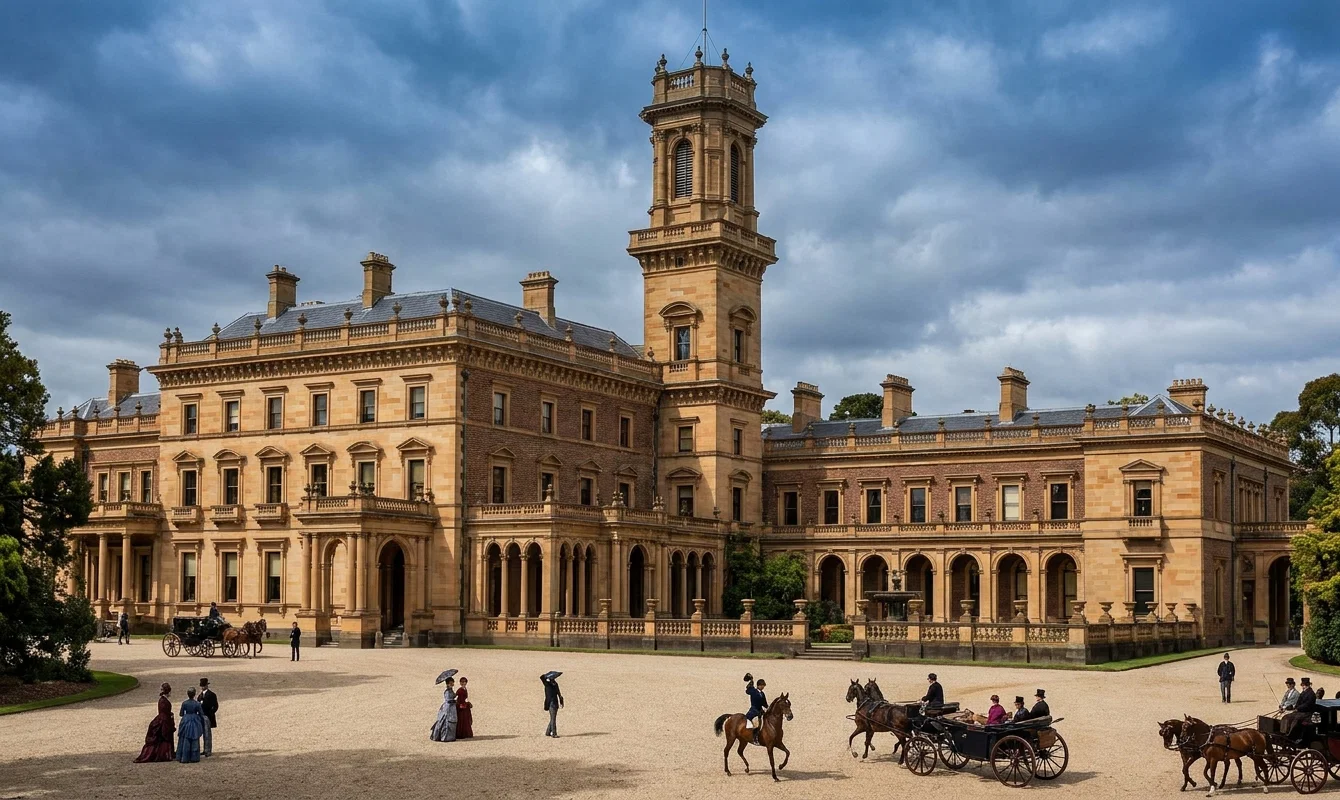
THE GOVERNMENT HOUSE, MELBOURNE, AUSTRALIA.
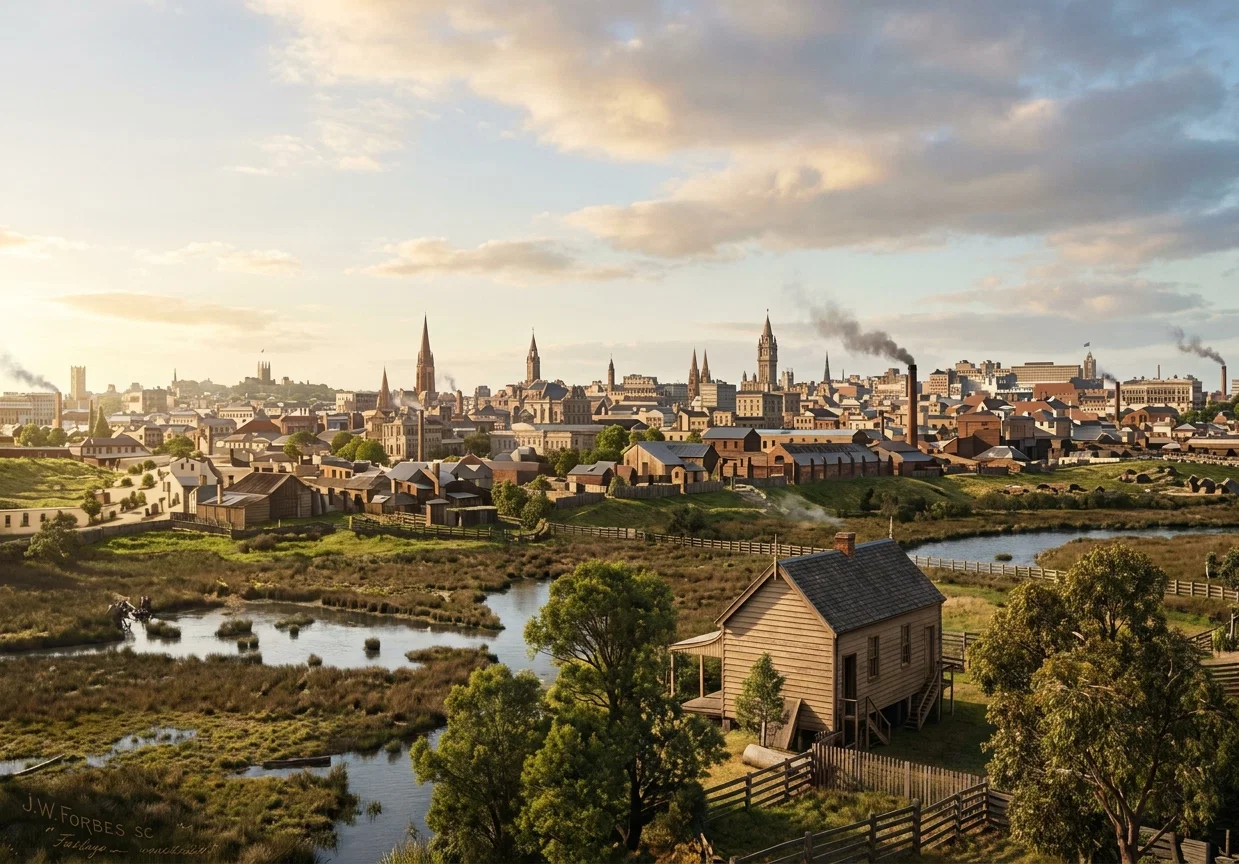
View of Melbourne.
The Treasury Building.
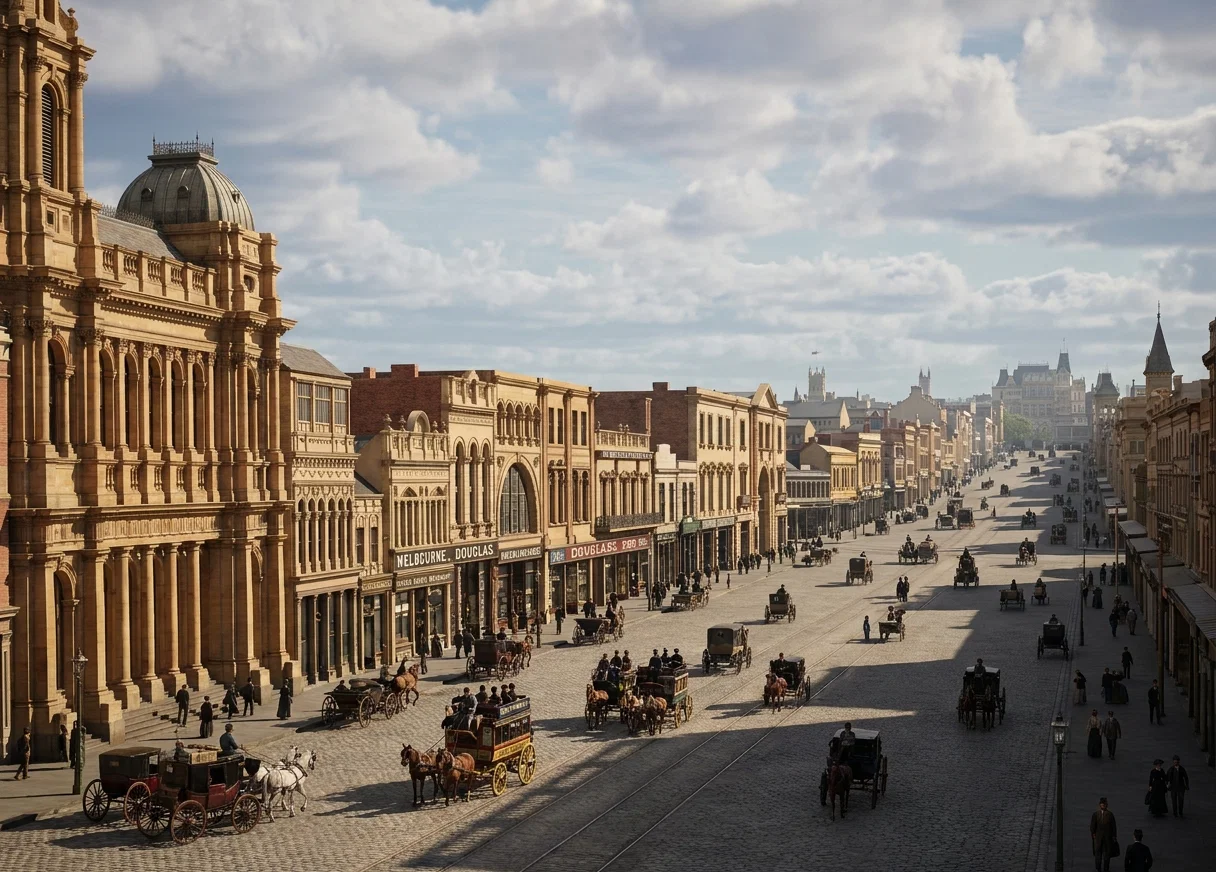
Burke Street, Melbourne.
This affair stirred the community. The people wanted to see the contractor. Accordingly he promised to meet them, and tell them why he worked on Sunday. He expected to see only a few persons, but was surprised to find the house crowded. He gave them a Bible reading on the Sabbath question, and left them deeply interested, and earnestly calling for preaching on the subject.
The members of one firm in a suburb of Melbourne who sold American organs and employed agents to travel through the Colony, after accepting the truth, placed our publications in the hands of their agents. They also opened a book department in their store, where our publications were offered to their customers. Thus far they have been very successful in obtaining subscribers for the Bible Echo, as well as in selling it and our other publications. Other merchants have embraced the truth, and thus a number of stores are closed every Sabbath.
Not many families were broken by the truth. In most instances, every member accepted it heartily. Most of these are from the middle class,—contractors, school-teachers, printers, foremen of wholesale houses, and persons engaged in managing and carrying on various kinds of business. Not one who united with us was at that time using tobacco or drinking ardent spirits. They were persons who had begun the work of reform before the truth found them; and nearly all were persons of influence. This gave our work a favorable standing.
The success of our work troubled the clergy so much that councils were held to find a man who would debate with Eld. Corliss. Individuals from all classes sent and procured our leading denominational works; but after reading these, they seemed to think that it was better not to debate. Before this, the Disciples had encouraged discussion, and had a standing challenge to debate with any one who did not agree with the views of their church. But on this point they became suddenly silent. They used the apostle’s expression, “The servant of the Lord must not strive,” although they had never appeared to realize its application before. By this general agitation of the subject, we became extensively known. The efforts against the truth only served in the end to help it forward.
INCIDENTS CONNECTED WITH THE BIBLE READINGS.
During the winter, the opposition to our Bible readings was very great. Ministers and others came for miles to oppose our Bible readings, which were sometimes entirely broken up on account of the bitter feeling manifested. Some time afterward, however, we learned that the first meeting which one person attended, was thus broken up, but notwithstanding this, he was there convinced of the truth. He has since taken an active part in the work, devoting his whole time to it.
At another time a minister and a few of his friends came a number of miles to meet us, thinking that our views could be easily overthrown. When asked to read a text which was directly contrary to his faith upon a certain point, he would do so, but with the greatest apparent confusion of mind as to what it said. After collecting his thoughts, and wiping the perspiration from his forehead, he would deny the point proved by the text. We did not discuss with him at all, but would simply say that perhaps he did not get the full meaning of the text, and would better read it again. In this way we would spend a long time upon one passage. His friends became much interested, and quite fully convinced of the fallacy of his position.
At the close of the meeting he desired a reading upon the subject of the kingdom and its manner of being set up. His position upon this point was that the Jews would return to Jerusalem, and that the second coming of Christ would be invisible. We spent three evenings of two hours each with him and his friends on this one question. He would acknowledge the truth, point by point, as we took it up, and then at the close would simply say that he did not believe what we taught. We never realized the soundness of our views as we did when met by the fiercest opposition. The simple reading of the Bible would, for the time being, silence the worst opposers.
On another occasion, a clergyman informed his parishioners that he would attend and show them how easily our views could be refuted. Eld. Israel conducted the reading. The gentleman came, but he soon became confused and refused to read, and while some of his friends read for him, he would stoutly deny the testimony.
In one case we were invited by the man of the house to come and hold as many Bible readings as we pleased. We went one night and held a reading which changed the views of every member of the family excepting himself, and we were not invited to come again.
ORGANIZATION OF THE FIRST CHURCH.
Sunday, April 10, 1886, after a second course of meetings by Eld. Corliss, we met to organize the first S. D. A. church in Australia. There were eighteen persons present who had signed the covenant, besides those who came from America; and seven others applied for admission by baptism. These were baptized the following Sabbath, and each Sabbath for a number of weeks members were added, until the church numbered fifty-five. Up to May, 1886, one year from the time we left San Francisco, the entire number enrolled was ninety. Besides this, there were about thirty-five names on the covenant. A missionary society also was organized, and a club of about two hundred papers was taken and paid for by the members at the retail price so as to help the society. Many copies of these papers are remitted by the brethren to their friends in England. Children from eight to thirteen years of age take an active part in this work.
A church that will seat about twelve hundred persons has been rented in the city of Melbourne at forty pounds ($194) per year. This is to be used simply for Sabbath meetings, and for a business meeting to be held one day in each month. When not otherwise engaged, it can be rented for evening meetings for one pound ($4.87) per night.
CLOSE OF THE TENT SEASON.
In reference to the closing of the tent season, Eld. Corliss writes:—
“Our tent meetings closed the last of April, with good feeling all around. Thirty-five have signed the covenant. [This was in the suburb Yarra.] Sunday afternoon I called the brethren together in the tent, and spoke to them on the tithing system. Then I read them a detailed statement of our expenses during the entire tent season, including the seating for the tent, our printing bills at the Bible Echo office, and everything except the cost of the tent itself. This all amounted to99between eighty-two and eighty-three pounds (about $410). Quite a portion of this had already been paid by the contributions placed in the box at the door of the tent, and by other donations. There still remained, however, a deficit of about thirty-two pounds. This the brethren made up in less than ten minutes. We did not even have to ask them to give; but the first thing I heard after reading the statement was some one saying, ‘I will give five pounds toward making up the amount.’ Then one after another responded so rapidly that I had to ask them to wait until I could take down their names. It did me good to see how they took hold of the work, as though they were perfectly accustomed to it. We even dare to hope that when it is needed, the brethren will feel able to help themselves to another tent.
“Our book sales at the tent amounted to between fourteen and fifteen pounds. We learned at this meeting how to dispose of our tracts. We put them together in shilling packages, and they went off at times as fast as we could deal them out. Some nights we would sell from twelve to fifteen shillings’ worth. In this way we scattered much truth which cannot fail to bear fruit. I would not be surprised if a good many more would embrace the truth from this effort. But I must say that I never saw more persistent effort to hinder and destroy a work. The devil fought to the end.
“Everything that could be thought of was tried against us. We were denounced as Yankees, and the people were warned to keep away; but they did not seem to heed the warning. Then the Campbellites challenged us to debate; but when I accepted, they sent a note politely backing out until I should challenge them in writing. So I took advantage of their delay, to present some strong arguments for the truth and against their position. Then the Plymouth Brethren had flaming posters put up all around town with the significant heading, ‘Christians, beware!’ A number of these were posted on high boards in front of the tent. But still the interest increased. All these things seemed to help forward the work rather than hinder it.”