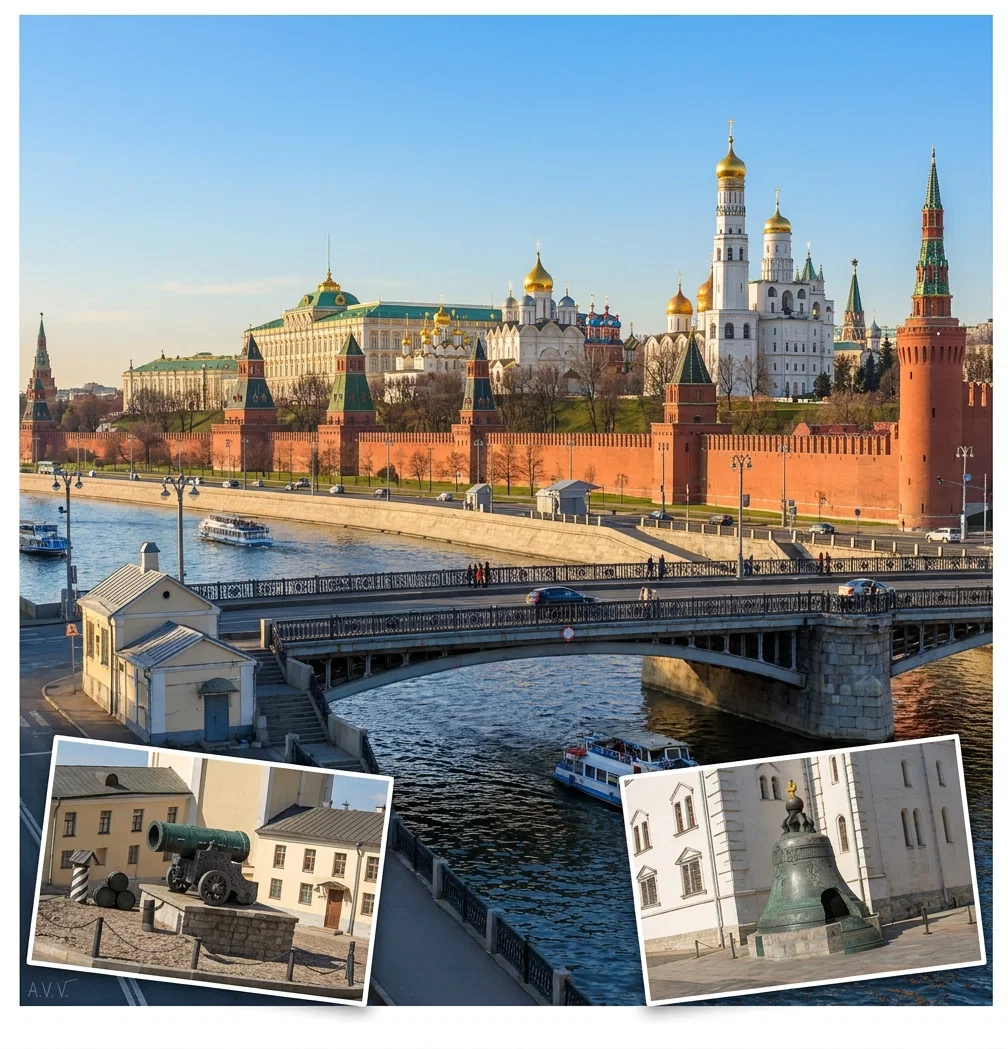
Next morning at Koslov Bro. Roth and I were obliged to separate, his return ticket taking him by the southern route, while I took the much shorter and quicker route by the way of Moscow. I arrived in Moscow Sunday night, and as my train was not to leave until Monday evening, I started out early in the morning to see some of the sights in this ancient capital of Russia. My first visit was to the Kremlin, a celebrated fortress in the heart of the city. On my way I noticed a fine carriage with six large black horses driving through the streets. As it passed, every one uncovered his head, bowed reverently, and crossed himself. It stopped beside a chapel, and the people, rich and poor, rushed up to it, some gentlemen and ladies even leaving their carriages. Drawing nearer, I saw in it two priests clad in rich garments, one holding a light and a large cross. The people kissed the cross, and269the hands of the priests, and even the seams of their garments.
A few steps farther brought me to the famous Red Square, where is the sacred place from which the emperors proclaimed their will to the people. Here stands the St. Basil cathedral, a very old-looking structure, with its many different colors, and here is also the most noted gate of the Kremlin, that of the Redeemer. The picture of the Saviour which hangs over the entrance is regarded with great veneration by the Russians, those who approach it uncovering their heads while yet at a distance. As I forgot to do so, several shouted to me at once to take off my hat. Passing through the gate, I saw the tower of Ivan the Great, and on a granite pedestal at its base the king of bells, the largest in the world, a monster twenty-six feet high and sixty-seven feet in circumference, and weighing four hundred and thirty-two thousand pounds. It has fallen twice from the tower, first in 1706, and again in 1737; the last time a large piece was broken out.
A View in Moscow.
As it was too early to ascend the tower, I visited some of the public edifices within this vast fortress: for the Kremlin is not one single building, but an immense pile of buildings surrounded by walls and270battlements. I went first to the cathedral of St. Michael, which contains the tombs of the czars down to the time of Peter the Great; and afterward visited the beautiful Cathedral of the Annunciation, with its rich interior covered with gold and gems, its gilded roof and nine cupolas.
Then passing a number of monstrous cannon, I went through the arsenal, which contains a famous collection of arms, and many jeweled thrones and crowns and other historical relics. Here I saw the oldest golden crown, worn by Vladimir I., 956–1015; also an imperial globe on which were eighty-nine rubies, twenty-three sapphires, fifty emeralds, thirty-seven pearls, and fifty-eight diamonds. Among the splendid robes and imperial regalia were those worn by the present emperor and his wife at their coronation. As I viewed the vast collection, presenting the greatest treasures of this mighty empire, the finest spoils of Asia, and the choicest gifts of kings, and noticed how carefully they had to be guarded, many of the showcases being kept sealed, I thought of the words of Solomon: “I gathered me also silver and gold, and the peculiar treasure of kings and of the provinces. . . . Then I looked on all the works that my hands had wrought, and on the labor that I had labored to do; and, behold, all was vanity and vexation of spirit, and there was no profit under the sun.”
The emperor being absent, I with other visitors was allowed to pass through the imperial palace with its grand reception halls and its multitude of rooms, some furnished in modern style, others after different ancient fashions. In every part of the palace there were chapels for worship, and many of the rooms were decorated with scenes from the Bible. In one portion of this vast building was the room where the synod has its sessions. I was glad when my wanderings were over, pitying rather than envying those who occupy these rooms from time to time.
As the sky was now clear, I ascended the great tower, to enjoy from its summit one of the most remarkable views in the world. Below was Moscow, with its seven hundred thousand inhabitants, the center of the national life of Russia, the place of the coronation of the czars, the commercial emporium of Central Russia and Western Asia, the “holy mother city,” in the creed of the people. Its thousand spires, domes, and minarets, with their diversity of shape and color, sparkled in the bright sunlight. There was the Kremlin, with its fine public buildings, its rich cathedrals, and grand palace. There were the lofty walls of the Kremlin, forming a triangle nearly a mile in length, the battlements, the eighteen towers, the five gates, and the fine boulevards surrounding all. There was the river Moskva winding its way like a silvery thread through the city; the great bazaar with its thousand shops occupied by merchants trading with Siberia, China, Tartary, and almost all other portions of the world; the great mass of houses reaching to the hills beyond,—truly, it was a magnificent view. From its promiscuous mingling of palaces and huts, Moscow has been fitly described as being at once “beautiful and rich, grotesque and absurd, magnificent and mean.”
It seemed hard to leave such a sight, but the hours passed rapidly, and I had to hasten. Looking for a moment at a few of the thirty-four bells which this tower contains, some of them of enormous size, making a brief visit to the Church of the Assumption, where271emperors are crowned, and pausing for a glance at the great bazaar, I hastened to the train.
ACROSS THE BORDER.
Next morning we were in Smolensk, an old fortified city noted for the victory gained here by Napoleon I. in 1812, by which his way was opened to Moscow. A twenty-four hours’ ride brought us to Brest, an important railroad center. Just beyond it are some of the strongest fortifications of Russia. Here we entered ancient Poland, and instead of the Greek churches we now saw those of the Roman Catholics. The country became more thickly settled and better cultivated. About noon we reached Pragga, one of the suburbs of Warsaw. Passing many factories and some strong fortifications, we crossed the Vistula, getting a partial view of Warsaw, a city of four hundred thousand souls. Arriving at the main depot, we took our tickets on the fast train for Berlin. Warsaw disappeared from view, and by evening, Oct. 6, we had reached Alexandrow, the border station.
Here our passes had to be given up to the police for examination, and while they looked them over I went to a restaurant for supper, as I had had nothing to eat all day. Hardly had I commenced my meal when an officer called out some name; I listened—it was mine. For a moment I grew pale, wondering why I should be singled out among so many passengers, after all the care that I had taken to get my pass in order. Could it be that I was to be again arrested, when almost beyond danger? Once more he called, and this time more sharply. I arose and told him that I was the person. In a harsh tone he bade me follow him, and we entered a room where a number of officers were recording the passes of the passengers. There I was informed that the officials in Saratov had neglected to affix the stamp to my pass. I never paid thirty cents more cheerfully in my life. I went back to the restaurant, finished my supper, and then entered the German cars. A few moments later the officer returned our passes, the engine whistled, gave a few good puffs, and soon we crossed a little stream,—thank God, in Germany!
The Russian Mission has been opened. Not without cost, it is true. Dangers and difficulties are still in the way. Imprisonment and persecution threaten the laborer. The preacher is not at liberty to present the message. But as it is God’s cause, who can hinder? As little as men could prevent the spread of the gospel in its earlier stages, or stay the progress of the Reformation, so little can this truth be held. Satan is fully aware that there is a vast field opened in Russia, and he uses every means to bar the entrance. But could the vail be lifted, we would see hundreds and thousands of Germans in Russia, yes, and Russians also, who are investigating the truths of the last message. Many are deeply convicted. Some begin to yield. About eighty are already obeying. Some of these begin to feel a burden to labor for others, and notwithstanding all the dangers, a few are nobly dedicating themselves to the work. All over this vast empire the believers are scattered, and through them the light circulates. It extends even to far-off Asia, and some there already know of present truth. The truth has found an entrance, the seed is firmly planted, and, God giving the increase, it will undoubtedly grow and prosper, so that a number from this nation also may be among the 144,000.
THE USE OF TENTS IN EUROPEAN FIELDS.
At the European Missionary Council of 1885, much thoughtful attention was given to the question as to whether the use of tents was practicable in the work in Europe. Efforts with tents had been twice made in England, and though the first effort had for various reasons been abandoned, the second, which had been carried on during the summer preceding this session of the Council, had met with encouraging success. After thorough discussion and mature deliberation, the Council recommended the procuring of an additional tent for England, and a tent each for Scandinavia, Germany, France, and Italy.
Some of the reasons which led to the adoption of this recommendation may be briefly stated as follows:—
1. The difficulty and expense of obtaining suitable places for holding public meetings. These difficulties exist in different degrees in the various localities where the work has been commenced, but in all these fields the situation leaves much to be desired in the way of public access to the people.
England is perhaps the most favorably situated in this respect of any of the European fields, but even there it is often impossible to obtain suitable halls for holding religious meetings,—halls which would give the right character to the work,—without large expense, and (272) sometimes they cannot be obtained at any price. The class distinctions so prevalent there, are carried so far that there may be said to be almost a caste in halls. At least the character of the audiences depends largely on the class of halls which are secured, and those of the better class are high in price. In some localities also the halls are controlled by the clergy of the Church of England, who use their influence to oppose their being occupied to teach dissenting doctrines. It was the opinion of those who had labored with the tent during the summer of 1885, that the use of tents would successfully meet some of these difficulties in England, and prove in many cases a more practical and less expensive method of reaching the public than by holding meetings in halls.
TENT LABOR AND COLPORTER WORK.
In France it is often impossible to secure proper halls, from the fact that they do not exist. The policy of the French government in years past has been to prohibit large gatherings of the people, so there has been no demand for rooms for public assemblies. It is but a few years since the law was in force strictly forbidding the assembling of more than twenty persons for a meeting of any kind, except the religious meetings held in the regularly established temples for worship. For this reason, even though the laws are now more liberal, there is great difficulty in273securing places large enough to convene a large assembly. If the permission to use tents could be secured in this country, it would obviate, it was judged, a serious difficulty in reaching the masses.
In Germany, although halls can be secured, they are almost invariably connected with drinking establishments, so that their surroundings are not favorable for the holding of religious meetings. The rental of halls is usually expensive. The laws in Germany are more favorable to the protection of religious meetings than in most of the countries of Europe. Meetings in a tent would without doubt have the same protection as those held in halls, and so the most favorable opportunity would be provided for reaching the public.
In Scandinavia the spirit of religious liberty and toleration is much more prevalent than in the countries of Central Europe. The general customs of the people seem more in harmony with the freedom of our American institutions, especially in religious matters. But even here it is often difficult to find suitable places for meeting. In the cities, halls can be obtained; but in the smaller places they are not so readily found. It was thought that if tents could be used successfully in all these countries these obstacles which in many instances have proved a serious hindrance to the work might be by this means overcome.
2. Tent-meetings would furnish a better means of advertising our work, attracting the attention of the people, and bringing the laborers into direct association with those for whom they are laboring, than meetings held in halls. The novelty of using tents for religious meetings would serve to draw the people by arousing their curiosity. The experiment in England has shown that the people were willing to assist in contributing toward the expenses and support of those who were laboring for them, and by this means the laborers were brought into personal association with the people. In many cases this would be a great point gained, as it is very often difficult to break down the barriers which seem to exist between the common people and their religious teachers.
3. As regards the health of the laborer, tent work offers decided advantages over some other methods of work. In England open-air meetings are quite commonly held as a popular means of reaching the masses; but this method of labor involves serious risk to the speaker, whose vocal organs are severely strained in order to secure the attention of the people and to make himself heard. The tax upon the lungs and vocal organs is much less in speaking in a tent than in the open air. It is also very difficult to develop in this manner a definite interest among the people. The audiences in open-air meetings are made up more largely of a floating element, and are much more changeable than those which would attend the lectures held in tents.
The tent also furnishes a much more healthful location for the audience as well as for the speaker, than the crowded, badly ventilated rooms and halls which are the best locations obtainable for meetings in many of these countries.
These, and other reasons which might be named, seemed to furnish abundant reason for a thorough effort to test the question whether tents could be successfully used in these fields, and it will without doubt be of interest to the reader to learn something as to the success of the experiment during this first season.
The result of this trial has been in the main encouraging. It has been demonstrated in all these countries excepting Germany, where a tent has not been employed, that meetings of this kind can be held. In Italy the free protection of the authorities has been readily accorded, and no serious difficulty has been found in maintaining a good degree of order. The attendance has been, it is thought, much larger than it would have been in274any hall that could have been secured; and while the results have not been as great as might have been desired, yet the effort has been as successful in this respect as those that have been carried on in the usual way.
At Nîmes, France, there was at the outset serious disturbance in the meetings, and that, too, not from the lower class of roughs alone, but as well from the cultivated and gentlemanly appearing students of the schools. For a time these disturbances seemed to seriously threaten a failure of the effort. The authorities would promise no protection, as they claimed not to have the force to hold in check the disorderly elements. Special permission had to be secured from the authorities for the holding of each meeting, which of course involved much difficulty, and a perplexing loss of time. But by patience and perseverance and the blessing of God, these difficulties were all overcome, and during the last weeks the meetings were as quiet and orderly as those held in any place of worship. The authorities also consented after a time to grant a permission covering several weeks, and thus the effort was closed with no greater obstacle in the way than would be encountered in the most favorable locality.
This we consider very decided success, as in no country of Central Europe are there greater difficulties to be encountered, either in the restrictions of the government or the condition and spirit of the people, than in France.
Not only has there been a good attendance at the meetings, but, despite the unpropitious commencement, the results have been very gratifying. Seventeen persons have embraced the truth, and there is still a good interest to hear. Public Bible readings have been introduced, both in the tent and in private houses. The Bible readings held in the afternoon in the tent have often been nearly as largely attended as the preaching service.
In connection with this tent effort, thousands of copies of a tent journal have been distributed from house to house through the city. There is every reason to believe that this distribution has laid the foundation for a good work yet to be accomplished in the future, and that the real results of this effort are not to be estimated by the present apparent fruit.
When we take into consideration the special hindrances to public labor in France, which have already been referred to, it will be seen that the importance and bearing of the success of this first effort is not inconsiderable. To have demonstrated that a successful tent-meeting can be held in France, is really a great point gained. The prestige of this effort will doubtless have its influence in favor of future work of this kind in that country.
In Scandinavia the tent effort has proceeded much as it would have done in one of our American Conferences. No permission was required for the privilege of pitching the tent. Eld. O. A. Olsen, who has labored with the tent there in connection with other brethren, states that he has never witnessed a more cordial and hospitable feeling on the part of any people than was manifested by the citizens of Moss, from the very outset of their efforts there. He states also that he has never been able in any locality to present the truths of the message in a more direct manner or in a shorter period of time. The effort there being still in progress, it is impossible to speak definitely as to the final results, but from the present season’s experience it would seem safe to assume that Scandinavia offers as good a field for labor with the tent as is to be found anywhere.
Although circumstances have prevented a tent effort in Germany during the present season, there seems to be no reasonable ground to suppose that this country will prove an unfavorable exception275to those in which an effort has already been made. The laws are certainly more favorable than in France, while the general disposition of the people toward religion and public labor in its behalf cannot be otherwise than favorable to Germany.
In England the effort with the tent during the present season has not, perhaps, been quite so favorable as those of last year, and yet there has been nothing which would indicate any serious obstacle in the way of this kind of work. The climate of England, it is true, is unfavorable to the preservation of tents, as it is damp, with but a comparatively limited share of sunshine; but it is thought that with good care tents will last for a reasonable time even in this climate. The climate of France and Germany is in this respect peculiarly favorable, while that of Italy and Scandinavia is good.
In the matter of expense, these initial efforts with tents have been quite costly, more so than will be the case in the future. It cannot, however, be denied that work of this kind must always involve a heavy expense; but as compared with the expense of holding meetings in the usual manner, it is believed that the result will not be unfavorable to the use of tents in these fields.
As a whole, the efforts of the present season offer many reasons for encouragement. A new step has been taken in the public presentation of the truth to the people of Europe. There still remains much to be done in the way of educating workers who shall be prepared to labor in connection with such efforts in such a manner as to make them most efficient and most successful. Without doubt very much yet remains to be learned by experience as to how to adapt this method of work to the conditions of the people so that the best results may be secured. But we fully believe that with increased experience this will be found a practical and efficient method of reaching the people, one which will yield results commensurate with the considerable expenditures demanded to carry it forward, and that by the blessing of God tent work will prove to be one of the successful methods of extending the proclamation of the present truth in Europe. B. L. WHITNEY.
COLPORTER WORK IN EUROPE.
The work of proclaiming the third angel’s message in the various countries of Europe, is a great work, and one attended with many difficulties. The solemn truths of the message relative to our present position in the world’s history, and our present duty in regard to Sabbath reform, are even more unpopular here than in America, and as a rule the circumstances and surroundings of the people are such as to make it more difficult for them to obey the truth after they accept it. The older the country, the more completely do men seem to be hedged about with barriers against reforms of any character, and especially against any change in matters of religion.
As we study the progress of religious reformations in different parts of the world, we shall notice that usually those who live in new and growing countries are most ready to investigate new truths. Either they or their ancestors have sought the new country in hope of bettering their circumstances, or because they were dissatisfied with the old channels in which their lives had been running. In many cases the same impulses that led them to seek for improvement in their temporal matters, lead them to carefully investigate all that pertains to their spiritual welfare, and to promptly accept and act upon whatever commends itself to their judgment. There is also a class that are so progressive as to become unstable. In the older countries, that which is ancient276is venerated, and that which has stood for many generations without change, is most highly regarded. In religious matters this sentiment prevails to a marked degree. That a church has been established for many generations, that it was founded by men of wisdom and piety, that many good men have died in its communion, are regarded as the highest testimonials to its purity and authority. In theory these things are regarded as next in importance to the authority of the Scriptures, while in fact they are often accepted as superior to the Scriptures.
Under such circumstances it is very difficult to make rapid progress in the teaching of the weighty truths of the third angel’s message; truths which are startling for their antagonism with the ancient and popular traditions that have been accepted as truth for centuries; truths that cannot be accepted without the sacrifice of many social ties and financial interests, and which present frequent crosses and tests of fidelity. But this is the character of the truths that must be proclaimed to every nation, kindred, and people, to prove who are willing to obey God regardless of the trials that will come upon them, and thus to purify and prepare a people for the coming of their Lord.
We need not expect that the people will flock in eager crowds to hear the preaching of this message, we cannot look for them to seek out the teacher of unpopular doctrines, or to attend the meetings of our missionaries, till their attention has been called to the importance of the doctrines under consideration, and to the fact that the Scriptures are the only true authority on these matters.
If our efforts to advance the knowledge of Bible truths shall be attended with the highest success in the various countries of Europe, we must have a large number of laborers who will visit the people at their homes, find them in the fields, or meet them as they come from their workshops, who will speak to them a few earnest words, and place in their hands those publications that will direct their minds to the Scriptures that point out the time in which we live, and show the reforms that are required of the people of this generation. Minds once aroused in this way are ready to listen to the preaching of the message. In the great Reformation of the sixteenth century a large share of the work of arousing the people to the necessity of reform, and of teaching the true doctrines, was done by the circulation of pamphlets and tracts, and it is plainly to be seen that the same means must be largely depended upon for the spread of the truths of the third angel’s message.
Let us notice what has been done in our different missions, and this will give us a clue to what may be accomplished when a larger number of trained workers shall enter the field. In England quite a number of young women have entered the field as colporters, and their success, considering their experience in the work, is very encouraging. They go from house to house, laboring mostly among the women, whose husbands are away at their work. They sell papers, tracts, and pamphlets. The most common method of operation is for two to go together to one of the larger towns, and after engaging room and board in a private family, they set out upon their canvass. They take a good supply of the latest number of Present Truth, and a few tracts, such as “The Second Advent” and “The Sufferings of Christ,” and go from house to house offering the paper first, and afterward the tracts. They canvass in this way as much of the town as they can until another number of the paper is issued. Then they begin where they did at first, and go over the ground again. On this second visit they usually sell a smaller number of papers, and a larger number of tracts and pamphlets. Some of those who purchased the first paper will refuse277to buy a second, while others who have become interested in the paper will not only buy another, but will express their opinion with reference to the teachings of the one they have read. This opens the way for the introduction of other tracts and pamphlets, and frequently for the sale of larger books. It also opens an unlimited field for the holding of Bible readings.
Up to the present time the young men who have engaged in this work have not been quite so successful, and as they are usually accustomed to larger wages, it is more difficult for them to engage in this kind of work. A few of our brethren who are stationed at the great sea-ports and are furnished with a quantity of tracts and periodicals to be placed on the ships, have become quite successful in selling our books and pamphlets to the sailors and officers of these ships, and there is a fair prospect that with skillful economy and increased experience they may be able to support themselves in this way. The method of canvassing employed in the United States is but little practiced in England, and has not yet been carried to success by any of our brethren. We have no doubt that it can be in some localities when we shall have experienced workers, and books which shall correspond in price and style to the popular editions published in England. One of the principal obstacles to be met in this branch of the work is the fact that the wealthier classes are somewhat difficult to approach.
What seems to be most needed for the development of the different branches of this work in England, is, that a city mission training school be established, where those faithful young people who are now engaged in the colporter work may receive a more thorough course of instruction, and may work in connection with persons of experience, thus becoming fitted to do still better work than they have done in the past; that a few experienced Bible workers be sent to this field, to assist in the work of the city mission school, and to go with the Bible workers here who may enter the field, in following up the interest raised by the work of the colporters; and that some successful canvassers who have gained a thorough experience in the work, shall come and make a study of the situation, and develop by experiments in various places what can be done in England in this line of work. Besides this, it seems necessary to the best success of the work, that several of our most popular books and pamphlets, as well as many of our tracts, shall be published in England in a style and at prices that will compare favorably with English publications. The few efforts that have been made to illustrate our papers and tracts, have met with marked success. The colporters say that they can sell twice as many copies of those tracts that are illustrated as of those that are not.
In Scandinavia the situation is quite different. So far as the difficulty of getting at the people is concerned, it is much the same here as in America. In the cities, and wherever the people are well-to-do, the work goes forward much the same as it does there. Here as elsewhere the cities are hard places to work in, unless the canvasser or colporter has much skill and experience, and for this reason our colporters have worked mostly in the country. There the largest part of the people are very poor, and are trained to the closest economy. Very few feel able to buy more than a few small tracts or the least expensive pamphlets, but as a rule they treat the colporter kindly, and if he is gentlemanly, and wins their confidence, he can lodge and board with them at a very trifling expense.
Very early in the history of this mission, Eld. Matteson saw the importance of the colporter work, and the necessity of having a good assortment of books for this use. Therefore he devoted his best energies to the preparation of books on the various points of present truth, in such a form as would be most salable.278Having some experience in the printing business, and being able to write in the language in which the books were to be printed, he was able to push this work forward as fast as the limited means at command would permit. His energy and faith in the enterprise inspired courage in others, and for a number of years several men have been constantly in the field. The above circumstance, with the fact that our Scandinavian colporters have been thoroughly schooled in economy and industry, working early and late, and contriving every possible way to save expense, has enabled them to make their work almost entirely self-supporting.
In Scandinavia, as in England, a city mission is needed, where persons can be trained in the best methods of colportage in the cities, and in the work of holding Bible readings. There seems to be no part of Europe where the work done by colporters shows greater results than in Scandinavia, nor where the canvassing work promises to be more successful. “The Life of Christ,” issued in parts and illustrated, is having a rapid sale in both Danish and Swedish.
Within the limits of the Central European Mission, there are so many countries, with such widely differing circumstances, that it is difficult to describe the situation. As a rule, the nearer we get to Rome, the greater are the difficulties in the way of selling publications, and the less favorable are the prospects for the canvasser and colporter to make a living from their commissions. In the more southern countries there is less interest in religious books than in England and Scandinavia, and an absence of that hospitality that is such a help to the colporter in Scandinavia; and the fact that tracts furnished by the missionary societies of England and America have been so freely distributed in these countries, materially hinders the sale of religious books.
The fact that those having the burden of the publishing work in this mission have not had a thorough knowledge of the languages in which the books were to be printed, and that all their work must be submitted to the tedious process of translation, has greatly delayed the publication of pamphlets and large books, the printing of the journals and a few tracts being all that they had time to edit, and all that the office had capacity to publish until the new building was completed. During the last year, considerable progress has been made in the translation and printing of some of our larger books, such as “The History of the Sabbath,” “The Life of Christ,” and similar works, and we expect soon to see a good assortment of our most important books issued in both German and French.
In Switzerland, where our brethren are the most numerous, the colporter is required to pay such a heavy license as almost to forbid this kind of work. But a commissioner whose license costs but a few francs a quarter, can sell books on about the same plan as is adopted by our canvassers in America. The experience of Bro. Keller in Zurich, and that of Bro. A. Vuilleumier and others in French Switzerland, show that there are times when good lists of subscribers may be obtained for both the French and the German paper. But unbounded energy is required to make this work a financial success.
In France and Italy the colporter’s license is not very expensive. But for reasons mentioned above, small tracts do not meet a ready sale. The journals may be sold at a low price, but the people are slow to give their subscription for any length of time. The price looks large, and who knows but they will tire of the paper before the subscription has expired? In these countries, small pamphlets, with one or two illustrations, seem to meet with the most favor, and in some localities a colporter can do a lively business if he has a good supply of these. It appears to us at this time that the most profitable279way of working in these countries is for the laborer to become acquainted with the people by colporter work, and then by holding Bible readings to follow up any interest that may be aroused.
In Germany we have never given colporter work a fair trial. Until within a few months, we have had neither books nor laborers. Now we have the books, but where are the laborers? The colporters of other societies do good work in Germany, and are really successful. Among the Germans in Russia the work has just begun, and although there are many obstacles to be met in this field, and some risks to be run, there seems to be a people there who are hungry for the truth, and who will obey the truth at all hazards when they understand what it is. There are a few faithful men in Russia engaged in this work. In Russia, as in Scandinavia, a large number of the people are very poor, but there is the same spirit of hospitality, and the colporter can live among them at very small expense.
So far as tried, the work of holding Bible readings appears to be quite as successful in all these countries as it is in America. In England, in Scandinavia, in France, in Switzerland, and in Russia, wherever adopted, the Bible readings are highly appreciated, and have proved a marked success. In the course of the meetings lately held in Nimes, France, the Bible readings were almost as largely attended as the regular preaching services, although held many times in the middle of the day. In Russia, where the risks are so great to any one who shall preach or proselyte, this seems to be the most promising means of assisting the people to find out what the Bible teaches.
In Central Europe, as well as in England and Scandinavia, some of the most urgent wants of the cause are, a city mission which may serve as a training school for colporters and Bible workers; a few experienced canvassers who understand the European languages to come and help to set this branch of the work in successful operation in the various countries; and several persons who have had experience in colportage and Bible work, to enter each of the great fields that are waiting for laborers, and to work with those laborers of less experience who may be raised up here to engage in the work.
Who are there among our German, French, and Scandinavian Sabbath-keepers in America, men and women of stability and experience, who desire to do something in the great work of reform, and who have a burden for the people of their own nationality? Who are there among the young and strong that are willing to labor in difficult fields, and to sacrifice ease and comfort for the work of the Master? Is there not in some of these fields a work for you? If you desire to be laborers in these countries, begin the work of preparation without delay. Foreign missions need persons of experience, those who have learned how to work under varied circumstances, and have proved their faithfulness and ability, persons who can bear hardship like good soldiers, and who know how to economize time and means.
Are there not many who might become useful laborers in these fields if they would thoroughly prepare themselves for the work? Are there not many who will at once enter the field as colporters among their people in America, or who will join some of our city missions, and there gain an experience that will enable them to be both helpers in the work and teachers of others in these various fields of Europe? The field indeed is very wide, and the time to labor is short, and at this eleventh hour in the day, the Master of the vineyard is saying to those who are standing in the market-place, “Go ye also into the vineyard, and whatsoever is right, that shall ye receive.”
W. C. White.