Before his return to America, Eld. Haskell rented a new building on the corner of Weiherweg and Belchenstrasse, which was occupied by the office and the mission family soon after his departure. This building was much larger and better adapted to the wants of the work than the one which had heretofore been occupied. It contained a good-sized hall, which was fitted up for public meetings. During the winter which followed, a course of lectures was delivered in this hall by Bro. Erzenberger. It was well attended, and as the result several persons embraced the truth, all of whom were Germans.
During the spring of the following year, Dr. J. H. Kellogg, who was making a tour of some months in Europe, accompanied by his wife and sister, spent a few days with the mission family at Basle. This visit was a source of real encouragement to the workers here, on account of the practical interest manifested by Dr. Kellogg in the work and in the health and comfort of the workers. During his short visit he introduced some changes in the arrangement of39the new building which they had recently entered, whereby its sanitary conditions were greatly improved, and rendered superior to most of the buildings of the city. He also made a careful examination of the case of Bro. Andrews, suggesting such measures as in his judgment might be beneficial in arresting the progress of his disease. He also manifested a deep interest in the case of Sister Oyer, who for some months had been seriously ill with what proved to be that fatal malady, consumption. The interest of Dr. Kellogg in those cases, as well as in those of many others who improved the occasion of his brief visit to avail themselves of his medical advice, was held in grateful remembrance, especially by Eld. Andrews, who highly appreciated this visit.
Dr. Kellogg also visited the company of Sabbath-keepers at Naples, and manifested a deep and practical interest in their effort to maintain the truth in that city under circumstances so well calculated to discourage them.
At the session of the General Conference held in Rome, N. Y., Dec. 7, 1882, it was recommended by this body, in view of the extreme feebleness of Eld. Andrews, and the necessity of his receiving immediate assistance, that Eld. B. L. Whitney and family be sent to join in the work of this mission. In accordance with this recommendation they sailed from New York, accompanied by the aged mother of Eld. Andrews, and her daughter-in-law, Mrs. Martha Andrews, the 28th of June, reaching Basle the 26th of July. They found Eld. Andrews indeed very feeble, being confined most of the time to his bed, and yet by dictation doing a large amount of editorial work on Les Signes. From this time he continued to grow more feeble, although he continued his editorial work even to the last number of the paper issued before his death.
This year also Eld. D. T. Bourdeau and family returned to join again in the work in this mission. Sailing from New York Sept. 4, he reached Basle Sept. 19, five years after his departure for America. After spending one Sabbath at Basle, he made a tour among the churches of Switzerland, and on two occasions attended the ordinance of baptism. Eleven persons were baptized. On one of these occasions he had opportunity to witness the prejudice which had been aroused on the part of the people in consequence of the work of the Salvation Army. In some instances its members had manifested marked disrespect, and even defiance, toward the civil authorities, and excitement and prejudice had been manifested in a strong degree. This is not the only instance in which our work has had to encounter strong prejudice from this cause.
THE CONFERENCE OF 1883.
This meeting convened at Basle, Oct. 19. A special effort had been made to secure a more general representation than had been present at any previous annual meeting. In addition to a full attendance from different parts of Switzerland, brethren were present from Germany, Italy, and Roumania. The presence of delegates from these latter countries, which heretofore had never been represented at any general meeting, was a feature of interest and encouragement. The financial report showed that the various contributions for the support of the cause during the year were more than double those of any preceding year. This increase was doubtless due in large measure to the earnest appeals of Eld. Haskell on40the occasion of his visit the previous year, and the zeal and interest in the work which had thus been stimulated.
The representatives from Germany made an earnest appeal for help in the work in their field. During a considerable period but little labor had been done in their locality, and while these brethren remained steadfast in their allegiance to the truth, they were very desirous for public effort to extend the work to others.
An appeal was also made by the brethren from Italy for a periodical to be published in their language. The removal of Dr. Ribton and others from Naples to Alexandria had exerted a discouraging influence on the work there; but after the return of Bro. A. Biglia, efforts had been made by himself and others to revive the interest in that city, and to unite the efforts of those who still continued to observe the Sabbath. It was judged by these brethren that the issuing of a journal in the Italian language would furnish one of the most efficient means for the propagation of the truth in that country; and in accordance with this conviction they united in making this appeal.
Bro. Thomas G. Aslan, the representative from Roumania, presented also a request from the friends in that country for publications in their language. Bro. Aslan had received the Sabbath truth from the preaching of Eld. Czechowski, and though he had not been fully instructed in the truths of the message, he, with some others, had continued during these years to love and cherish the light which they had thus received. He had sufficient knowledge of the French to read Les Signes, and had at his own expense translated from the French and published some tracts on the present truth. He was desirous of having a periodical in his own tongue, as a means of proclaiming the message in that country.
These appeals for the general extension of the work moved the hearts of the brethren present, and a sense of the greatness of the work yet to be accomplished in these countries pervaded the meeting. While it was not in the province of this meeting to grant the petitions from the various countries, they passed resolutions requesting the General Conference to take such action, and pledging themselves to second, as far as possible, whatever effort might be recommended.
DEATH OF ELD. ANDREWS.
During the weeks previous to the assembling of the Conference, Eld. Andrews failed so rapidly that it became evident that, unless God should graciously interpose in his behalf, his life could not long continue. Although so very weak in body as to be almost wholly incapable of exertion, his mind was clear, and he looked forward with great interest to this meeting of the brethren. For some weeks he had been unusually calm and cheerful, and seemed willing to live or die as God should see fit. He seemed to take a deep interest in the proceedings of the meeting, and experienced a special blessing and relief from suffering on the occasion of a special season of prayer held at the beginning of the Sabbath. On Sunday morning, at his request, a few friends met in his room for prayer, after which he seemed much relieved, but continued to fail steadily until five o’clock, P. M., when he quietly and peacefully fell asleep in Jesus.
The occurrence of his death under these circumstances, when the demands of the work appeared greater than ever41before, seemed like an irreparable loss to the cause. Bro. Andrews had been connected with the mission from its very commencement, and now that he had fallen at his post, the brethren felt deeply the importance of consecrating themselves anew to the work. This was the thought expressed in the resolution adopted by them on this occasion. The last act of his life, performed within three hours of his death, was with trembling hand to assign to the mission the last $500 of his earthly possessions which had not as yet been otherwise disposed of. The following resolution was passed with deep feeling by the Conference:—
“Whereas, Our heavenly Father has seen fit in his providence to lay his hand upon us in the removal from our midst of our dearly beloved brother, Eld. J. N. Andrews, therefore—
Resolved, That while we humbly and reverently bow in submission to the will of God, we feel that we have sustained an irreparable loss, both personally and in the work, and that in view of this loss we will consecrate ourselves anew to the work to which he gave his life, seeking to follow his example of sacrifice and devotion to the cause of God.”
REORGANIZATION OF THE TRACT SOCIETY.
Owing to various causes, principally the feeble health of Bro. Andrews, which had prevented his laboring among the churches, the organization of the Tract Society, commenced in the year 1874, had not been fully carried out. Realizing more fully than ever before its importance and practical value, the brethren were desirous that a thorough organization should be effected in harmony with the plan generally adopted by our American brethren. In view of the fact that complete records had not been kept of the organization already commenced, it was decided that the society should be newly organized; and in accordance with this plan sixty-one persons paid their membership of five francs each. B. L. Whitney was chosen president, and John Vuilleumier secretary. The field represented by the delegates present was divided into districts, and a Board of Directors was chosen.
In order to effect a more thorough organization of the Tract and Missionary Society, and to increase the interest in this branch of work, a general missionary meeting was held at Chaux-de-Fonds, Nov. 24–26. Seven directors were present, and librarians from nearly all the local societies. In addition to the special instruction given concerning the details of the missionary organization, the brethren were invited to subscribe for copies of the new German paper which it was expected would be published with the beginning of the new year. With the utmost cheerfulness, and without urging, those present subscribed for six hundred and eighteen copies to be used in the missionary work. The regular edition of Les Signes was at this time six thousand copies, all of which were either sent to regular subscribers or used in the missionary work.
Reference has already been made to the sickness of Sister Anna M. Oyer. From the first it was evident that the disease had taken a firm hold, and was making steady progress which the efforts of skillful physicians could not arrest. Her death occurred Nov. 26, and she was buried in the mission lot of the beautiful cemetery of Basle. By her death the mission was deprived of the labors of an earnest and untiring worker.
The practical importance of the Sabbath-school work was also considered at the Conference, and an effort was made to stimulate greater regularity in42this branch of work in the various churches. To aid in securing this end, a Sabbath-school Association was formed, of which B. L. Whitney was chosen president, and E. H. Whitney secretary. An executive committee of five was also chosen.
During the winter of 1883–4, Eld. D. T. Bourdeau, who had located in the city of Bienne, gave a course of lectures in that city, and also in Tramelan. As the result of these efforts, several persons were added to the companies in these places. A reorganization of these churches was effected, and a Sabbath-school was organized in each locality.
THE PUBLICATION OF NEW JOURNALS.
The recommendation of the Swiss Conference having been favorably received by the General Conference, with the year 1884 the publication of three new journals was commenced in the office at Basle. The Herold der Wahrheit, a sixteen-page German monthly of the same size and form of Les Signes des Temps, was the largest and most important of the three. It was designed to fill the same place in the German European work that Les Signes was already filling in the French. With a commendable zeal the Swiss brethren, although most of them French, subscribed for a large number of copies of this new paper for distribution among their German friends and neighbors. This good work was undertaken by these brethren with as much interest and zeal as though the new periodical had been in their own tongue. The brethren in Germany also subscribed liberally for clubs of the Herold, taking about twelve hundred copies for the missionary work. From the beginning of its publication an edition of five thousand was printed, and of this edition whatever copies were not mailed to regular subscribers were sent out as specimen copies according to the plan adopted with Les Signes. This journal met with a favorable reception, and many subscribers were obtained as the result of sending these specimen numbers.
L’Ultimo Messaggio—“The Last Message”—was the title of a sixteen-page quarterly sheet in Italian. Bro. Biglia remained in Basle for a time after the annual Conference, to assist in the preparation of this new sheet, which was to be the messenger of the present truth to that country which had so long been under the direct dominion of error.
Bro. Aslan had also remained after the Conference to perform a like work in behalf of the journal for Roumania. The preparation of this periodical required especial care, owing to the peculiar accents of this language. But when Bro. Aslan returned to his home he carried with him a good supply of the Adevărului Present—“The Present Truth”—for distribution among his fellow-countrymen. An edition of two thousand copies of each of these quarterly journals was printed.
THE VISIT OF ELD. BUTLER.
The laborers in the various missions in Europe, and the brethren and sisters connected with them, were furnished with a new and tangible proof of the deep and practical interest which our American brethren feel in the prosperity and progress of these missions, in the action taken by the General Conference of 1883 in regard to them. Not only were resolutions passed in favor of the extension of the publishing work, but it was also voted that Elds. Butler and Haskell should visit Europe to assist by their experience and personal counsel in the adoption of such plans as would43most practically and efficiently place the work on the broader basis which the extent and importance of the field seemed to demand. No action of this body could indicate more clearly the intelligent and determined purpose on the part of our American brethren to secure the most practical advancement of the work in these countries than this resolution to spare these experienced and efficient laborers from the urgent and increasing demands of the cause in that field to make this visit. Their willingness to make this sacrifice was highly appreciated by the brethren in Europe.
As circumstances prevented Eld. Haskell from joining Eld. Butler in this tour, the latter sailed from New York by the S. S. State of Nebraska, reaching Glasgow, Feb. 27, 1884. Eld. Butler was accompanied by Elds. M. C. Wilcox and J. H. Durland, who came to join the English Mission, and Eld. A. C. Bourdeau, who was to engage in the French work in the Central European Mission. After spending a few days in England, during which time arrangements were made for the publication of the new sixteen-page monthly journal, the Present Truth, he proceeded on his journey to Basle.
A general gathering of the laborers of the Central European Mission was soon after held in this city, which was also attended by a good representation of the brethren from various parts of Switzerland. The words of courage addressed to these brethren by Bro. Butler, the plans formed for the carrying on of the work in this field, and the blessing of God which was present in this meeting, made it a season of special encouragement to all who attended. After visiting various localities in Switzerland, Eld. Butler made a tour to the Waldensian Valleys, visited the company of Sabbath-keepers in Naples, and extended his tour to Pitesti, Roumania. This was the first visit of any Seventh-day Adventist to the believers in that country, and it was an occasion of great interest to them. Although in both the latter places his words had to be interpreted twice in speaking to the brethren, first into French and then into Italian or Roumanian, the practical instruction which he gave was listened to with deep interest.
If the visit of Eld. Haskell marked a new era in the history of this mission, in the revival and extension of the missionary spirit among our people, and in the laying of new plans for individual missionary effort, not less did Eld. Butler’s visit mark a new era in the more thorough organization of the churches and Conference, and in broader plans for the publishing work.
ORGANIZATION OF THE SWISS CONFERENCE.
Although the brethren of Switzerland had held their regular annual meetings for the transaction of business, and although these meetings have been designated in this sketch as Conferences because of their similarity to these organizations among our people, it was found on examination that no regular Conference had been organized, nor had the body of believers in Switzerland been thus recognized by the General Conference. In fact, the work of church organization had not been fully and thoroughly carried out among any of the companies of believers until recently, and it was therefore decided that a thorough Conference organization should be effected according to the plan adopted by our American churches and Conferences. A meeting appointed for this purpose was held at Bienne, May 24-27, 1884, to which all the churches sent delegates.44There was also a full representation of the brethren from different parts of Switzerland. This was the largest gathering of Sabbath-keepers that had been held in Central Europe up to that time, there being about one hundred and twenty-five present. Under the direction of Eld. Butler, a regular Conference was organized, including the five churches of Switzerland. The churches of Vohwinkel and Solingen presented, through Eld. James Erzenberger who had been recently laboring among them, a request to unite with this Conference. This request was granted. The church at Naples, Italy, represented by Bro. A. Biglia, and the company at Pitesti, Roumania, represented by Bro. Thomas G. Aslan, were also received into the Conference at their request. This cordial union of the different parts of the field, irrespective of national lines, a practical illustration of the nature of our message, was a pleasant feature of the occasion.
Much practical instruction concerning the nature of church and Conference organization and the relation of individuals to the churches of which they are members, was given by Eld. Butler, and an earnest desire was manifested on the part of the Swiss brethren that the work among them should be brought fully into harmony with the system of organization which the experience of years in other countries had proved to be the most practical and advantageous. Fifteen persons were baptized.
The officers elected at this Conference were as follows: President, B. L. Whitney; secretary, Arthur Borle; treasurer, J. E. Dietschy; executive committee, B. L. Whitney, Albert Vuilleumier, Adémar Vuilleumier. A resolution embodying the sincere appreciation of the brethren and sisters of this Conference, for the visit of Eld. Butler, and also for the previous visit of Eld. Haskell, and expressing their gratitude to the American brethren for their interest thus manifested, was unanimously adopted.
In addition to the work of organizing the Conference, Eld. Butler presented quite fully his views respecting the importance of the publishing work as one of the great means for the advancement of the cause in this mission. During his visits in these various countries, he had become deeply impressed with the comparative importance of this branch of the work as a means for the presentation of the truth to the people of Europe. The vast population to be reached, the difficulties in the way of public labor, and the scarcity of laborers prepared to preach the doctrines of the message, were all urged as weighty reasons why intelligent plans should be laid for a large extension of the publishing work. He expressed the conviction that the time was not far distant when a publishing house would be established at Basle, and, in view of this probability, presented the importance of preparing the way for this work to go forward by the donation of means for this purpose.
These suggestions were received with favor by those present, and when opportunity was given to manifest their practical interest in this work, they responded freely with pledges for a new office of publication. In a short time over 10,000 francs, or more than $2000, was subscribed for this purpose, and the entire subscription during this meeting was not less than $2,500. When it is considered that none of these brethren are wealthy, and that the industry from which most of them gain their livelihood was in a very depressed state, this action on their part may be regarded as very liberal.
THE SECOND EUROPEAN COUNCIL.
Immediately following the meeting at Bienne, the second session of the European Council assembled at Basle, May 28, continuing to June 1. This important meeting furnished perhaps as striking an illustration as any meeting ever held by Seventh-day Adventists, of the inspired declaration that the message is to go to every “kindred, and tongue, and people, and nation.” There were representatives from nine different nations, and the discourses delivered were translated into four languages. Although there was such diverse representation of nationalities, the spirit of unity and harmony which prevailed in the important deliberations and decisions of this assembly showed that the message in all these nations is one, truly uniting all hearts in the great work of preparing a people for the coming of Christ.
The general relation of this Council to the various missions in Europe, as well as the details of its organization, were more fully defined at this session than at its first assembly; and as the work had been considerably enlarged in all the missions, during the interval between these meetings, a much greater variety of subjects demanded consideration at this time. Owing to the peculiar situation, the affairs of the Central European Mission occupied quite a share of the attention of the Council. A large committee was formed to examine the question as to whether it would be advisable to continue to rent a building for the publishing work, to purchase the one now occupied, or to erect a new building for this purpose. This committee, after having carefully examined the question, reported unfavorably as to renting for a term of years or purchasing the building already occupied, and recommended the erection of a new building.
In accordance with this recommendation, a fine lot on the corner of Weiherweg and Rudolfstrasse, the site of our present publishing house, was purchased at a cost of 29,361 francs.
Plans were considered for the erection of a new building on this lot, and while the Council did not take the responsibility of deciding the question of the immediate erection of this building, it was decided to submit these plans to the General Conference Committee, with the recommendation that the building be immediately proceeded with. The action of the Council on this question alone, as will be readily seen, was to have an important bearing on the future work of this mission.
The further organization of the Council, as decided at this session, provided for the election of an Executive Board of three, which should have the general supervision of the work in all the missions, under the direction of the General Conference Committee. In addition to this, there was to be an Executive Board of three for each mission, and these should have the special oversight of the work in their respective missions. The Executive Board chosen for the Central European Mission consisted of Elds. B. L. Whitney, A. C. Bourdeau, and D. T. Bourdeau. It was recommended that Eld. A. C. Bourdeau accompany Bro. Aslan to Roumania to labor for a time in that country, and to effect a thorough organization of the believers there.
At the close of the Council, Eld. Butler immediately returned to America, and the brethren who had enjoyed this interesting and profitable occasion of counseling together, and who had shared much of the blessing of God at this46meeting, were soon scattered to their widely separated fields of labor. Eld. A. C. Bourdeau, according to the recommendation of the Council, accompanied Bro. Aslan to Roumania, Eld. D. T. Bourdeau soon went to France, where he engaged in a course of lectures at Branges, while Eld. Erzenberger returned to Germany to engage in labor in a new field not far distant from the locality of his former labors.
At this time Sister Addie S. Bowen who had been for years an efficient worker in the Tract and Missionary Society in America, came to join in the work here. The lack of experienced laborers in this branch of the work, rendered her coming particularly opportune, and her assistance of much value.
THE NEW PUBLISHING HOUSE.
In the latter part of the month of July a telegram was received from the president of the General Conference to go forward immediately with the erection of the new publishing house on the lot which had been purchased for this purpose.
Word was at once sent to Bro. L. Hansen of Christiania, Norway, a practical builder of large experience, who had been present at the session of the Council and had consulted with the brethren concerning the plans for this new publishing house. He immediately came to Basle and prepared detailed plans for presentation to the Building Department of the city.
Before permission for the erection of any building can be secured, plans and drawings showing all the details of the construction must be submitted to a commission appointed by the city government, for their inspection and approval. The regulations concerning this are very strict, the city laws regulating the manner in which buildings must be constructed, and describing with great minuteness how every part of the work must be done.
In addition to this examination by the Building Department, these plans have also to be submitted to a sanitary commission, which has the right to object to any feature of the plan that does not meet their approval. The plans which were submitted by Bro. Hansen, and which had been made according to the instruction of the chief of the Building Department, were condemned by this commission, because the plan for the press room indicated that it was to be built three feet below the level of the street. The ground on which this objection was made was that no room built below the level of the ground was suitable to be employed as a regular work room. Permission to construct the building in this manner was therefore refused. An appeal to the City Council for special permission to construct the press room according to the proposed plan was also refused; but a direct appeal to the sanitary department at last succeeded in removing the objection, and the construction of the building was allowed to proceed.
Ground was broken in August; but owing to various delays the work on the walls was not commenced until the first day of September. As Bro. Hansen could not remain to personally superintend its construction, a contract was made with one of the largest builders of the city, which specified that the building should be under roof by the first day of November. It was necessary that the building be roofed at that time, in order to be occupied by the first of July, when the contract expired for the building then occupied. The Building Department would not allow the new building47to be occupied until eight months after it was roofed. The work was carried forward rapidly, and although the building was not fully completed at the last-named date, sufficient progress had been made to allow it to be occupied at that time both by families and by the printing work.
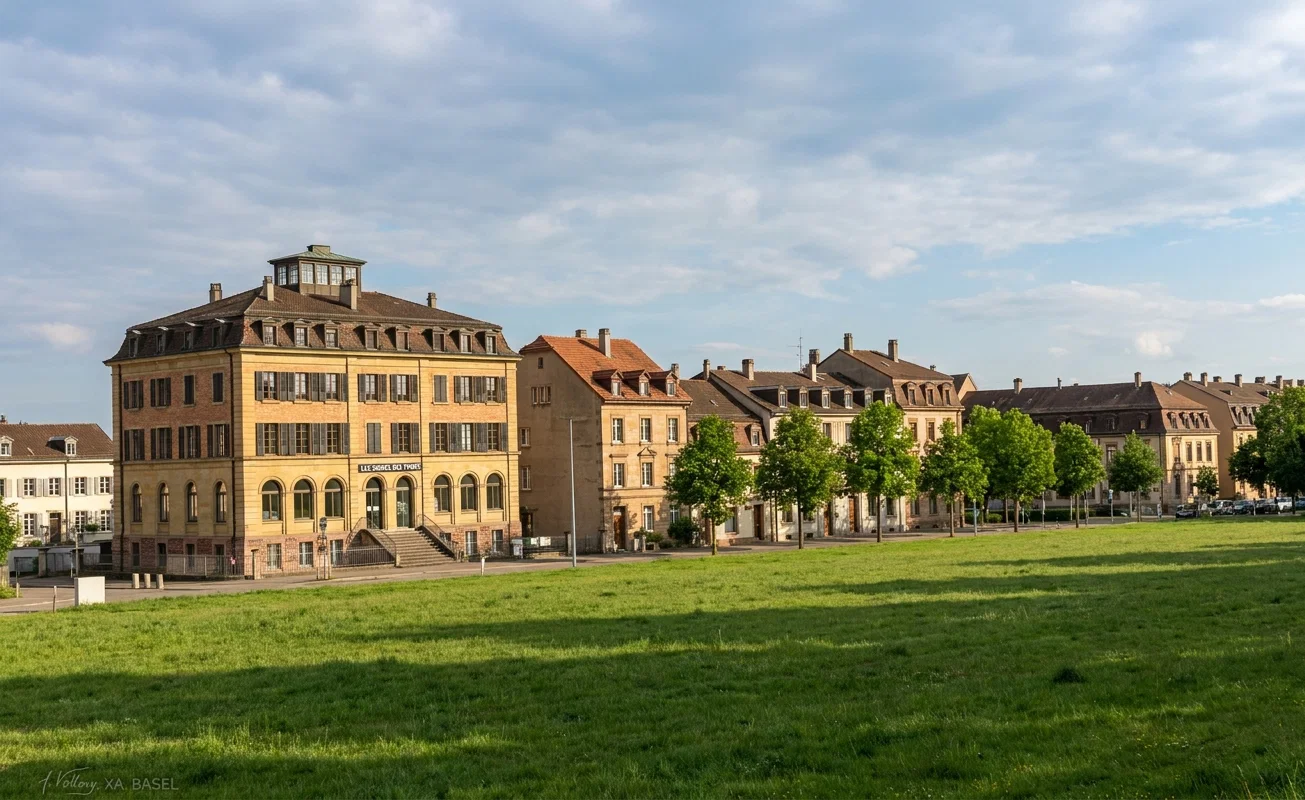
VIEW OF WÄHRINGWEG, BASEL. OFFICE OF Les Signes des Temps AT THE LEFT.
In March, 1885, Bro. H. W. Kellogg came to assist in the purchase and fitting up of the machinery and fixtures for this establishment. His long experience in our central office of publication at Battle Creek made his services in this respect of great value, and his faithful and untiring efforts contributed much to make this new publishing house what it is reputed to be, one of the most complete and best equipped establishments of the kind in Switzerland. Bro. R. H. Coggeshall, an experienced printer who had long been employed in the Review Office, accompanied Bro. Kellogg to take the oversight of the printing work in the new office.
DESCRIPTION OF THE BUILDING.
The building is a substantial structure, 46 ft. in width by 76 ft. in length, four stories in height including the mansard, with basement and sub-basement. It is built of stone, the floors being supported by a central partition also of stone, and by heavy iron pillars. The first or main floor is built of iron and brick, so that the basement is thoroughly fire-proof. Broad stone steps lead to the double front entrance of this main floor. The right-hand entrance opens directly into the meeting-hall, which occupies one-half of this entire floor. This hall is plainly but neatly finished, is well lighted, and is capable of seating about four hundred. Underneath the pulpit is a reservoir, which furnishes a convenient baptistry.
The left-hand entrance opens directly to the main hall and stairway of the office portion of the building. The first door at the left opens into the counting room, or business office, just beyond which is a smaller private office. Immediately in the rear of these is a large room, twenty-one feet square, used as a folding and mailing room, which occupies the remainder of this floor. Ascending the stairway to the second floor, a door on the left opens into the main composing room, a room of the same size as the folding room and directly over it. This room has six large windows opening to the west and north, which furnish an abundance of light so necessary for a room devoted to this purpose. In front of the composing room is the editor’s room and library. This room is connected with the main corridor by a narrower one which separates the composing room from two small rooms used for translating and proof-reading.
Directly across the main hall from the composing room is a large room also used for composing and job work. The remaining portion of this floor is occupied at present with a suite of family rooms; but these are constructed in such a manner that when the increase of the work demands it they can easily be transformed into larger rooms for this purpose.
The next floor and the mansard are devoted entirely to apartments for the families that furnish homes for those engaged in the work. The attic, a large room well lighted by a central observatory, is used as a store room for publications. Descending from the attic by the hydraulic elevator, which is operated by the regular pressure of the city water works, we return to the basement, the elevator reaching its landing in the midst of the press room. One-half of the entire basement is occupied49by this room, which is lighted by nine large windows, opening on the south, west, and north. Here are a large Wharfdale stop-cylinder press, a Peerless job press, a large power paper-cutter, and an improved wire stitching machine. The bindery, which at present occupies a part of this room, is furnished with standing press, perforator, board cutter, job backer, and all necessary tools. This room is connected with the main corridor of the first floor by a stairway, and the large doors opening directly into the rear yard. The remaining portion of the basement, that directly underneath the meeting-hall, is divided into three apartments by transverse heavy stone walls. The room next to the street is occupied by a fully equipped stereotype foundry. The apartment in the rear, connecting directly with the press room, is used as a store room for paper, while the middle apartment is divided into small cellars for the use of the families that occupy the building.
From the press room we descend into the sub-basement. Here are the two gas motors which furnish the power for driving the machinery. One of these motors is of two-horse power, the other of double this strength; and they are so arranged that both can be used at the same time if required. All the shafting for the transmission of this power, lies under the ceiling of this room, thus avoiding much dust and noise in the working room. In this sub-basement is also located the large furnace which heats the entire building by means of hot water circulating through pipes and coils in the various rooms. The smoke pipe from this furnace communicates heat to a large shaft located in the center of the building, thus furnishing a good central ventilation for each story.
All the working rooms are connected by electric bells and acoustic tubes, thus furnishing convenient means for communication.
The building is admirably situated, fronting to the south on Weiherweg, and to the west on Rudolfstrasse. Across Weiherweg to the south is a large government park, or parade ground. The publishing house is entirely disconnected from any other building, and occupies only about one-third of the lot on which it is situated. The entire cost of the building, including machinery, was more than $30,000, and it is in every way well adapted to the work for which it was designed.