Although the Swiss Republic contains twenty-two cantons, or States, and has a population of three million of people, it is not a large country, being only about half the size of the State of Maine. Besides this, it is estimated that two-thirds of its surface consists of lakes, rivers, and uninhabitable heights. Hence it will be seen that its rich valleys and habitable mountain sections support a dense population.
The course of our journey led through the wild and magnificent scenery of Lake Lucerne, or, as it is sometimes called, “Lake of the Four Forest Cantons,” because it is bounded by four cantons, whose forest-clad mountains in many places rise abruptly from the water’s edge. This beautiful lake, with its swans and flocks of half-tamed birds, we passed at our right.
Besides being noted for its scenery, this lake is intimately associated with those historical traditions connected with William Tell, the so-called liberator of Switzerland from the Austrian yoke. In the pleasant little town of Altorf, a colossal statue of Tell has been erected on the very spot, it is said, whence he aimed at the apple placed on the head of his own son by command of the tyrant Gessler; while one hundred and fifty paces distant stands a fountain erected on the supposed site of the lime-tree by which Tell’s child stood while awaiting his father’s arrow.
Several centuries ago, parts of Switzerland were often visited by earthquakes. They have since entirely ceased; but floods, avalanches, snowstorms, and land-slides still threaten the inhabitants with frequent dangers. We passed through one scene of desolation caused by a land-slip in the summer of 1806. The season had been very rainy, and one afternoon about five o’clock a strata composed of flint rocks, limestone, and other soft formations, upwards of one mile in length, one thousand feet in breadth, and one hundred feet in thickness, was precipitated from a height of three thousand feet into the valley below, burying four villages, with four hundred and fifty-seven of the inhabitants. The scene of this catastrophe was between the celebrated Rossberg and Rigi mountains. From the top of the Rossberg to a point nearly half way up the Rigi the surface of the earth was converted into a rocky chaos. Time has covered these fragments of rock with moss and other vegetation, but the track of the slide can still be distinctly traced.
The glaciers of Switzerland are the reservoirs which feed some of the largest rivers of Western Europe. The Rhine and the Rhone both have their source in Switzerland, not many miles apart. Flowing in different directions, the Rhine empties its waters into the North Sea, the Rhone into the Mediterranean.
Our course over the Alps lay through the great St. Gotthard pass. The road228through this pass is a marvel of engineering skill. It was ten years in building, and has been completed only four years.
THE ST. GOTTHARD PASS.
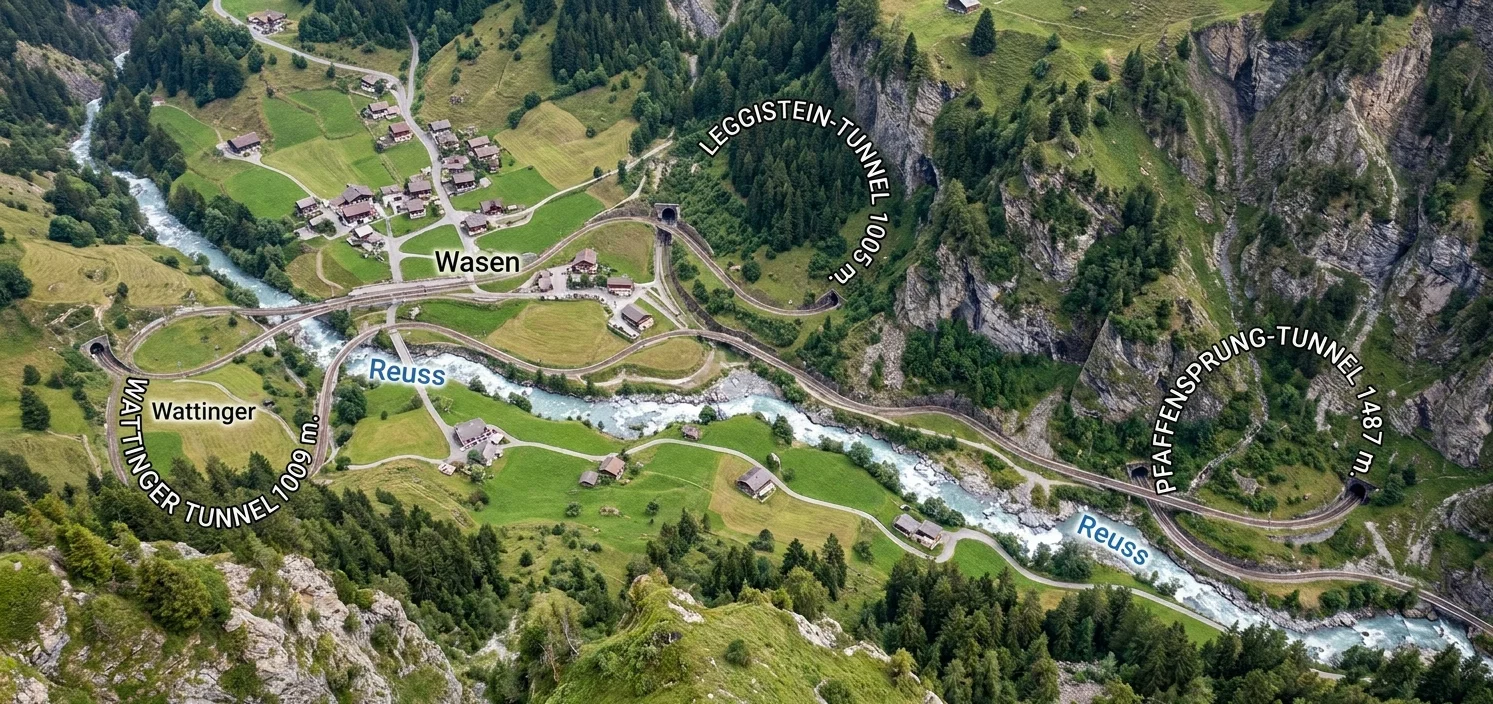
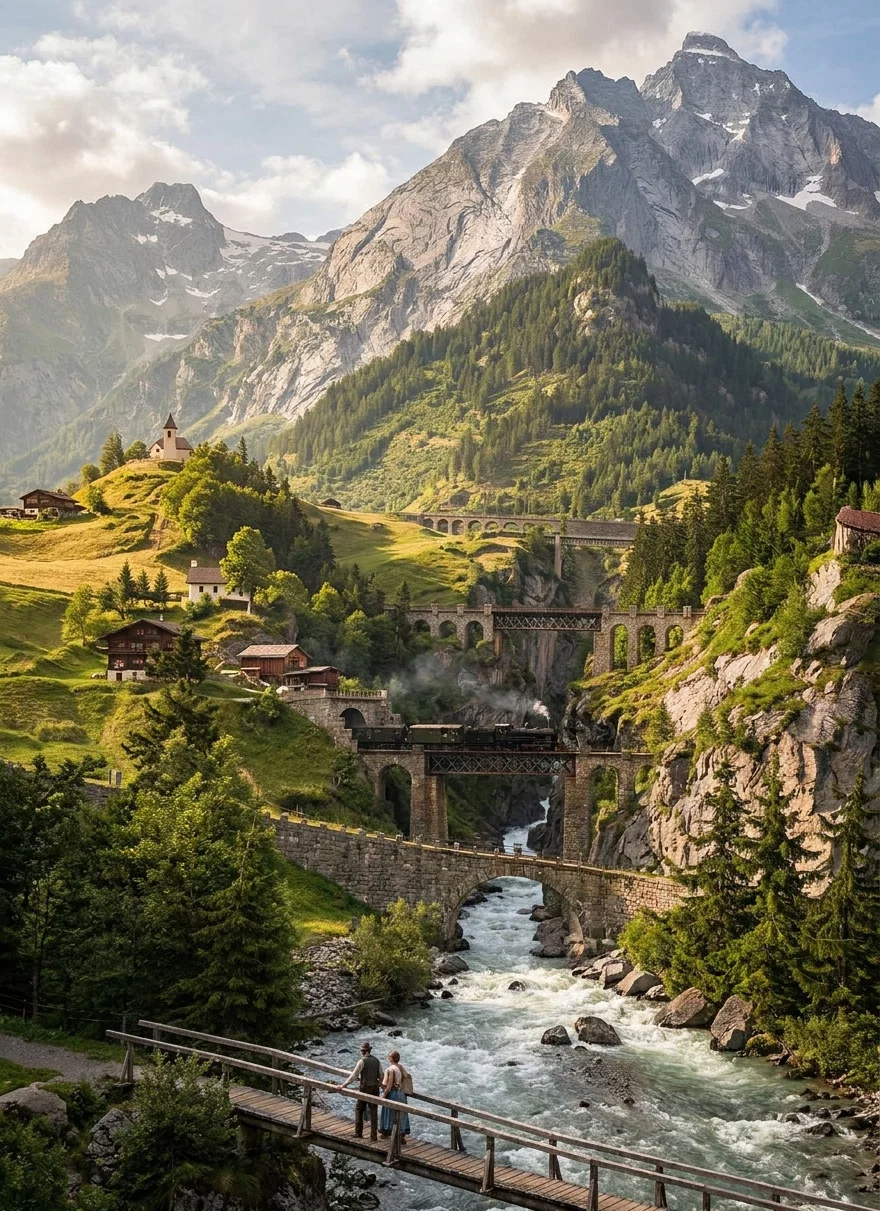
After leaving Erstfeld, a large railway station, the ascent begins. A heavier engine has been attached to the train, and we enter a rocky defile flanked by steep and lofty mountains. At the base of these rushes the foaming river Reuss, forming of itself a succession of beautiful waterfalls, and receiving numberless smaller cascades which appear to spring from the tops of the highest peaks. As we proceed, the gorge begins to narrow and the interest to increase. It seems as though the turbulent Reuss, thinking merely of its own convenience, had cut a place just large enough for itself through the solid rocks. Therefore the train is obliged much of the way to make a path for itself within the mountain. The heaviest grade on the road is one foot in four. In many places, however, it has been made much less than this, by the use of bridges and curved tunnels, as shown in the accompanying engraving. There are three of these tunnels on the north side of the mountains, and four on the south side. In the first of these tunnels, the Pfaffensprung, the train enters the side of a mountain, describes a complete ascending circle of over sixteen hundred yards, and, emerging from the mountain, crosses its own track one hundred and fifteen feet above the place where it entered. Then, crossing the boiling Reuss by a huge iron bridge, the train enters the Wattinger loop tunnel, in which an ascent of seventy-six feet is made. Then another bridge across the river, the considerable village of Wasen, and we plunge into the third curved tunnel. Beyond this the train skirts the mountain side, from which is obtained a grand view of the windings just traversed, lying far below. Altogether, this railroad has over fifty bridges, most of them large iron structures, and fifty-six tunnels.
DIAGRAM OF LOOP TUNNELS ON NORTH SIDE OF ALPS.
The longest of these is called, by way of distinction, the St. Gotthard. This one tunnel is nine and one-fourth miles long. In the middle of it the road reaches its highest elevation, 3787 feet above the sea, and then begins to descend on the other side. During the seven and one-half years in which this one tunnel was in process of construction, twenty-five hundred workmen on an average were employed daily, and sometimes the number reached three thousand four hundred. The boring229was commenced on both sides of the mountain at the same time; and such was the engineering skill displayed that when the workmen came together, there was not the variation of an inch in their work. The contractor, Mr. Louis Favre, did not live to see the completion of his task, having died of apoplexy in the tunnel three years before it was finished.
The St. Gotthard Pass.
It took our train twenty-five minutes to pass through this tunnel; but the arrangement for ventilation is so complete, a current of fresh air being constantly forced through the tunnel, that we found it unnecessary even to close the windows. There was something solemn in the thought that while we were nearly four thousand feet above the level of the sea, there were yet from six to seven thousand feet of solid rock piled above our heads, and three thousand three hundred and fifty feet above us lay the clear waters of Lake Sella. It was with a sense of relief that we emerged from this dark cavern, only, however, to be again lost in wonder, this time not so much at the workmanship of man as at the mighty works of God.
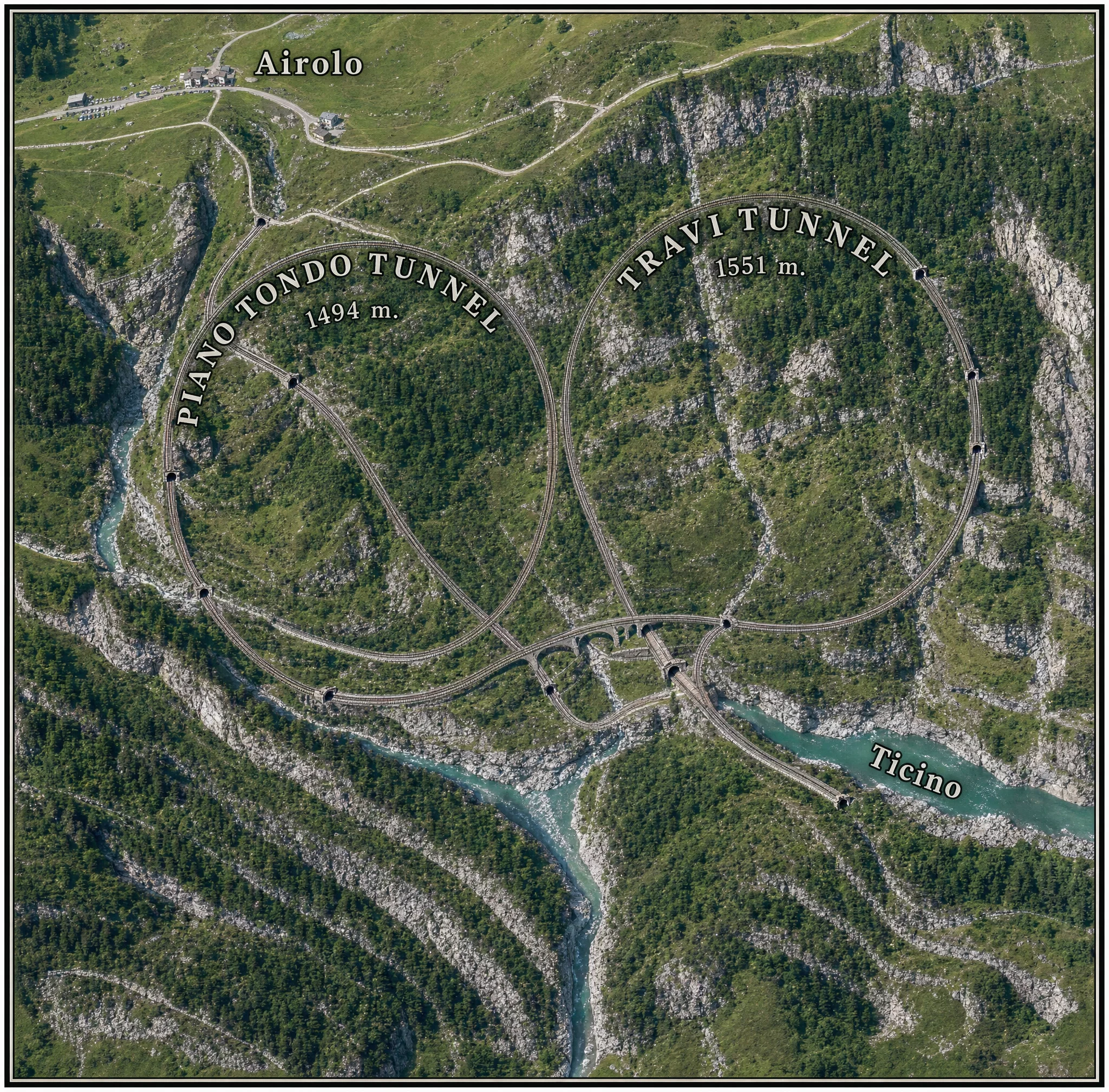
Soon after leaving the St. Gotthard we come to Airolo, the first Italian-Swiss village. From this point the road descends the valley of the Ticino by means of numerous windings, and by straight and circular tunnels. Soon an immense mountain projects into the valley, apparently with the desire to check the course of the impatient, swift-flowing Ticino; but by some means the river has succeeded in forcing a passage through it, and descends in a series of falls through a wild, rocky gorge to a lower region of the valley, while the railway accomplishes the descent by means of two circular tunnels, the Piano Tondo and the Travi, one below the other in cork-screw fashion. In each of these tunnels a descent of one hundred and eighteen feet is made, thus enabling the train to descend an otherwise impassable gorge. From this point the valley begins to widen. Beautiful cascades are seen pouring over the cliffs on each side, and interspersed among the rocks are noble chestnut, walnut, mulberry, and fig trees.
At Bellinzona about four o’clock in the afternoon our train was divided, and a portion of the cars and passengers wound their way around the mountain side toward Milan, while we continued our course to Turin, along the border of the beautiful Lake Maggiore. Here we arrived about ten o’clock in the evening, and found excellent accommodations at a hotel near the station. After a good night’s rest, we were ready to continue our journey at an early hour.
CIRCULAR TUNNELS ON SOUTH SIDE OF ALPS.
About thirty miles west of Turin we left the vast plains which “stretch like a garden for two hundred miles along the foot of the Alps,” and, passing through a narrow opening in a low range of mountains, entered the Piedmont valleys. Only one of these valleys, that of Lucerne, is traversed by the railroad. Soon after entering this valley, several others spread out like a fan,231some at our right and some at our left. But it is in this central and largest valley, at the terminus of the railroad, that Torre Pellice is situated, and thither our course is directed, that, if possible, we may encourage the little company there who are striving under great difficulties to obey God. We reached this place Friday, about 9 A. M., and were welcomed to the hospitable home of Eld. A. C. Bourdeau, who, according to the vote of the last European Council, had just located here with his family.
LABORS IN THE PIEDMONT VALLEYS.
The next day, Sabbath, I spoke to the brethren and sisters in the hired hall in which they held their regular Sabbath meetings. Owing to a delay in getting out the appointment, few besides our own people were present. But I felt the same interest in speaking to the few that I would have felt in addressing hundreds. Choosing as my text Isa. 56: 1–7, I tried to impress upon them the importance of obeying God and walking in the light, regardless of the opinions or course of the world.
“Thus saith the Lord, Keep ye judgment, and do justice; for my salvation is near to come, and my righteousness to be revealed. Blessed is the man that doeth this, and the son of man that layeth hold on it; that keepeth the Sabbath from polluting it, and keepeth his hand from doing any evil. Neither let the son of the stranger, that hath joined himself to the Lord, speak, saying, The Lord hath utterly separated me from his people; neither let the eunuch say, Behold, I am a dry tree. For thus saith the Lord unto the eunuchs that keep my Sabbaths, and choose the things that please me, and take hold of my covenant: Even unto them will I give in mine house and within my walls a place and a name better than of sons and of daughters; I will give them an everlasting name, that shall not be cut off. Also the sons of the stranger, that join themselves to the Lord, to serve him, and to love the name of the Lord, to be his servants, every one that keepeth the Sabbath from polluting it, and taketh hold of my covenant; even them will I bring to my holy mountain, and make them joyful in my house of prayer. Their burnt-offerings and their sacrifices shall be accepted upon mine altar; for mine house shall be called an house of prayer for all people.”
The question may arise in some minds why we as a people are separated from the world into little companies. We answer, It is not because we choose to differ from those around us, but because we see the necessity of obeying all the requirements of God. If any feel that it is of no consequence whether we obey all his commandments or not, they have only to look back to Eden to see what dire results befell Adam and Eve because of disobedience. It is for us to choose whether we will go over the same ground as they in transgression, or whether we will walk in the light that has shone upon us, and be found of our heavenly Father in the path of humble obedience. His blessings and promises are for those who love and obey him.
Some urge that it is of no consequence whether we keep the Sabbath or not; but we say that from the Bible standpoint it is a matter of great importance. Had it not been important, God would not have wrought in so marvelous a manner to deliver his people from Egyptian bondage. It was because he saw that they could not obey his commandments in their servitude, that he revealed his mighty arm in bringing them into a place where they could serve him. When they came to Sinai, he took occasion to refresh their minds in regard to his requirements. Christ and the Father, standing side by side upon the mount, with solemn majesty proclaimed the ten commandments, placing in the very center of the decalogue the Sabbath command. Again232and again the Lord told the people that if they would keep his Sabbath he would take them to himself to be his chosen people; and again and again sorrow and shame were brought upon them because they failed to keep it. He also told them that the Sabbath should be a sign between him and them forever, that they might know that he was the Lord their God. Therefore it is of great importance that the Sabbath be regarded according to the commandment.
We want to know the truth, the whole truth, as it is in Jesus. We cannot afford to cherish error on any point. Those who take their stand firmly upon the truth will know what affliction and persecution are. Few at the present time have any experimental knowledge of what these are. They may think they are having a hard time, but God is simply testing them to see if they have root in themselves. He is proving them, as he proved Adam and Eve in Eden, to see if they will obey him.
“Well,” says one, “if it were convenient, I would keep the Sabbath; but as it is, there is too great a cross connected with it.” Paul says, “God forbid that I should glory, save in the cross of our Lord Jesus Christ, by whom the world is crucified unto me, and I unto the world.” Here is a double crucifixion. As the conscientious Christian takes his stand upon Bible truth, there are always those who refuse to accept it, and choose the world. The wife may take her position in favor of truth, while the husband may oppose it. Here a trial comes in at once, the trial of separation in faith and feeling. Shall we say to that wife, “You should leave your husband because he does not keep the Sabbath?” No, indeed. If she was a faithful wife before she accepted the truth, and if she sees in her friends those for whom Christ has died, she will seek to discharge her duties with even greater fidelity after she accepts the truth, that if possible she may lead them to see the light. “But,” it is asked, “should not the believing wife yield her convictions of duty because of her husband’s unbelief?” By no means; because Christ is her Lord and Master. She cannot cast aside the claims of high Heaven upon her. The same is true of the believing husband or child.
The work of overcoming is an individual work. Our only safety is in taking our position firmly in favor of the word of God; for this is the only foundation that will stand the test. And then as we try to walk in the path of humble obedience, we must expect to meet trials. They will come upon us from quarters where we least expect them. But we must remember that all who have obeyed the word of God have had the cross to lift; and in lifting it they helped others to lift it.
If we have correct ideas of the mission of Christ on earth, and of what our work is, we shall not become discouraged because we are few. Said Christ, when asked if there be few that shall be saved, “Enter ye in at the strait gate; for wide is the gate, and broad is the way, that leadeth to destruction, and many there be which go in thereat.” Now he gives the reason: “Because strait is the gate, and narrow is the way, which leadeth unto life, and few there be that find it.” The fact that you are few in this place, brethren and sisters, is no reason that you should become discouraged. It seems to me, as I look upon the towering mountains that surround your valleys, that if I lived in this place, I would mark the spot where so many suffered in ages past for233the truth, and taking courage from them, would lift the cross and obey the truth at any cost. As I think of those who have yielded their lives rather than the truth, it is plain to me what God has revealed concerning his people: “They shall walk with me in white; for they are worthy.”
God does not give us the spirit of the martyrs to-day, for we have not come to the point of martyrdom. He is now testing us by smaller trials and crosses. And at times when it seems that the billows of temptation will go over our heads, let us remember that the eye of God is watching over us, and let us be willing to endure all the trials that he sees fit to send.
John in holy vision saw a company standing around the great white throne, every one of them having white robes. The question is asked, Who are these, and whence came they? And the answer is given: “These are they which came out of great tribulation, and have washed their robes, and made them white in the blood of the Lamb. Therefore are they before the throne of God, and serve him day and night in his temple; and he that sitteth on the throne shall dwell among them. They shall hunger no more, neither thirst any more; neither shall the sun light on them, nor any heat. For the Lamb which is in the midst of the throne shall feed them, and shall lead them unto living fountains of waters; and God shall wipe away all tears from their eyes.” If you want to be among this company, you must not study how you can escape trials in this life. Do not keep thinking what a little company you are, but get your eyes fixed on Jesus. From his own lips the words come ringing down along the lines to our time, “He that loveth father or mother more than me is not worthy of me; and he that loveth son or daughter more than me is not worthy of me. And he that taketh not his cross, and followeth after me, is not worthy of me.”
Jesus left the royal courts of heaven, clothed his divinity with humanity, and for our sakes became poor, that we through his poverty might be made rich. The question with him was not, Is it convenient for me to do this? Neither should it be with us, Is it convenient to obey God and keep the Sabbath? The question rather should be, Is it duty? What say the Scriptures? The Lord says in the words of my text, “Blessed is the man that doeth this, and the son of man that layeth hold on it; that keepeth the Sabbath from polluting it, and keepeth his hand from doing any evil.” Again the promise is made, “If thou turn away thy foot from the Sabbath, from doing thy pleasure on my holy day; and call the Sabbath a delight, the holy of the Lord, honorable; and shalt honor him, not doing thine own ways, nor finding thine own pleasure, nor speaking thine own words; then shalt thou delight thyself in the Lord; and I will cause thee to ride upon the high places of the earth, and feed thee with the heritage of Jacob thy father; for the mouth of the Lord hath spoken it.”
All we need to know is the will of the Master. He says, “Go forward.” We should obey, even though the Red Sea were before us. He has promised to be a present help to us in every time of need. Then let us not sink down under trials, nor allow them to separate us from Jesus. As we look at the everlasting hills around us, they should remind us that God has a controversy with the nations, and that all who have lost their lives for the truth’s sake will come forth234from where they have fallen, to be rewarded with everlasting life in the city of God. Outside the city will be those who persecuted them. As these see the great light shining upon the faithful ones from Jesus, they will wish that they had been the persecuted instead of the persecutors. What agony will come upon them, as they hear the song of triumph echo and re-echo through the courts of heaven, and realize that the despised and persecuted are finally accepted of God!
But what will it profit a person, if, after enduring persecution, he then gives up the truth? Christ gave his life for us, and now, if necessary, we should give our lives for him. We are his, for he has bought us; and we ought not to rob him of that for which he has made this infinite sacrifice. The third angel is represented as flying through heaven, proclaiming the commandments of God and the faith of Jesus. This message is to prepare a people for the coming of Christ. If men should refrain from proclaiming it, the very stones would cry out. The people must be warned. The words of the prophet are, “Cry aloud, spare not, lift up thy voice like a trumpet, and show my people their transgression, and the house of Jacob their sins.” We have a solemn work to do to proclaim this message of warning to the world. Are we engaging in this work? Will men arise in the Judgment and say, “You never told me that these things were so”? Will the gates of the city of God be closed against us, or shall we dwell with Jesus through the ceaseless ages of eternity? We want to give to God all that there is of us. It is only to the faithful workers that the Saviour says, “Come, ye blessed of my Father, inherit the kingdom prepared for you from the foundation of the world.”
Dear friends, I entreat you to be firm to truth and to duty. Trials may press closer and closer; but Jesus will lead you, if you will let him. Pray much. Be willing to separate from everything that separates you from God. Then, in the day of trouble, he will come to your deliverance, and will hide you under the shadow of his wings. When your names are cast out as evil, and friends turn against you, remember how Jesus was treated on earth. Spies were constantly upon his track, seeking to catch him in his words, that they might find accusation against him. Can his followers expect better treatment than he received? Peter felt that it was too great an honor to be put to death as his Lord was, and petitioned that he might be crucified with his head down. He considered it an honor to suffer for Christ. Why should not we?
AN INTERRUPTION.
Here the discourse was broken in upon by questions from one who had kept the Sabbath a short time, but who had recently given it up. Rising in the congregation, he said, “This Sabbath question has been a great trouble to me during the last year, and now I would like to ask a question: Is the observance of the Sabbath necessary to my salvation? Answer, yes or no.” I answered promptly, This is an important question, and demands something more full than yes or no. All will be judged according to the light that has shone upon them. If they have light upon the Sabbath, they cannot be saved in rejecting that light. But none will be held accountable for light which they have never received. I then quoted the words of Christ, “If I had not come and spoken unto them, they had not had sin; but now they have no cloak for their sin.” It was with the greatest difficulty, however,235that I made these remarks; for the questioner kept jumping to his feet, and interrupting me, and in the most excited manner and with the most violent gestures demanding that the answer be yes or no.
Several times while I was speaking he tried to restate my remarks, giving them just the meaning that he wished them to have, and that he has since given them; and as many times he was corrected by persons present who understood both French and English. He then began to read and comment upon something which he had written in regard to the Sabbath. But he proceeded so rapidly that he gave little opportunity for his remarks to be interpreted, and therefore I could get but little idea of what he was trying to say. One statement which I did understand, however, was to the effect that Christ, instead of teaching the Sabbath, broke it. To this I felt that I must respond. I said: “I hope our brother will not place himself on the side of the Pharisees in their accusations against Christ; for if their charge of Sabbath-breaking could have been sustained against him, they would not have been under the necessity of hiring false witnesses to testify against him.” At this he became very much enraged, and charged me with calling him a Pharisee. This, however, was corrected by several persons present, and he said, “I beg pardon.”
When I saw that I could have no opportunity to finish my discourse, or to answer his question as fully as I would have liked, I told the people that I would be obliged to defer any further answer till some future time, and that I would then make it by writing, as he was not prepared to listen to anything I might say. This I did soon after in an article entitled, “Walking in the Light,” published in Les Signes des Temps. I also sent him an invitation to come and talk the matter over with me, that we might see what is truth. But he declined to do so.
FURTHER LABORS.
The next afternoon, while I was speaking, he came into the hall again. If I said anything that he agreed with, he would nod his head in approval, and if, on the contrary, I said anything that he did not approve, he would shake his head, and begin to talk in an undertone to those near him. I kept right on as though we did not hear his words of disapproval; but when I began to read the words of Christ in his memorable sermon on the mount, “Whosoever, therefore, shall break one of these least commandments, and shall teach men so,” etc., he jumped to his feet, and with the most frantic gesticulations cried out to Eld. A. C. Bourdeau, who was acting as interpreter, “Do you keep the commandments any better than the Pharisees? Answer me.” Notwithstanding his repeated demands for an answer, we kept right on with our work just the same as though nothing had happened, determined that this meeting should not be broken up as the other had been. This was too much for him, and grasping his hat, he rushed out of the hall in a rage. We were then permitted to continue our meeting in peace. The few who were present, instead of being disturbed by what had happened, seemed236much strengthened by the words spoken. The Lord has a people here, and if faithful they will yet see others added to their numbers.
When we came to Italy, it was with the desire that we might not only learn something of the habits and customs of the people, and the best means of reaching them, but that we might be the means of strengthening and encouraging the brethren and sisters, and that we might also obtain a little much-needed rest. In the latter we were somewhat disappointed, although we did enjoy some features of our stay very much. The climate is healthful, the air clear and bracing. Throughout our stay of three weeks the weather was delightful. Although it was December, most of the time we had the doors open as in summer. Several days we spent some time in riding. This was a great luxury to me, especially as I was suffering much with a lame hip and a broken ankle, and was able to walk but little.
After the unpleasant interruption in our first two meetings, we felt that there was no assurance that we could hold other meetings in the same hall without similar annoyances, as the one who interrupted the meeting was the owner of the hall. Before the next Sabbath another hall had been hired, and handbills posted stating that meetings would be held Friday and Sunday evenings, and Sabbath and Sunday afternoons. The names of the speakers were not announced, but Eld. Bourdeau’s name was signed to the bill. Judge of our surprise, the next morning after our bills were posted, to see other bills, the same size and style, posted by the side of ours, stating that Eld. Miles Grant would hold a series of meetings in a hall directly above ours, on the same days but at different hours. From a remark made by Eld. G. in one of his lectures, it appears that he came to Torre Pellice the same day that we did; but for some reason his arrival was kept quiet, and no announcement of his meetings was made until after our notices had appeared.
Friday evening at seven o’clock I spoke about three-quarters of an hour from the text, “Come unto me, all ye that labor and are heavy laden, and I will give you rest.” At eight o’clock Eld. G. spoke in the room above. Eld. Bourdeau attended, also M. K. White, who took short-hand notes. I did not go, although Eld. G. thought I was present, and told the people so, which statement, however, he corrected at the next meeting.
His subject the first evening was sanctification; but he could not refrain from mentioning my name. He did so, however, in a very guarded manner. The next night he spoke more freely, and bringing forth the precious dish of slander that he loves so well, he served up to the people in his very best style the rare tidbits that he has been gathering and manufacturing during the last thirty years, as condemning evidence that the visions of Mrs. White are not of God. During all these years one of the principal burdens of his work seems to have been to follow on my track, and spread these statements which have been manufactured by false witnesses, some of whom had become disaffected because they had been reproved for their wicked course. It has been shown again and again, both by pen and voice and by the testimony of many witnesses, that these reports have no foundation in truth; but what cares he for this? He loves his falsehoods too well to give them up. And now we are charitable enough to venture the opinion that237having repeated them so many times he really believes many of them to be true, and feels as zealous as ever Saul did, believing that in trying to tear down my influence he is doing God service.
It has ever been against my principle to enter into controversy with any one, or to spend my time in vindicating myself against the attacks of those who do not hesitate to adopt any means to pervert the truth, or to cast stigma upon those who stand in defense of the law of God. Nothing would please Satan and his followers better than to have me engage in this work; for then they would give me enough to keep me busy all the time, and thus my real work would be left undone. But this is not the work that God has given me. Years ago I determined to let nothing draw me from the work of speaking and writing plain Bible truth. Unmoved alike by condemnation or approval, censure or applause, falsehood or flattery, I have not shunned to declare, without partiality and without hypocrisy, the message that God has given me. I have always borne, and trust that I shall ever continue to bear, a plain, decided testimony against sin in the church and out.
Here in the valleys we were among a people, who, as a rule, are ignorant of the Bible and of the power of God. Eld. Grant had no hold upon them, and they knew little if anything of my former life and labors. Then why should I depart from my established custom, and spend the precious moments of my stay with this people in vindicating myself? Would it not be better for me to crowd into my talks all the practical religion possible, and thus do the people all the good I could? We felt that it would be best to do this; and so it proved.
Some who heard Eld. G. preach went home and told their friends that he had come to quarrel with a woman; that they did not like his spirit, and they wanted no more of such meetings. The report went out that two Adventists had come to the valleys, and were quarreling with each other. This was a mistake, as some afterward learned; for there was no response made to his unreasonable and untimely raid. In the ten discourses that I gave in the valleys I made no more reference to Eld. G. than if he had been in his own native State. After giving four or five discourses, he withdrew to other parts, having accomplished little if anything. Many who afterward attended our meetings seemed much surprised and pleased with them. They said they had been entirely misinformed in regard to the nature of our meetings, and expressed much regret that they had not attended them all.
Sunday afternoon, Dec. 13, I spoke from the words, “By faith Moses, when he was come to years, refused to be called the son of Pharaoh’s daughter; choosing rather to suffer affliction with the people of God, than to enjoy the pleasures of sin for a season.” The best of attention was given. Many thanked me for the good words they had heard. Several of these understood English.
In the evening we had a good, intelligent congregation. The Spirit of God helped me as I tried to present before them the reward of the faithful from the text, “Let not your heart be troubled; ye believe in God, believe also in me. In my Father’s house are many mansions,” etc. At the close of the meeting, nearly all came forward and shook hands with me. One man who could speak English said, “The Lord has been present to-night and assisted238by the inspiration of his Spirit in speaking the word.” Several expressed an earnest desire for us to remain longer. The interest to hear was certainly much greater than when we first came.
Our continual prayer is that the Lord will open the way for the truth to find access to the people of these valleys. I have felt grieved to see them being deceived by men who claim to be teachers of the Bible, but who misinterpret its plainest teachings. But the work is the Lord’s, and he can cause even the wrath of men to praise him. The truth is sure to triumph gloriously; but how and when it is not for us to decide.